
Uncategorized
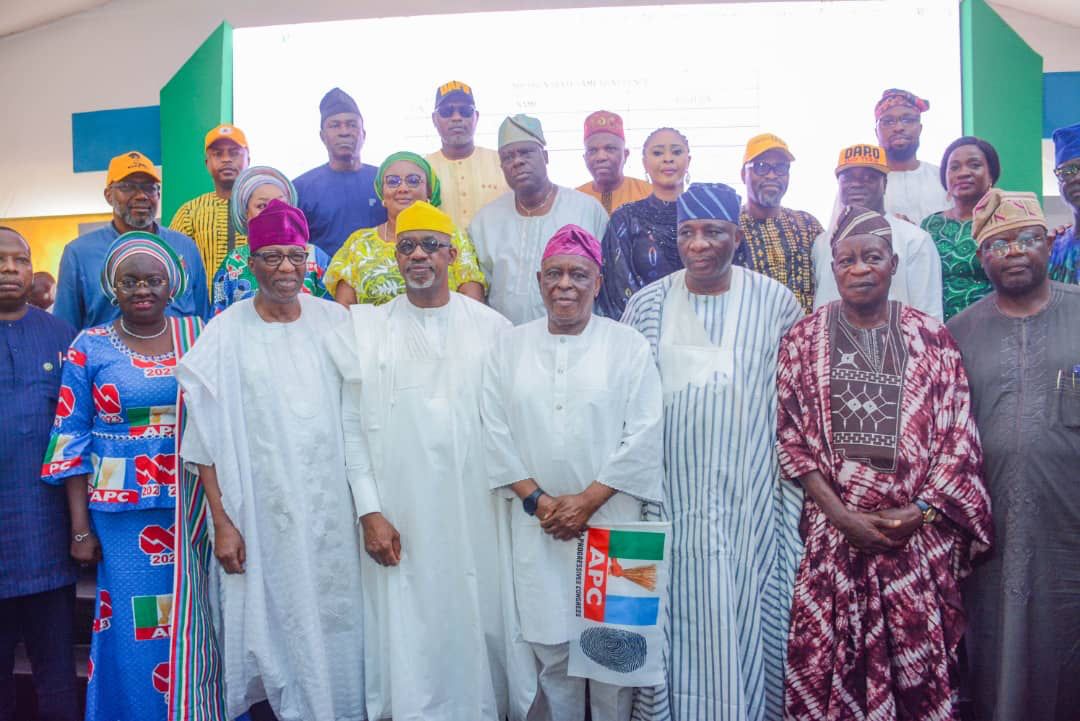
2023: Abiodun unveils campaign council, secretariat in Ogun

2023: Abiodun unveils campaign council, secretariat in Ogun
…promises issue based campaigns
Sahara Weekly Reports That The Ogun State governor, Dapo Abiodun, has unveiled the campaign Council for the 2023 elections, with a promise that his campaign will be constructive and issue based.

Speaking at the unveiling of the Council and the commissioning of the State Campaign Secretariat at Oke-Mosan, Abeokuta, on Saturday, Abiodun said his administration has in the last three and a half years embarked on people’s oriented projects, saying his second term campaign would focus on how to deliver dividends of democracy to the people.
“We must engage in constructive and issue based campaign in line with the provisions of the electoral and rule of engagements. We have done more than enough projects to ease our campaign while we promiseto do more for the benefits of the people of Ogun State if voted into power again.

“As we proceed to meet our people to seek their votes in this campaign for all our candidates in the state, let me assure you all that our administration will remain unwaveringly committed to the equitable development of our state and the implementation of people oriented and purposeful infrastructure, in line with our policy of inclusiveness and good governance”, he said.
The governor noted that his government was pro-active by lowering the political temperature in the state by being tolerant and respectful of the activities of all political parties in Ogun.

“We have continued to create a level playing ground for all individuals irrespective of their political affiliations. This is unlike the previous administration that turned the period of campaign into War and brigandage”, he noted.
The governor enumerated the numerous projects and achievements recorded in the last three years and six months to include construction of over 800 kilometres of roads; affordable houses; renovation of schools and health facilities; youth and women empowerment; agriculture, among others.
On areas to focus on in his second term if voted next year, Governor Abiodun listed electrification to ensure uninterrupted power to the major cities, towns and industrial hubs; project light up Ogun; provision of water supply by carrying out the major overhauling of Arakanga
Water Works to make water available for the people of Abeokuta and its environs, among other projects.
He stated further that efforts would be geared towards sustaining the peaceful atmosphere of the state to attract more investors by deploying technology for surveillance and crime detection, noting that “Security to us is very important, as we understand that No investor will invest in an environment that is not secured. Hence, will continue to provide Hilux vans, Armoured Personnel Carrier (APC) and other logistics for our security agencies in the state”.
He stated further that a Special Intervention Programme that would benefit over 40, 000 people in the first instance, implementation of the multimodal transport master plan, as well as the completion of the Agro Cargo at Iperu Remo; construction of a Dry Port at Kajola and a logistics hub at Wasinmi; leveraging on the abundance of oil resources in Tongeji Island and Olokola, would be given due attention
He noted that the state under his watch would intensify efforts at gearing the Internally Generated Revenue Service (IGR) to be more revenue driven, in order to be able to implement his administration’s developmental agenda.
Abiodun, however, charged the campaign council members to live up to the expectation by winning Ogun for the progressives again in the presidential, gubernatorial, Senate, House of Reps and the House of Assembly elections, submitting that “our campaign must percolate to the grassroots for the good of our party”.
In his goodwill message, the former governor of Ogun State and the grand Patron of the Campaign Council, Olusegun Osoba, stressed the need for the people to collect their Permanent Voter’s Cards, as the available record shows that the south west has the highest number of unclaimed Voter’s Cards in the country.
He contended that Ogun State is the cradle of progressive ideals in the country, hence, the need for the party members to support and promote all the candidates in the forthcoming elections.
Also speaking, former governor Gbenga Daniel who described Governor Abiodun as a good chess player who was able to bring people of diverse political leanings together, said it was time for the people to come together and work for the good of the party in the coming elections.
The APC gubernatorial candidate in Oyo State, Senator Teslim Folarin, called on the members to put their house in order and carry out adequate marketing of their candidates from the president down to members of the House of Assembly respectively.
In his welcome address, the Ogun State Chairman of All Progressives Congress (APC), Yemi Sanusi stated that the Campaign Council covers all candidates seeking elective post in the 2023 general elections, urging members to work together and shun disunity to jointly achieve victory.
He admonished the candidates to buckle up and complement the efforts of the governor by working harder than in 2019 to achieve a landslide victory.





FOPCHEN Calls for Dialogue as Court Fixes May 28 for Continuation
OTA, OGUN STATE — Proceedings in a widely followed legal case resumed on March 24, 2026, at the High Court of Ogun State, Ota Division, ending with a fresh adjournment as the court fixed May 28, 2026, for continuation.
During the session, legal representatives for all parties restated their positions and addressed preliminary matters, laying the groundwork for more substantive arguments at the next hearing. Observers noted that the case continues to attract significant public attention due to its perceived implications for law, culture, and societal values.
The Foundation for the Protection of Cultural Heritage in Nigeria (FOPCHEN) used the occasion to reiterate its call for constructive national dialogue. The group emphasized that while the judicial process must be respected, broader societal engagement remains essential.
According to the organization, issues relating to values, responsibility, and cultural identity should not be confined solely to courtroom deliberations but should involve active participation from various sectors of society.
Legal analysts present at the proceedings described the matter as one with far-reaching implications, noting that arguments advanced in court could shape future interpretations surrounding sensitive cultural and moral questions.
The presiding judge subsequently adjourned the case to May 28, granting all parties time to refine their submissions and respond to issues raised during the hearing.
As anticipation builds ahead of the next court date, Nigerians across different sectors continue to monitor developments closely, keen to see how the judiciary navigates the delicate balance between constitutional rights and cultural expectations.
Uncategorized
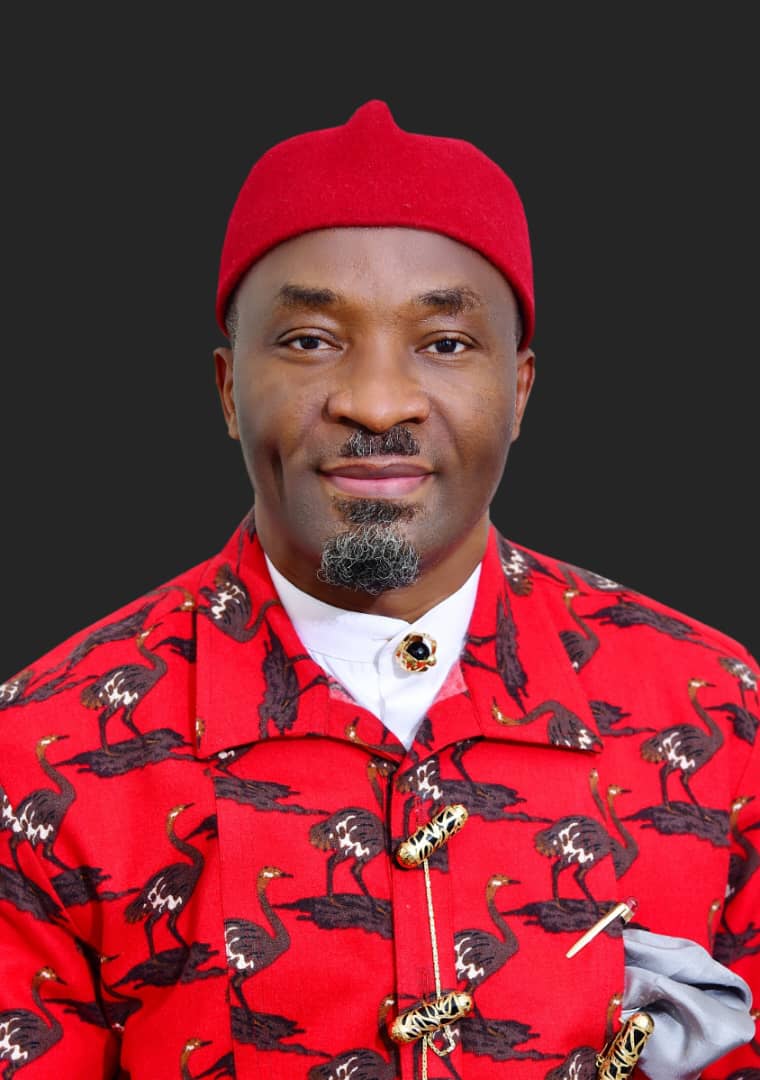
CRG: Politicians Must Stop Witch-Hunting, Focus on Nation Building — Says NYSC Cleared Deputy Speaker Since 2023
CRG: Politicians Must Stop Witch-Hunting, Focus on Nation Building — Says NYSC Cleared Deputy Speaker Since 2023
By: Boye Ola
The Centre for Responsible Governance (CRG) has called on political actors and interest groups to desist from what it described as needless witch-hunting of the Deputy Speaker of the House of Representatives, Benjamin Okezie Kalu, following renewed controversies surrounding his National Youth Service Corps records.
The organisation noted that the clarification by the National Youth Service Corps (NYSC) regarding the matter is not a recent development, as a formal verification letter had already been issued as far back as May 23, 2023.
The letter, referenced NYSC/CCD/VER/10/5.1/VOL1/02, had already addressed and cleared the questions surrounding the Deputy Speaker’s NYSC records.
Reacting to the renewed debate, the spokesman of the Centre,
Obande George, said it was troubling that issues which had already been clarified by a competent national institution were being resurrected for political purposes.
According to him, the time has come for political actors to move away from destructive engagements and concentrate on building the nation.
“It is important to note that the NYSC had already issued a verification letter dated May 23, 2023 addressing the matter.
Reopening issues that have already been clarified by a competent authority suggests that some individuals are more interested in political witch-hunting than in national progress,” George said.
The CRG stressed that democracy thrives when institutions are respected and their determinations are accepted in good faith rather than constantly questioned for political advantage.

George also commended the Deputy Speaker for demonstrating maturity and composure throughout the controversy, despite what he described as sustained provocations.
“Honourable Benjamin Kalu has shown remarkable calm and maturity in the face of intense public scrutiny and political provocation.
Instead of engaging in unnecessary public confrontation, he allowed institutions to speak through their records.”
The Centre warned that Nigeria’s political culture must evolve beyond constant character attacks and sensational allegations, which often distract public officials from their responsibilities.
According to the organisation, the country’s development requires constructive engagement among political actors rather than continuous attempts to discredit opponents.
“Nigeria cannot move forward if political energy is constantly spent on digging up allegations and amplifying rumours. Our leaders and political actors must redirect their focus to governance, policy and nation building.”
CRG therefore urged Nigerians to rely on verified information from credible institutions and avoid spreading speculative claims that could damage reputations or destabilise public discourse.
The organisation reiterated that respect for due process and institutional integrity remains essential for strengthening Nigeria’s democracy.

@The Centre for Responsible Governance, Email: [email protected], Instagram: crgngo6, Twitter: crgng06, Threads: crgngo6
Uncategorized
IWD 2026: Ajadi Celebrates Women, Urges Them To Seek More Elective Positions In Future Elections

IWD 2026: Ajadi Celebrates Women, Urges Them To Seek More Elective Positions In Future Elections
A Leading People’s Democratic Party, (PDP) Governorship Aspirant in Oyo State, Ambassador Olufemi Ajadi Oguntoyinbo has felicitates with women in the country on the occasion of this year’s International Women’s Day.
The international Women’s Day is celebrated on 8 March, commemorating women’s fight for equality and liberation along with the women right’s movement. It gives focus to issues such as gender equality and reproductive rights. International Women’s Day originated from labour movements in Europe and North America during the early 20th century.
In a statement issued on Sunday to commemorate this year’s edition of the International Women’s Day, Ajadi said the role of the women in nation building cannot be over emphasised.
He recalled the role played by prominent Nigerian women like Mrs Funmilayo Ransome- Kuti, Margaret Ekpo and Wuraola Esan towards the liberalization and the growth of the country and urges women to follow their footsteps by not only participate in the political process but seek more elective positions.
He urges the political leaders to encourage and give more chances to women for them to contest and occupy elective positions in the country.
Ajadi also called for more respect for women, saying they are definitely behind whatever success recorded by the menfolk.
He said domestic violence against women should be stopped, saying they deserves respect for their role in moulding the future leaders.
According to the statement, “I celebrate and congratulate our women on this year’s occasion of International Women’s Day. We cannot underestimate the role played by our women both at home, in the social circle and in politics. They deserve more respect.
“I equally called on them not only to be a passive participants in politics but to determine to seek more elected positions in future elections. They should aspire more from the position of dancing and singing at campaigns to seek more elective positions. The ratio of men to women in elective positions in the country is embarrassing. Women should stand up and fight for more elective positions.
“I also use the occasion of this year’s Women’s Day to appeal to Nigerians to stop domestic violence against the women. If we treat our women well, our country will witness unprecedented developments”.


-

 society7 months ago
Religion: Africa’s Oldest Weapon of Enslavement and the Forgotten Truth
-

 news4 months ago
WHO REALLY OWNS MONIEPOINT? The $290 Million Deal That Sold Nigeria’s Top Fintech to Foreign Interests
-

 society6 months ago
“You Are Never Without Help” – Pastor Gebhardt Berndt Inspires Hope Through Empower Church (Video)
-

 celebrity radar - gossips2 months ago
Dr. Chris Okafor Returns with Power and Fire of the Spirit -Mounts Grace Nation Altar with Fresh Anointing and Restoration Grace on February 1, 2026