
society
Afero Farmers protest displacement from Government allocated farmland in Lagos by Nigerian Military

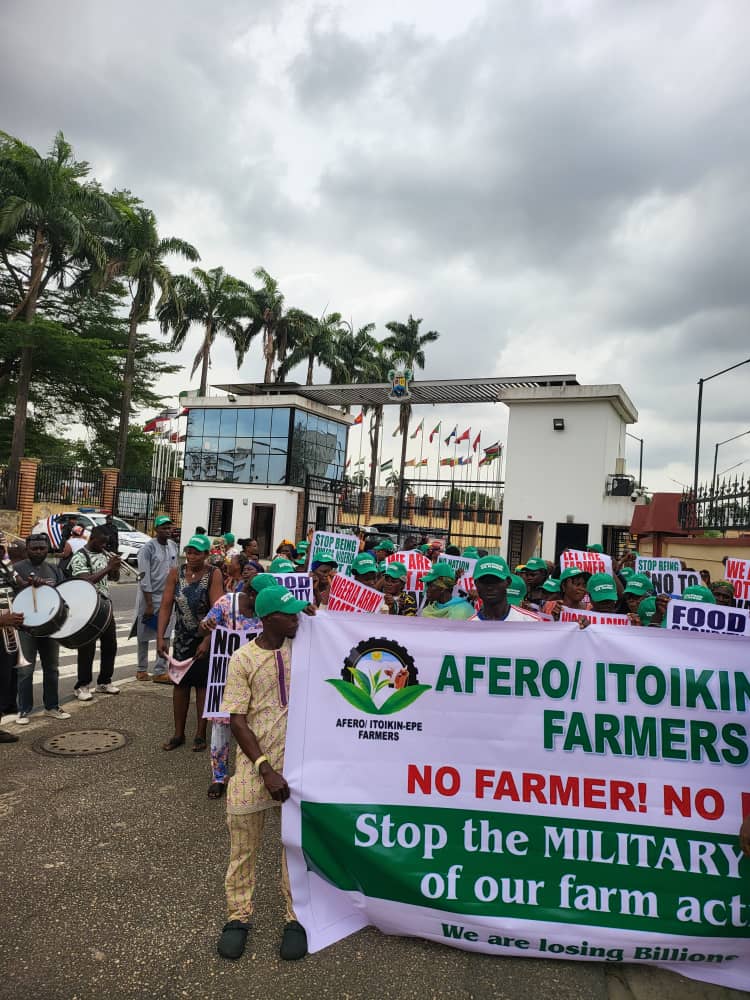
Afero Farmers protest displacement from Government allocated farmland in Lagos by Nigerian Military
…Ask Lagos State government, House of Assembly Speaker, well-meaning Nigerians to help them recover lost investment
A group of Nigerian Corporate farmers from the Diaspora and Nigerian Farmers, has protested their displacement from their corporate farms which produces crops and animal worth millions of naira on a daily basis.
Speaking during a protest at the Lagos State House of Assembly, Chairman Afero/Eluju Mowo/Mutaku commercial farmers, Wale Oyekoya, said they had a dream of building a better Nigeria and for this, they brought back their life savings and foreign investment to invest in Nigeria.
Oyekoya said: “Those dreams were crushed when on the morning of the 11th day of December 2023, in a brutal display of violence and utter carnage during the late season rains around 11:15 am that day they were violently invaded and brutally attacked by elements of the Nigerian military.
“We are not cutlasses and hoes farmers, we utilise the latest in mechanised machinery and equipment imported from China, US and France and practice farming on a Commercial scale thereby contributing to a large percentage of crop production to the Country and to Lagos State.
“The Nigerian Government in its wisdom instructed the Nigerian Army, the same Army supported by the taxes paid by the very same farmers, to redeploy its resources from protecting the territorial integrity of Nigeria to attack its Nigerian citizens and the soldiers mercilessly taunting the farmers with the fact they cannot do anything because there will be no repercussions and they will never be held accountable for their actions.
“There was no letter of warning, phone call, Memo demand or indeed any correspondence that the farmers have done anything wrong or even that they should vacate the land. Even a declaration of war generally requires some sort of warning nothing of sort took place.
“Instead the Nigerian Military, men whose salaries and livelihoods depend on taxpayers’ money beat the living daylights out of the hand that feeds them. This is really what the Security Vote is now being used for.
“This is why we Nigerians pay our taxes. So that we can be terrorised, tortured and mocked by the very people whose livelihoods we are sponsoring.
“The government is always asking for foreign investors, but who wants to invest in a country where one day you are carrying out your farming activities to prepare for the Christmas and New Year festive sales, with Billions of Naira worth of your life savings, the next day you are running for your life and dodging bullets as if you are in apocalypse IV!
“We sold off our successful companies, investments and houses from all over the world to invest in this our country Nigeria, We used the money to finance, fencing, designing farmland, landscaping, commercial fish ponds, piggeries, poultries, rabbitries, cattle ranches, hydroponic and greenhouse farms of different foods and cash crops for exports and local consumptions, snail pens, general abattoirs, etc. and invested sophisticated mechanised agricultural machines, preservative and processing electronic equipment, electricity generating plants, farmhouses, irrigation machinery, only to have it all callously destroyed not by brigands, bandits or Boko Haram but by the same Nigerian government that claims to be seeking foreign investments, claims to be trying to alleviate the food crisis when that could not be further from the truth.”
Oyekoya said they got the land legitimately from Lagos State Government. As a law abiding citizens, we reported the military invasion to the govrnment in December and on January to the the governor and Speaker of the House and nothing has been done and we are loosing investment money daily as the military men will not allow us to enter into our farms and their workers and the military men continue looting our properties and crops on a daily basis. He noted that they have been on the land allocated to them by Lagos State undisturbed for the past ten years peacefully and commercially farming their crops and raising their animal till the military invasion in December 2023.
“We had no idea when we were allocated parcels of land by a Lagos State Government that the land belonged to the military government and who waited patiently for us to set up and operate for over 10 years before sending various soldiers to take up combat positions all over the farmland and alleging the land belongs to the Nigerian Military.
“They started firing bullets at the farm workers who were running for cover and anyone they got hold of they beat up indiscriminately women, small children, and teenagers, some of our customers were flogged with horsewhips and relieved of their personal belongings.
“They went on to destroy crops, plants and hundreds of millions of nairas worth of imported farming equipment, stealing livestock, breaking down the walls erected for protective covers of the farms effectively decimating and disbanding the whole business enterprise of farmers on over 300 acres of land.
“To give you an idea of the scale of destruction the Vatican which is a whole country with embassies all over the world rests on 200 Acres of Land.
“Anyone can go there now and they will find the Nigerian army there on the Afero Farmers farmland to date because this was a government-backed initiative and this was further corroborated by the Senior army officer that led the invasion Brigadier General Ememe from 81 division, who categorically confirmed it.
“We, like you, used to believe that there was once a country called Nigeria, one in which the Nigerian army was not above the law. Today it has been emphatically been made clear to us that is not the case.
“There was no need for the Federal Government to take the path of violence and intimidation. They did it because they can and they could. We were not aware that the inflationary food prices were part of the government policy and agenda.
“They should simply have told us that they want to keep food prices high, they do not want us to invest our hard-earned money and expertise in Lagos State and we would happily have gone to another country where our investment would be appreciated.
“We, the Afero farmers had previously relied on the assurances of the Lagos State Government to grant it Allocation documents, survey plan, and Certificate of Occupancy and put it in exclusive possession and ownership of the State’s owned land with the further implied assurance that it will enjoy peaceful holding and use of the said land, we agreed to the aforesaid new location as part of the expected compensation although very far off from its displaced Afero community.
“We have lost billions in investments and many of us are facing financial crisis as we had to borrow money when our original investment was taken over by Lagos State ostensibly for public good but we later discovered it was parcelled up and used as housing estates.
“In this circumstance, we no longer see Lagos State or Nigeria as a safe investment destination but more as the Wild Wild West Africa that they have shown themselves to be. We want ALL our money back and we want our land back and we want Justice.
“This has been a learning experience the wealth of which we will ensure that all our brothers and sisters in the diaspora are emphatically made aware of. Nigeria is a country that is hostile to foreign investment and no foreigner should risk investing here as they could lose not only their investment but also their lives.
“We are tax-paying citizens with voters cards and to our shame and abject disappointment we voted for this government, and for this we apologise to our Nigerian Brothers and Sisters both in this country and in the diaspora. We were sold a dream and like you we bought it.
“You could be next. What is there to stop it from happening to you? You too could be sitting in your house or your farm and then the Nigerian Army will invade, beat up your wife, your workers, laugh in your face whilst destroying your property. They will collect taxes from you from your hard-earned money claiming it is for for security vote but instead it will be used to grab your property and terrorise you.
“We therefore ask members of the general public, and other Nigerian officials who have a conscience to have pity on us and assist us to get our money and land back. We have learned a hard lesson from this Nigerian Government and we shall never forget it,” he said.





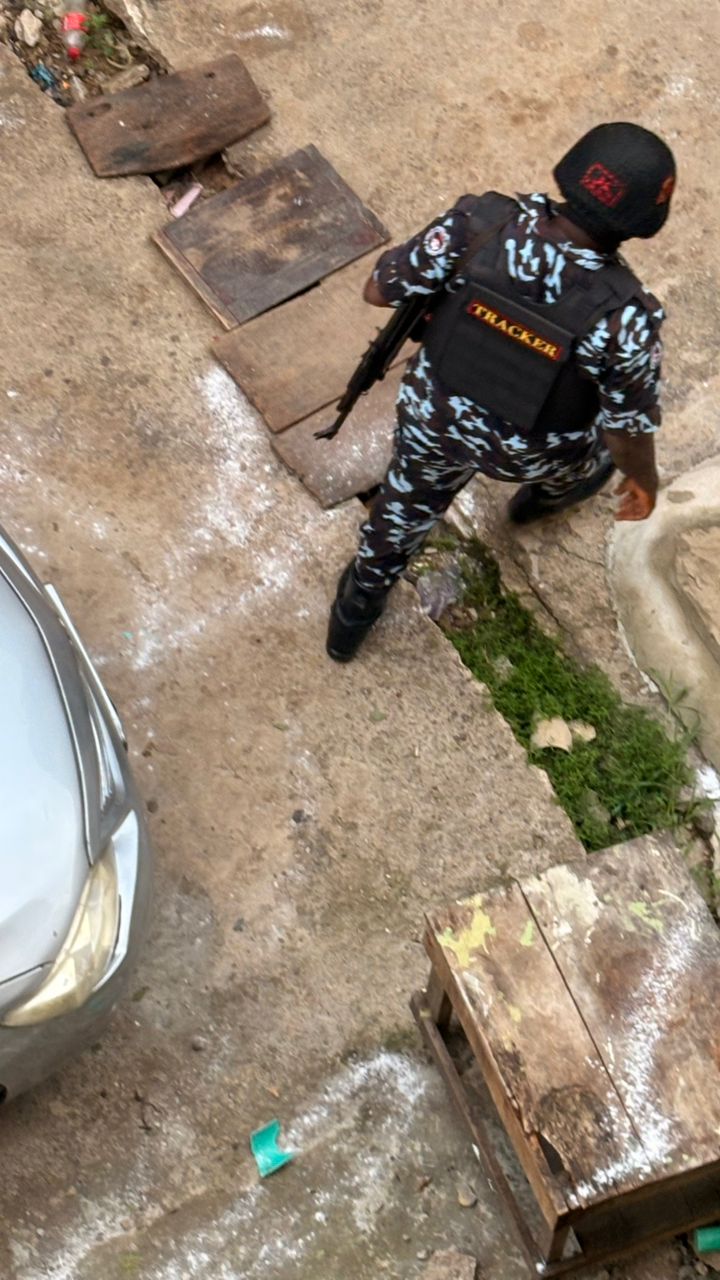
Police Officers Detained as Family Property Dispute Sparks Demolition Controversy in Lagos
By Ifeoma Ikem
A property dispute within the Omotayo-Ojo family has taken a dramatic turn following a controversial demolition exercise at a residential building in Ikosi-Ketu, Lagos State, which reportedly left tenants displaced and led to the detention of some police officers allegedly involved in the operation.

The property, located at 23B Loveall Street, Ikosi-Ketu, has been the subject of a prolonged ownership tussle since the death of its owner, Chief Oludola Omotayo Ojo, the Babaalaje of Imesi-Ile, Osun State, in 2019.
Residents said tension erupted when a group of individuals, accompanied by security operatives, stormed the premises and commenced demolition activities.
According to eyewitnesses, portions of the building were pulled down while tenants rushed to salvage their belongings from affected apartments.
The residents alleged that windows, doors and roofing sheets were damaged during the exercise, exposing parts of the building to the elements and causing significant losses to occupants.
At the centre of the dispute is Mrs Mojisola Omotayo Ojo Alolagbe, who claimed that the property was allocated to her by her late father during his lifetime as a source of financial support.
She alleged that some family members had persistently challenged her ownership claim despite ongoing legal proceedings relating to the administration of the deceased’s estate.
Alolagbe further claimed that the latest incident was part of a series of attempts to wrest control of the property, citing previous cases of alleged vandalism and partial demolition in November 2025, January 2026 and February 2026.
The situation escalated further when reports emerged that police officers allegedly involved in the demolition were later apprehended and conveyed in a Black Maria vehicle over questions surrounding the legality of their participation in the operation.
Sources familiar with the matter said those behind the demolition had initially claimed to be acting on approval from the Lagos State Ministry of Lands. However, the authenticity and extent of such approval could not be independently verified as of the time of filing this report.
The development has generated concern among residents and community members, who questioned the involvement of security personnel in what they described as a civil matter.
Some tenants, who said they had recently renewed their tenancy agreements, lamented the destruction of their property and appealed to the authorities for protection and possible compensation.

They also called for a thorough investigation into the circumstances surrounding the demolition, insisting that the rights of all parties involved should be protected.
Stakeholders have urged the Lagos State Government, security agencies and the judiciary to intervene and ensure that the dispute is resolved through lawful means to prevent further escalation.
The controversy has continued to draw public attention, raising concerns over property rights, estate administration and the role of law enforcement agencies in civil disputes.


UKA Gears Up for Final ATC Exchangeability Test Run as June Preparations Begin.
May 30, 2026 – As the month of June gathers momentum, the *United Kingdom of Atlantis, UKA*, a sovereign nation has unveiled a series of vital guidelines and preparatory packages to ensure citizens and stakeholders run the *ATC Exchangeability* process effectively.
In an official update, the *President of Atlantic Crown Limited, Empress of Attica Empire UKA*, confirmed that the *Final Test Run of ATC Exchangeability* is scheduled for the month of June 2026. The exercise marks a key phase ahead of the *Official Exchangeability Window, set to run from July 2026 to February 2027*.
### Key Highlights from the Presidential Briefing
1. *Final Test Run – June 2026*
The test run is designed to validate systems, procedures, and user readiness before full activation. Citizens, partners, and designated participants are urged to follow all official advisories released by UKA authorities during this period.
2. *Official Exchangeability Period*
Following the successful completion of the June test run, the Official Exchangeability will commence in july 2026 and we are Expecting Full Exchange ability between July Ending, 2026 to February 2026.
UKA stated that detailed schedules, eligibility requirements, and step-by-step instructions will be communicated progressively through verified UKA channels.
3. *Benefiting Packages for June*
In line with UKA’s commitment to citizen empowerment, the month of June will feature “benefiting packages” aimed at education, preparation, and seamless onboarding. These packages are intended to equip the people of UKA with the knowledge and tools needed for effective participation.
4. *Commitment to Transparency*
Addressing the nation, the Empress of Attica Empire UKA emphasized:
_“Final Test Run of ATC Comes up in The Month of June, As We Prepare For The Official Exchangeability, Between July 2026 To Feb 2027. All Information Will Be Communicated.”_
UKA reaffirmed that only information released through official UKA platforms should be regarded as authoritative.
The United Kingdom of Atlantis is encouraging all citizens, representatives, and interested parties to remain alert to official communications, attend designated orientation sessions, and avoid unofficial sources. UKA’s dedication to order, clarity, and the collective benefit of its people as the nation moves into this significant phase.
For updates, advisories, and participation guidelines, citizens are advised to monitor official UKA communication channels.
United Kingdom of Atlantis, UKA, is a sovereign nation, committed to national development, citizen welfare, and structured economic participation through initiatives such as ATC Exchangeability.
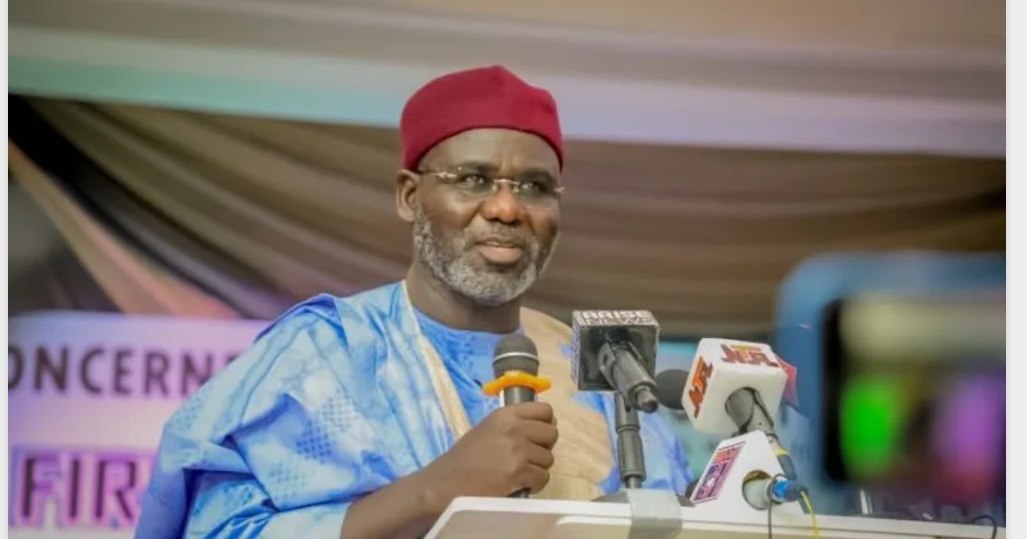
Three Years On, General Buratai Hails Tinubu’s Economic, Security Achievements
Former Chief of Army Staff, Lt. Gen. Tukur Buratai (retd.), has commended President Bola Ahmed Tinubu for what he described as bold economic reforms and improved security efforts as the President marks three years in office.
In a goodwill message on Thursday to commemorate Tinubu’s third anniversary as President and Commander-in-Chief of the Armed Forces, Buratai said the administration had taken courageous decisions that would leave a lasting impact on Nigeria’s development.

According to him, President Tinubu broke a long-standing cycle that had hindered national growth by removing fuel subsidy and implementing foreign exchange reforms aimed at stabilising the naira and strengthening the economy.
He noted that the reforms were beginning to yield positive results, citing the global acceptance of Nigerian debit cards, the gradual revival of local refineries, access to student loans, and ongoing road and infrastructure projects across the country.
“The FCT Administration has also recorded remarkable progress, completing major road projects that remained unfinished for over 16 years,” Buratai stated.
The former army chief also praised the administration’s security efforts, saying renewed military offensives against insurgents, terrorists and bandits had led to notable successes across various parts of the country.
He specifically lauded recent joint operations involving Nigerian and United States forces against Boko Haram and ISWAP in the North-East, as well as intensified counter-banditry operations in the North-West.
“We have seen notorious ISWAP commanders being neutralised. I congratulate the Commander-in-Chief, the Minister of Defence, the Chief of Defence Staff, the Service Chiefs, the Inspector-General of Police and heads of intelligence agencies for their efforts,” he said.
Buratai, however, acknowledged that challenges remained, stressing the need for more aggressive military operations and intelligence-driven strategies in the coming year.
While urging Nigerians to remain hopeful, he said celebrating the President’s achievements did not amount to ignoring the difficulties facing the nation.
“Because you truly care, you have shown the courage to trade short-term comfort for long-term hope. Nigerians need your reassurances, and that is why we remain optimistic and full of confidence,” he added.
The retired military officer reaffirmed his support for the Tinubu administration and expressed confidence that the foundation being laid by the government would deliver a brighter future for the country.
He also prayed for God’s guidance, wisdom, strength and good health for the President as he continues to lead Nigeria.


- Deputy (Dep.) Finance Minister Courts Investors to Transform Ghana’s rice Economy June 4, 2026
- Mobile health services in Kenya reduce the risk of stillbirths June 4, 2026
- JustMarkets Research Highlights Global Growth Divergence as a Key Market Driver June 4, 2026
- African Development Bank Group approves $125 million investment in African Trade and Investment Development Insurance (ATIDI) to expand risk insurance capacity in Africa June 4, 2026
- Congo Energy & Investment Forum 2027 to Position Brazzaville as a Hub for Global Energy Deal-Making June 4, 2026
- Africa Skills Hub (ASH) Transitions to ASH Africa as it Marks 10 Years of Impact June 4, 2026
- When women farm better, Eswatini eats better June 3, 2026
- Togo Hosts the 8th Annual Forum of National Volunteer Agencies in the Economic Community of West African States (ECOWAS) Region June 3, 2026
- Indigenous Peoples gravely vulnerable to Ebola epidemic, warn United Nations (UN) independent experts June 3, 2026
- Meeting between Parliamentary Vice-Minister ONISHI and His Excellency (H.E.) Mr. Cosgrow, Principal Minister and Minister for Agriculture, Fisheries and Blue Economy of Seychelles June 3, 2026
- Deputy (Dep.) Finance Minister Courts Investors to Transform Ghana’s rice Economy June 4, 2026
- Mobile health services in Kenya reduce the risk of stillbirths June 4, 2026
- JustMarkets Research Highlights Global Growth Divergence as a Key Market Driver June 4, 2026
- African Development Bank Group approves $125 million investment in African Trade and Investment Development Insurance (ATIDI) to expand risk insurance capacity in Africa June 4, 2026
- Congo Energy & Investment Forum 2027 to Position Brazzaville as a Hub for Global Energy Deal-Making June 4, 2026
- Africa Skills Hub (ASH) Transitions to ASH Africa as it Marks 10 Years of Impact June 4, 2026
- When women farm better, Eswatini eats better June 3, 2026
-

 news6 months ago
WHO REALLY OWNS MONIEPOINT? The $290 Million Deal That Sold Nigeria’s Top Fintech to Foreign Interests
-

 society1 month ago
SOCIAL MEDIA IS NOT A BATTLEFIELD COMMAND – WHY THE NIGERIAN ARMY’S ACTION AGAINST JUSTICE CRACK IS A NATIONAL SECURITY IMPERATIVE
-

 celebrity radar - gossips4 months ago
Dr. Chris Okafor Returns with Power and Fire of the Spirit -Mounts Grace Nation Altar with Fresh Anointing and Restoration Grace on February 1, 2026
-

 celebrity radar - gossips6 months ago
Prophet Kingsley Aitafo Releases 2026 Prophecy: ‘Nigeria Will Rise, but the World Must Prepare for Turbulence’