
Bank
Analysts place “buy” on Fidelity Bank


Analysts place “buy” on Fidelity Bank
Highly-rated, independent investment advisory firms have picked Fidelity Bank as a very attractive stock with potential to generate high returns for investors.
Independent investment research reports by many market pundits reviewed at the weekend showed that Fidelity Bank was assigned “buy” ticker, a recommendation to investors to consider the potential attractive returns of the bank.
The research reports were based on the historical and current operational performances of the bank as well as the clear-sighted implementation of the bank’s growth plan. The reports also considered the quality of board and management and the general human capital and resources of the bank.
The investment advisory reports included those of Afrinvest Group, FSDH Capital and CardinalStone among others.
Analysts were unanimous that Fidelity Bank’s share price could double in the period ahead given professional assessment of top traditional performance parameters including the company’s operational reports, investors’ preference and projections.
CardinalStone stated that Fidelity Bank’s share price could double citing the bank’s “robust earnings growth” and the increasing profitability of its core banking operations.
After an extensive review of the global and domestic stock markets, FSDH Capital selected Fidelity Bank as one of the “FSDH Top Picks”, a group of stocks that the investment advisory firm considered to be most attractive for discerning investors. FSDH Capital’s stock selection considered a stock’s pricing history, dividend history, fundamental values and peer ratios among others.
Providing background on analysts’ exhaustive research for stock selection, Afrinvest explained that the company’s fair value estimate “takes into account a weighted average of price estimates derived from a blend of valuation methodologies including the Discounted Cash Flow (DCF) and its variants as well as other relative and comparable trading multiples valuation models”.
“However, we attach the most weight to DCF valuation methodology, particularly the Dividend Discount Model (DDM), Free Cash Flow (FCF) model and Residual Income Valuation/Model (RIV/RIM). The utilization of comparable trading multiples is guided by the analysts’ understanding of the banks’ fundamentals, as well as key price drivers from the firm, industry and macroeconomic perspectives,” Afrinvest stated.
The “buy” rating, according to analysts, implies that “the expected total return over the next 12 months is 25 per cent or more. Investors are advised to take positions at the prevailing market price as at the report date”.
Afrinvest projected that Fidelity Bank, with a dividend yield of 9.3 per cent, has price upside potential of more than 35 per cent. This effectively makes the stock an inflation-hedging stock, implying that investors in the bank’s shares can retain money value despite the current inflationary environment.
Futureview Group said Fidelity Bank’s recent operational reports highlighted the bank’s “excellent operational performance and the breadth of its income sources”.
The audited report and accounts of Fidelity Bank for the year ended December 31, 2023 had shown that gross earnings rose by 65 per cent to N555.83 billion. The top-line performance was driven by significant growths across income lines including 55 per cent growth in interest income, 562 per cent increase in other operating income and 44 per cent growth in fee and commission income.
The bottom-line fared better with net profit after tax rising by 99 per cent to N99.46 billion in 2023. Earnings per share (EPS) thus jumped by 93 per cent to N3.11, providing a strong buffer for the bank to increase dividend payout without undermining its sustainability.
Interim report and account of the bank for the first quarter ended March 31, 2024 also showed that the bank started the current business year on stronger footing with three-digit growths across key performance indicators.
The three-month report, released at the Nigerian Exchange (NGX), showed that gross earnings increased by 89.9 per cent to N192.1 billion in first quarter 2024. The bank’s top-line performance continued to be driven by broad-based growths across income lines with interest income rising by 90.7 per cent and non-interest income growing by 84 per cent in first quarter 2024.
Growth in interest income was primarily spurred by a higher yield environment and strong earning assets base, while the increase in non-interest income was led by double-digit growth in account maintenance charges, foreign exchange (forex)-related income, trade, banking services, and remittances, supported by increased customer transactions.
Profit before tax doubled by 120 per cent to N39.5 billion in first quarter 2024 as against N17.9 billion in first quarter 2023. The bank’s performance was driven by expanding market share with total deposit rising by 17 per cent within the three months to N4.7 trillion, compared with N4 trillion recorded at the end of 2023. The bank also increased its supports for national economic growth with net loans and advances rising by 21 per cent from N3.1 trillion at the end of 2023 to N3.7 trillion by March 2024.
Managing Director, Fidelity Bank Plc, Nneka Onyeali-Ikpe said the bank’s performance was due to its strategic focus on customer-centricity, digital innovation and operational excellence.
“Despite the challenging macroeconomic environment, we remained resilient and agile, delivering double-digit growth on key income lines while advancing our business sustainability agenda.
“Beginning the year on this inspiring note reaffirms our strategy of helping individuals to grow, inspiring businesses to thrive and empowering economies to prosper. We are committed to our guidance as we build a more resilient business franchise with a well-diversified earnings base in 2024,” Onyeali-Ikpe said.
Ranked as one of the best banks in Nigeria, Fidelity Bank is a full-fledged customer commercial bank with over 8.5 million customers serviced across its 251 business offices in Nigeria and the United Kingdom as well as on digital banking channels.
The bank has won multiple local and international awards including the Export Finance Bank of the Year at the 2023 BusinessDay Banks and Other Financial Institutions (BAFI) Awards, the Best Payment Solution Provider Nigeria 2023 and Best SME Bank Nigeria 2022 by the Global Banking and Finance Awards; Best Bank for SMEs in Nigeria by the Euromoney Awards for Excellence 2023; and Best Domestic Private Bank in Nigeria by the Euromoney Global Private Banking Awards 2023.




GTCO Plc Releases 2025 Full Year Audited Result
…Declares Another Record Dividend of ₦12.76k; Re-affirming Unrivalled Capacity to Creating Value
Guaranty Trust Holding Company Plc (“GTCO” or the “Group”) has released its Audited Consolidated and Separate Financial Statements for the year ended December 31, 2025, to the Nigerian Exchange Group (NGX) and London Stock Exchange (LSE).
The Group reported profit before tax of ₦1.23trillion underpinned by strong growth in core earnings, with interest income and fee income increasing y-o-y by 23.2% and 25.9%, respectively. The performance reaffirms its capacity to generate sustainable earnings and builds on the momentum from 2024, when GTCO delivered a record profit of ₦1.27trillion, driven in part by ₦517.5billion in fair value gains, which did not recur in 2025.
The Group’s 2025 profit after tax came in at ₦865.75billion against ₦1.02trillion recorded in 2024. The profit after tax reflects the impact of recent fiscal policy adjustments to the taxation of investment securities, notably withholding tax on short-term instruments. However, when normalised for this effect, underlying earnings remain robust, driven by growth in core operating income.
The Group continues to maintain a well-structured, healthy, and diversified balance sheet in all the jurisdictions wherein it operates a Banking franchise, as well as across its Payments, Pension and Funds Management business verticals. Total assets and shareholders’ funds closed at ₦17.8trillion and ₦3.4trillion, respectively. Capital Adequacy Ratio (CAR) remained very robust and strong, closing at 43.8%, likewise asset quality improved as evidenced by IFRS 9 Stage 3 Loans which closed at 3.4% and 5.0% at Bank and Group level in FY-2025 (Bank, 3.5%, and Group, 5.2% in December 2024). Cost of Risk (COR) also improved to 2.2% from 4.9% in December 2024. In specific terms, the Group’s loan book (net) grew by 12.4% from ₦2.79trillion as of December 2024 to ₦3.13trillion in December 2025. Similarly, deposit liabilities grew by 23.8% from ₦10.40trillion to ₦12.87trillion during the same period.
Commenting on the results, the Group Chief Executive Officer of Guaranty Trust Holding Company Plc, Mr. Segun Agbaje, said: “Our 2025 result underscores the resilience and depth of our earnings capacity. Following a record 2024, which included significant fair value gains, our focus has been on strengthening the sustainability of our earnings by driving growth across our core banking and ecosystem businesses. The strength of our underlying earnings, despite a stronger Naira and tighter regulatory parameters, reflects the quality of our franchise and the discipline with which we execute our strategy. Importantly, this strong core earnings performance underpins our capacity to sustain and grow shareholder returns. Our record dividend payout this year is not only a reflection of our current profitability but also of our confidence in the Group’s long-term earnings potential. Looking ahead, we remain focused on scaling our ecosystem, driving innovation across our financial services platform, and delivering consistent, high-quality earnings that support superior value creation for our shareholders.”
Overall, the Group continues to post one of the best metrics in the Nigerian Financial Services Industry in terms of key financial ratios i.e., Post-Tax Return on Equity (ROAE) of 28.3%, Post-Tax Return on Assets (ROAA) of 5.3%, Capital Adequacy Ratio (CAR) of 43.8% and Cost to Income Ratio of 27.9%.
Guaranty Trust Holding Company Plc is a leading financial services group with operations across Africa and the United Kingdom. Renowned for its strong corporate governance, innovative financial solutions, and customer-centric approach, the Group provides a wide range of banking and non-banking services including payments, funds management, and pension fund administration. GTCO Plc is committed to delivering long-term value to stakeholders while driving growth and development across its markets

ZENITH BANK OPENS MANCHESTER BRANCH TO SUPPORT CROSS-BORDER TRADE AND INVESTMENT
Zenith Bank Plc has announced the opening of a new branch in Manchester, United Kingdom, marking another significant milestone in the bank’s international growth and its commitment to strengthening financial connections between Africa and global markets.
The official opening ceremony, scheduled to hold on Tuesday, March 17, 2026, is expected to attract government officials from Nigeria and the United Kingdom, regulators, investors, customers, and business leaders from both countries, underscoring the growing economic ties and investment opportunities between the two markets.
The new Manchester branch will complement Zenith Bank’s existing operations in the United Kingdom and serve as a strategic hub for supporting businesses engaged in international trade and investment. Through the branch, the bank will provide corporate banking, trade finance, treasury and related financial services to clients operating across the United Kingdom, Europe and Africa.Speaking ahead of the launch, the Group Managing Director/Chief Executive Officer of Zenith Bank Plc, Dame Dr. Adaora Umeoji, OON, said: “The opening of our Manchester branch represents another important step in Zenith Bank’s growth as a leading African financial institution connecting businesses and markets across continents. Manchester is one of the United Kingdom’s most dynamic commercial centres, and our presence here will further strengthen financial connections between businesses in the UK and opportunities across Africa’s rapidly expanding markets.
”Founded in 1990 by its Founder and Chairman, Jim Ovia, CFR, Zenith Bank has grown into one of Africa’s most respected banking institutions, boasting a robust capital base and a remarkable history of year-on-year profitability. Built on a strong foundation of people, technology and service, the Bank has consistently delivered innovative financial solutions while maintaining a disciplined approach to growth and risk management. The impressive performance of the Bank has consistently earned it excellent ratings, recognition and endorsement from local and international agencies and institutions.Headquartered in Lagos, Nigeria, Zenith Bank operates over 500 branches and business offices across the 36 States of the Federation and the Federal Capital Territory (FCT). The Bank currently operates subsidiaries in several African countries including Ghana, Sierra Leone, Gambia, and Cote d’Ivoire, while maintaining a presence in major international financial centres including the United Kingdom, France, UAE and China.
In recent years, Zenith Bank has continued to expand its international network as part of its strategy to support global trade and investment flows involving Africa.Manchester, widely regarded as one of the United Kingdom’s most vibrant economic centres, hosts a diverse base of businesses across sectors such as manufacturing, engineering, logistics, technology and consumer goods. The city’s strong commercial ecosystem and international outlook align closely with Zenith Bank’s expertise in corporate banking, structured finance and trade finance.The Manchester branch will work closely with the Bank’s London operations and its broader international network to support clients seeking to expand across markets and unlock new opportunities in both the United Kingdom and Africa.
With the opening of the Manchester branch, Zenith Bank continues to advance its vision of building a truly global African banking institution that connects businesses, facilitates trade and investment, and creates stronger economic bridges between Africa and the world.
Alpha Morgan Bank Deepens Presence in Abuja with New Branch in Utako
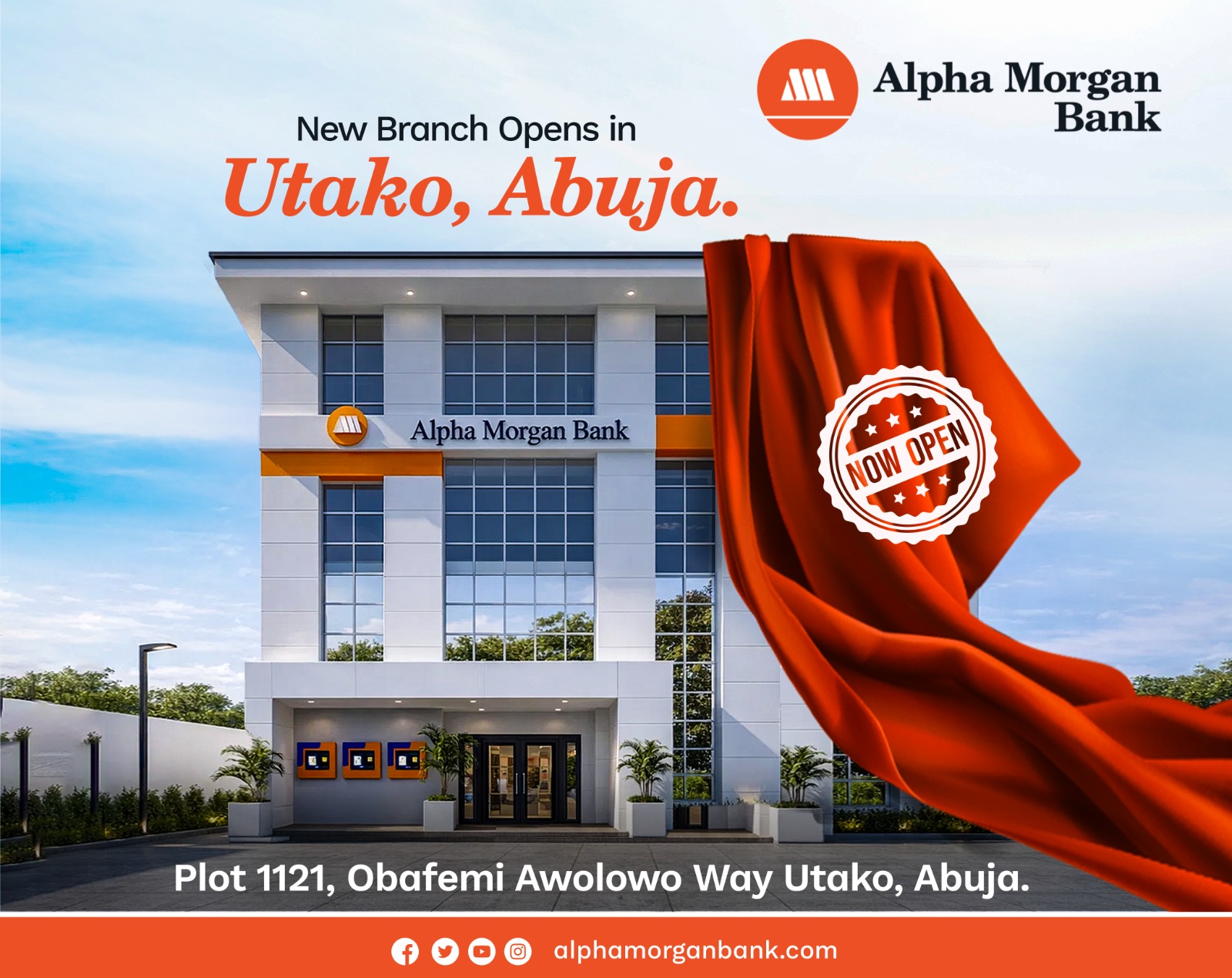
Marking another milestone in its expansion drive, Alpha Morgan Bank has opened a new branch in Utako, Abuja, reinforcing its strategy of building closer institutional ties within key business communities and bringing its financial expertise closer to individuals, and enterprises driving the city’s growth.
The new branch, located at Plot 1121 Obafemi Awolowo Way, Utako, Abuja is strategically positioned to serve individuals, entrepreneurs, and corporate clients within Utako and surrounding districts.
The expansion follows the Bank’s recently concluded Economic Review Webinar held in February 2026, as the bank continues to position as a thought-leader in the financial services industry.
Speaking on the opening, Ade Buraimo, Managing Director of Alpha Morgan Bank, said the move underscores the Bank’s commitment to accessibility and service excellence.
“Proximity matters in banking. As communities grow and commercial activity expands, financial institutions also evolve to meet customers where they are. The Utako Branch allows us to deliver our services to people in that community efficiently while maintaining the high standards our customers expect,”
The Utako location will provide a full suite of retail and corporate banking services, including account opening, deposits, transfers, business banking solutions, and financial advisory support.
Customers and members of the public are invited to visit the new Utako Branch to experience the Bank’s approach to satisfying banking.


-

 society7 months ago
Religion: Africa’s Oldest Weapon of Enslavement and the Forgotten Truth
-

 news4 months ago
WHO REALLY OWNS MONIEPOINT? The $290 Million Deal That Sold Nigeria’s Top Fintech to Foreign Interests
-

 society6 months ago
“You Are Never Without Help” – Pastor Gebhardt Berndt Inspires Hope Through Empower Church (Video)
-

 celebrity radar - gossips2 months ago
Dr. Chris Okafor Returns with Power and Fire of the Spirit -Mounts Grace Nation Altar with Fresh Anointing and Restoration Grace on February 1, 2026