
celebrity radar - gossips
Bishop Peace Okonkwo Opens up on 35 Years of Marital Bliss with TREM’s BIshop ” Life with him is quite Interesting but not without challenges”


Life with my Mike Okonkwo, is an interesting one but not without challenges. “Since I married him about 35 years ago, God has really been our helper all the way. I told you there were challenges we had our own share. But the bible says we should look onto Jesus the author and finisher of our faith. And because we agree together, we overcome. The bible says if two will agree together many things shall be done. We always stand in faith trusting God to help us. Throughout these challenges God has really been our helper and he has seen us through. It is not been all rosy. Anyone who tells you that everything has been beautiful is not true. There have been ups and downs but we just hang in there. There is not else you can do because you can’t run from God. When it comes to God, you run to Him. When there are challenges He is the only one who will see you through all the challenges. I will say it has been 35 years of God’s faithfulness, helping us; helping us in the ministry and home. He has helped us thus far to be able to bring up our daughter. By the next few months, she is going to get married so God has been good. In this wonderful encounter with her, she opened up on her family and other sundry issues…
How did you meet Bishop?
It is a long story. It used to be in one of the churches. You know when the civil war ended, people were seeking God. Everybody wanted to get close to God because we lost everything. In one of the churches, we the young ones, came into that church because we felt we needed God now, that was where I met him and it was in a church. I didn’t meet him first, I met the senior sister. The woman sort of took likeness of me. She likes me so much. Because Bishop at that time was very shy, he couldn’t talk to a woman. He is a very shy person, his sister was the one who said my brother likes you. I said which brother? Because they are all brothers; she said the one that is a banker. I said we will talk about it. So, one thing led to one another.
What was it that you saw in him that you liked?
The first time, I didn’t like anything because he felt he was arrogant because of his family background. The first time I said what is wrong with this young man why is he cocky?
How did he convince you to leave your secular job to join the ministry?
He didn’t convince me. I knew it was time because we all started the ministry together. He is someone who is hungry for God’s word. And whenever he wants to do anything, he pursues it. He wanted to travel abroad. And then, he went. But he said God spoke to him. I was also very much involved in the work of the ministry. I have been an usher, I sand in the choir. So I got involved in all the various departments. And I was work at the defunct Fincom, at Adeniyi Jones in those days. He said God told him that its time I give up the job. But he didn’t tell me. He told God if it is true that you are saying it talk to her. When he came back, the then board met with us and said with your input why don’t you come full time into the ministry? I said to them I will pray about it. I am the first out of many children. I have a lot of sister and brothers. They all depend on me including my mum because my father is late. When I was praying I told God, I said God it is you that will tell me what to do when I talk to my mum and she agrees that means it’s you. The money I usually send to her for upkeep that means I won’t be able to meet up. I spoke to her. When I had my first child, my mum came down so I told her. She just said: ‘the Lord will provide.’ I threw in the towel because of that and decided to join the ministry.
What was the first two years with Bishop like?
35 years what can I remember? Bishop is somebody that can defend you anytime. He loves you, he stands for you. He is not somebody that will deny you when the chips are down. He will stand for you one he knows you are doing the right thing. One or two things I know he likes to cook. He will also teach you how to do it. It is so funny that he came from a background where they are about six boys they always had people who lived them who did all the cooking. I don’t know how he learnt how to cook this vegetable soup. There was a day he said let me teach you and he is a funny person. To play game with Bishop, you will fall on the floor while playing with him especially Ludo game. If he is the one winning, just resign to your fate. He will make you laugh in such a way that you wont feel bad loosing.
Looking at your experience with bishop, what is your take on women, men handling household chores in a marriage?
I believe that a man should help the wife. Thank God for this part of the world where we have people who can help us. Abroad, the man does his part, the woman does her part. I believe in Nigeria it should be the same. I have walked up to one of my pastors’ house one day and I met the man cutting Okro. They just came back from abroad. The people who know about it said ‘eh, come and see pastor so and so.’ And I said what is wrong with that? If the man can help in anyway; why not? Don’t force it on him let it be out of his own freewill.
How much interest do you take in how Bishop appears outside?
Bishop is very stylish and he can put things together. My daughter tells me that if I want to buy anything for her that her father must see it first. I don’t really care about fashion, all I know is just wear good cloths and be clean but my husband is really into it.
How do you feel about him turning 70?
I will say it is God’s doing because everywhere I go people ask me what I am giving to him because he looks younger. I have begged him to reduce his schedule but he won’t. He just tells me all I need do for him is pray for him. As I was coming back from Aba on Monday, he was coming back from Warri and he is not around today.
How do you cope with your husband’s absence most of the time?
Me too my schedule has increased but I know that he has to go and be used by God. That is what gives him joy and I want him to be happy.
Are there times in your life that in your life that you have looked back and ask God questions such as why He called your husband into the ministry?
When we were facing trails, I told God that it was rather too much. I got married and the next week, he went to Sambigo for 6 months. We went to Ghana and came back for few days and the women said they have never seen something like that. I knew he has to go because God needs his attention. I knew God will need his time and that is why I use this to talk to my pastor’s wives. When they want to work with me, I prepare them, this work demands urgency, so they must be able to hold on to it and pray for their husbands.
Do you remember some memorable moments together with Bishop?
We went to his friend’s place in US, he loves motor bike. And we were on motor bikes together but we didn’t move. Bishop is quiet interesting. I am a football lover and Tennis and am a Chelsea fan. Bishop is Manchester United. When we watch football we sit on the carpet of our sitting room to watch it. Because I love Tennis, he became interested in Tennis. Those moments we watch tennis together, we laugh. Sunday evening especially, we love to relax.
Which is your favourite city in the world and why?
I like Isreal because of the God aspect. The other places I have been to, I am always in or out of the hotel to do something. Except few places that i move around to see the town. For Nigeria, I like Uyo. I had my first experience two years ago.
What are some of the achievements you have made from your women’s meeting over the years?
God has been gracious. We started like a mustard seed. If you come here last Thursday of the month, you will see that about 3 to 4000 women here. The women know my passion. When I went for a conference, I discovered that women were dying of cancer that can be treated. So when I turned 60, they planned a concert which we went for and now we are going from state to state, testing the women. We get doctors and pay the doctors to treat them. we also do widows empowerment, maybe because my mother is a widow. She is still alive, she is 85. At a time, God spoke to me about how my mother had toiled and I needed to start doing something for them. I sent some people to one of the villages during Christmas and these women prayed for me from 9 0’clock to 4 0’clock and they have never met me. They said how God can talk to somebody in Lagos. When the school in Nigeria was facing depression, I said is this how our children were going to go? That gave birth to Word of Power Group of Schools. We just opened a Secondary school in Asaba and everything that God has used me to pioneer comes out of a burden. You can go to our acquisition centre and see for yourself. Today girls are pregnant and they have come to this place. Their parents must have chased them out of the house or the person that impregnated them is nowhere to be found. I take them to this home, make them go to the hospital, pay the hospital bills and educate them that when they have their babies, they decide what to do with the babies; I don’t get involved in that. Nobody will do anything. My interest is that you must either go to school or learn a vocation. We were able to train 3 graduates because they live in the home, come to church and go to their vocations. The ones that wants to go to the universities, we sponsor them.
How do you surprise daddy?
It is very difficult to surprise daddy because he will know where you are coming from but I am going to surprise him this 70th birthday. He is so sensitive.
What are the things you share in common?
So many things. Like this morning, when we finished prayer, we started talking, Uche joined us. He doesn’t like Toothpaste pressed from the middle and am used to it. We eat together and we do exercise together in our compound. We play table tennis together.
How do you advise women in your church on seeking God’s face while looking for life partners?
I advise them to like the person and when you start praying, certain things will happen and God will lead you. We were quarrelling all the time in that church and he found out that he is so fond of me. Don’t allow anyone to tell you this is your husband.
As a female bishop how has it been working with other female ministers and bishops?
I have not really come to work with other female bishops. It is only mama when we did the work of the Chibok girls. I work with a lot of pastors. Here we have about 25 male pastors and they know that when I want something done, they do it. I have both wonderful male and female pastors here. We have a lot of good pastors that can preach and teach the word and handle different areas of the ministry because we have to pass the baton. We can’t be in it forever. That is why we are so much involved in the young ones. We have ordained so many pastors because we have to ensure there won’t be any vacuum when we leave.
What are you family values?
In the family I believe that a husband and wife should see things the same way and there should be an alter in the family. The way things are going everywhere, it is hard for people to have a family alter because a family that pray together stay together. Training of the children is very vital. You must pray about their schools and other things.
What advice do you have for women and men who get into corruption?
We are praying and I believe that in our life time, God will give us the Nigeria of our dreams. We will see the dividends of democracy. We need to tie our belts because corruption has eaten deep and there must be drastic measures taken. We just have to pray for those in authority. We have started the campaign in 2012. We have done screening for 8,000 women in different states. 12,000 men and women have enjoyed free medical screening because they check that BP. We have de-warmed about 5,000 children at each centre and the drugs are given free.
Can you talk about people you admire in the ministry?
The ministry started when there was no woman as a pastor. We started the women ministry. There was no mentor then and now there are so many ministers now. We have mama Idahosa, Mummy Mercy, Rev Roseline and so many others but we pioneered the female pastors.
What is the next step for you now?
As the door opens, we go into it. I don’t just do something because I want to do. I do something because I am led to. All these things were borne out of passion. When I noticed that the skill acquisition centre here was doing well. I had to build one in the village, which was dedicated in December. We have over 30 students there now, both male and female. Male do barbing and other things. We got the teachers from Lagos and sent them there. The ladies do dress making and other things. In May we visited and I wept because I saw transformation. One woman said to me that she had been in the village doing nothing and her children hardly eat but now she makes cake. People come to do cake for their wedding. My family menu has changed. A young man said he has wanted to do computer but he couldn’t afford it. He said but we brought it to them. When I saw the development, I said if this is all God wants me to do in life, them am fulfilled. All I need is put a value in somebody’s life. This way, the world will be a better place.
Have circumstances of life taught you anything?
Yes. It has made me know that we have to sit where people have sat. That is a big teacher. A man called me yesterday from the village and thanked me that he had finished university. The man has five children but couldn’t train them. When I heard it, I gave one of the girls a scholarship. Her parents called me and told me she had finished and thanked me. There is this girl that her father said she will kill because she got pregnant. I put her in my home and have her baby and she has gone back to school today. When you have an opportunity to help somebody, please do. It is God that shows mercy.
What is your take on single parenting?
It is not biblical and it is not right. If you find yourself in such situation, we can’t condemn you. One of my ladies here wedded last year and she is 47 years. For every woman, there is a man. Your time will come. If something happens along the line, how will you train that child?
What are some of the values you got from your mother?
She is a prayer warrior; I told her the other day to stop fasting. I made her not to more than 12. She said that is what she did to bring her children up. When her husband died, she went on her knees and that is one of the things I learnt from her. My daughter is now a pastor. When I had her, I told God that I will have her for some time and give her back to God. I didn’t tell her but I watched her grow that way. When she went to do her A levels abroad, I put all the Jesus I can inside her before she left. I didn’t just tell her, she saw it in my character. When she was eight, Saturday she will do her homework. She will stay in the morning till evening inside doing her homework. When she was going out to study, she was 17. I visited her in one of the period she was in school; her corner was very arranged unlike others. It was a foundation she had from the beginning. I later told her what I told God and she and her husband have to work it out. You don’t let children do what they feel like.
What is your final word on family relationships in the home?
I will tell them to pray together and stick together no matter what you are passing through. Share your family issues and be open to yourselves, believe God for the best and serve God.
What is your message for bishop on his birthday?
Man of God, you know I love you so much and apart from God, you are the best thing that happened to me. My prayer for you is keep on keeping on. The lord is with you and I will love you till I die.




celebrity radar - gossips
Adron Homes Celebrates Visionary Chairman, Aare Adetola Emmanuel King, at 51
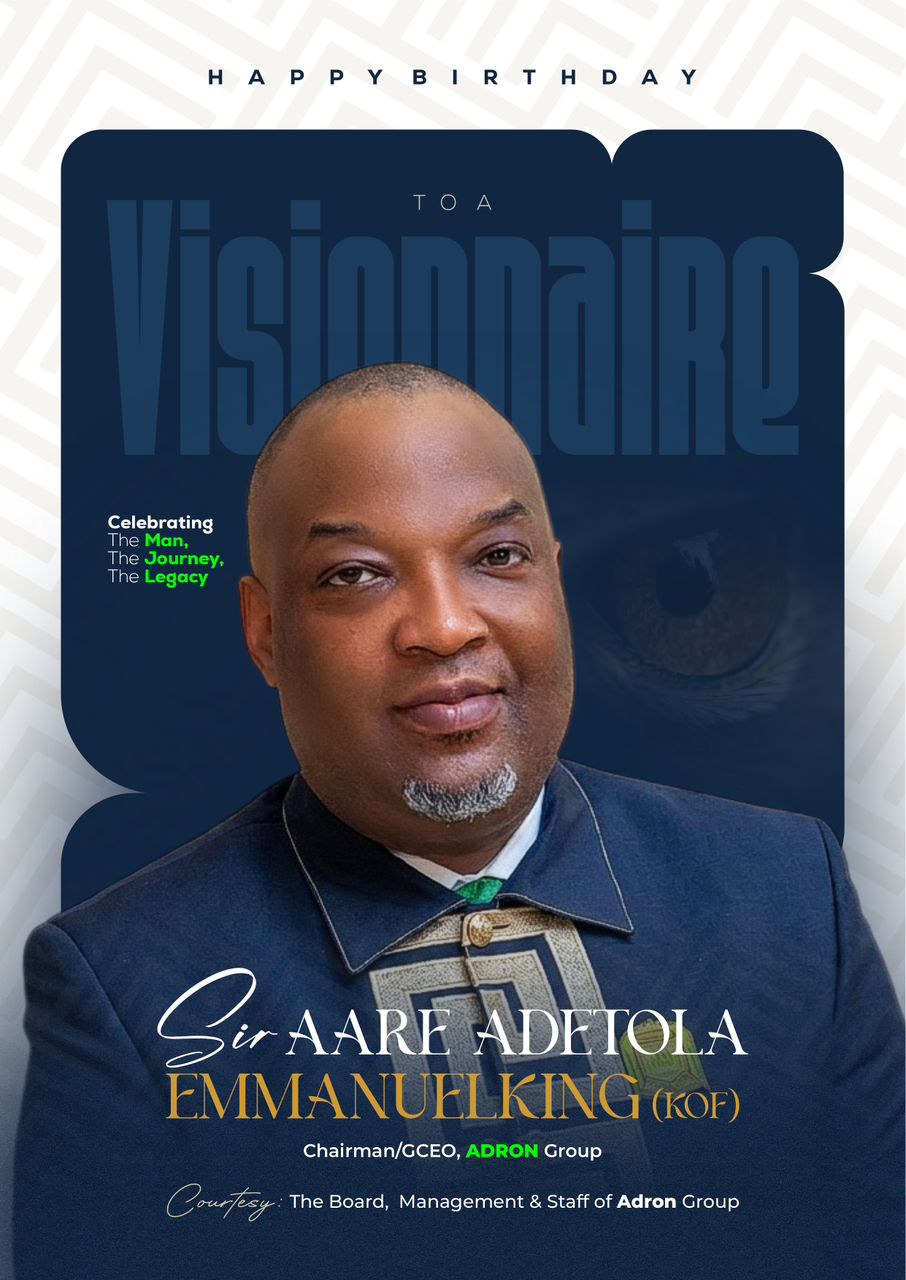
Adron Homes Celebrates Visionary Chairman, Aare Adetola Emmanuel King, at 51
The management and staff of Adron Homes and Properties Limited have joined family, friends, associates, and well-wishers across the globe to celebrate their Chairman and Chief Executive Officer, Aare Adetola EmmanuelKing, as he marks his 51st birthday.

In a statement released by the company, the milestone was described as a celebration of an exceptional leader whose vision, resilience, and entrepreneurial brilliance have not only transformed Adron Homes into a household name in Nigeria’s real estate sector but have also redefined affordable housing across the country.
Under his dynamic leadership, Adron Homes has continued to expand its footprint, delivering value-driven residential solutions while empowering thousands of Nigerians with opportunities for home ownership. His commitment to excellence, innovation, and customer satisfaction has remained the driving force behind the company’s sustained growth and industry leadership.
The statement further highlighted Aare EmmanuelKing’s passion for nation-building and community development, noting his significant contributions to job creation, youth empowerment, and the promotion of socio-economic development through real estate investments.
“As a leader, mentor, and visionary, Aare Adetola EmmanuelKing has consistently inspired a culture of excellence, integrity, and dedication within the organization. His ability to turn bold ideas into reality continues to position Adron Homes as a trailblazer in the industry,” the statement read.
The company expressed profound gratitude for his steadfast leadership and prayed for continued wisdom, strength, and sound health as he embarks on another year of impactful achievements.
As he celebrates his 51st birthday, the entire Adron Homes family proudly honours a man whose legacy continues to shape the future of real estate in Nigeria.
Happy 51st Birthday, Aare Adetola EmmanuelKing!

Oba Ara Releases Emotional Tribute to Late Taiwo Adegbodu
Taofik Afolabi
The gospel music community continues to grieve the painful loss of Taiwo Adegbodu, a beloved figure whose sudden departure left a deep void among fans, colleagues, and loved ones. In response to this loss, renowned gospel minister Rotimi Onimole, popularly known as Oba Ara, has released a moving tribute song that captures both the sorrow of the moment and the enduring legacy of the late singer.
Oba Ara, a proud son of Isale Eko, channels raw emotion throughout the song, using heartfelt lyrics and soul-stirring melodies to reflect on his personal connection with Taiwo Adegbodu. In the tribute, he openly expresses how deeply the news of Adegbodu’s passing shook him, describing it as a painful and unexpected loss that is difficult to come to terms with.
The song goes beyond mourning, it celebrates the life, ministry, and impact of Taiwo Adegbodu. Oba Ara highlights the late artist’s dedication to spreading the gospel through music, his inspiring voice, and the spiritual influence he had on many within and beyond Nigeria. Through powerful verses, he paints a picture of a man who lived for God and touched countless lives through his ministry.
Listeners have described the tribute as both comforting and deeply emotional, as it resonates with the collective grief of the gospel music community. It serves as a reminder that although Taiwo Adegbodu is no longer physically present, his music, message, and legacy will continue to live on.
In honoring his late colleague, Oba Ara not only pays his respects but also offers a source of healing for fans and fellow ministers, using music as a tool to process grief and celebrate a life well lived.
celebrity radar - gossips
Buratai, Fagbemi , Shagaya, Olofa, Others Eulogise Olowu Kuta’s Olori On 60th Birthday, Foundation Launch

Buratai, Fagbemi , Shagaya, Olofa, Others Eulogise Olowu Kuta’s Olori On 60th Birthday, Foundation Launch
Eminent personalities across the Nigeria stormed the TFK Event Centre, Bala Mohammed Way, Guzape, Abuja, to celebrate the 60th birthday of Olowu Kuta’s Olori, Queen Jumai Amoke and her Foundation Launch on Saturday 28, March 2026.

From former Chief of Army Staff, Lt Gen TY Buratai rtd, to the Minister of Justice and Attorney-General of the Federation, Prince Lateef Fagbemi; Olofa of Offa, HRM Oba Mufutau Gbadamosi. Even top businesswoman and socialite, Chief (Mrs) Bola Shagaya, was in attendance.


Other dignitaries were newly promoted Deputy Inspector-General of Police and former AIG Zone 2 , Lagos , Adegoke Fayoade, Major General Abdumalik, Major General Samuel Adebayo rtd (Fmr CDI);
Major General Anthony Omozoje rtd (Fmr Copp);
Alhaji Tajudeen Owoyemi (Asiwaju of Offa and CEO Radisson Hotel Nigeria;
Dr Waheed Olagunju, former managing director of Bank of Industry, Oniba of Iba, Lagos State, HRM Oba Dr Suleiman Raji ;
Justice Falola, Olu of Ile-Ogbo , Oba Adetoyese amongst many traditional rulers and captains of industry too numerous to mention.
Speaking at the occasion, the Chief Host, Olowu of Kuta, HRM Oba Dr Adekunle Oyelude Makama, CON , Tegbosun iii, who is also the husband of the celebrant commended Queen Jumai for ‘ her slender arms full of kindness’ to establish such humanitarian Foundation, ‘Amoke Children and mother in Need Foundation’ at a time Nigerians are going through economic crisis occassioned by the global meltdown.
Olowu also commended her steadfastness and love for the less privileged and downtrodden.
The monarch refrenced the task before his wife’s humanitarian gesture said her best is yet to come.
” Olori Amoke Jumai, I celebrate you. You will celebrate 70, 80, 90 and continue to shine as you continue to put a smile on people’s faces. I love you, “Olowu Kuta added.
To Lt Gen Buratai, a former army chief and former Nigerian Ambassador to Benin Republic, the reward of hard work is more work.
Buratai, who also doubles as Balogun Agba of Owu Kuta, a chieftaincy title reserved for a generalismo congratulated Queen Jumai for attaining the age of 60 in good health.
The retired army General said he’s not surprised by the turn out of eminent personalities across the country to celebrate the Olowu Kuta’s Olori because she merited it through her hospitality to all, adding that Allah the most merciful, most beneficial would accept all her act of ibadah.
The minister of Justice, Prince Fagbemi, was full of praises for Queen Jumai for deeming it fit to have a place in her heart to accommodate the needy and less privileged in ‘our society.’
Prince Fagbemi urged the guests to contribute generously to support the Foundation in order to continue to alleviate poverty and put a smile on the faces of the people.
” I congratulate you on your 60th birthday and Foundation Launch. I wish you many happy returns of the day and many more fruitful services to the country and motherland”, Prince Fagbemi added.
The celebrant, Queen Jumai who was grining from ear to ear thankfully said she was excited by the turn out and the response of the people to her foundation.
Queen Jumai, however, promised to continue to use her resources and donations received for the good of the needy and less privileged in the society.
” I want to appreciate my own Kabiesi Olofa of Offa , for his presence and im I’m using him as a point of contact to all other Kabiesis present here, the minister of justice and Attorney-General, you’re welcome, sir; Mrs Bola Shagaya, I salute your enterprise, Lt Gen Buratai, I’m grateful, sir; DIG Fayoade, Justice Falola and other dignitaries too numerous to mention, I thank you, all. To my darling husband, Kabiesi Olowu , I thank you immensely for your support. And to my family and friends, I thank you , all. E se pupo!”, she said.


-

 society7 months ago
Religion: Africa’s Oldest Weapon of Enslavement and the Forgotten Truth
-

 news4 months ago
WHO REALLY OWNS MONIEPOINT? The $290 Million Deal That Sold Nigeria’s Top Fintech to Foreign Interests
-

 society6 months ago
“You Are Never Without Help” – Pastor Gebhardt Berndt Inspires Hope Through Empower Church (Video)
-

 celebrity radar - gossips2 months ago
Dr. Chris Okafor Returns with Power and Fire of the Spirit -Mounts Grace Nation Altar with Fresh Anointing and Restoration Grace on February 1, 2026
You must be logged in to post a comment Login
You must log in to post a comment.