
society
Community Policing: Fayemi makes case for police reform, need to address trust issue

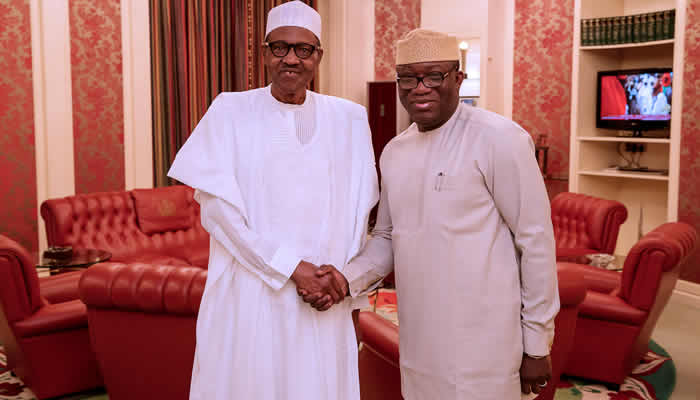
The Governor of Ekiti State, Dr. Kayode Fayemi, has reiterated the need for a reform mechanism that would improve citizens’ trust in the Nigeria Police for the intent and purpose of community policing to be achieved.
Dr Fayemi stated this during a stakeholders’ forum on community policing, involving heads of security agencies, public servants, politicians, civil society organisations, youth and women organisations, heads of government institutions, trade and professional groups in Ado-Ekiti at the weekend.
The Ekiti State Governor spoke, just as a former Inspector General of Police, Mr Sunday Ehindero urged stakeholders to support the holistic establishment of community policing to tackle the menace of banditry, kidnapping and other security challenges bedevilling the Country.
Dr. Fayemi who stated that community policing is vital to addressing security challenges in the country, however lamented the non-implementation of a wide range of recommendations made at different conferences on how the Nigeria Police can be reformed in the last 20 years.
The Governor who spoke through the State Attorney- General and Commissioner for Justice, Mr Wale Fapohunda; said the establishment of a police ombudsman with the mandate to receive and address citizens’ complaints against police officers and also address cases of abuse against police officers had become imperative.
He also urged the Federal Government not to despise recommendations made by the Judicial Panel of Inquiry set up in the wake of the ENDSARS protests with special attention on getting justice and compensations for victims of police abuse.
The Governor also called on the Minister of Police Affairs to engage a reputable audit firm to undertake an audit of the salaries, the wages, allowances of police officers including manpower and equipment available to the police, stressing that police force with poor condition of service and struggling to survive cannot deliver the purpose of community policing.
Fayemi said: “A large number of our people still don’t see police as their friends. So it seems to me that an important way we can get that trust is through police reform. We cannot simply hope to achieve the intent of community policing without police reforms.
“The Federal Government should take seriously the reports of the judicial panel of inquiry that has been set up in the aftermath of the ENDSARS protests. If we are going to move forward we have to look backward and ensure that our people that have serious issues with police are properly compensated and their pains recognized.
“There is nothing wrong with the Nigeria Police today that has not been subject of multiple reports of many committees which the IG and myself participated. There are many high level reports on police reforms including two constitutional conferences.
“The tragedy is that the recommendation of this committee and that of constitutional conference had largely been left unattended to. We need to look at those reports bring them back to life and base on those reports agreed on an actionable agenda that is time bound for the use of the country as a whole and for the enhancement of police reforms in Nigeria.
“We absolutely need to revisit the conditions of service of police officers, the situation of police barracks, the situation of police stations, all the allowances entitled to the Police. There has been too much theory about the need to improve the conditions of service of the police officer an unhappy police force cannot deliver community policing, is crucial.” He added.
In his presentation, former IG Ehindero said tackling security challenges solely from the angle of security personnel has shifted to community stakeholders playing vital roles in providing intelligence that would assist the security agencies to perform optimally.
Ehindero who noted that such approach of community policing was what assisted in the rescue of the abducted secondary School Students in Katsina State, said the need to embrace community policing by supporting it was crucial to overcoming the security challenges bedeviling the Nation.
The Assistant Inspector General of Police in charge of Zone 17 comprising of Ekiti and Ondo, David Folawiwo called on the Stakeholders to take ownership of community policing. He said the Inspector General of Police was committed to making constabularies who were nominated by their community to serve in their locality thereby ensuring that there is police presence in every hamlet, villages and towns.
Earlier in his welcoming address, the State Commissioner of Police, explained that the programme was designed to enhance and expand the horizon of collaboration between security agencies and other critical stakeholders in the society particularly traditional rulers and community leaders at the grassroots.
In attendance at the forum were the Deputy Governor, Otunba Bisi Egbeyemi, Secretary to the State Government, Hon Biodun Oyebanji, Head of Service, Mrs Peju Babafemi; Chief of Staff, Hon Biodun Omoleye; Chief Judge of Ekiti State, Hon Ayodeji Daramola; represented by Justice John Adeyeye, traditional rulers led by the Chairman traditional Council, Oba Ayodeji Alabi represented by Owaoye of Okemesi Oba Gbadebo Adedeji and other top government functionaries.




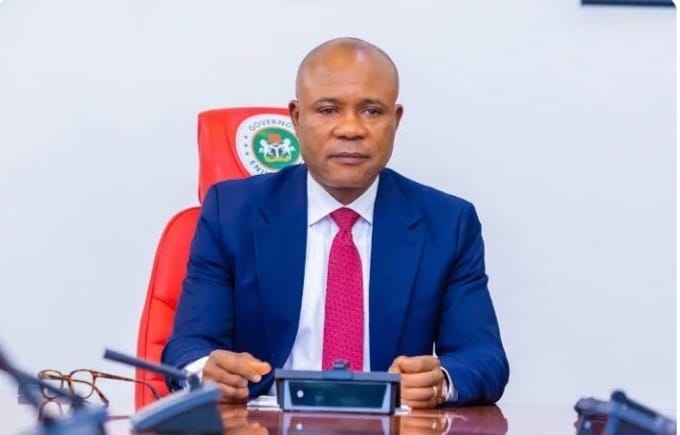
Gov. Peter Mbah @54: From Campaign Vision to Transformational Leadership in Enugu State
By George Omagbemi Sylvester
“From Campaign Promises to Measurable Impact: How Gov. Peter Mbah is Transforming Enugu State Ahead of His 54th Birthday”
Governor Peter Mbah is being celebrated on March 16, 2026, ahead of his 54th birthday tomorrow, March 17, 2026, for his visionary leadership, developmental initiatives, and enduring impact on Enugu State.
Mbah began his journey to the governorship under the Peoples Democratic Party (PDP) during the 2022 primaries, running on a platform of economic revitalisation, security enhancement, education reform, healthcare expansion, and youth empowerment. His campaign emphasized making Enugu State a business-friendly, investment-ready, and socially inclusive environment, promising policies to raise the state’s economy significantly while improving living standards for citizens.
Elected governor on March 18, 2023, and sworn in on May 29, 2023, Mbah immediately began translating campaign promises into action. Within months, his administration launched strategic initiatives across multiple sectors, reflecting a commitment to governance that is both pragmatic and people-focused.
Security and Public Safety
One of Mbah’s first priorities was enhancing security. He established AI-powered command centers, modern surveillance systems, and rapid response squads, reducing crime rates and making Enugu a model for safety in the region. Citizens and investors alike have praised these measures for creating a secure environment that encourages commerce and tourism.
Education and Healthcare
Mbah has made education and healthcare cornerstones of his administration. The state now boasts 260 Smart Green Schools equipped with ICT labs and digital learning tools. In healthcare, he constructed 260 Primary Healthcare Centres, ensuring that communities across the state have access to essential medical services. His policies reflect a vision of equitable development and human capital empowerment.
Infrastructure and Urban Renewal
Under his leadership, nearly 1,000 km of roads have been completed or rehabilitated, while urban centers have undergone significant renewal. Water schemes long neglected were revitalized to provide reliable supply, and waste management initiatives have improved public sanitation across the state. Mbah’s administration also prioritizes long-term city planning, with projects like the International Conference Centre and future smart city developments underway.
Economic Reform and Revenue Generation
Digitization has been central to Mbah’s economic reforms. Land and tax systems were modernized, broadening the revenue base and improving transparency, all without imposing new taxes. These measures have attracted investors and strengthened the state’s economy, demonstrating that governance can be efficient, accountable, and growth-oriented.
Transport and Aviation
Mbah launched Enugu Air and upgraded urban transport infrastructure, including modern bus terminals and a fleet of CNG-powered buses, easing mobility for residents and creating new employment opportunities.
Leadership Style and Legacy
Described by analysts as a “talk and do” leader, Mbah combines strategic planning with direct engagement at the grassroots level. His cabinet has been restructured to align with developmental goals, including the creation of a Ministry of Energy and Mineral Resources to harness local potential. These steps demonstrate a focus on long-term, sustainable governance.
As he celebrates his 54th birthday on March 17, 2026, stakeholders and citizens honor a leader whose tenure has consistently prioritized progress, inclusivity, and citizen welfare. Supporters have even suggested endorsing him as a sole candidate in the 2027 elections, reflecting confidence in his leadership and track record.
Governor Mbah’s journey from campaign promises to tangible achievements illustrates a governance model grounded in vision, action, and accountability; an enduring legacy for Enugu State and a benchmark for Nigerian leadership.

society
SUPERSTAR7EVEN RELEASES ‘OMO TO SHUN / SORRY’, A POWERFUL TWO-TRACK PROJECT INTRODUCING A LIFESTYLE-LED ERA

SUPERSTAR7EVEN RELEASES ‘OMO TO SHUN / SORRY’, A POWERFUL TWO-TRACK PROJECT INTRODUCING A LIFESTYLE-LED ERA
Lagos, Nigeria – Superstar7even, the rising Lagos-based artist, has dropped her latest project, ‘Omo to Shun / Sorry’, a two-track release that marks the beginning of her journey as a force to be reckoned with in the music industry. This release is the first phase of a larger body of work scheduled for later this year, setting the stage for a trailblazing career.
‘Omo to Shun / Sorry’ is more than just a music release – it’s a narrative experience. The two tracks are designed to be experienced together, telling a story of confidence, ambition, and personal independence. ‘Omo to Shun’ is an anthem of self-assurance, capturing the essence of everyday moments where confidence is expressed through presence, not performance. ‘Sorry’ shifts the focus to the importance of hard work, financial autonomy, and long-term vision, creating a cohesive storyline that showcases Superstar7even’s artistic depth.
This project is supported by a three-month rollout strategy that prioritizes community engagement and fan participation. The campaign spans digital platforms, campus networks, radio appearances, and offline touchpoints in student-led environments, encouraging fans to interpret, share, and connect with the music on a deeper level.
“We wanted to create a release that would spark a conversation, not just about the music, but about the lifestyle and values that Superstar7even represents,” said the artist. “This is just the beginning, and we’re excited to share our journey with our fans.”
‘Omo to Shun / Sorry’ is available on all major streaming platforms. Join the movement and experience the sound of confidence, ambition, and modern independence.
*About Superstar7even*
Superstar7even is a Lagos-based artist whose work explores themes of confidence, ambition, and personal independence. Her releases are structured as long-form narratives, emphasizing continuity, audience participation, and cultural relevance.


*Connect with Superstar7even:*
Instagram: @Superstar7even
TikTok: @Superstar7even
X: @thatgirl7even
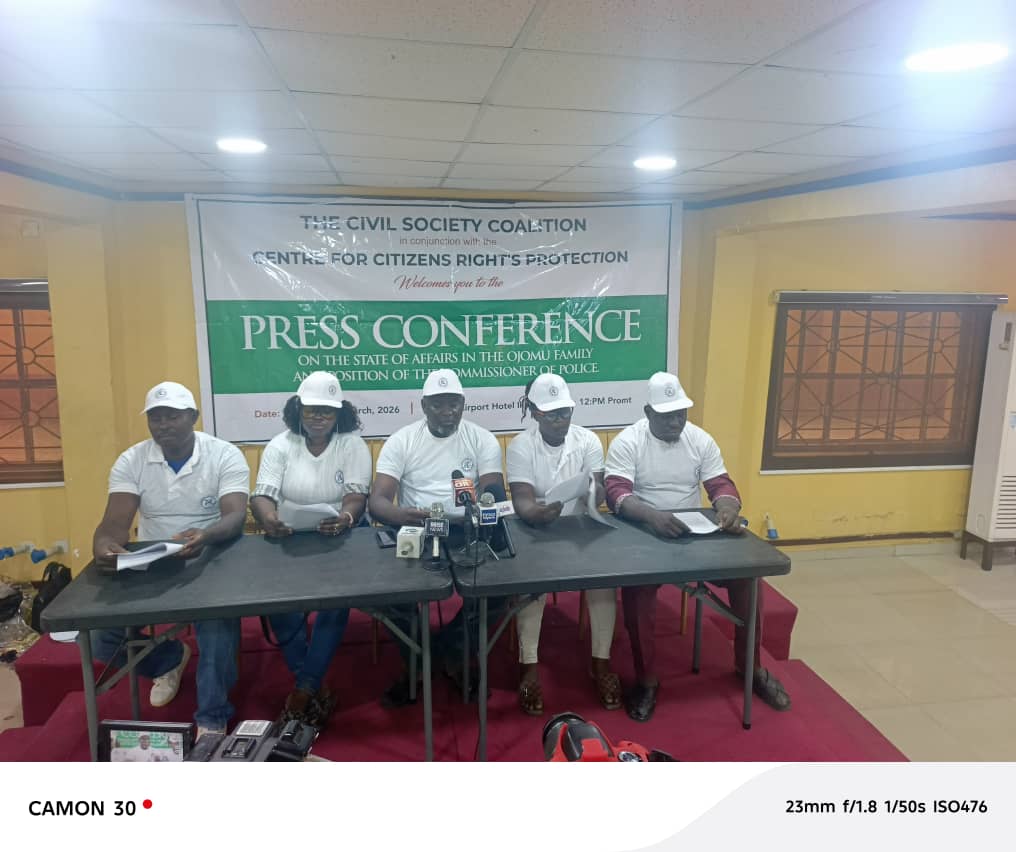
Coalition urges IGP to rebuild public confidence on Nigerian police
…Seeks investigation of AIG Moshood time in Lagos
The Coalition of Civil Society Organisations in collaboration with the Centre for Citizens’ Rights has urged the Inspector General of Police to rebuild public confidence in the Nigeria Police Force.
Speaking at a press conference in Lagos, the President of the Coalition, Adeyemi Olorunsogo and its Secretary, Kolawole Abe Emmanuel, said Nigerians expect professionalism, impartiality, and accountability from the leadership of the Force.
The Coalition expressed concern over consistent and clear repeated interference of the Lagos police command in matters that are purely civil in nature, and actions that suggest a troubling pattern of bias in the handling of sensitive disputes.
It said: “Over the past few weeks, our coalition has repeatedly drawn the attention of the public to the disturbing conduct of the Nigeria Police Force in Lagos State, particularly under the leadership of the immediate past Commissioner of Police, Mr. Olorundare Jimoh Moshood.
“We, therefore, call on the newly appointed Inspector-General of Police to exercise utmost caution in the deployment and assignment of senior officers, particularly in situations where their previous conduct has generated serious public concern.
“We note that Mr. Moshood has now been posted away from Lagos. We also acknowledge the appointment of the new Inspector-General of Police, Mr. Tunji Disu, whose professional reputation in intelligence-led policing, crime management and strategic leadership has earned him public respect.
“In view of this new leadership and in the hope that professionalism and accountability will define the next phase of policing in Nigeria, this coalition has resolved to suspend its earlier planned protest until further notice.
“In situations where the police ought to remain neutral and professional, the conduct of the former Commissioner appeared to tilt the scale in favour of certain interests, thereby undermining public confidence in the impartiality of law enforcement.
“In February 2026, without a valid court order, without a formal invitation, and without a lawful warrant of arrest, the former Commissioner reportedly declared Alhaji Hammed Tajudeen Akanbi wanted for murder.
“This declaration arose in the context of a family and community land dispute involving factions within the Ajiran community. Allegations bordering on murder is a very sensitive one as it does not only speak to law but sanctity of life and one accused of such if not cleared carries a life time burden.
“Following that declaration, the property of Alhaji Akanbi was reportedly destroyed by individuals who allegedly operated under the protection and watch of officers of the Lagos State Police Command.
“The Nigeria Police Force must never be seen as taking sides in private civil disputes. The integrity of law enforcement depends on neutrality, professionalism, and respect for the rule of law.
“Declaring a citizen wanted without a lawful warrant, proper investigation, or court order raises serious concerns about abuse of police authority and must never become a precedent in a democratic society.
“While promotions within the Police Force fall under the authority of the Police Service Commission, we believe that officers whose actions have generated significant public concern should be carefully scrutinized before being entrusted with greater responsibility.
“The appointment of the new Inspector-General of Police presents an opportunity to rebuild public confidence in the Nigeria Police Force. Nigerians expect professionalism, impartiality, and accountability from the leadership of the Force.
“Civil society exists to hold power accountable. Our intervention is not political; it is a duty to protect the rule of law and defend the rights of citizens. We wish the new Inspector-General of Police success in his assignment and urge him to live up to the expectations of millions of Nigerians who desire a police force that is professional, impartial, and accountable.”


-

 society6 months ago
Religion: Africa’s Oldest Weapon of Enslavement and the Forgotten Truth
-

 news3 months ago
WHO REALLY OWNS MONIEPOINT? The $290 Million Deal That Sold Nigeria’s Top Fintech to Foreign Interests
-

 society6 months ago
“You Are Never Without Help” – Pastor Gebhardt Berndt Inspires Hope Through Empower Church (Video)
-

 Business7 months ago
GTCO increases GTBank’s Paid-Up Capital to ₦504 Billion