
Bank
FIDELITY BANK BEGINS INTERNATIONAL EXPANSION DRIVE

FIDELITY BANK BEGINS INTERNATIONAL EXPANSION DRIVE

With its half-year 2022 results showing a 20.7 per cent rise in profit after tax year-on-year, Fidelity Bank Plc, which last week announced the planned acquisition of Union Bank UK, is leaving no one in doubt with its readiness to avail itself of the tremendous gains of international presence.
In response to their peculiar needs and ever-changing business environment, commercial banks in Nigeria have continued to raise their scale through deliberate acquisitions and business combinations.
This is because, unlike in the past when the Central Bank of Nigeria (CBN) had to raise the capital threshold, forcing banks to either opt for public offers to raise additional funds or merge with operators with similar visions, it is the competition for the sphere of influence that is driving most mergers and acquisition these days.
Analysts attribute the development to the shrinkage of business opportunities amid the current global economic challenges.
Banking industry watchers said with the keen competition by fintech companies and the rising appetite of consumers of banking products for innovations and risks, there are pressures on banks to leave their comfort zones and respond to these growing needs.
Consequently, banks decided to go for options that are best suited for them including the option of a holding company where they bring their non-banking operations under one umbrella. Others decided to go for acquisitions to create a niche for themselves.
It is under the latter category that Fidelity Bank Plc falls as it announced a business combination with a United Kingdom bank last week.
The bank disclosed that it has entered into a binding agreement for the acquisition of a 100% equity stake in Union Bank UK Plc for which the central bank has issued a letter of no objection.
The move is seen as an opportunity for Fidelity Bank to optimise its international banking licence and take advantage of the planned business combination with Union Bank UK, which has been offering competitive banking services including personal banking, trades finance, treasury management, and structured trade and community finance, which offers to individual and corporate clients for as far back as 1983.
Although the transaction is subject to the approval of the Prudential Regulatory Authority of the United Kingdom, Fidelity Bank officials said they hope to leverage the gains of the acquisition to improve the bank’s returns to its shareholders and to add value to its current and prospective customers.
Improved Half-Year Result
The news of the planned acquisition came the same week that Fidelity Bank’s half-year result for 2022 made its way to the public domain.
Analysts said with the impressive results, Fidelity Bank has demonstrated the capacity to be competitive in the Nigerian banking industry.
According to the unaudited half-year results, the bank posted a profit after tax of N23.307 billion for its 2022 half-year results, representing a growth of 20.72% year-on-year.
In the financials submitted to the Nigeria Exchange Group Limited (NGX), the bank also made significant improvements across key performance indicators.
The results indicate that the bank’s gross earnings rose by 37.87% to N154.843 billion from N112.304 billion reported in 2021, driven by a 50% growth in net interest income.
Profit before tax stood at N25.079 billion from N20.628 billion posted in 2021, representing a growth of 21.57%.
Interest and similar income using the effective interest rate method rose by 48.45% from N85.090 billion recorded in the first quarter (Q1) of 2021 to N126.348 billion in the period under review.
Based on the result the Board of Directors under the powers vested in it by Section 426 of the Companies and Allied Matters Act (CAMA 2020), proposed an interim dividend of 10 Kobo per share amounting to N2,896,258,569.20 from Retained Earnings as of 30 June 2022.
The Register of Shareholders will be closed on September 13, 2022. The qualification date is September 12, 2022.
On September 20, 2022 dividends will be paid electronically to shareholders whose names appear on the Register of Members as of September 12, 2022, and who have completed the e-dividend registration and mandated the Registrar to pay their dividends directly into their bank accounts.
The planned acquisition of Union Bank UK signposts the final transition of the former Union Bank of Nigeria Plc to new separate owners. In December 2021, Union Bank’s core investors – Union Global Partners Limited and Atlas Mara –reached a Share Sale and Purchase Agreement (SSPA) with Titan Trust Bank (TTB) for the sale of 89.39 percent of Union Bank’s issued share capital.
The agreement came a decade after the initial investment by the core investors in 2012.
Commenting on the bank’s performance in March, the MD/CEO, Fidelity Bank Plc, Nneka Onyeali-Ikpe, said: “Digital Banking gained further traction driven by new initiatives in our retail business and the enhancement of existing digital banking products.
We now have 56.0% of our customers enrolled on the mobile/internet banking products and 90.0% of total customer-induced transactions done on digital platforms with digital banking business contributing 27.6% to net fee income.”
Fidelity Bank is described as a highly capitalised bank with a Capital Adequacy Ratio (CAR) of 19.8% in H1 2022. It successfully acquired and integrated two operating commercial banks (FSB and Manny Bank).
The bank boasts of a strong trade and export business with a diversified portfolio across sectors and market segments. It also has a wide distribution network serving over seven million customers. Today, Fidelity Bank is the only bank of its size in Nigeria with no business operation outside the shores of Nigeria.
Value Addition
At an interactive session with some financial journalists in Lagos last week, the bank’s Executive Director in charge of Operations and Information, Mr. Stanley Amuchie, explained that the acquisition aligns with the bank’s short to medium-term aspirations and international expansion drive.
Interestingly, UBUK’s competitive range of banking services includes Personal Banking, Trade Finance, Treasury Management, Structured Trade, and Commodity Finance which it offers to individual and corporate clients.
Listing the attraction in the UBUK, Amuchie said the bank offers a robust range of banking services to customers doing business from and into Africa, including trade finance, personal banking, business banking, treasury services, and commercial lending.
It is going to be a plus for Fidelity Bank to combine business with the UBK which provides extensive trade financing to businesses or individuals, that includes secure tracking of physical risks and events in the chain between importers and exporters.
Amuchie explained that up till now, what Fidelity Bank does when it needs to satisfy the demand of its Nigerian customers with banking needs in the UK is to work with other banks.
However, with the ongoing acquisition, the bank will not only meet the needs of its customers with ease, but it will also be able to conserve fees that it would have paid to another bank.
“Union Bank UK provides extensive trade financing to businesses or individuals that includes secure tracking of physical risks and events in the chain between importers and exporters,” he stated, adding that the bank provides transaction and liquidity management services to individuals and businesses, helping clients trade across borders and ensuring timely delivery and collection of payments.
Enhanced Product Offering
According to him, a significant captive business opportunity exists in Fidelity books as well as enhanced product offerings, bundled services, and cross-selling.
Other low-hanging fruits from the acquisitions include the offer of international banking service support, especially for HNIs in Nigeria, trade finance, and a corresponding banking relationship with Fidelity Bank.
In terms of operation, there is the prospect of cross-border collaboration in sales and client services, while the possibility of shared services will be considered.
Amuchie also talked about workforce transformation and integration of performance culture by the time the acquisition is fully consummated.
The acquisition also raises the prospect of significant captive business opportunities for UBUK from Fidelity Bank’s existing foreign currency transactions in Nigeria.
Fidelity Bank is also looking at the possibility of revenue and cost optimisation through cross-selling and shared services.
It is also believed that complementary business operations will enable strong value creation for shareholders and clear benefits for customers, staff, and other key stakeholders.
Throwing more light on the expectations from the acquisition, Amuchie pointed out that “UBUK will service other subsidiaries of Fidelity Bank under the proposed Holdco structure.
He added that there is potential for stronger customer loyalty and stickiness through integrated financial services and bundled products for diaspora customers and corporate banking clients, etc.
The bank was recently recognised as the Best SME Bank Nigeria 2022 by the Global Banking & Finance Awards. It has also won awards for the ‘Fastest Growing Bank’ and ‘MSME & Entrepreneurship Financing Bank of the Year’ at the 2021 BusinessDay Banks and Other Financial Institutions (BAFI) Awards.
Commenting on the agreement, Onyeali-Ikpe said: “This transaction aligns with our strategic plan of expanding our services touchpoints beyond the Nigerian market and providing straight-through services that meet and exceed the needs of our growing clients.
The diverse bouquet and business model of Union Bank UK offer a compelling synergy and we hope to build on the existing capacity to create a scalable and more sustaining service franchise that will support the wider ecosystem of our trade businesses and diaspora banking service





Fidelity Bank grows gross earnings by 38% to N434.95b in Q1
Fidelity Bank Plc recorded 37.9 per cent growth in gross earnings to N434.95 billion in first quarter 2026 as the international commercial bank continued to expand its core banking market share.
Interim report and accounts of Fidelity Bank for the three months ended March 31, 2026 released at the Nigerian Exchange (NGX) showed that gross earnings rose from N315.42 billion in first quarter 20025 to N434.95 billion in first quarter 2026, representing an increase of 37.9 per cent.
The top-line performance was driven by impressive growth in the bank’s core business operations with interest incomes rising by 22.8 per cent to N314.48 billion in first quarter 2026 as against N256.10 billion in first quarter 2025.
With net interest income at N180.97 billion, the bank closed the period with profit before tax of N92.48 billion. After taxes, net profit stood at N74.47 billion for the three-month period. Earnings per share remained high at N5.69, underlining the capacity of the bank to reward its shareholders.
The balance sheet of the bank also emerged stronger. Total assets crossed the N11 trillion mark to N11.35 trillion by March 2026 compared with N10.46 trillion recorded in December 2025. Customers’ deposits increased from N6.89 trillion to N7.38 trillion. Total equity rode on the back of earnings growth to a 27.5 per cent increase from N1.09 trillion in December 2025 to N1.39 trillion by March 2026.
The first quarter 2026 results further consolidated the strong earnings outlook of the bank, which had successfully completed its recapitalisation amidst impressive earnings performance in 2025.
Fidelity Bank had recorded double-digit growths in interest and non-interest incomes as well as key balance sheet items during the year ended December 31, 2025.
The audited report showed that gross earnings rose from N1.04 trillion in 2024 to N1.52 trillion in 2025, an increase of 45.6 per cent. Interest and similar incomes had grown by 38.7 per cent from N803.1 billion in 2024 to N1.11 trillion in 2025. Fees and commission incomes also rose by 44.7 per cent from N78.4 billion to N113.4 billion. The bank recorded net profit after tax of N242.4 billion in 2025.
The bank’s balance sheet emerged stronger with total assets rising by 18.6 per cent to N10.46 trillion in 2025 as against N8.82 trillion in 2024. Customer deposits increased by 16.1 per cent from N5.94 trillion to N6.89 trillion, reflecting continued franchise strength and an improved funding profile. Net loans and advances meanwhile declined by 2.4 per cent to N4.28 trillion in 2025 as against N4.39 trillion in 2024, attributable to customers paying down on their mature obligations.
The bank had in 2025 strengthened its capital position, with eligible capital rising to N561 billion, above the regulatory minimum of N500 billion for banks with international authorisation. In addition, capital adequacy had remained robust, with Capital Adequacy Ratio of 30.94 per cent by December 2025 as against 23.47 per cent by December 2024.
Managing Director, Fidelity Bank Plc, Dr. Nneka Onyeali-Ikpe, said the first quarter 2026 results reinforced the bank’s strong and resilient business model.
She noted that with the remarkable success of its recapitalisation programme and continuing expansion, Fidelity Bank has entered a new era of growth and impressive returns.
“We are on a stronger footing and confident that we will set new growth records that are reflective of our legacy and the future we are working on,” Onyeali-Ikpe said.
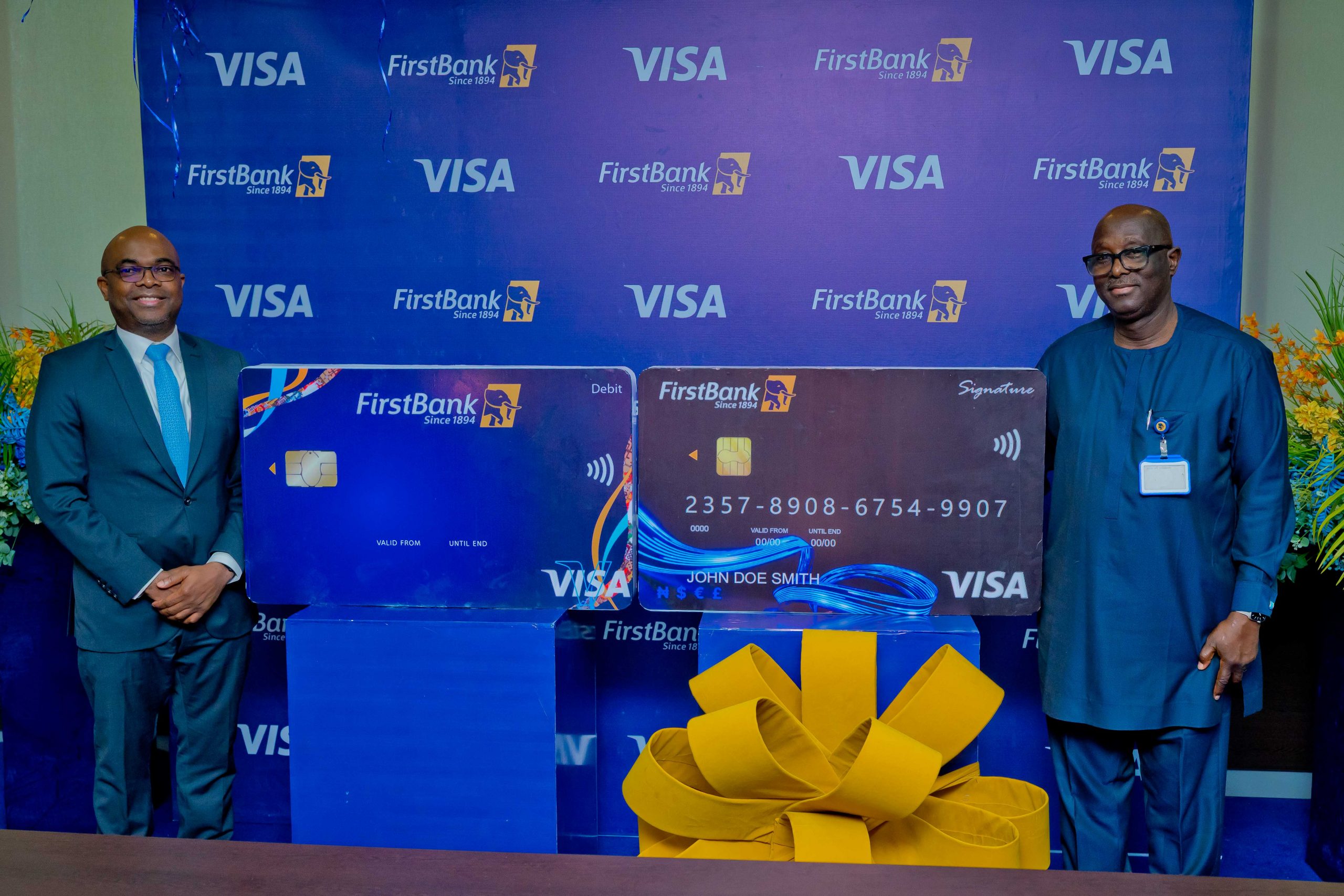
FirstBank, Visa Expand Premium Card Portfolio with Visa Signature Launch
Designed for Nigeria’s affluent segment, Visa Signature unlocks world-class benefits through Visa’s global network across travel, lifestyle, and premium merchant offers.
Lagos, Nigeria – May 15, 2026 – First Bank of Nigeria Limited, in partnership with Visa, has announced the launch of Visa Signature, a premium card offering designed for Nigeria’s affluent segment. The card unlocks an exclusive portfolio of lifestyle benefits, global travel privileges, and curated merchant offers through Visa’s worldwide acceptance network, giving high-spending Nigerians a product built around how they live.
Visa Signature targets Nigeria’s top executives, business owners, and frequent international travelers who expect more from their financial products. Through Visa Global benefits and Visa Destination offers, cardholders gain access to preferential rates, premium experiences, and priority services across hundreds of partner merchants, hotels, airlines, and destinations around the world. The card supports both domestic and cross-border transactions, ensuring seamless payment experiences whether cardholders are in Lagos, London, or Dubai.
Commenting on FirstBank’s ambition for its premium cardholders, Chuma Ezirim, Group Executive, eBusiness & Retail Products, FirstBank, said: “At FirstBank, we are dedicated to creating financial solutions that reflect the evolving lifestyles of our customers. We understand that our premium customers aspire to experiences that reflect their global outlook. Visa Signature is crafted to meet those expectations, offering access to exclusive experiences, global connectivity, and lifestyle privileges that empower our customers to live without boundaries. We remain focused on creating value and reinforcing our position as the partner of first choice for Nigerians at home and abroad.”
Highlighting the strategic importance of the FirstBank partnership, Andrew Uaboi, Vice President and Cluster Head, West Africa, Visa, noted: “Nigeria’s affluent consumers are among the most active and globally connected spenders on the continent. Visa Signature is designed to serve that profile with the depth of benefits and the breadth of acceptance they deserve. We are delighted to work with FirstBank in making this available to the Nigerian market.”
The launch marks a strategic step for FirstBank in deepening its premium product offering. FirstBank’s existing Visa portfolio already serves millions of Nigerians across everyday retail, cross-border commerce, and online transactions through Visa Infinite, Visa Gold, Naira Credit, and Visa Prepaid cards. Visa Signature adds a dedicated tier for the affluent segment, giving this customer group the recognition and privileges their spending profile demands.
Visa Signature is available to eligible FirstBank customers. Interested customers can visit any FirstBank branch nationwide or contact their dedicated relationship manager to apply.

Visa (NYSE: V) is a world leader in digital payments, facilitating transactions between consumers, merchants, financial institutions, and government enti

Tony Elumelu at Africa Forward Summit: “Our Youth Do Not Need Handouts”
Heirs Holdings Founder tells Presidents Ruto and Macron that Africa wants partners of substance, based on equality, and that power and infrastructure must come first.
At the 2026 Africa Forward Summit, convened by Kenyan President H.E. William Ruto and French President H.E. Emmanuel Macron, Heirs Holdings Founder and Group Chair, Tony O. Elumelu, CFR, delivered a direct message to a room of heads of state, investors, and global business leaders: Africa is open for partnership, not patronage.
“We welcome true partnership — partnerships of substance and based on equity — where Africans and African solutions catalyse Africa’s future”, he remarked.
Elumelu argued that Africa’s transformation hinges on two foundational investments — electricity and infrastructure — and that private capital must do the heavy lifting.
“The private sector is what will help us mobilise capital to drive investment in infrastructure, investment in electricity. These are two critical requirements for the economic prosperity and development of Africa,” he said. “If we create the right operating environment, we will create jobs for our people. We will alleviate poverty and deliver growth and prosperity.”
With more than 65 percent of Africans under 35, Elumelu pushed back hard against the traditional language of aid.
aid.
“In Africa, we have a young population. There is no room for victim mentality. Our youth do not need handouts; they need jobs, they need improved access to electricity, they need to join the internet. What is important is providing this enablement, this infrastructure requirement, so that our young ones can realise their potential.”
His Tony Elumelu Foundation (TEF) has now provided access to training for 2.5 million young Africans and funded over 27,000 entrepreneurs across all 54 African countries — the continent’s largest entrepreneurship platform.
Elumelu signalled openness to every credible partner, regardless of geography.
“It is a good place to be at, as Africans, now. We should embrace those who want to help us catalyse growth in Africa. And let us not forget Africa is the fastest growing region globally – and it is not just demographics” he said.
“In the 21st century, the mindset must change. It should be a mindset that embraces economic prosperity and development, a mindset that creates the environment that will help us alleviate poverty in Africa, create jobs for our young people.”
Tony Elumelu’s participation at the summit aligns with Heirs Holdings’ broader commitment to driving long-term African development through strategic investments across sectors critical to economic transformation, including power, financial services, healthcare, hospitality, and technology.
The 2026 Africa Forward Summit concluded with renewed calls for deeper collaboration between governments, development institutions, and the private sector, as leaders exploredaid.
“In Africa, we have a young population. There is no room for victim mentality. Our youth do not need handouts; they need jobs, they need improved access to electricity, they need to join the internet. What is important is providing this enablement, this infrastructure requirement, so that our young ones can realise their potential.”
His Tony Elumelu Foundation (TEF) has now provided access to training for 2.5 million young Africans and funded over 27,000 entrepreneurs across all 546 African countries — the continent’s largest entrepreneurship platform.
Elumelu signalled openness to every credible partner, regardless of geography.
“It is a good place to be at, as Africans, now. We should embrace those who want to help us catalyse growth in Africa. And let us not forget Africa is the fastest growing region globally – and it is not just demographics” he said.
“In the 21st century, the mindset must change. It should be a mindset that embraces economic prosperity and development, a mindset that creates the environment that will help us alleviate poverty in Africa, create jobs for our young people.”
Tony Elumelu’s participation at the summit aligns with Heirs Holdings’ broader commitment to driving long-term African development through strategic investments across sectors critical to economic transformation, including power, financial services, healthcare, hospitality, and technology.
The 2026 Africa Forward Summit concluded with renewed calls for deeper collaboration between governments, development institutions, and the private sector, as leaders explored pathways to accelerate inclusive growth and strengthen Africa’s position within the global economy.


- Powerful call for dialogue and compromise to secure peace in South Sudan issued on International Peacekeepers Day May 30, 2026
- Over 1,000 Participants Join Rwenzori Marathon Activation Run in Mombasa May 30, 2026
- World Health Organization (WHO) actively participated in the 2nd Summit on Healthcare Integration in Portuguese-speaking countries May 30, 2026
- Annual Meetings (AM) 2026: “Africa has what It takes” - Experts call for stronger financial systems to help Africa mobilise capital at scale May 30, 2026
- Eritrea Participates at Organization of African, Caribbean and Pacific States Meetings May 30, 2026
- Annual Meetings 2026 (AM2026): African Development Bank Group’s 2025 Annual Report Highlights Strong Results and a New Chapter for Africa’s Transformation May 29, 2026
- Eritrea: Progress of National Animal and Plant Health Laboratory May 29, 2026
- Invest Africa, the Mayor of London and FirstBank United Kingdom (UK) to Host Joint Closing Reception as part of The Africa Debate 2026 May 29, 2026
- Merck Foundation Chief Executive Officer (CEO) Dr. Rasha Kelej met Gabon First Lady to discuss the strategy to continue their joint programs to build healthcare capacity and support girl education May 29, 2026
- ‘Crude Oil: Power, Turnaround and Transformation in Angola’ Debuts as Top 3 Amazon New Release May 29, 2026
- Powerful call for dialogue and compromise to secure peace in South Sudan issued on International Peacekeepers Day May 30, 2026
- Over 1,000 Participants Join Rwenzori Marathon Activation Run in Mombasa May 30, 2026
- World Health Organization (WHO) actively participated in the 2nd Summit on Healthcare Integration in Portuguese-speaking countries May 30, 2026
- Annual Meetings (AM) 2026: “Africa has what It takes” - Experts call for stronger financial systems to help Africa mobilise capital at scale May 30, 2026
- Eritrea Participates at Organization of African, Caribbean and Pacific States Meetings May 30, 2026
- Annual Meetings 2026 (AM2026): African Development Bank Group’s 2025 Annual Report Highlights Strong Results and a New Chapter for Africa’s Transformation May 29, 2026
- Eritrea: Progress of National Animal and Plant Health Laboratory May 29, 2026
-

 news6 months ago
WHO REALLY OWNS MONIEPOINT? The $290 Million Deal That Sold Nigeria’s Top Fintech to Foreign Interests
-

 society4 weeks ago
SOCIAL MEDIA IS NOT A BATTLEFIELD COMMAND – WHY THE NIGERIAN ARMY’S ACTION AGAINST JUSTICE CRACK IS A NATIONAL SECURITY IMPERATIVE
-

 celebrity radar - gossips4 months ago
Dr. Chris Okafor Returns with Power and Fire of the Spirit -Mounts Grace Nation Altar with Fresh Anointing and Restoration Grace on February 1, 2026
-

 celebrity radar - gossips6 months ago
Prophet Kingsley Aitafo Releases 2026 Prophecy: ‘Nigeria Will Rise, but the World Must Prepare for Turbulence’