
Bank
FIRSTBANK POWERS NIGERIA’S DIGITAL LENDING CHARGE WITH FIRSTCREDIT

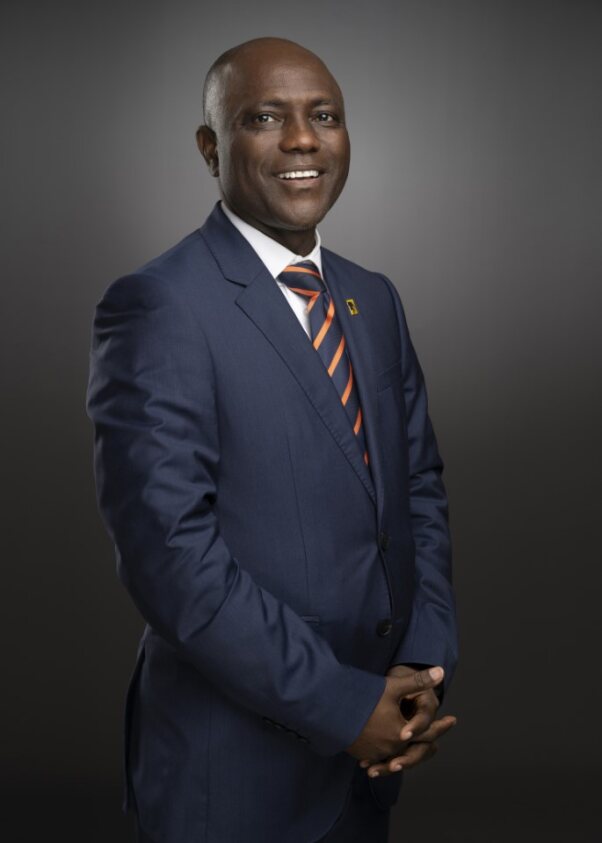
FIRSTBANK POWERS NIGERIA’S DIGITAL LENDING CHARGE WITH FIRSTCREDIT
In the fast-evolving world of digital banking, Nigeria stands on the brink of a financial revolution. As the global pandemic has accelerated digitalization, the need for accessible, efficient, and reliable financial services has never been more crucial. FirstCredit by FirstBank emerges as a groundbreaking digital lending solution designed to meet the demands of Nigerians where the need for quick cash is ticking ever northward.
The shift towards digital banking in Nigeria has been both rapid and transformative. With the increasing penetration of mobile phones and internet access, more Nigerians are embracing digital solutions for their financial needs. This trend has been further amplified by the COVID-19 pandemic, which necessitated minimal physical contact and prompted a surge in digital transactions.
Digital banking offers numerous advantages, including convenience, speed, and accessibility. For many Nigerians, especially those in remote areas, digital banking services have provided unprecedented access to financial tools and resources. However, despite these advancements, a significant gap remains in the availability of quick and hassle-free credit facilities. This is where FirstCredit steps in.
In a country where traditional lending processes are often bogged down by paperwork, collateral requirements, and lengthy approval times, FirstCredit emerges as a beacon of innovation. It addresses several critical needs, including:
Accessibility: Many Nigerians still lack access to traditional banking services. FirstCredit bridges this gap by offering loans that can be accessed from anywhere, anytime, using a mobile phone or tablet. There is no need to visit a bank, making it an ideal solution for those in remote or underserved areas. You do not need a smartphone to access FirstBank’s FirstCredit.
Speed: In a fast-paced economy, waiting weeks for loan approval is not feasible for many individuals and businesses. FirstCredit ensures that loan applications are processed swiftly, with funds disbursed immediately upon approval. This quick turnaround is crucial for addressing urgent financial needs.
Simplicity: Traditional loans often require extensive documentation and collateral, which can be a barrier for many. FirstCredit simplifies the process by eliminating these requirements. All that is needed is an active mobile number registered for USSD banking and a history of regular account transactions with FirstBank.
Flexibility: With a maximum loan amount of N300,000 and a flexible repayment tenor of up to 30 days, FirstCredit offers terms that are adaptable to the borrower’s needs. The flat interest rate of 8% and a 5% insurance fee per transaction are straightforward and transparent, ensuring borrowers are fully aware of the costs involved.
Features of FirstCredit
First Credit is designed with user convenience and financial inclusivity at its core. Here are some of its standout features:
Easy Access via USSD: Customers can apply for loans by simply dialing *894# and following a few straightforward steps. This USSD code is accessible on any mobile device, ensuring that even those without smartphones can benefit from the service.
No Documentation or Collateral: The absence of cumbersome paperwork and collateral requirements makes the application process smooth and accessible.
Immediate Disbursement: Once approved, the loan amount is credited to the borrower’s account immediately, providing instant financial relief.
Flexible Repayment: Borrowers have the option to repay the loan before the 30-day tenor, allowing for flexibility based on their financial situation.
Eligibility Criteria: To qualify, customers must have been in a relationship with FirstBank for at least six months, have a valid BVN, a good credit history, and use the mobile number registered for USSD banking. Regular account transactions further enhance eligibility.
The introduction of FirstCredit marks a significant milestone in Nigeria’s digital banking journey. As digital lending becomes more embedded in the financial ecosystem, it promises to unlock new opportunities for individuals and businesses alike.
For FirstBank, the move towards digital lending is not just a strategy for retaining market share but also a means to drive business growth and profitability. By leveraging technology, banks can offer personalized, efficient, and scalable financial services that meet the evolving needs of their customers, which FirstBank has leveraged on.
Moreover, the broader adoption of digital lending solutions like FirstCredit can have a transformative impact on Nigeria’s economy. It can empower small businesses with the capital they need to grow, support individuals in financial need, and foster a more inclusive economic environment.
FirstCredit is more than just a lending product; it is a visionary step towards a future where financial services are democratized and accessible to all Nigerians. As digital banking continues to evolve, solutions like FirstCredit will play a pivotal role in shaping Nigeria’s more inclusive and dynamic financial landscape.
Qualitative indicators suggest that FirstCredit has successfully addressed key financial needs in Nigeria. It’s design, focusing on accessibility, speed, and simplicity, aligns well with the demands of the Nigerian market. Continued success can be inferred from its widespread adoption and the broader positive trends in digital lending within the country. And Nigerians can trust that with FirstCredit, there is no ‘wayo’ because it is powered by West Africa premier financial institution and financial inclusion services provider, FirstBank.
Culled from NairaMetrics





ZENITH BANK OPENS MANCHESTER BRANCH TO SUPPORT CROSS-BORDER TRADE AND INVESTMENT
Zenith Bank Plc has announced the opening of a new branch in Manchester, United Kingdom, marking another significant milestone in the bank’s international growth and its commitment to strengthening financial connections between Africa and global markets.
The official opening ceremony, scheduled to hold on Tuesday, March 17, 2026, is expected to attract government officials from Nigeria and the United Kingdom, regulators, investors, customers, and business leaders from both countries, underscoring the growing economic ties and investment opportunities between the two markets.
The new Manchester branch will complement Zenith Bank’s existing operations in the United Kingdom and serve as a strategic hub for supporting businesses engaged in international trade and investment. Through the branch, the bank will provide corporate banking, trade finance, treasury and related financial services to clients operating across the United Kingdom, Europe and Africa.Speaking ahead of the launch, the Group Managing Director/Chief Executive Officer of Zenith Bank Plc, Dame Dr. Adaora Umeoji, OON, said: “The opening of our Manchester branch represents another important step in Zenith Bank’s growth as a leading African financial institution connecting businesses and markets across continents. Manchester is one of the United Kingdom’s most dynamic commercial centres, and our presence here will further strengthen financial connections between businesses in the UK and opportunities across Africa’s rapidly expanding markets.
”Founded in 1990 by its Founder and Chairman, Jim Ovia, CFR, Zenith Bank has grown into one of Africa’s most respected banking institutions, boasting a robust capital base and a remarkable history of year-on-year profitability. Built on a strong foundation of people, technology and service, the Bank has consistently delivered innovative financial solutions while maintaining a disciplined approach to growth and risk management. The impressive performance of the Bank has consistently earned it excellent ratings, recognition and endorsement from local and international agencies and institutions.Headquartered in Lagos, Nigeria, Zenith Bank operates over 500 branches and business offices across the 36 States of the Federation and the Federal Capital Territory (FCT). The Bank currently operates subsidiaries in several African countries including Ghana, Sierra Leone, Gambia, and Cote d’Ivoire, while maintaining a presence in major international financial centres including the United Kingdom, France, UAE and China.
In recent years, Zenith Bank has continued to expand its international network as part of its strategy to support global trade and investment flows involving Africa.Manchester, widely regarded as one of the United Kingdom’s most vibrant economic centres, hosts a diverse base of businesses across sectors such as manufacturing, engineering, logistics, technology and consumer goods. The city’s strong commercial ecosystem and international outlook align closely with Zenith Bank’s expertise in corporate banking, structured finance and trade finance.The Manchester branch will work closely with the Bank’s London operations and its broader international network to support clients seeking to expand across markets and unlock new opportunities in both the United Kingdom and Africa.
With the opening of the Manchester branch, Zenith Bank continues to advance its vision of building a truly global African banking institution that connects businesses, facilitates trade and investment, and creates stronger economic bridges between Africa and the world.
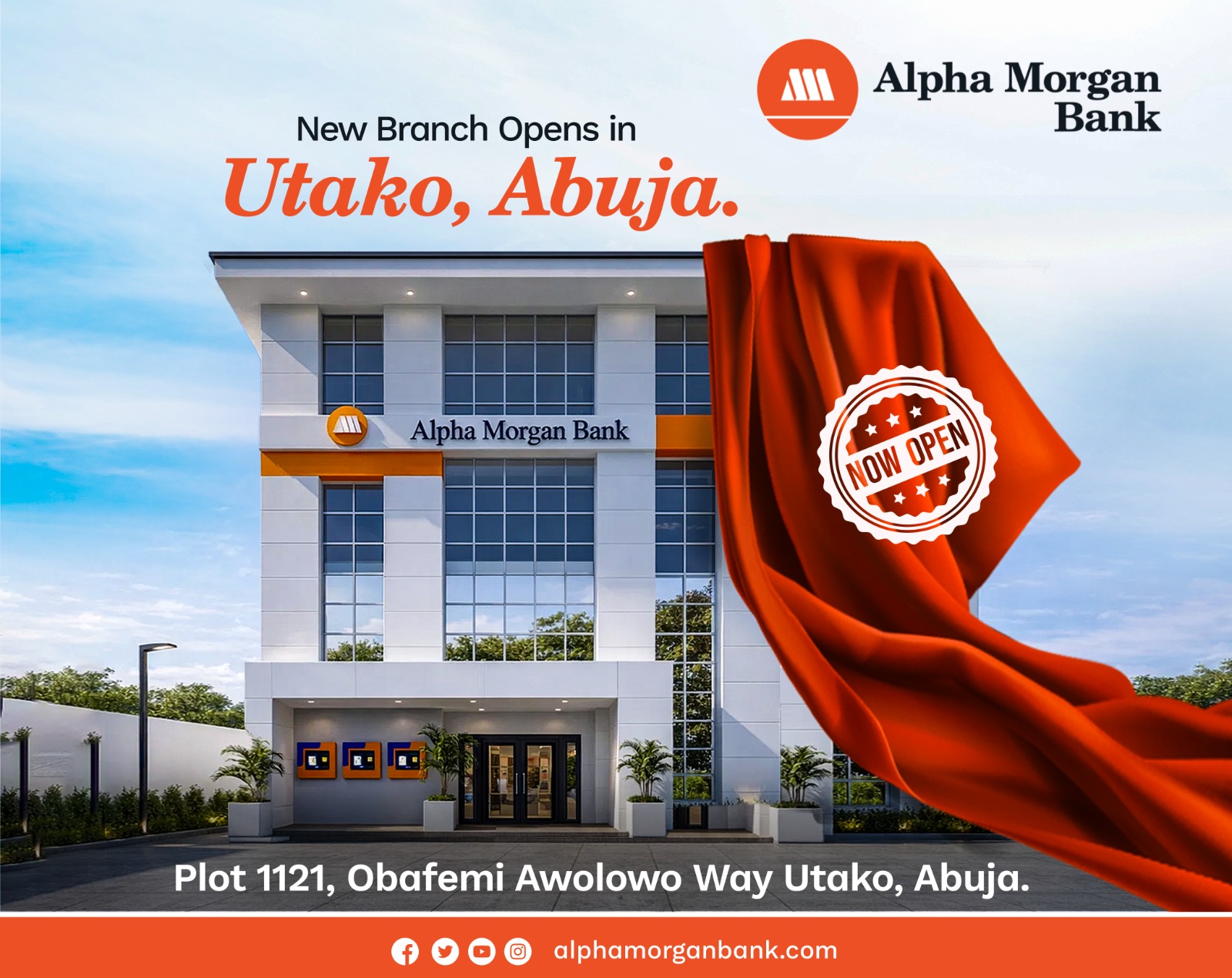
Alpha Morgan Bank Deepens Presence in Abuja with New Branch in Utako
Marking another milestone in its expansion drive, Alpha Morgan Bank has opened a new branch in Utako, Abuja, reinforcing its strategy of building closer institutional ties within key business communities and bringing its financial expertise closer to individuals, and enterprises driving the city’s growth.
The new branch, located at Plot 1121 Obafemi Awolowo Way, Utako, Abuja is strategically positioned to serve individuals, entrepreneurs, and corporate clients within Utako and surrounding districts.
The expansion follows the Bank’s recently concluded Economic Review Webinar held in February 2026, as the bank continues to position as a thought-leader in the financial services industry.
Speaking on the opening, Ade Buraimo, Managing Director of Alpha Morgan Bank, said the move underscores the Bank’s commitment to accessibility and service excellence.
“Proximity matters in banking. As communities grow and commercial activity expands, financial institutions also evolve to meet customers where they are. The Utako Branch allows us to deliver our services to people in that community efficiently while maintaining the high standards our customers expect,”
The Utako location will provide a full suite of retail and corporate banking services, including account opening, deposits, transfers, business banking solutions, and financial advisory support.
Customers and members of the public are invited to visit the new Utako Branch to experience the Bank’s approach to satisfying banking.
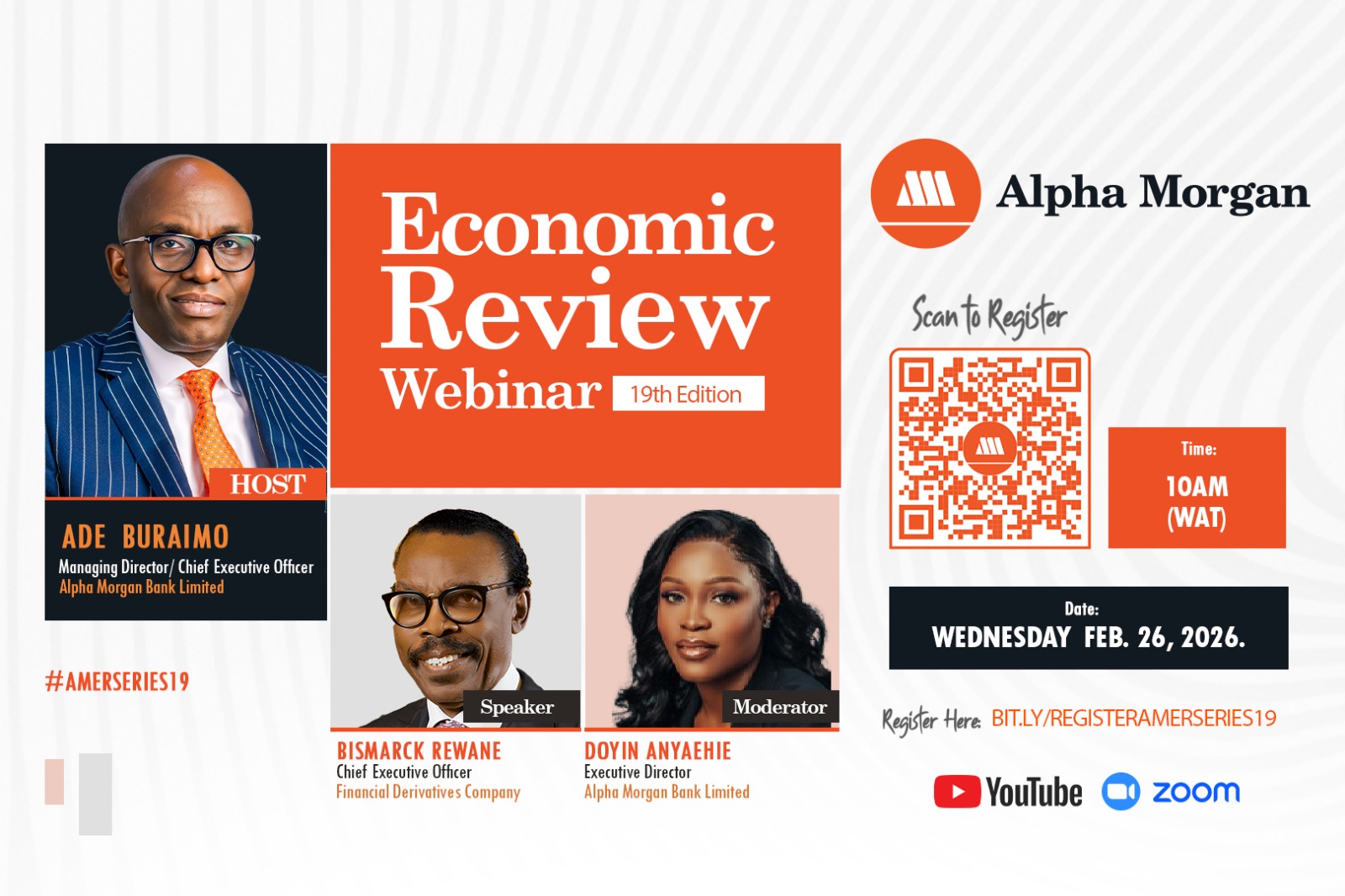
Alpha Morgan to Host 19th Economic Review Webinar
In an economy shaped by constant shifts, the edge often belongs to those with the right information.
On Wednesday, February 25, 2026, Alpha Morgan Bank will host the 19th edition of its Economic Review Webinar, a high-level thought leadership session designed to equip businesses, investors, and individuals with timely financial and economic insight.
The session, which will hold live on Zoom at 10:00am WAT and will feature economist Bismarck Rewane, who will examine the key signals influencing Nigeria’s economic direction in 2026, including policy trends, market movements, and global developments shaping the local landscape.
With a consistent track record of delivering clarity in uncertain times, the Alpha Morgan Economic Review continues to provide practical context for decision-making in a dynamic environment.
Registration for the 19th Alpha Morgan Economic Review is free and can be completed via https://bit.ly/registeramerseries19
It is a bi-monthly platform that is open to the public and is held virtually.
Visit www.alphamorganbank to know more.


-

 society6 months ago
Religion: Africa’s Oldest Weapon of Enslavement and the Forgotten Truth
-

 news4 months ago
WHO REALLY OWNS MONIEPOINT? The $290 Million Deal That Sold Nigeria’s Top Fintech to Foreign Interests
-

 society6 months ago
“You Are Never Without Help” – Pastor Gebhardt Berndt Inspires Hope Through Empower Church (Video)
-

 celebrity radar - gossips2 months ago
Dr. Chris Okafor Returns with Power and Fire of the Spirit -Mounts Grace Nation Altar with Fresh Anointing and Restoration Grace on February 1, 2026