
Uncategorized
Tukur Buratai: General Extraordinaire By Bukar Usman

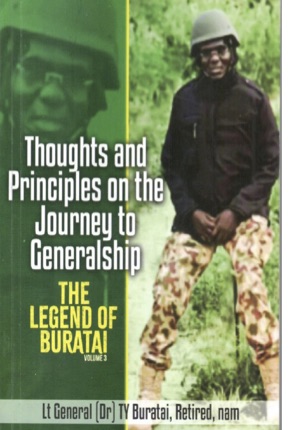
Tukur Buratai: General Extraordinaire
By Bukar Usman
The Legend of Buratai Vol. 3, Sprezzatura, Abuja, 2022; Amb. Tukur Yusufu Buratai, pp. 238
This volume of Legend of Buratai which has 9 chapters and is 238 pages long was published in 2022. It was preceded by two volumes. However, it was observed that the previous volumes did not quite discuss Lt General Tukur Yusufu Buratai’s (Gen Buratai) military career and the basis of his successes. Although Gen Buratai had planned to discuss his military career in his memoir, he yielded to the desires of his readers and devoted volume 3 to a narrative of the thoughts and principles that guided him on his way to generalship. And so very early in the book Gen Buratai declared that: “In my attempt to take a critical look at generalship and the road to that exalted circle in the military, I shall expound my understanding of what is leadership, types of leadership and the best leadership style that has worked for me, leadership and generalship, steps or things I did that helped me on the road to generalship, and pitfalls to avoid on the road. This is a recollection of my personal experience from the field and also theories I learned in the class” (p.6).

In effect, Gen Buratai’s military career began in his boyhood days. According to him, he was a born soldier. His father was a World War II veteran and soldiering was his first choice as a profession even though it was providence that got him enlisted into the Nigerian Army.
A friend of his at the Teachers College Potiskum that he also attended had intimated to him of an ongoing recruitment exercise into the Nigerian Defence Academy (NDA). He quickly applied, sat for the examination, passed, received his father’s blessings, and got enlisted into the Nigerian Army as a cadet in 1981. There, began his military career in earnest although his Indian teacher at the Teachers College Potiskum had noticed something extraordinary in his personality even at that youthful age as he kept referring to him in the class as a ‘great man’ (p.18).
As the narration goes, Gen Buratai outlined in detail step-by-step the process of his rise to generalship with the sole purpose of guiding his fellow cadets and junior officers on what to do for those of them who aspire from their lowly positions to be generals and even to a higher opportunity of the rank of a 3-star general that he proudly attained and served for 66months as Chief of Army Staff before he bowed out of service after 41years of military career.
Gen Buratai went on to further explain the purpose of writing this volume thus: “It is not an easy feat to rise to the level of a three-star general and Chief of Army Staff in Nigeria. There are principles and disciplines that I developed and learned from others that helped me to succeed in the Army. It will be a great disservice to humanity to keep them to myself and not to share (it) with those coming up; those who want work hard and smartly to succeed in the military” (p.30).
In his prescriptions on the road to generalship, Gen Buratai laid emphasis on personal development as being very critical to any cadet or junior officer, male or female, who wants to become a military leader, more so, in the mold of general, adding that: “…the best thing to do for any officer on the road to generalship is to be a good follower, imbibe the principles of diligence, loyalty, and excellence in all ramifications of one’s life. If you want to succeed as an officer and become a military leader, you must perform better in order to stand out from the crowd. Why? It is because good performance begets more and better opportunities” (p.31).
As a demonstration of his personal development, Gen Buratai recanted how after qualification as a teacher and graduation from NDA, he proceeded to acquire his first Degree in History at the University of Maiduguri and a Master of Philosophy in Security Studies from the Bangladesh University of Professionals. These are in addition to subsequent professional courses he went through as a military officer. In all modesty, Gen Buratai stated that in all this, he performed excellently well. It is on that account that he emphasized the benefit of education and reading which he said allow one to learn from the experiences of people one never met and who were widely reputed to be successful as military officers and as civilians in other professions in Nigeria and other countries. Gen Buratai said: “What usually distinguishes leaders from their peers and their followers is personal development for when others are busy partying and sleeping, the prospective leader is busy burning the midnight oil, reading voraciously, drinking from the fountain of wisdom and knowledge like a thirsty camel in the desert’’ (p.95), stressing that “…reading is to the mind what exercise is to the body” (p.98).
One should read widely and in-depth, digest or process what one has read, reflect, and make a concerted effort to put into practice what one has read, he further advised.
The rest of the book and more especially Chapter 7, pp. 103 -154, are devoted to discussions on leadership principles and citing numerous personalities worldwide who were successful based on critical success factors that include and most importantly the virtues of trust, honesty, influence, communication skill, loyalty, selflessness, diligence, determination, confidence, ambition, commitment, physical fitness, physical appearance, the spirit of camaraderie, optimism, alertness, personal character, professional capacity, the art of moderation, acquisition of multilingualism skills, style of leadership, leading by example, winning mentality, prayers, and avoidance of pitfalls encountered by others. Gen Buratai cited numerous personal and other examples backed by several quotations on the leadership of people who had been exceptionally successful in and out of this country and going back into history to include pronouncements by notable contemporary leaders and ancient philosophers of the likes of Confucious (551-479) and a famous military strategist Alexander the Great (356-324 BC).
It is noteworthy that to underline the importance of self-discipline Gen Buratai, quoting Plato, stated that: “… For a man to conquer himself is the first and noblest of victories” adding that “…the military officer needs to be disciplined in all ramifications of his life, the way he dresses, eats, periods of sleep, talks, walks, and relates with superiors and subordinates.
There is no way a military officer can rise to generalship without personal discipline” (p.118).
It is equally noteworthy that Gen Buratai being a qualified teacher, rendered the entire narration of the book in a style of an instructor addressing his students which in this case are military cadets and junior officers. It is also a credit to him that unlike books written by former fellow military officers, there is not much of the use of military terminologies which sometimes make it difficult for the non-military reader to understand. His was written in simple English all through.
There is no doubt that not only military officers but anyone else who reads the book stands to benefit immensely from the emphasis on self-discipline in everything one does as well as the imperatives and gains of persistence in the development of the body and mind.
Lieutenant General Tukur Yusufu Buratai who hails from Buratai Town in Biu Local Government of Borno State, North Eastern Nigeria, was born on November 24, 1960. He enlisted in the Nigerian Army in 1981 and retired in 2021. Post-military service, he served as Nigeria’s Ambassador to the Benin Republic, 2021-2022.
Bukar Usman is the former permanent secretary in the presidency, Abuja.
https://sunnewsonline.com/tukur-buratai-general-extraordinaire/





FOPCHEN Calls for Dialogue as Court Fixes May 28 for Continuation
OTA, OGUN STATE — Proceedings in a widely followed legal case resumed on March 24, 2026, at the High Court of Ogun State, Ota Division, ending with a fresh adjournment as the court fixed May 28, 2026, for continuation.
During the session, legal representatives for all parties restated their positions and addressed preliminary matters, laying the groundwork for more substantive arguments at the next hearing. Observers noted that the case continues to attract significant public attention due to its perceived implications for law, culture, and societal values.
The Foundation for the Protection of Cultural Heritage in Nigeria (FOPCHEN) used the occasion to reiterate its call for constructive national dialogue. The group emphasized that while the judicial process must be respected, broader societal engagement remains essential.
According to the organization, issues relating to values, responsibility, and cultural identity should not be confined solely to courtroom deliberations but should involve active participation from various sectors of society.
Legal analysts present at the proceedings described the matter as one with far-reaching implications, noting that arguments advanced in court could shape future interpretations surrounding sensitive cultural and moral questions.
The presiding judge subsequently adjourned the case to May 28, granting all parties time to refine their submissions and respond to issues raised during the hearing.
As anticipation builds ahead of the next court date, Nigerians across different sectors continue to monitor developments closely, keen to see how the judiciary navigates the delicate balance between constitutional rights and cultural expectations.
Uncategorized
CRG: Politicians Must Stop Witch-Hunting, Focus on Nation Building — Says NYSC Cleared Deputy Speaker Since 2023

CRG: Politicians Must Stop Witch-Hunting, Focus on Nation Building — Says NYSC Cleared Deputy Speaker Since 2023
By: Boye Ola
The Centre for Responsible Governance (CRG) has called on political actors and interest groups to desist from what it described as needless witch-hunting of the Deputy Speaker of the House of Representatives, Benjamin Okezie Kalu, following renewed controversies surrounding his National Youth Service Corps records.
The organisation noted that the clarification by the National Youth Service Corps (NYSC) regarding the matter is not a recent development, as a formal verification letter had already been issued as far back as May 23, 2023.
The letter, referenced NYSC/CCD/VER/10/5.1/VOL1/02, had already addressed and cleared the questions surrounding the Deputy Speaker’s NYSC records.
Reacting to the renewed debate, the spokesman of the Centre,
Obande George, said it was troubling that issues which had already been clarified by a competent national institution were being resurrected for political purposes.
According to him, the time has come for political actors to move away from destructive engagements and concentrate on building the nation.
“It is important to note that the NYSC had already issued a verification letter dated May 23, 2023 addressing the matter.
Reopening issues that have already been clarified by a competent authority suggests that some individuals are more interested in political witch-hunting than in national progress,” George said.
The CRG stressed that democracy thrives when institutions are respected and their determinations are accepted in good faith rather than constantly questioned for political advantage.

George also commended the Deputy Speaker for demonstrating maturity and composure throughout the controversy, despite what he described as sustained provocations.
“Honourable Benjamin Kalu has shown remarkable calm and maturity in the face of intense public scrutiny and political provocation.
Instead of engaging in unnecessary public confrontation, he allowed institutions to speak through their records.”
The Centre warned that Nigeria’s political culture must evolve beyond constant character attacks and sensational allegations, which often distract public officials from their responsibilities.
According to the organisation, the country’s development requires constructive engagement among political actors rather than continuous attempts to discredit opponents.
“Nigeria cannot move forward if political energy is constantly spent on digging up allegations and amplifying rumours. Our leaders and political actors must redirect their focus to governance, policy and nation building.”
CRG therefore urged Nigerians to rely on verified information from credible institutions and avoid spreading speculative claims that could damage reputations or destabilise public discourse.
The organisation reiterated that respect for due process and institutional integrity remains essential for strengthening Nigeria’s democracy.

@The Centre for Responsible Governance, Email: [email protected], Instagram: crgngo6, Twitter: crgng06, Threads: crgngo6
Uncategorized
IWD 2026: Ajadi Celebrates Women, Urges Them To Seek More Elective Positions In Future Elections

IWD 2026: Ajadi Celebrates Women, Urges Them To Seek More Elective Positions In Future Elections
A Leading People’s Democratic Party, (PDP) Governorship Aspirant in Oyo State, Ambassador Olufemi Ajadi Oguntoyinbo has felicitates with women in the country on the occasion of this year’s International Women’s Day.
The international Women’s Day is celebrated on 8 March, commemorating women’s fight for equality and liberation along with the women right’s movement. It gives focus to issues such as gender equality and reproductive rights. International Women’s Day originated from labour movements in Europe and North America during the early 20th century.
In a statement issued on Sunday to commemorate this year’s edition of the International Women’s Day, Ajadi said the role of the women in nation building cannot be over emphasised.
He recalled the role played by prominent Nigerian women like Mrs Funmilayo Ransome- Kuti, Margaret Ekpo and Wuraola Esan towards the liberalization and the growth of the country and urges women to follow their footsteps by not only participate in the political process but seek more elective positions.
He urges the political leaders to encourage and give more chances to women for them to contest and occupy elective positions in the country.
Ajadi also called for more respect for women, saying they are definitely behind whatever success recorded by the menfolk.
He said domestic violence against women should be stopped, saying they deserves respect for their role in moulding the future leaders.
According to the statement, “I celebrate and congratulate our women on this year’s occasion of International Women’s Day. We cannot underestimate the role played by our women both at home, in the social circle and in politics. They deserve more respect.
“I equally called on them not only to be a passive participants in politics but to determine to seek more elected positions in future elections. They should aspire more from the position of dancing and singing at campaigns to seek more elective positions. The ratio of men to women in elective positions in the country is embarrassing. Women should stand up and fight for more elective positions.
“I also use the occasion of this year’s Women’s Day to appeal to Nigerians to stop domestic violence against the women. If we treat our women well, our country will witness unprecedented developments”.


-

 society6 months ago
Religion: Africa’s Oldest Weapon of Enslavement and the Forgotten Truth
-

 news4 months ago
WHO REALLY OWNS MONIEPOINT? The $290 Million Deal That Sold Nigeria’s Top Fintech to Foreign Interests
-

 society6 months ago
“You Are Never Without Help” – Pastor Gebhardt Berndt Inspires Hope Through Empower Church (Video)
-

 celebrity radar - gossips2 months ago
Dr. Chris Okafor Returns with Power and Fire of the Spirit -Mounts Grace Nation Altar with Fresh Anointing and Restoration Grace on February 1, 2026