
Politics
2023: CAN THIS NIGERIAN REPUBLIC EVER WORK?

2023: CAN THIS NIGERIAN REPUBLIC EVER WORK?
“If men were angels, no government would be necessary. If angels were to govern men, neither external nor internal controls on government would be necessary. In framing a government which is to be administered by men over men, the great difficulty lies in this: you must first enable the government to control the governed; and in the next place oblige it to control itself”— James Madison, America’s fourth President and Father of Constitution, writing in Federalist No. 51, one of his several essays in the Federalist Papers.

Madison, Alexander Hamilton (America’s first Secretary of the Treasury) and John Jay (America’s first Chief Justice) wrote the Federalist Papers, under the pseudonym, ‘Publius,’ a major contribution to the content of America’s Constitution fully ratified May 29, 1790.
I agree with Madison. Giving the selfishness of humans, government is needed to control the governed, to avoid what 17th century English philosopher, Thomas Hobbes in his masterpiece, “Leviathan” described as (Hobbesian) State of Nature where “… life is solitary, poor, nasty, brutish and short.”
Similarly, I agree with Alexander Hamilton when he wrote in Federalist 10 that: “A firm union will be of the utmost moment to the peace and liberty of the States, as a barrier against domestic faction and insurrection. It is impossible to read the history of the petty republics of Greece and Italy without feeling sensations of horror and disgust at the distractions with which they were continually agitated, and at the rapid succession of revolutions by which they were kept in a state of perpetual vibration between the extremes of tyranny and anarchy…”
Continued Hamilton, “…The science of politics, however, like most other sciences, has received great improvement. The efficacy of various principles is now well understood, which were either not known at all, or imperfectly known to the ancients. The regular distribution of power into distinct departments; the introduction of legislative balances and checks; the institution of courts composed of judges holding their offices during good behavior; the representation of the people in the legislature by deputies of their own election: these are wholly new discoveries, or have made their principal progress towards perfection in modern times. They are means, and powerful means, by which the excellences of republican government may be retained and its imperfections lessened or avoided…”
Many a Nigerians hold this view that politics is a dirty game. But, I argue that politics is not a dirty game, as the science of politics has received great improvement, since the late 1780s.
The great improvement in the science of politics lies in the regular distribution of power into distinct departments; the introduction of legislative balances and checks; the institution of courts composed of judges holding their offices during good behavior; the representation of the people in the legislature by deputies of their own election. So, why is this Nigerian Republic not working? We shall see a handful of reasons in this piece.
In his Thisday opinion piece on September 2, 2020, entitled: “Of Igbos, 2023 and ‘Politics of Moral Consequence,” Bishop of Catholic Diocese of Sokoto, Most Rev. Dr. Matthew Hassan Kukah, decried that: “The quality of men and women at the helm of affairs cannot rescue this country (Nigeria) from its current state of decay and looming decomposition.”
Howbeit, the insightful work of French aristocrat and civil servant, Alexis De Tocqueville, entitled: “Democracy in America and Two Essays on America,” a book that captured his nine-month visit to America with his friend Gustave de Beaumont, in May 1831, make me remain cautiously optimistic about the future of this unworking Nigerian Republic.
Tocqueville in his masterpiece had opined that since 1776, America’s democracy has evolved through popular struggles and movements, that when conflicts arise, they’re solved by the groups in power and the groups that aspire to share power.
Tocqueville in his book, had held that when America’s Articles of Confederation (first grundnorm) became inadequate and defective, all the great men created from the 1765-1783 American Revolutionary War against Britain, were still alive, adding that America’s second constitution which laid her solid foundation (even till date) was drafted “by 55 finest minds, noblest characters that had ever emerged in the New World.”
The James Madisons of this world, Alexander Hamiltons, George Washingtons, Benjamin Franklins, Gouverneur Morriss, Charles Pinckneys, Jonathan Daytons, William Samuel Johnsons, Roger Shermans, John Dickinsons, William Livingstons, Hugh Williamsons, Rufus Kings, Abraham Baldwins, James McHenrys, et al.
Nigeria’s Five Core Problems
For Nigeria, after over 61 years of Independence and 22 years of a so-called representative government, this Nigerian Republic is still not working. Can it ever work?
The core problem with all that is wrong with this Nigerian Republic remains the inability of the ruling political elite to understand:
1. Nigeria’s operational model of government
2. Main purpose of government.
3. Key feature of a legitimate government.
4. Key duties of the branches and tiers of government.
5. How to rotate power at the centre taking into serious cognizance Nigeria’s multi-ethnic, multi-cultural and multi-religious colouration.
1. Government Model
To salvage whatever is left of this Nigerian Republic, there is an urgent need to keep the good models of countries like the United States before our eyes, so that we may get on step by step towards a good Constitution and internal improvement. For context, Nigeria’s Representative Democracy is akin to America’s.
The world over, there is no government model that is perfect. Arguably, me thinks Compound Republicanism/Federalism (Representative Democracy) remains the best bet for Nigeria and Nigerians, particularly, giving today’s socio-political and economic realities.
Before it’s too late, let’s lesson the conspicuous imperfections prevalent in this Nigerian Republic, by operating in practice, not in theory, the tenets of True Representative Democracy. This government model is based on consent of the governed (Nigerian people).
Going forward, all executive representatives at the Federal, States and Local Councils, including legislators at both chambers of the National Assembly, 36 State Assemblies and 774 Local Council Assemblies (Councillors) should be persons legitimately elected by the consent of the majority in peaceful, free, fair and transparent elections.
To achieving this, Nigeria urgently needs:
I. An unbiased census to be conducted every 10 years for political redistricting and economic planning.
II. National Identification Number to legally identify all Nigerian citizens, even at birth, including legal residents.
III. Clean Birth Register to register all births.
IV. Clean Death Register to register all deaths.
V. Clean Electoral Register tied to the NIN of all Nigerians.
VI. An unambiguous Electoral Law to among other things, guarantee electronic voting with paper trail.
2. Purpose Of Government
To avoid the Hobbesian State of Nature, government is necessary to basically secure and protect natural, unalienable rights such as right to Life, Liberty and Pursuit of Happiness.
A government that doesn’t secure these inalienable rights has become illegitimate and must be altered or abolished through the ballots. The 1776 U.S. Declaration of Independence document corroborates this position.
It read in part: “… We hold these truths to be self-evident, that all men are created equal, that they are endowed by their Creator with certain unalienable Rights, that among these are Life, Liberty and the pursuit of Happiness.–That to secure these rights, Governments are instituted among Men, deriving their just powers from the consent of the governed, –That whenever any Form of Government becomes destructive of these ends, it is the Right of the People to alter or to abolish it, and to institute new Government, laying its foundation on such principles and organizing its powers in such form, as to them shall seem most likely to effect their Safety and Happiness…”
3. Key Feature Of A Legitimate Government
In a True Representative Democracy, consent of the governed remains the only key feature of a legitimate government at all tiers (Federal, States and Local Councils). Only through peaceful, free, fair and transparent elections can this consent be given.
Only then can a Social Compact be established where the people make an agreement to accept the creation of that government and abide by the rules it makes.
4. Key Duties Of Branches Of Government
Unitary Executive
I. National Defence: To secure the country and its borders against invasion by foreign enemies. Thus, the executive is the Sword of the nation.
II. Foreign Commerce: Trade facilitation with other countries.
III. Monetary Policies: Formulating sound economic policies to protect the value of country’s legal tender (currency).
IV. Law enforcement of federal crimes to protect the rights of citizens from harm done by fellow citizens taking into full cognizance Equal Protection and Due Process.
V. Operate in States where it has operations. E.g., Postal Services, Immigration Services, Customs Services, etc.
Bi-cameral Legislature
I. House Of Representatives: Ideally, they are the purse of the nation. The President can’t lead Nigeria to war or go on borrowing spree without recourse to the House of Representatives.
II. Senate: This upper legislative chamber is needed for the stability of country. Recall the decision taken by the Senate on Tuesday, February 9, 2010 to empower Vice President Goodluck Jonathan to serve as acting president in order to resolve the constitutional breach by ailing President Musa Yar’Adua for failing to transmit a letter to the National Assembly and hand over to his deputy in line with Section 145 of the 1999 Constitution, since November 23, 2009.
That insightful decision known today as Doctrine of Necessity in Nigeria’s political lexicon brought stability to a nation in the dark as to the whereabouts of their President at the time.
Judiciary
In a True Representative Democracy, an independent Judiciary is indispensable. It’s the duty of the Judiciary to adjudicate and declare unconstitutional, acts of the legislature and executive that run afoul of the supreme laws of the land, without fear or favour.
Key Duties Of The Tiers Of Government
Exclusive Legislative List
Critically examining Nigeria’s 1999 Constitution, you realise that this Nigerian Republic isn’t working because the Federal Government causes major hold-up to good governance by taking up 68 items, most of them unnecessary, in the Exclusive Legislative List.
Concurrent Legislative List
Health, Education, Agriculture, Road, Housing, are the five major items on the Concurrent Legislative List. These areas are where powers are shared jointly by Nigeria’s Federal Government and the 36 State Governments, including FCT Abuja.
Residual Legislative List
Conspicuously showing why this Nigerian Republic isn’t working, one major item the 1999 Constitution guarantees the 774 Local Councils closer to the Nigerian people in the Residual Legislative List is Chieftaincy Matters.
My Position
Among other germane issues, on Item 39 in the Exclusive Legislative List, me thinks, nothing stops Nigeria’s Federal Government from devolving to States where they are found, the control of mines, minerals, including oil fields, oil mining, geological surveys and natural gas. This will give States more Internally Generated Revenue to survive without going caps in hand to Abuja, for monthly handouts.
On Item 45 in the Exclusive Legislative List, me thinks, giving Nigeria’s broken internal security architecture, the Nigeria Police Force should be decentralised. Internal Policing should be the duties of States and Local Councils, as it operates in saner climes such as the United States, United Kingdom, et al.
A Nigeria with 37 Independent State Police, 774 Independent Local Police Departments, with residents and indigenes of the respective States and Local Government Areas, making up the personnels, will be better secured that this current corruption-riddled centralised Police Force.
For space constraint, I will speak to this core issue of power devolution in subsequent pieces.
5. Power Rotation
Me thinks, we should revisit the memoranda of Mkpoko Igbo; Councils of Obas of Lagos, Ogun, Oyo, Osun & Ondo States of Nigeria, Northern Minorities, et al, during Abacha’s Constitutional Conference inaugurated June 27, 1994.
At that conference chaired by the late Justice Adolphus Karibi-Whyte, Mkpoko Igbo, et al, proposed that for Peace, Justice, Equity and Fairnes, office of the Nigerian President should be rotated among the six geo-political zones of South West, South East, South South, North West, North East and North Central.
3 Key Govt Decisions of the 1994/1995 Constitutional Conference:
1. Offices of the President, Vice President, Prime Minister, Deputy Prime Minister, Senate President and House Speaker should be rotated among the 6 geo-political zones. The Independent National Electoral Commission (INEC) will determine how?
2. The Power Sharing arrangement at the Federal level shall be entrenched in Nigeria’s 1998/1999 Constitution.
3. The Power Sharing arrangement shall be applicable for an experimental period of 30 (thirty) years.
Before government made its decision, the conference prescribed a single term of 5 (five) years for the President, arguing that this would encourage each zone to be patient and wait for its turn.
Former President Goodluck Jonathan made same suggestion while in office, but was brutally vilified.
Me thinks, had Nigeria implemented the above recommendations on return to civil rule in 1999, by 2029, all 6 (six) geo-political zones would have produced Nigeria’s President, including Vice President, Senate President and House Speaker.
Today’s bad blood arising from whose turn it is to produce the President would have been lessoned.
WAY FORWARD FOR 2023?
Since 1999, the President has rotated as follows:
South West- 8 years
North West- 11 years (by May 29, 2023)
South South- 5 years
South East- Nil
North East- Nil
North Central- Nil
For an equitable zoning formular by the two major political parties, the ruling All Progressives Congress (APC) and the opposition Peoples Democratic Party (PDP), I make the following suggestion:
South East (President)
North Central (Vice President)
North East (Senate President)
South South (Deputy Senate President)
South West (Speaker)
North West (Deputy Speaker).
Over the last 61 years of our chequered history, we have been talking as a people. Ahead of 2023, I beseech Nigeria’s ruling political elites to allow reason prevail, not passion.
In his masterpiece, “Founding Brothers: The Revolutionary Generation,” Joseph J. Ellis cited that “The survival of republics take realistic recognition of the need for limits, as well as liberation. It requires those at the helm of affairs to make sensible compromises with political power. The survival of any republic resides in the capacity to harness, indeed to consolidate the energies released by various movements for a better republic.”
Ikenna Asomba is a Journalist and student of Compound Republicanism, he writes from Charleston Illinois, United States.




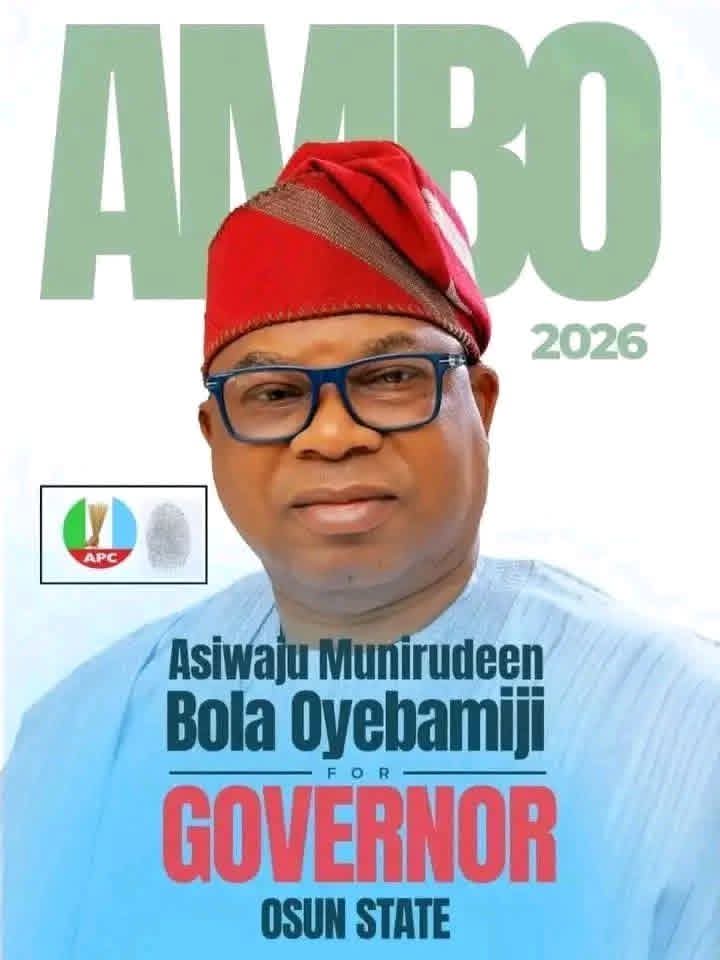
AMBO and the Osun Governorship Race: Assessing the Man, the Politics and the Vision
As political activities gather momentum ahead of the 2026 Osun State governorship election, a public affairs commentator, Oluseyi Olonade, has described the emergence of Asiwaju Munirudeen Bola Oyebamiji, popularly known as AMBO, as a significant development in the state’s political landscape.
In an article titled “Oyebamiji: The Man, The Politics and The Aspiration,” Olonade argued that the All Progressives Congress governorship hopeful possesses the character, experience and vision needed to reposition Osun State for sustainable growth.
According to the writer, Oyebamiji’s appeal stems from his extensive background in the banking sector, where he spent nearly three decades working with institutions including Wema Bank, Trans International Bank, Spring Bank and Enterprise Bank.
A native of Ikire in Irewole Local Government Area, Oyebamiji was described as a technocrat whose experience in corporate governance, finance and risk management has shaped his approach to public administration.
The article noted that his public service journey gained prominence in 2012 when he was appointed to oversee the then Osun State Investment Company Limited. Under his leadership, the organisation was reportedly restructured and transformed into Omoluabi Holdings Limited.
The writer further highlighted Oyebamiji’s tenure as Commissioner for Finance under successive APC administrations, where he was credited with managing the state’s finances during challenging economic periods.
Olonade also referenced Oyebamiji’s appointment as Managing Director of the National Inland Waterways Authority, describing it as further evidence of his administrative and leadership capabilities.
The article contrasted Oyebamiji’s governance philosophy with that of the current administration in Osun State, arguing that the APC aspirant favours institutional reforms, economic diversification and fiscal discipline.

According to the writer, Oyebamiji’s proposed agenda includes strengthening transparency in government spending, expanding internally generated revenue, attracting private-sector investments and promoting industrial and agricultural development.
The article also highlighted youth empowerment, entrepreneurship development and digital skills acquisition as key components of his vision for the state.
Olonade concluded that the forthcoming governorship election would present voters with a choice between different approaches to governance, expressing confidence that Oyebamiji’s experience and developmental agenda make him a strong contender in the race.
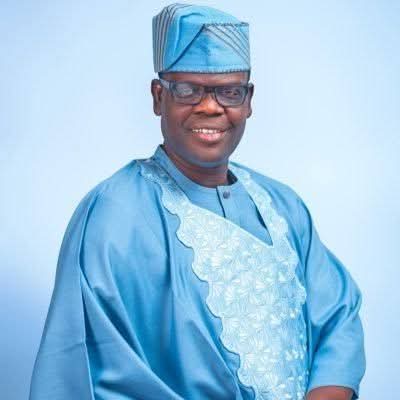
*Oselu Tiwa nTiwa Endorses Oriyomi Hamzat for Oyo Governorship*
A sociopolitical support group in Oyo State, Oselu Tiwa nTiwa, has declared its support for Alhaji Oriyomi Hamzat as the authentic governorship candidate of the Accord Party ahead of the forthcoming governorship election in the state.
The group made its position known in a statement jointly signed by its President, Mr. Adewale Oluwaseyi and Secretary, Alh. Adebayo Oyewole, on Thursday, describing Hamzat as a grassroots figure with strong connection to the people and a track record of humanitarian interventions across Oyo State.

According to the group, the endorsement followed what it described as careful observation of Hamzat’s leadership qualities, compassion and dedication to the welfare of ordinary citizens.
“Oriyomi Hamzat has consistently demonstrated empathy, courage and selfless commitment to humanity. Through his numerous interventions in the lives of ordinary citizens, he has become a symbol of hope to many families and communities,” the statement read.
Oselu Tiwa nTiwa also appealed to the national leadership of the Accord Party to prioritise the long-term future and electoral growth of the party in its decision-making process.
The group noted that Hamzat’s candidacy presents an opportunity for the party to strengthen its grassroots support base and expand its political relevance across Oyo State.
“We respectfully appeal to the National Leadership of the Accord Party to look beyond immediate political calculations and consider the bigger picture, the future growth, stability and electoral success of the party in Oyo State and beyond,” the statement added.
The group further expressed confidence in the leadership of the party, saying it believes the party’s national officers and stakeholders would take decisions that reflect fairness, inclusiveness and the collective interest of members.
While calling on party loyalists to remain calm and united, Oselu Tiwa nTiwa said continued consultations among stakeholders would help strengthen the Accord Party ahead of the election.
Signed:
Alh. Adebayo Oyewole,
Secretary.
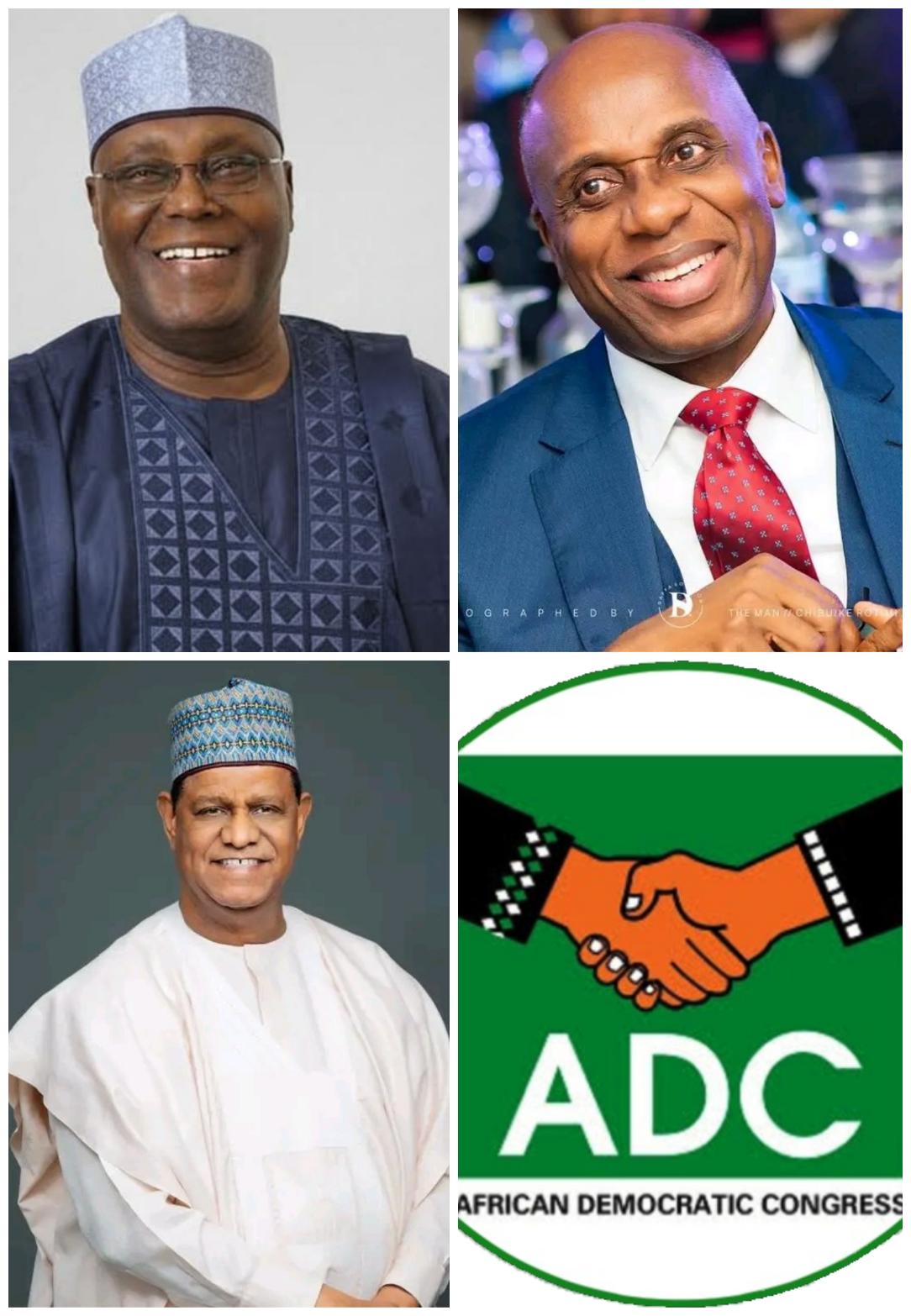
Atiku Set To Clinch ADC Presidential Ticket, Leads Amaechi, Hayatu-Deen In 34 States
Former Vice President of Nigeria and frontline presidential aspirant of the African Democratic Congress (ADC), Atiku Abubakar, is projected to emerge winner of the party’s presidential primaries, according to impeccable sources in Abuja.
The primaries, conducted across over 8,000 wards in the 36 states of the federation and the Federal Capital Territory, reportedly placed Atiku far ahead of his closest rivals — former Rivers State Governor, Rotimi Amaechi, and former Chairman of the Nigerian Economic Summit Group, Mohammed Hayatu-Deen.

Highly placed party insiders disclosed that Atiku is currently leading in 34 states, including the FCT, after securing dominance across the 19 Northern states, the five South-East states, and the six South-West states, while also maintaining a strong showing in at least three states in the South-South geopolitical zone.
The sources added that the outcome reflects what they described as “an overwhelming nationwide acceptance” of the former vice president within the opposition party ahead of the 2027 general election.
Meanwhile, the ADC leadership has invited members of the press to the official announcement of the final collated results scheduled for 11:00 a.m. on Tuesday, May 26, 2026, in Abuja.
The declaration of results is expected to be broadcast live on ARISE Television and two other major television stations, while also being livestreamed on the party’s official social media platforms on X and Facebook.
Speaking ahead of the announcement, the founding National Chairman of the ADC, Chief Ralph Nwosu, said the decision to televise the exercise live was aimed at promoting transparency and democratic accountability.
“We want millions of Nigerians at home and in the Diaspora to witness democracy in action,” Nwosu said.
He further revealed that the party leadership would encourage all three presidential aspirants to publicly embrace a peace accord and commit themselves to working together in unity for the party’s success.
According to him, the move is necessary to strengthen internal cohesion and position the ADC for victory in the presidential election scheduled for January 16, 2027.
Details later.


- Merck Foundation Chief Executive Officer (CEO) Dr. Rasha Kelej together with Kenya First Lady support the education of 47 Kenyan Schoolgirls by providing Annual Scholarships till they Graduate June 2, 2026
- Annual Meetings 2026: Governors Back the Bank’s Platform Solutions to Transform Aviation and Health Systems in Africa June 2, 2026
- ThinkMarkets launches ChelseaAI, bringing live CFD trading into Artificial Intelligence (AI) assistants June 2, 2026
- Afreximbank Invites Rugby Africa President Herbert Mensah to Address the 33rd Annual Meetings on a Panel Exploring Sport as a Driver of African Industrialisation June 2, 2026
- Afreximbank Deepens Commitment to Economic Progress in The Bahamas June 1, 2026
- African Electric Vehicle (EV) platform Spiro raises $215M in equity to scale electric mobility and energy infrastructure across Africa June 1, 2026
- Africa Centres for Disease Control and Prevention (Africa CDC) Statement on Attacks Against Health Facilities During the Bundibugyo Virus Disease Response in the Democratic Republic of the Congo June 1, 2026
- Putting consumers at the centre of Africa’s dairy transformation June 1, 2026
- International Rescue Committee (IRC) warns Democratic Republic of the Congo (DRC) Ebola outbreak likely far larger than official figures suggest June 1, 2026
- South Africa: Portfolio Committee on Health Marks National Cancer Survivor Day and Reaffirms Importance of Early Detection and Public Awareness June 1, 2026
- Merck Foundation Chief Executive Officer (CEO) Dr. Rasha Kelej together with Kenya First Lady support the education of 47 Kenyan Schoolgirls by providing Annual Scholarships till they Graduate June 2, 2026
- Annual Meetings 2026: Governors Back the Bank’s Platform Solutions to Transform Aviation and Health Systems in Africa June 2, 2026
- ThinkMarkets launches ChelseaAI, bringing live CFD trading into Artificial Intelligence (AI) assistants June 2, 2026
- Afreximbank Invites Rugby Africa President Herbert Mensah to Address the 33rd Annual Meetings on a Panel Exploring Sport as a Driver of African Industrialisation June 2, 2026
- Afreximbank Deepens Commitment to Economic Progress in The Bahamas June 1, 2026
- African Electric Vehicle (EV) platform Spiro raises $215M in equity to scale electric mobility and energy infrastructure across Africa June 1, 2026
- Africa Centres for Disease Control and Prevention (Africa CDC) Statement on Attacks Against Health Facilities During the Bundibugyo Virus Disease Response in the Democratic Republic of the Congo June 1, 2026
-

 news6 months ago
WHO REALLY OWNS MONIEPOINT? The $290 Million Deal That Sold Nigeria’s Top Fintech to Foreign Interests
-

 society4 weeks ago
SOCIAL MEDIA IS NOT A BATTLEFIELD COMMAND – WHY THE NIGERIAN ARMY’S ACTION AGAINST JUSTICE CRACK IS A NATIONAL SECURITY IMPERATIVE
-

 celebrity radar - gossips4 months ago
Dr. Chris Okafor Returns with Power and Fire of the Spirit -Mounts Grace Nation Altar with Fresh Anointing and Restoration Grace on February 1, 2026
-

 celebrity radar - gossips6 months ago
Prophet Kingsley Aitafo Releases 2026 Prophecy: ‘Nigeria Will Rise, but the World Must Prepare for Turbulence’