Connect with us

society

Throwback: Primate Ayodele’s Interview With Tribune Newspaper About Nigeria On December 31, 2023

Published

on

Throwback: Primate Ayodele’s Interview With Tribune Newspaper About Nigeria On December 31, 2023
Throwback: Primate Ayodele’s Interview With Tribune Newspaper About Nigeria On December 31, 2023


In this interview, popular seer and spiritual head of Inri Evangelical Spiritual Church, Lagos, Primate Elijah Ayodele speaks on 2024 and what awaits Nigeria and the world.


Throwback: Primate Ayodele’s Interview With Tribune Newspaper About Nigeria On December 31, 2023

The economy

NIGERIANS need to be watchful, prayerful, and constantly appeal to God. The government needs help. If the government refuses to listen to God’s warning, it is bound to get into problems. The Bola Tinubu government is out of line. When I warned that voting for an All Progressive Congress federal government would lead to calamity and storm, many people felt I was talking rubbish. With all the economic formulas that the current government is postulating, it can’t get a correct model that will help the country. The World Bank and the IMF have killed Nigeria’s economy. If President Tinubu continues to listen to them, Nigeria will die. There is still payment of fuel subsidy. Tinubu cannot play with a subsidy. The complete removal of subsidies will result in complete economic trouble. We cannot buy fuel for N100 anymore. They are lies.

I foresee that under the current realities, the cefa will be stronger than the Naira. Also, the dollar will rise to N1400 and this will shake the economy so badly that some forces are hell-bent on frustrating the Tinubu-led Federal government but they will not be successful.

The economy will be fluctuating (rising and falling} to the extent that the Central Bank of Nigeria will cry out. The opposition will take several steps to fight the present government but they will miss their strategies. Government palliative is part of the things that are ruining the economy and has not added anything good to the economic revival. I foresee the Nigerian economy will fluctuate, it will be unstable and inflation rates will rise astronomically. The economic stability will crash down to very low levels even though the Central Bank of Nigeria {CBN} and the federal government will be working to find a way forward. I have not seen anything better, for the future looks gloomy.

Do not play politics with Nigerians. The government must do what is right. Playing politics with Nigeria will destroy the country and the nation will collapse. We must be realistic if we want to balance the nation. Increment in workers’ salaries will not improve things. The Nigeria Labour Congress (NLC) is blindfolded. The President of the NLC is incompetent; he will not be able to achieve anything. He is weak; he is only making political noise. He should stop making noise.

We must stop patronizing the dollar. It is killing our country. There must be a constant power supply; we must use our mineral resources to negotiate. The ministry that is supposed to be feeding Nigeria is the Ministry of Mines. The person who is in charge must work with the CBN governor. We must improve our mechanized farming.

In 2024, the government must reduce the price of food commodities; giving out palliatives is a fraud; it is a scam. There should be food markets in various states for genuine food palliatives. The price of a bag of rice can be reduced to N20,000. We must also improve our road infrastructure. These would make Nigeria better. God still insists that Tinubu is his plan but not his purpose for Nigeria. The cost of living will become unbearable in 2024 if the government refuses to do what is needed. There will be a shortage of water. We are smiling and suffering. Prices in essential commodities will rise.

Insecurity

They cannot end insecurity in 2024. The police and other forces must be equipped. There will be another unguided missile attack that will kill civilians. When this repeats itself, people would insist that it was orchestrated. If there is an adjustment in the war against terror in Nigeria, then it will work. The government must create employment opportunities; this will help in the fight against insecurity. We must also look at the issue of state policing again. If there is food, infrastructure, and electricity, then things will pick up. A cashless policy will destroy Tinubu’s government. We must pray against religious and ethnic war in Nigeria. A prominent African president will escape a bomb attack. Let us pray that Customs officers will not be attacked. The head of the NIS might be changed. Some people will rubbish the efforts of the EFCC chairman. More insecurity in the North. Benue, Plateau, Abuja, Ondo, and Kogi will experience more insecurities.

Politics

If Obaseki doesn’t take it easy, PDP will lose in Edo. If PDP loses, Obaseki will be troubled. Ondo State’s Aiyedatiwa will be frustrated, he cannot rule Ondo State. Tinubu will take over Ondo State. Some five PDP governors will rescue the party. Fubara must not cross to APC. He must remain in PDP; he should not follow Wike. If he does, that will be the end of his political career. He should not fight against Wike. If he fights against Wike, he will not win. The Akwa Ibom state governor too must not cross to APC. If Mbah comes out to contest for the governorship election, he may destroy Soludo. Soludo must prepare himself because the APC is ready to take over the state. If care is not taken, Ganduje and Tinubu will part ways. The relationship between Tinubu and Shettima will be constrained. Some of the President’s allies will fight his wife. He must watch his health properly. Seyi Makinde must not leave PDP; if he does, he will not make it politically again. Gbajabiamila will receive a rude shock.

Nigeria will keep borrowing and it would become so burdensome that we would start to beg for relief. Giving us debt relief is another bondage because there will be conditions. There are three cabals bent on hijacking Tinubu’s government. Buhari and Tinubu will still fight. A prominent leader in Afenifere will pass away. Nigeria will break if there is no restructuring as of 2035. Nnamdi Kanu’s bail will be unconditional and it is not too certain. Samuel Ekpa must be careful so that he will not be arrested.

Infrastructure

There will be problems in the telecommunications industry. G5 has come to stay. The tax on these companies will increase and the burden of this will drive some of them away. The government has plans to establish a telecommunication company. Let us pray that we won’t witness any fire outbreak in any federal secretariat. Let us pray that no governor’s office will be set ablaze. A prominent pastor will die, same with an Islamic scholar. And ex-governor will pass on. Building collapse in Abuja is imminent; there will be a bomb scare in Abuja. I foresee the Nigeria Gas Company will be shut down as there will not be enough gas to meet the energy needs of companies and the Transmission Company of Nigeria. Let us pray so that the facilities of the Transmission Company of Nigeria will not be attacked. I foresee the Ijede Power plant, Egbin Thermal Station, Shiroro Dam, and Kanji Dam will have problems and be shut down. Let us pray so that none of the dams will become dry. I foresee that the Abuja Electricity Distribution Company Kubwa substation and the Apo substation will be shut down.

Global terrorism and insecurity

At the global level, I foresee the emergence of a new set of terrorist organizations different from HAMAS in Gaza, the Kurdistan Workers Party {PKK} in Turkey, Boko Haram in Nigeria, and Al-Shabaab in Somalia. I foresee a network of terror gangs scheming in the year 2024 to cause havoc and also plan evils towards the United States of America, the United Kingdom, the State of Israel, France, Germany, and Turkey to create a breakdown of law and order and a state of insecurity. The spirit of God revealed to me that there will be aborted or failed coups de-tat in some countries. I foresee another terrorist group that is a faction of the PKK in 2024. The Al-Shabaab terror gang, Al-Qaeda, and ISIS criminals will begin to terrorize more countries in Africa and Europe. Europe will begin to witness more frequent acts of terrorism. The spirit of God says another coalition of terrorist groups will emerge in Africa. The band of criminals will work hand in hand with the likes of AL-QAEDA and Boko Haram.

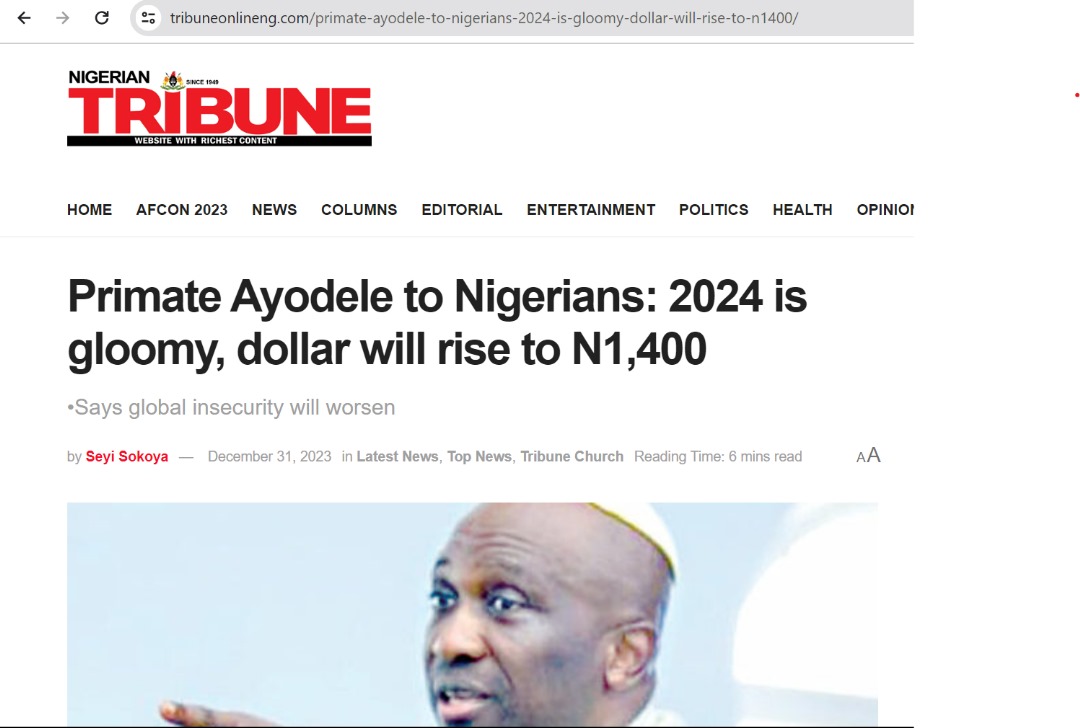
Primate Ayodele to Nigerians: 2024 is gloomy, dollar will rise to N1,400

Politics

Customs at the Crossroads: When Lawmakers Look Away and the Executive Looks Aside

Published

on

Customs at the Crossroads: When Lawmakers Look Away and the Executive Looks Aside

Customs at the Crossroads: When Lawmakers Look Away and the Executive Looks Aside


By Dr. Bolaji O. Akinyemi


In a democracy, legislative oversight is the scalpel that cuts through deceit, inefficiency, and corruption in public institutions. It is the people’s last institutional shield against abuse of power. But what happens when that shield becomes a shelter for the very rot it is meant to expose? And what happens when the Executive arm, whose duty is to supervise its agencies, pretends not to see?


Customs at the Crossroads: When Lawmakers Look Away and the Executive Looks Aside


The unfolding drama between the National Assembly and the Nigeria Customs Service (NCS) reveals more than a policy dispute. It exposes a dangerous triangle of confusion, complicity, and economic sabotage. At stake is not only the rule of law but the survival of an economy already gasping under inflation, a weak naira, and suffocating costs of living.


The House Talks Tough


In June 2025, Nigerians saw a glimpse of legislative courage when the House of Representatives Committee thundered at Customs:

> “Nigerian Customs Service, by June 30, must not collect CISS again. You are to collect only your 4% FOB assigned by the President. Even the 7% cost of collection you currently take is illegal—it was an executive fiat of the military, not democratic law. Any attempt to continue these illegal collections will be challenged in court. The ‘I’s have it.”

The voice was firm, the ruling decisive. Nigerians expected a turning point.

But the righteous thunder of the House was quickly muffled by the Senate’s softer tone, which suggested not the enforcement of the law but a readiness to bend it.


Senate: Oversight or Escape Route?


At a Senate Customs Committee session, Senator Ade Fadahunsi admitted openly that Customs has been operating illegally since June 2023. Yet rather than demand an end to illegality, he extended a lifeline to Comptroller-General Bashir Adeniyi:

> “If we come back to the same source… the two houses will sit together and see to your amendment so you will not be walking on a tight rope.”


But should Adeniyi be handed a loose rope while Nigeria’s economy hangs by a thread?

Instead of accountability, the Senate Customs Committee floated adjustments that would make life easier for Customs. The nation was given hints about fraudulent insurance and freight data, but instead of sanctions, what we saw was a search for escape routes. This is not oversight—it is overlook.


Smuggling and Excuses


The Senate Committee also lamented cross-border smuggling—Nigerian goods like cement flooding Cotonou, Togo, and Ghana at cheaper prices than in Nigeria. Senator Fadahunsi blamed the Central Bank’s 2% value deposit for encouraging the practice.

But where are the Senate’s enforcement actions—compliance checks, stiffer sanctions, cross-border coordination? None. The result is predictable: smugglers prosper, reserves bleed, and ordinary Nigerians pay more for less.


A Bloated Customs Budget


The Service’s 2024 capital allocation ballooned to ₦1.1 trillion from ₦706 billion. Instead of channeling these resources into modern trade systems, Customs is expanding empires of frivolity—such as proposing a new university despite already having training facilities in Gwagwalada and Ikeja that could easily be upgraded.


Oversight is not an afterthought; it is the legislature’s constitutional duty. To see waste and illegality and yet propose amendments that would legalise them is to turn oversight into overlook.


Customs has about 16,000 staff, yet many remain poorly trained. Rather than prioritise capacity building, the Service is busy building staff estates in odd locations. How does Modakeke—an inland town with no border post—end up with massive Customs housing projects, while strategic border towns like Badagry, Idiroko, and Saki remain neglected? Is Bashir Adeniyi Comptroller-General of Customs—or Minister of Housing?


The 4% FOB Levy: A Policy Blunder


The central controversy is the Federal Government’s plan to replace existing port charges with a new 4% Free-On-Board (FOB) levy on imports.

Nigeria is an import-dependent nation. This levy will instantly hike the costs of cars, spare parts, machinery, and raw materials—crippling industries and punishing consumers.

Already, the consequences are biting:

A 2006 Toyota Corolla now costs between ₦6–9 million.

Clearing agents who once paid ₦215,000 for license renewal must now cough out ₦4 million.

New freight forwarder licenses have jumped from ₦600,000 to ₦10 million.

Customs claims the revenue is needed for its modernisation programme, anchored on a software platform called B’Odogwu. But stakeholders describe this so-called “Odogwu” as epileptic—if not comatose. Why commit trillions to a ghost programme that will be obsolete by January 2026, when the Nigerian Revenue Service is set to take over Customs collections?


Industry Raises the Alarm


The Manufacturers Association of Nigeria (MAN) has warned that the levy will worsen inflation, disrupt supply chains, and hurt productivity.

Lucky Amiwero, President of the National Council of Managing Directors of Licensed Customs Agents, calls the levy “economically dangerous.” His reasoning is straightforward:

The 4% FOB levy is much higher than the 1% CISS it replaces.

Peer countries like Ghana maintain just 1%.

The new levy will fuel inflation, raise the landed costs of goods, and destabilise the naira.

He also revealed that the Customs Modernisation Act, which introduced the levy, was passed without Senate scrutiny or meaningful stakeholder consultation. He estimates that the levy could add ₦3–4 trillion annually to freight costs—burdens that will be transferred directly to consumers.


Who Is Behind the “Odogwu” Masquerade?


The haste to enforce this levy, despite its looming redundancy, raises disturbing questions. Who benefits from the “Odogwu” project draining trillions? Why the rush, when NRS will take over collections in a few months?

This masquerade must be unmasked.


The Price Nigerians Pay

For ordinary Nigerians, this policy translates into one thing: higher prices. Cars, manufactured goods, and spare parts are spiraling beyond reach. A nation struggling with inflation, unemployment, and a weak currency cannot afford such reckless experiments.

So, while the Senate looks away, the Executive cannot look aside.

The Executive Cannot Escape Blame.


It is easy to focus on the failings of the legislature. But we must not forget: the Customs Service is an agency of the Federal Ministry of Finance, under the direct supervision of the Honourable Minister of Finance, Mr. Wale Edun.

If Customs is breaking the law, wasting resources, or implementing anti-people policies, the buck stops at the Executive’s table. The Minister of Finance is Chairman of the Customs Board. To fold his hands while the Service operates in illegality is to abdicate responsibility.

History gives us a model. In 1999, the Minister of State for Finance, Nenadi Usman, was specifically assigned to supervise Customs and report directly to the President. Meanwhile, Ngozi Okonjo-Iweala focused on broader fiscal and economic policies. That division of responsibility improved accountability. Today, the absence of such an arrangement is feeding impunity.

President Tinubu and his Finance Minister must act decisively. Oversight without executive will is a dead letter.

A Call to Accountability

The truth is stark:

Customs has been operating illegally since June 2023 to the Senate’s own confession.

The 4% FOB levy will deepen inflation and worsen economic hardship.

The Ministry of Finance bears ultimate responsibility for Customs’ conduct.

Until importing and consuming, Nigerians demand accountability—of the Comptroller-General, the Senate, and above all, the Finance Ministry—this bleeding will continue.

Nigerians deserve better. They deserve a Customs Service that serves the nation, not a privileged few. They deserve a House that enforces its resolutions, not one that grandstands. They deserve a Senate that upholds the law, not one that bends it. And above all, they deserve an Executive that does not look aside while illegality thrives under its ministry.

Only public pressure can end this indulgence. If Nigerians keep silent, we will keep paying the price—in higher costs, weaker currency, and a sabotaged economy.

Citizens’ Charge: Silence is Not an Option

Fellow Nigerians, the Customs crisis is not a drama for the pages of newspapers—it is a burden on our pockets, our businesses, and our children’s future. Every illegal levy is a tax on the poor. Every abandoned oversight is an open invitation to corruption. Every silence from the Executive is an approval of impunity.

We cannot afford to fold our arms. Democracy gives us the power of voice, the duty of vigilance, and the right to demand accountability. Let us demand that:

The Senate and House of Representatives stop playing good cop, bad cop, and enforce the law without compromise.

The Ministry of Finance takes full responsibility for the Customs Service, supervising it in the interest of Nigerians, not vested interests.

The President intervenes now, before the Service crosses the dangerous line of turning illegality into policy.


History will not forgive a people who suffered in silence when their economy was bled by recklessness. Silence is complicity. The time to speak, to write, to petition, to protest, and to demand is now.

Customs must serve Nigeria—not sabotage it.

Dr. Bolaji O. Akinyemi is an Apostle and Nation Builder. He’s also the President of Voice of His Word Ministries and Convener Apostolic Round Table. BoT Chairman, Project Victory Call Initiative, AKA PVC Naija. He is a strategic Communicator and the CEO, Masterbuilder Communications.

Email:[email protected]
Facebook:Bolaji Akinyemi.
X:Bolaji O Akinyemi
Instagram:bolajioakinyem

Continue Reading

religion

Apostle Johnson Suleman: Firebrand of Faith, Prophet to the Nations, Voice to a Generation

Published

on

Apostle Johnson Suleman: Firebrand of Faith, Prophet to the Nations, Voice to a Generation

Apostle Johnson Suleman: Firebrand of Faith, Prophet to the Nations, Voice to a Generation


By Femi Oyewale


In the beginning, there was just one man with a burning vision. Today, that man has become a global force whose voice thunders across continents, whose prayers ignite miracles, and whose mission is transforming destinies worldwide. He is Apostle Johnson Suleman, the fiery Restoration Apostle, the humanitarian preacher, and the global trailblazer reshaping the Christian faith for a new generation.


Apostle Johnson Suleman: Firebrand of Faith, Prophet to the Nations, Voice to a Generation


From Auchi to the World


Born in Auchi, Edo State, Nigeria, Apostle Suleman’s rise from humble beginnings to international prominence is nothing short of remarkable. What started as a divine calling has now evolved into a global mandate, reaching millions through Omega Fire Ministries International (OFM).


His story is the classic tale of vision meeting conviction—of a man who dared to believe God not just for himself, but for nations. From a modest congregation, OFM has spread like wildfire, with branches in Africa, Europe, Asia, the Americas, and beyond.


The Man & The Mission


Apostle Johnson Suleman: Firebrand of Faith, Prophet to the Nations, Voice to a Generation


To know Suleman is to understand passion—passion for God, for people, and transformation. He lives by one mantra: populate Heaven, depopulate Hell.


His pulpit is a battlefield, his voice a trumpet, his words a sword. Through his fiery sermons, prophetic declarations, and healing crusades, countless men and women testify of divine encounters—cancers healed, destinies restored, impossibilities overturned.


But beyond the pulpit lies the heart of a humanitarian. Suleman’s mission has always extended beyond preaching. He funds scholarships for the underprivileged, empowers widows with homes, sets up businesses for struggling families, and supports countless orphans. In times of crisis, he has sent relief materials across regions, proving that true ministry is not only heard—it is seen.


The Impact


Step into one of his crusades, and the atmosphere tells its own story. Stadiums overflow. Multitudes gather, hungry for hope. From London to Houston, Dubai to Johannesburg, crowds testify to healings, deliverance, and restoration.


Through Celebration TV and other digital platforms, Suleman’s voice penetrates homes, villages, and cities, giving access to millions who may never step into a physical church. His boldness in confronting social ills and speaking truth to power has also established him as a fearless voice beyond the church walls.


The Global Moves


Apostle Suleman is not just a Nigerian voice—he is a global phenomenon. His recent international crusades draw audiences in their tens of thousands, breaking barriers of race, culture, and language.


From prophesying to presidents to laying hands on ordinary citizens, his message is universal: God still speaks, God still heals, God still restores.


Each global tour solidifies his place as one of the most influential Christian leaders of the 21st century. He is as comfortable commanding a crowd in Chicago as he is in Accra, as bold in Paris as he is in Abuja.


The Legacy in Motion


Apostle Johnson Suleman is more than a preacher—he is a movement. A man consumed by vision, driven by compassion, and equipped with an anointing that refuses to be confined by borders.


From Auchi to America, from pulpits to palaces, from widows to world leaders, his impact is undeniable. And as the Restoration Apostle continues to blaze trails across nations, one thing is certain: his legacy is still unfolding, and his global moves have only just begun.


Continue Reading

society

Senator Musa’s Legacy of Intellect, Compassion and Delivery

Published

on

Senator Musa’s Legacy of Intellect, Compassion and Delivery By Suleiman Adamu

Senator Musa’s Legacy of Intellect, Compassion and Delivery

By Suleiman Adamu

In Nigeria’s dynamic democratic landscape, where leadership often teeters between self-interest and public service, few figures emerge as true exemplars of covenantal representation. Senator Mohammed Sani Musa, CON, affectionately known as “Musa 313,” stands as a beacon of intellectual rigour, empathy, and impactful delivery. Representing Niger East Senatorial District, he has woven a legacy of legislative excellence and grassroots development that resonates far beyond the confines of his constituency, touching the heart of Nigeria’s democratic aspirations.

Great leaders are not born of chance; they are shaped by discipline, preparation, and an unrelenting commitment to progress. Senator Musa embodies this truth. A proud son of Niger State, he embarked on an academic journey that laid the foundation for his remarkable career. At Ahmadu Bello University, Zaria, he earned a Bachelor of Science in Business Administration, specialising in Banking and Finance, in 1990. This degree was not merely a credential but a springboard for his intellectual evolution.

Driven by a thirst for knowledge, he pursued further studies at global institutions, securing a Postgraduate Diploma in Public Policy and Management from the University of London and a Postgraduate Certificate in International Management from the University of Liverpool. These academic milestones equipped him with a nuanced understanding of governance, economics, and institutional reform, moulding him into a technocrat with a worldview enriched by comparative models of development.

Long before he stepped into the political arena, Musa was already a thinker whose ideas were informed by global perspectives and a deep appreciation for systemic change. Senator Musa is no ordinary parliamentarian. His presence reverberates from the hallowed chambers of the National Assembly in Abuja to the dusty roads of rural Niger East. He is a statesman whose intellectual sophistication is matched by his accessibility and empathy, a rare blend that allows him to connect with both policymakers and ordinary citizens.

His nickname, “Musa 313” is a symbol of trust and familiarity, a proof of the bond he has forged with his people. Unlike many legislators whose names fade beyond roll calls, Musa has etched his mark on the annals of parliamentary relevance since his election in 2019. As Chairman of the Senate Finance Committee, he shoulders one of the most critical roles in Nigeria’s legislative framework. His committee oversees fiscal discipline, appropriation, and national planning—responsibilities that demand precision, foresight, and patriotism.

Under his leadership, oversight reports and finance bills are scrutinised with meticulous care, earning him the confidence of Nigerians who see in him a guardian of the nation’s economic integrity. Musa’s legislative contributions are profound and far-reaching. His sponsorship of transformative bills reflects a mind attuned to both the immediate needs of his constituents and the structural challenges facing Nigeria.

Among his notable legislative efforts is the Bill to Regulate and Formalise Employment of Domestic Workers, Interns, and Other Informal Sector Employees (SB 629, 2025), currently in its second reading. Another landmark proposal is the National Rural Employment Guarantee Bill of 2021, a bold initiative to combat rural unemployment and foster economic inclusion in Nigeria’s hinterlands. The Critical Infrastructure Protection Bill of 2021 addresses the pressing need to safeguard Nigeria’s assets against sabotage and insecurity, a critical issue in a nation grappling with infrastructural challenges.

Musa’s vision for education is evident in the National University of Health and Medical Sciences, Suleja Bill, which aims to bolster medical training and healthcare delivery. His Loan Recovery Regulation Bill of 2020 seeks to sanitise the banking sector, while the Constitutional Court of Nigeria Bill of 2020 underscores his commitment to constitutionalism. The Constituency Delimitation Centre Bill of 2020 further demonstrates his dedication to strengthening democratic representation.

Each of these bills reveals a legislator who thinks locally but legislates nationally, addressing the unique needs of Niger East while tackling Nigeria’s broader developmental imperatives. Yet, for Senator Musa, legislation is not an end in itself but a means to transform lives. He understands that parliamentary privilege must translate into tangible progress for his constituents. In Niger East, his interventions are a testament to this philosophy, touching every facet of human development.

In education, Musa recognises that knowledge is the ladder by which societies ascend. He has renovated classrooms and constructed a principal’s office at Government Technical College, Minna, ensuring that students learn in dignified environments. His establishment of an ICT Centre in Ija Gwari, Tafa LGA, is a forward-thinking investment in the digital economy, empowering rural youths to compete in a technology-driven world. His scholarship programs, spanning primary, secondary, and tertiary levels, have opened doors for countless students, with international undergraduate opportunities in China and India offering a global stage for Niger East’s brightest minds. These initiatives are not mere gestures but structural investments in the future, ensuring that the next generation is equipped to lead.

Senator Musa’s Legacy of Intellect, Compassion and Delivery
By Suleiman Adamu

In healthcare, Musa’s mantra of “Health is Wealth” guides his efforts to improve lives. Across the nine local government areas of Niger East, he has facilitated the installation of solar power and generators in primary healthcare centers, ensuring that immunisation, maternal care, and rural treatments are not hampered by power outages. His commitment to maintenance ensures these facilities remain functional, bringing dignity and reliability to healthcare delivery.

In agriculture, the lifeline of Niger East, Musa’s benevolence shines through. He has distributed 10,000 bags of grain to alleviate hunger and provided farm implements and fertilisers to rural farmers, boosting productivity and food security. His tailoring empowerment scheme for 100 youths is a deliberate effort to catalyse cottage industries, fostering economic self-reliance and preserving the region’s agrarian heritage.

Musa’s infrastructure projects further illustrate his responsiveness to his people’s needs. In Ginyin Village, Shiroro LGA, he constructed a solar borehole, delivering clean, safe water to residents who once struggled for this basic necessity. A 1km road in Kuta, Shiroro LGA, has improved connectivity, while electrification projects, including 500KVA transformers in Iwa Gurara and other communities, have brought light to darkened villages.

The renovation of Sukeja Town Hall has provided a communal space for gatherings, reinforcing social cohesion. Each project—water for the thirsty, light for the darkened, roads for the isolated—reflects Musa’s ability to listen and act, addressing the immediate needs of his people while laying the foundation for long-term progress. What sets Senator Musa apart is his embodiment of the qualities that define an uncommon parliamentarian: intellectual grounding, legislative productivity, constituency visibility, empathy, and national relevance.

He is not a populist chasing fleeting applause but a leader who feels the pulse of his people and synchronises it with national priorities. While others may settle for episodic empowerment, Musa builds a systematic architecture of development, weaving together education, healthcare, agriculture, and infrastructure into a cohesive vision for Niger East.

In just two years in the 10th Senate, he has redefined parliamentary responsibility, proving that senators need not be absentee representatives or mere voices in the capital. His work is a bridge between law-making and life-building, a testament to his refusal to divorce policy from people.

Musa’s impact extends beyond Niger East. His legislative efforts address national challenges, from unemployment to infrastructure security, positioning him as a statesman of national consequence. His ability to balance local needs with Nigeria’s broader aspirations makes him a model for aspiring leaders. Niger East is fortunate to have him; Niger State takes pride in his achievements, and Nigeria is enriched by his service.

To honour Senator Musa 313 is to recognise a rare fusion of intellect, compassion, and delivery—a leader who has rewritten the narrative of representation. His contributions are luminous chapters in Nigeria’s democratic journey, illuminating the path for others to follow.

*Adamu PhD is a researcher writing from UniAbuja.

Continue Reading

Cover Of The Week

Trending