
society
Power is a Loan, Not a Possession: The Sacred Duty of Planting People


Power is a Loan, Not a Possession: The Sacred Duty of Planting People.
By George Omagbemi Sylvester for SaharaWeeklyNG.com
Power is not an inheritance. It is not a birthright. It is not even a possession. Power, in its truest form, is a loan temporary, conditional, and transient. It is entrusted to individuals by people, institutions or circumstances, but it always comes with an expiry date. The tragedy of our world, however, is that too many leaders behave as though power is eternal. They clutch onto it, abuse it, weaponize it and in the end, leave nothing behind but ruins, regret and ridicule.

The French philosopher Voltaire once remarked: “With great power comes great responsibility.” But in our era, we must go further: with great power comes the obligation to plant people. To plant people is to empower them, mentor them, uplift them and prepare them for a time when you are no longer in the spotlight. For one day, inevitably, the motorcades will vanish, the applause will fade and the titles will turn into footnotes. What will remain is the impact you left on human lives.
The Fragility of Power: Why No One Holds It Forever.
History, politics and life itself have shown that power is fleeting. Even the most feared emperors and the most influential presidents eventually yield to time. The Roman Empire, once stretching across continents, collapsed. The mighty Pharaohs of Egypt, who believed themselves divine, are remembered today only as names etched on tombs. Closer to home, African military dictators who once ruled with iron fists now live in obscurity, some begging for relevance in old age.
Former U.S. President Barack Obama put it sharply: “The arc of history is long, but it bends toward justice.” What he meant is that no matter how powerful you think you are, time has a way of humbling everyone. Leaders who imagine themselves irreplaceable soon discover the bitter truth: power is seasonal and every season changes.
This is why the greatest leaders are those who use their moment not to build monuments to themselves but to build people. Because monuments crack, but people remember.

Leadership Beyond Tenure: Planting People as Legacy.
Leadership, in its essence, is not measured by the number of years spent in office but by the number of lives transformed in that period. Nelson Mandela, who ruled South Africa for just one term, remains immortal in global memory not because he clung to office but because he planted people and values. He mentored a new generation of South African leaders, built institutions and showed the world that humility is the highest form of power.
John C. Maxwell, the world-renowned leadership expert, insists: “The greatest legacy a leader can leave is having developed other leaders.” The logic is simple; TITLES DIE, but PEOPLE LIVE ON. The greatest misuse of power, therefore, is to leave people the same (or worse) than you met them.
The Tragedy of Hoarded Power.
When power is hoarded instead of shared, the result is decay. Leaders who suppress others to protect their dominance always end up isolated. They mistake fear for loyalty, but once they step down, the very people who applauded them disappear. History is full of such examples.
Idi Amin of Uganda, Mobutu Sese Seko of Zaire and Sani Abacha of Nigeria all wielded absolute power in their days. But what became of them? Their regimes collapsed in disgrace. They planted no people, built no successors and left their nations bleeding. Today, they are remembered not for greatness but for tyranny.
Contrast this with leaders like Lee Kuan Yew of Singapore, who invested heavily in education, youth empowerment and national capacity-building. Though gone, he planted a nation of thinkers and innovators. Singapore, once a poor fishing island, is now a first-world economy, proof that planting people outlives personal reign.
Why Planting People Matters in All Spheres of Life.
This principle is not limited to politics. In business, religion and community leadership, those who succeed in developing people extend their influence far beyond their lifetimes. Steve Jobs, the co-founder of Apple, understood this. Though a perfectionist, he invested in building a strong leadership culture at Apple. That is why, years after his death, Apple continues to thrive.
In religion, Jesus Christ is perhaps the greatest example of planting people. He never built a palace or wrote a book. Instead, He invested in twelve disciples, ordinary men who later carried His message to the ends of the earth. Over two thousand years later, His influence remains unmatched, because He planted people, not monuments.
The Reality Check: What Happens When Power Ends.
We must never forget: the applause will fade. The titles will become past tense. The security convoys will vanish. The table will empty. At that point, what will remain is not the office you once occupied but the lives you touched.
The 20th-century historian Lord Acton’s timeless warning remains true: “Power tends to corrupt and absolute power corrupts absolutely.” Yet, there is a caveat often ignored; power can also elevate, if used rightly. It can inspire, empower and transform. The leader who recognizes this truth plants seeds in people while their influence lasts, because they know they will not hold it forever.
The Call to Leaders: Plant People While You Can.
To every leader (political, corporate, spiritual or community-based) the call is urgent: plant people while your voice still carries weight. Mentor the youth, empower the voiceless and create platforms for others to rise. While your hand still holds the pen, sign opportunities into others’ lives. Because one day, the pen will no longer be yours to hold.
The Nigerian novelist Chinua Achebe once wrote: “One of the truest tests of integrity is its blunt refusal to be compromised.” The integrity of leadership is tested not by the ability to acquire power, but by the willingness to share it, to empower others and to leave behind a generation better prepared than the one before.
A Personal Reflection.
Every society that has risen to greatness has done so on the back of leaders who planted people. Japan invested in education after World War II and became a global economic giant. Rwanda, under Paul Kagame, rose from genocide by investing in its people, particularly women and the youth. The evidence is overwhelming: leaders who plant people never die; their names are written in the hearts of men.
Conversely, leaders who hoard power, suppress others and treat their positions as private empires often face tragic endings. They die lonely, forgotten or mocked, not because they didn’t once have power, but because they failed to use it meaningfully.
Final Word: Power as a Loan, Legacy as an Obligation.
At the end of the day, the truth remains eternal: power is a loan, not a possession. It is lent for a while and must be returned. But while it is in your hands, you have the sacred duty to plant people.
The applause will fade. The convoys will vanish. The spotlight will dim, but the people you lifted will carry your name across generations. They will become your greatest reference long after the titles are gone.
So, use power wisely. Not to silence, not to oppress, not to immortalize yourself, but to plant others. Because when all is said and done, people are the only legacy that never dies.





FOPCHEN Seeks Wider Engagement As Court Defers Hearing
OTA, OGUN STATE — The High Court of Ogun State, Ota Division, on Thursday resumed hearing in the ongoing matter involving cultural and societal concerns, before adjourning proceedings till Thursday, July 2, 2026, for continuation of hearing.
At the resumed sitting on May 28, 2026, counsel representing the various parties revisited key issues in the case and made further submissions before the court.
The matter, which has continued to generate public interest across different sectors, again drew attention from legal observers and stakeholders who described the case as one with significant implications for societal values, cultural identity and constitutional interpretation.
Speaking after the proceedings, the Foundation for the Protection of Cultural Heritage in Nigeria, popularly known as FOPCHEN, renewed its appeal for dialogue and constructive engagement among Nigerians, stressing that sensitive cultural and moral issues should not be left entirely within the confines of the courtroom.
According to the group, broader conversations involving traditional institutions, civil society organisations, religious leaders and policy stakeholders remain necessary in addressing issues relating to national values and social responsibility.
Legal analysts at the court premises noted that arguments being canvassed by parties in the suit could shape future legal interpretations surrounding cultural and moral questions in the country.
Following submissions by counsel, the presiding judge adjourned the matter till Thursday, July 2, 2026, to enable parties further prepare and respond to issues raised during the hearing.
The development has continued to spark reactions among observers, with many Nigerians closely monitoring the proceedings ahead of the next hearing date.

US-Based Society Lady, Fehintola-Brat Extends Eid-El-Kabir Greetings To Muslims
United States based fahionista of class, Chief (Mrs) Ayoola Fehintola-Brat has extended a warm greetings to Muslim faithful all over the world on the occasion of the 2026 Eid-El-Kabir celebration.
Fehintola-Brat who is the Balogun Egbe Obaneye Obinrin Akile Ijebu, and the Yeye Asofin of Idenaland in her message to Journalists urged Muslim to continually uphold the enduring values of sacrifice, obedience, faith, and compassion, which are central to the significance of Eid-El-Kabir festival.
A quiet philantropist whose humanitarian services has won her several laurels urged Muslims to use the spiritual occasion to pray for the peace co-existence of Nigerians regardless of religious, social and political leanings stressing that the oneness of the country should not be underplay.
In a related development, she expressed her felicitations to all sons and daughters of Ijebuland on the forthcoming Ojude Oba 2026 celebration, tasking age-groups otherwise known as Regbregbe to be more proactive in giving back to their immediate communities.
According to her, the beauty of the age-groups in Ijebuland is the need to contribute immensely to the development of the land in no small means. “This we will continue to achieve with God on our side”, she concluded.
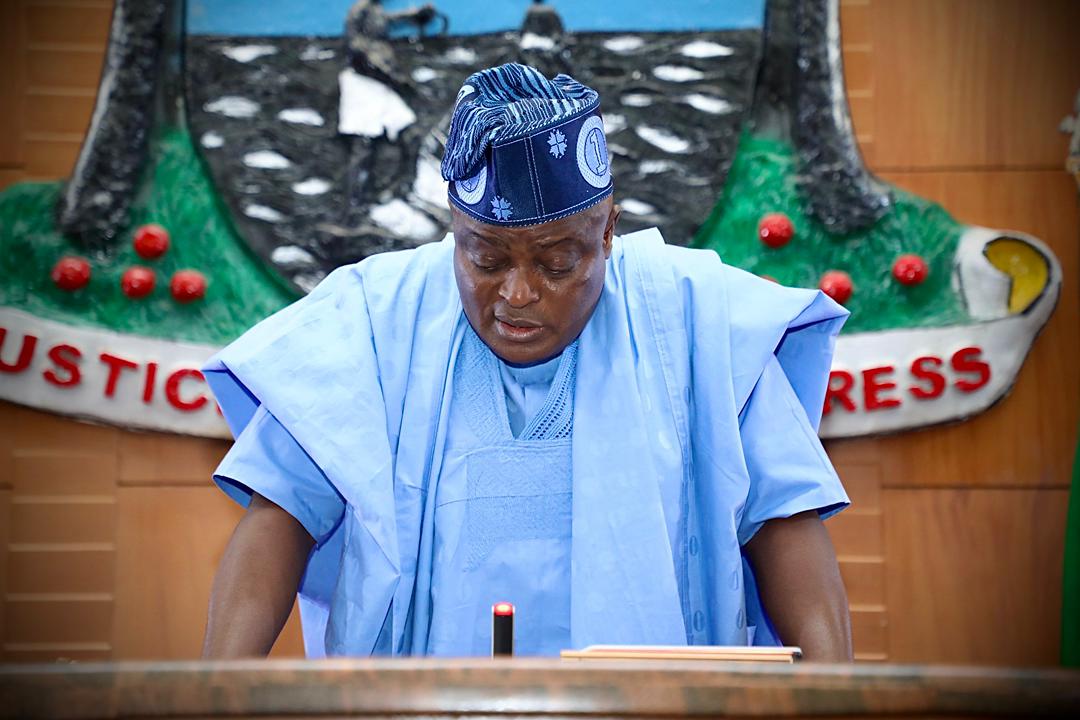
Sallah: Obasa Felicitates Muslim Ummah, Commends Nigerians for APC Primaries Turnout
The Speaker of the Lagos State House of Assembly, Rt. Hon. Mudashiru Obasa has extended warm felicitations to Muslims in Lagos State and across Nigeria on the occasion of Eid al-Adha.
In a statement released by his Chief Press Secretary, Mr. Dave Agboola, Obasa described the festival as a season of sacrifice, reflection, and gratitude, urging the faithful to continue to uphold the values of peace, unity, and love that strengthen the nation.
He noted that the celebration of Eid al-Adha is not only a spiritual milestone but also a reminder of the importance of togetherness and collective responsibility in building a stronger society.
He, likewise, emphasized that the festival provides an opportunity for Nigerians to renew their commitment to national progress and to support leadership that prioritizes development and prosperity.
Obasa, however, commended Nigerians, particularly members of the All Progressives Congress (APC), for their massive turnout during the recently concluded party primaries. He described the participation as a clear demonstration of the people’s confidence in the government of President Bola Ahmed Tinubu and their belief in the administration’s vision for a greater Nigeria.
“The APC primaries have shown the resilience of our democracy and the confidence Nigerians have in the leadership of President Bola Ahmed Tinubu and the Renewed Hope Agenda. This is a strong message that our people are ready to continue supporting policies that will drive growth and prosperity,” Obasa stated.
The Speaker further encouraged Muslims to celebrate responsibly, stressing that the joy of Eid should be accompanied by prayers for the continued peace and progress of Lagos State and Nigeria.
“As you celebrate with family and loved ones, may this season bring joy, peace, and prosperity to your homes. Let us remain united in our resolve to build a stronger nation,” he added.
On behalf of the Lagos State House of Assembly, Obasa wished all Muslims a happy and fulfilling Eid al-Adha celebration.


- Annual Meetings 2026 (AM2026): African Development Bank Group’s 2025 Annual Report Highlights Strong Results and a New Chapter for Africa’s Transformation May 29, 2026
- Eritrea: Progress of National Animal and Plant Health Laboratory May 29, 2026
- Invest Africa, the Mayor of London and FirstBank United Kingdom (UK) to Host Joint Closing Reception as part of The Africa Debate 2026 May 29, 2026
- Merck Foundation Chief Executive Officer (CEO) Dr. Rasha Kelej met Gabon First Lady to discuss the strategy to continue their joint programs to build healthcare capacity and support girl education May 29, 2026
- ‘Crude Oil: Power, Turnaround and Transformation in Angola’ Debuts as Top 3 Amazon New Release May 29, 2026
- Société Nationale des Pétroles du Congo (SNPC) Chief Ominga to Speak at African Energy Week (AEW) 2026 as Congo Accelerates Gas Expansion May 29, 2026
- South Africa: Deputy President Mashatile arrives in India for a Working Visit May 29, 2026
- Seychelles: President Visits Key Development Sites on Coetivy Island May 29, 2026
- Accelerating regional action to advance mental health care in Africa May 29, 2026
- President of the Republic of Seychelles Meets Young La Digue Talent Ahead of London Showcase May 29, 2026
- Annual Meetings 2026 (AM2026): African Development Bank Group’s 2025 Annual Report Highlights Strong Results and a New Chapter for Africa’s Transformation May 29, 2026
- Eritrea: Progress of National Animal and Plant Health Laboratory May 29, 2026
- Invest Africa, the Mayor of London and FirstBank United Kingdom (UK) to Host Joint Closing Reception as part of The Africa Debate 2026 May 29, 2026
- Merck Foundation Chief Executive Officer (CEO) Dr. Rasha Kelej met Gabon First Lady to discuss the strategy to continue their joint programs to build healthcare capacity and support girl education May 29, 2026
- ‘Crude Oil: Power, Turnaround and Transformation in Angola’ Debuts as Top 3 Amazon New Release May 29, 2026
- Société Nationale des Pétroles du Congo (SNPC) Chief Ominga to Speak at African Energy Week (AEW) 2026 as Congo Accelerates Gas Expansion May 29, 2026
- South Africa: Deputy President Mashatile arrives in India for a Working Visit May 29, 2026
-

 news6 months ago
WHO REALLY OWNS MONIEPOINT? The $290 Million Deal That Sold Nigeria’s Top Fintech to Foreign Interests
-

 society4 weeks ago
SOCIAL MEDIA IS NOT A BATTLEFIELD COMMAND – WHY THE NIGERIAN ARMY’S ACTION AGAINST JUSTICE CRACK IS A NATIONAL SECURITY IMPERATIVE
-

 celebrity radar - gossips4 months ago
Dr. Chris Okafor Returns with Power and Fire of the Spirit -Mounts Grace Nation Altar with Fresh Anointing and Restoration Grace on February 1, 2026
-

 celebrity radar - gossips6 months ago
Prophet Kingsley Aitafo Releases 2026 Prophecy: ‘Nigeria Will Rise, but the World Must Prepare for Turbulence’