
Bank
Fidelity Bank: Improved Share Price as Growth Indicator

Fidelity Bank: Improved Share Price as Growth Indicator
When the management of the Nigerian Exchange Limited (NGX) in July 2023 announced that it was reclassifying Fidelity Bank Plc from small-price stock to medium-price stock, financial analysts concluded that the road to attaining Tier1 status by the bank is closer than ever imagined.
In full year 2022. Fidelity Bank briefly fell into the Tier 1 category and saw the highest gross earnings of N337.10 billion and profit before tax of N53.68 billion. The bank’s higher interest income relative to interest expense led to a net interest margin of 7.70 per cent, ahead of other similar banks.
Regarding its financial position, the bank had the highest total assets at N3.99 trillion in 2022. The bank’s relatively low-risk asset exposure kept non-performing loans (NPLs) at 2.90 per cent, the second lowest in the Tier 2 category ahead of Wema Bank.
Although the group has struggled with curtailing operating costs with CIR above 50 per cent, Fidelity earned the second lowest CIR among Tier 2 banks at 59.00 per cent, slightly behind FCMB at 53.90 per cent in FY 2022.
In 9M 2023, Fidelity Bank, according to Proshare analysts will rise to full Tier 1 status in its next Tier 1 Banking Sector Report review based on Proshare’s Banking Strength Index (PBSI)) led second-tier banks in gross earnings, profitability, total assets, customer deposits, and loans and advances.
However, its non-performing loan ratio (NPLR) rose to 3.54 per cent after Wema Bank’s 2.50 per cent, while its cost-to-income ratio (CIR) settled at 49.86 per cent, which was an improvement from the previous year’s ratio.
Significantly, in its full-year 2023 results, the bank’s total assets as of December 31, 2023 has risen to N6.2 trillion.
The bank closed 2023 as the fifth best banking stock on the floor of the NGX with a share price of N10.85 and a market capitalization of N347.3 billion, depicting an annual gain of 149.4 per cent, Fidelity Bank also showcased a commendable financial performance.
Notably, it achieved a net income of N91.8 billion in the nine months ending September 2023, reflecting a substantial 162.46% year-on-year growth from the corresponding period in 2022.
Furthermore, the bank registered an impressive return on equity of 28.48 per cent during the first nine months of 2023.
The 2023 performance of the bank was similar to that of 2022 as it was one of the three banks that led the list of the best-performing banks on the NGX. The other banks are FCMB and FBN Holdings.
The research pours into the performance of thirteen of Nigeria’s largest commercial banks analyzing improvement year on year over two quarters.
The analysis revealed that the thirteen banks raked in a sum of N298.84 billion as post-tax profit between July and September 2022, representing an increase of 29.9 per cent compared to N228.54 billion recorded in the corresponding period of 2021.
The commercial banks remained resilient despite economic headwinds, which saw the nation’s aggregate GDP growth slowed to 2.25 per cent in Q3 2022 from 3.54 per cent recorded in the previous quarter and 4.03 per cent in the corresponding period of 2021.
Also, banks’ loans to customers grew by 5.5 per cent between June and September 2022 to stand at N23.76 trillion, representing a net new loan of N1.23 trillion in three months. However, this showed a slightly slower growth than the 6.81 per cent increase recorded in the comparable period of 2021.
NGX reclassification
The NGX said the reclassification became necessary because Fidelity Bank shares have been trading above the N5.00 mark since February 2023.
According to the NGX, rule 15.29 of the Rulebook of the Exchange, 2015 (Dealing Members’ Rules) notes that equities priced above N5 per share for at least four of the most recent six months of trading, or new security listings priced above N5 per share at the time of listing on NGX are classified as medium price stock.
“Fidelity Bank traded above the N5.00 mark on February 20, 2023 and has remained above the N5 mark up until close of business on 30 June 2023.
“This indicates that Fidelity Bank has been trading above N5 for at least four months in the last six months. Therefore, it should be reclassified from small price stock to medium price stock,” it pointed out.
The bank has continued to post commendable financial performance every quarter as it cements its position amongst tier-one banks in the country.
In the half-year 2023 results and for the second year running, the bank emerged as the company with the highest earnings per share on the Nigerian Exchange Limited (NGX).
According to a report, Fidelity Bank, Seplat Energy, Total Energies, Okomu Oil, Presco, Dangote Cement, MTN Nigeria, BUA Foods, First City Monument Bank (FCMB) and Geregu Power emerged as the companies with the highest earnings per share within that review period.
Earnings per share (EPS) is a company’s net profit divided by the number of common shares it has outstanding.
It also indicates how much money a company makes for each share of its stock and is a widely used metric for estimating corporate value.
A higher EPS indicates greater value because investors will pay more for a company’s shares if they think the company has higher profits relative to its share price.
Fidelity Bank recorded an earnings per share of N184 in the first half of 2023 from N79 in the first half of 2022.
The share price of the bank as of Thursday, April 25, 2024, stood at N9.00 per share as the bank traded 12.642 million shares valued at N112.071 billion in 246 deals.
Fidelity Bank’s share price movement has shown intense volatility in an upward direction over the past years. The stock price has risen from N2.52 on January 04, 2010, to N10.00 on March 15, 2023, generating a YTD return of 297 per cent.
The bank’s market capitalization as of Thursday, April 25, 2024, stood at N288.11 billion. Average volume stood at 11.76 million, share outstanding was 32.01 billion while free float was 31.72 billion
Stakeholders speak
Analysts believe the bank’s share price underlines its earnings growth and financial performance as higher dividend yields and future earnings forecasts have triggered demand in the money lender’s shares.
Over the last ten years, the bank’s share price has risen to a resistance (highest price) of N14.20 on March 05, 2024, and a support price (lowest price) of N0.76 on November 16, 2016.
According to a Lagos-based stockbroker, ‘Fidelity Bank demonstrates the classical admonition to prospective investors of entering low and selling high. Over the last eight years, Fidelity’s stock price has risen by 44.19 per cent on a compound annual basis; very few stocks could prove a better inflation hedge”.
Ambrose Omordion, Chief Research Officer at Investdata Consulting Limited, believes that this is the best time for Fidelity as the bank’s share price is doing well among its peers.
He said, “Fidelity is doing well and its share price is one of the best among its peers. This is so because the bank has recorded impressive results in its 2023 financial year. In June 2023, the bank shares rose by 32 per cent making it the nation’s best-performing bank share as of half year (June 30).
“I can only see a better bank now and in the future. The bank is a potential Tier 1 bank and the performance of the bank is a pointer to the fact that the bank will scale the recapitalisation hurdle of the Central Bank of Nigeria (CBN)”.
Prince Anthony Omojola, National Coordinator, Independent Shareholders Association of Nigeria (ISAN), asserted that “Fidelity Bank is moving up in terms of performance. They have joined those paying interim dividends and they have also dipped their hand into big money tills for huge investment. They have borrowed big to be able to handle bigger contracts and be able to reap big. The reclassification is welcomed and I hope they will not disappoint us. If they can meet expectations, the benefit will be for Nigeria”.
On his part, Sam Ndata, Doyen of Nigerian Stockbrokers and non-executive director at UIDC Securities Limited commented, “This is a good development. If a company performs well, it will surely be rewarded to earn investors’ confidence”.
Mr Boniface Okezie, the National Coordinator, Progressive Shareholders Association of Nigeria, commented, “Fidelity Bank has paid its dues in the financial services sector. It has contributed immensely to the development of the small and medium enterprises (SME) sector yet pays dividends to the shareholders. Last year, it took the market by surprise by declaring a dividend of 50k per share which had not happened in previous years. The massive investment in ICT and effective branch network shows it is ready to serve the customers in a better way and make the shareholders happy.”







Bank
Separating Fact from Confusion: What Nigerians Need to Know About the 7.5% VAT on Banking Service Fees

In recent weeks, digital-banking customers and social media, especially on Twitter have raised concerns about deductions labelled as “VAT” on transfers and other charges.
Some dangerously false narratives, which when you take a critical look, you’ll clearly see that they have been orchestrated and sponsored by malicious elements, have given the impression that the 7.5% Value Added Tax (VAT) is a new or arbitrary charge introduced by fintechs, or that it applies to the amounts customers send. These claims are misleading and deserve careful clarification which is the purpose of this piece.
First, it’s important to understand how VAT works in Nigeria’s financial sector today. VAT on fees and charges for financial services has long been part of Nigeria’s tax system. The then Federal Inland Revenue Service (FIRS) had issued information circulars on March 31, 2021 where it stated that VAT on Financial Services (Circular No. 2021/04) that most fees, commissions, and charges by financial institutions (banks, insurance companies, brokers) are subject to 7.5% VAT.
This justifies a recent advertorial the Nigeria Revenue Service (NRS) which stated unequivocally that VAT was not newly introduced on banking service charges by recent tax reforms, and that it did not impose a new tax obligation on customers in that regard.
However what was left unsaid in that publication was that on the 12th of December, the tax agency had written to all financial institutions and payment gateways based on past meetings with operators that following from the new Tax Act, they were reminded of their mandatory obligations to collect, deduct and remit VAT at the prescribed rate.
The Agency then gave an 18- day grace period to all players to configure and align their systems while directing full compliance with the directive with effect from January 19, 2026. And so, some fintechs sent messages to their customers in the spirit of clarity and transparency.
It must be said that what has changed is that in a bid to widen the tax net, microfinance banks and fintechs who were not obligated to deduct and remit said VAT before now, have now become compelled to do so. The enforcement and standardised collection of VAT across banks and fintech platforms including mobile transfers, USSD transaction fees, and card issuance fees with compliance deadlines issued by tax authorities. So why anyone would vilify any financial institution obeying the laws of the land beats my imagination.
For those who have raised questions around transparency and wrongly suggesting that fintechs are suddenly imposing new, unexplained costs on users – as it has been explained above, this is a matter of regulatory compliance, not a lack of transparency or customer exploitation. These VAT deductions are not new fees created by the companies themselves, and providers are not arbitrarily raising their prices.
In closing, two things that everyone must bear in mind as we move forward in this new tax climate – all stakeholders including fintech platforms and regulators must communicate better and clearly. Nigerians must refrain from peddling unsubstantiated claims and malicious narratives, it has no benefits for anyone and erodes trust in systems.
FirstBank Introduces Exclusive 500-Seater Bleacher at Carnival Calabar & Festival 2025
Lagos, 26 December 2025 – FirstBank, West Africa’s premier financial institution and financial inclusion services provider, has officially announced its sponsorship of the Carnival Calabar & Festival 2025, unveiling a landmark addition set to redefine the carnival experience — the first-ever private premium seating area at the event.
The highlight of FirstBank’s participation is the construction of a 500-seater premium bleacher, designed to provide comfort, safety, and an elevated viewing experience for carnival enthusiasts.
Speaking on the sponsorship, the Acting Group Head Marketing and Corporate Communications, FirstBank, Olayinka Ijabiyi, noted that the carnival aligns with the Bank’s First@Arts initiative, a platform dedicated to supporting the creative arts value chain across Nigeria. He said, “We recognise the transformative power of the arts, including carnivals, in inspiring people and strengthening national unity. For more than 131 years, we have supported platforms that promote self-expression, social reflection and cultural exchange. Our investment in the Carnival Calabar & Festival demonstrates our commitment to preserving the nation’s rich cultural heritage through First@Arts.”
“As part of our sponsorship this year, we are introducing the first-ever private 500-seater premium bleacher to further elevate the carnival experience. This exclusive seating is designed to provide exceptional comfort and an unforgettable viewing experience for attendees,” Ijabiyi added.
The Chairman of the Cross River State Carnival Calabar Commission, Gabe Onah, also commented on FirstBank’s sponsorship. “FirstBank’s involvement is a strong demonstration of private-sector support for culture and tourism. This partnership not only enhances the overall quality of the carnival but also strengthens its global appeal,” he said.
The Carnival Calabar & Festival 2025 is officially marketed by Okhma Global Limited, the appointed Official Marketer responsible for brand partnerships, promotional engagements, and ticket sales. Okhma Global Limited has partnered with the Cross River State government in delivering Carnival Calabar & Festival for over ten years, playing a key role in strengthening the carnival’s commercial growth and global visibility.
Alpha Morgan Bank Backs Cultural Preservation at the 2025 Iganmode Festival
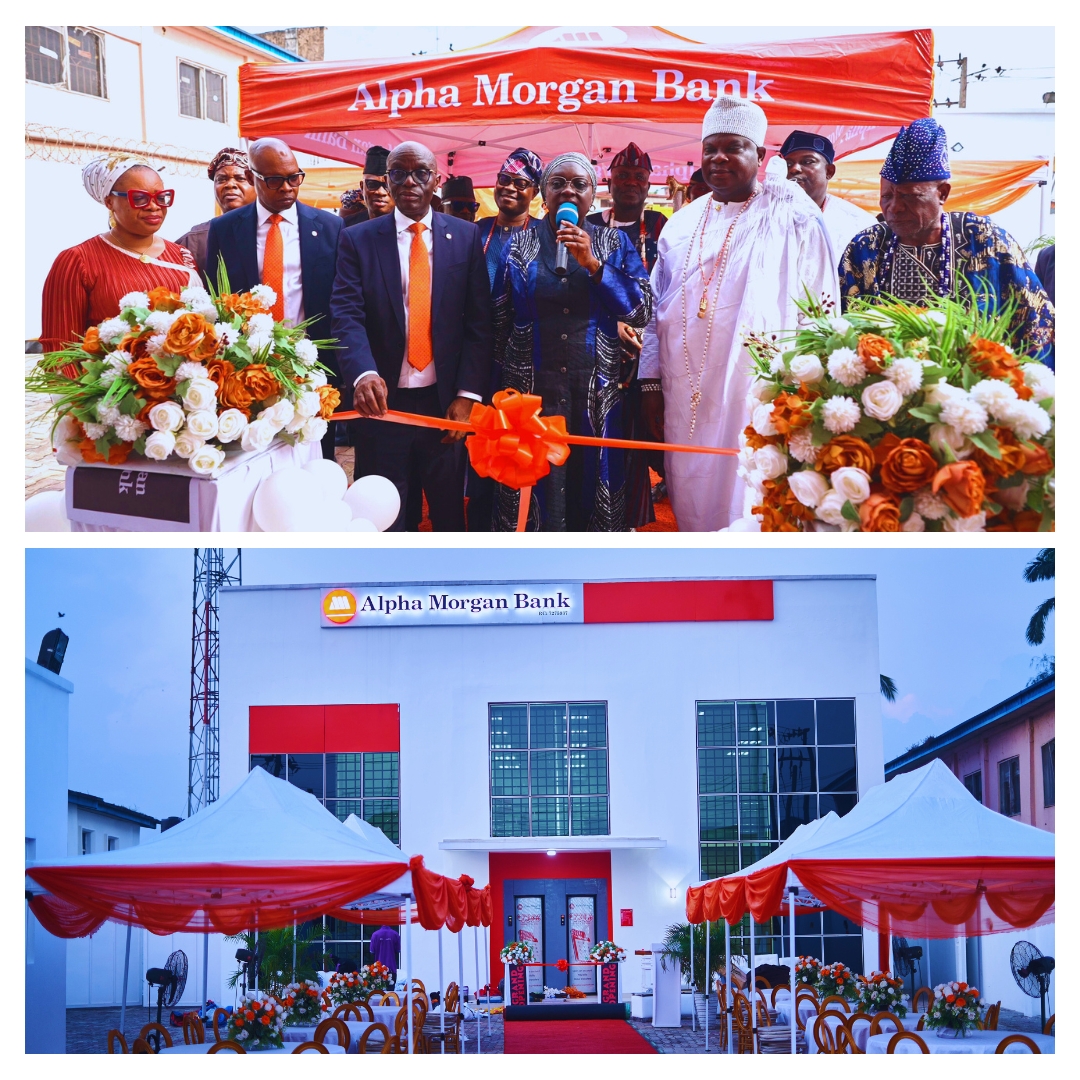
Alpha Morgan Bank has reaffirmed its commitment to cultural preservation and community development as one of the major sponsors of the recently concluded Iganmode Cultural Festival (Odun Omo Iganmode) held in Sango-Ota, Ogun State.

The annual festival, a landmark cultural celebration in the ancient town of Ota, showcased the rich heritage, history, and identity of the Awori people. The event came alive with vibrant displays of traditional music, dance, colourful regalia, and performances that reflected the deep-rooted customs and values of the community.

Alpha Morgan Bank’s sponsorship followed closely on the heels of the recent launch of its Sango-Ota branch, further underscoring the Bank’s dedication to supporting local initiatives, promoting indigenous culture, and fostering sustainable community development in Ota and its environs.
The ceremony attracted an impressive array of dignitaries, including former President of Nigeria, His Excellency Chief Olusegun Obasanjo; Deputy Governor of Ogun State, Engr. (Mrs.) Noimot Salako-Oyedele; and the Olota of Ota, His Majesty, Prof. Adeyemi Obalanlege, alongside several other traditional rulers and members of royal households from across the state. Their presence highlighted the cultural and historical significance of the festival to Ogun State and the wider Yoruba nation.
Alpha Morgan Bank’s participation as a major sponsor reflects its broader corporate vision of strengthening community values and supporting initiatives that promote Nigeria’s rich cultural heritage. The Bank joined thousands of attendees in celebrating a festival that continues to serve as a symbol of unity, pride, and cultural continuity for the people of Ota.
The 2025 edition of the Iganmode Festival was widely acclaimed as a success, leaving guests and participants with lasting impressions of a colourful, well-coordinated celebration that honoured tradition while fostering communal harmony.



-

 celebrity radar - gossips6 months ago
Why Babangida’s Hilltop Home Became Nigeria’s Political “Mecca”
-

 society6 months ago
Power is a Loan, Not a Possession: The Sacred Duty of Planting People
-

 Business6 months ago
Batsumi Travel CEO Lisa Sebogodi Wins Prestigious Africa Travel 100 Women Award
-

 news6 months ago
THE APPOINTMENT OF WASIU AYINDE BY THE FEDERAL GOVERNMENT AS AN AMBASSADOR SOUNDS EMBARRASSING