
Health
FG unveils plans to bring back 12,400 japa doctors

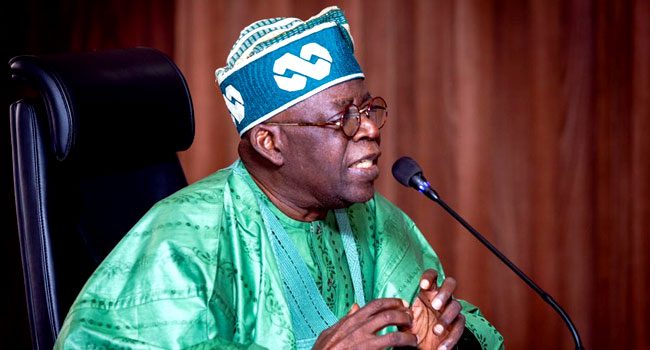
FG unveils plans to bring back 12,400 japa doctors
President Bola Tinubu, on Monday, approved the National Policy on Health Workforce Migration to address the continued exodus of Nigerian doctors abroad.
The policy, announced by the Coordinating Minister of Health and Social Welfare, Prof Muhammad Pate, on his X handle on Tuesday, aims to woo an estimated 12,400 Nigerian-trained doctors practising abroad
According to Pate, who also appeared on Channels TV on Tuesday evening, 67 per cent of Nigerian-trained doctors are practising in the United Kingdom alone.
“The recruitment countries, that recruit our professionals, should they not have some responsibilities to help us expand the training? Because the strain of health workers’ migration is continuous; it’s not going to stop tomorrow.
“the UK will need Nigerian doctors; 67 per cent of our doctors go to the United Kingdom and 25 per cent of the NHIS workforce is Nigerian.
“Nigerians are very vibrant, very entrepreneurial, and very capable wherever they are. If Nigerians hold back from the UK, for instance, the NHS will struggle to provide the services that many Nigerians are going there to get,” the minister said.
Pate said the policy signed by the President was more than just a response to the ongoing exodus of healthcare professionals but a comprehensive strategy to manage, harness, and reverse health workers’ migration.
While health workers believed the policy might be positive, they demanded the details and implementation plan.
Announcing the policy on Tuesday, the health minister said, ”This afternoon, HE President Bola Ahmed Tinubu, GCFR @officialABAT, in-council, approved a landmark policy set to transform healthcare human resource management in Nigeria.
“The National Policy on Health Workforce Migration addresses the critical challenges facing Nigeria’s health human resources. As the AU Champion for Human Resources for Health and Community Health Delivery Partnership, Mr President’s commitment to a resilient and robust healthcare system is powerfully reflected in this forward-looking policy.
“This policy is more than just a response to the ongoing exodus of healthcare professionals; it’s a comprehensive strategy to manage, harness, and reverse health worker migration. It envisions a thriving workforce that is well-supported, adequately rewarded, and optimally utilised to meet the healthcare needs of all Nigerians.”
Many Nigerian healthcare workers leave the country for greener pastures, leaving their colleagues to contend with additional workload and extended call hours.
The push factors, according to them, are inadequate equipment, worsening insecurity, poor working conditions, and poor salary structure.
The minister noted that central to this vision was the Nigeria Human Health Resource Programme, which sets a framework for regular reviews of working conditions, ensuring that health workers, especially in rural and underserved areas, receive the recognition and rewards they deserve.
“By fostering an environment conducive to professional growth and stability, the policy aims to retain top talent within Nigeria.
“In an increasingly digital world, integrating advanced health technologies is essential. The policy’s focus on digital health infrastructure—including electronic medical records, telehealth, and a comprehensive health workforce registry—marks a significant step towards a more efficient, data-driven health system. These innovations will streamline healthcare delivery and enhance the equitable distribution of health workers, ensuring access to quality care for all Nigerians.
“Capacity building is at the heart of this policy. It recognises the importance of continuous professional development, with strategic partnerships and opportunities for international training to equip our healthcare professionals with cutting-edge skills. This investment in human capital underscores our commitment to retaining and empowering our healthcare workforce,” he stated.
He added that the policy addressed the return and reintegration of Nigerian health professionals from the Diaspora.
The minister said by establishing streamlined registration processes and providing attractive incentives, the policy would not only encourage the return of talented professionals but also actively reintegrate them into the health system.
“This approach leverages the expertise of our Diaspora to bridge gaps within the health sector. Also, the policy champions reciprocal agreements with other nations to ensure that the exchange of health workers benefits Nigeria. These bilateral and multilateral agreements are designed to protect national interests while respecting the rights and aspirations of our healthcare professionals. We call on recipient countries to implement a 1:1 match—training one worker to replace every publicly trained Nigerian worker they receive.
“Recognising the importance of work-life balance, the policy includes provisions for routine health checks, mental well-being support, and reasonable working hours, especially for younger doctors. These measures aim to create a supportive work environment, reducing burnout and enhancing job satisfaction.
“The governance of this policy will be overseen by the National Human Resources for Health Programme within @Fmohnigeria, in collaboration with state governments. This ensures responsible implementation and alignment with broader sector-wide health objectives.
“With this decisive action, the National Policy on Health Workforce Migration is set to secure the future of Nigeria’s healthcare system. Under Mr President’s leadership, this policy will further catalyse the transformation of our health sector, ensuring access to quality healthcare for all Nigerians.
“As we embark on this journey, all stakeholders are invited to contribute to building a healthcare system that reflects our nation’s potential and promise,” Pate said.
Explaining the policy further, the Senior Adviser, Media and External Relations, Tashikalmah Hallah, said the government was negotiating with countries where Nigerian healthcare workers migrate to to help Nigeria improve health training facilities.
“We are talking to those countries that our health workers are going to, to see if they can now help Nigeria to improve provisions of some of the facilities that will enable Nigeria to train more health workers.
“The Federal Government has expanded our admission quota and improved on these medical institutions, so they are now encouraging all these countries where our health workers go, to assist us in maintaining these health institutions.”
Hallah said the implementation of the policy takes effect immediately.
“It’s a policy, it was adopted by the Federal Executive Council yesterday (Monday). So, it is immediate, and it has been approved. So, it’s a Nigerian government policy. This is a policy binding on healthcare workers.
He emphasised that the FG has established a policy allowing healthcare workers to travel abroad for training and then return to apply their new knowledge.
“Currently, there is a request by Qatar for 10 medical doctors to go there to study, especially in oncology. So, immediately after the training, they are coming back to the country,” he said.
he President of the Medical and Dental Consultants Association of Nigeria, Prof Muhammad Muhammad, said the policy looks more theoretical than real.
Muhammad also called for the details of the policy for a better understanding.
“The issue is that we need to see the detail, it’s not just the English that matters. People bring a lot of policies on the ground, very well drafted and crafted, but execution is usually a problem. It might be difficult to say we are fully in support or otherwise if we have not seen the document.
“I have planned to check on the Ministry of Health, maybe tomorrow (today), to see if we can get the document and look at it. They mentioned certain things that we have been advocating – the welfare of doctors, improvement of the work environment, and retraining, but how they are going to do it needs to be spelled out in the document.


Health
Insuring the Elite, Abandoning the Sick: Nigeria’s Shameful Healthcare Hypocrisy under Tinubu-led Government

Insuring the Elite, Abandoning the Sick: Nigeria’s Shameful Healthcare Hypocrisy under Tinubu-led Government
By George Omagbemi Sylvester
In a nation where hospitals are crumbling, medications are priced beyond the reach of the average citizen and thousands are dying in silence, the Federal Executive Council (FEC) has approved a life insurance scheme not for the vulnerable poor not for the overworked doctors or underpaid civil servants, but for President Bola Ahmed Tinubu, Vice President Kashim Shettima and top government officials who already enjoy the most luxurious Healthcare often abroad and at public expense(imagine oo). This move is not only insensitive; it is an insult to the Nigerian people(better insult).

Let us examine the harsh reality faced by millions of ordinary Nigerians daily. The cost of basic medication has exploded under this administration. A common antibiotic like Augmentin, used for respiratory and bacterial infections, has become a luxury. Lonart and Coartem, used to treat malaria a disease responsible for 23% of under-five child deaths in Nigeria (UNICEF, 2023) have doubled and tripled in price.
A vial of insulin, once sold for ₦5,650, now goes for ₦12,500. Patients with diabetes, if they are not already suffering from complications now face death simply because their monthly medication is no longer affordable. Hypertension drugs are also out of reach for many, pushing people to rely on dangerous local concoctions and unregulated herbal remedies. Unsurprisingly, stroke-related deaths have increased, according to reports from the Nigerian Cardiac Society in 2024.
Asthma patients, too are gasping for air literally. Inhalers, which were ₦8,000 just a few months ago, now cost ₦22,900. Cancer patients are not spared. The cost of Zoladex injections, used in breast and prostate cancer treatment, has skyrocketed from ₦60,000 to ₦145,570 even as high as ₦200,000 in some states. Herceptin, a life-saving breast cancer drug, now goes for over ₦600,000, up from ₦300,000. Chemotherapy and radiotherapy sessions, once subsidized in some hospitals, now cost up to ₦1 million per session.
Yet in the face of this national health emergency, the same government that cannot fund teaching hospitals or enforce price control on essential drugs is spending public funds to insure the lives of leaders who already enjoy world-class treatment in Dubai, the UK and Germany.

Why not ordinary Nigerians?
It is time we asked the hard questions: Why is a government that has failed to deliver affordable healthcare prioritizing life insurance for the elite? What exactly are they insuring their lives against? The very hunger and poverty their policies have unleashed?
Even the late Chinua Achebe warned us when he wrote: “The trouble with Nigeria is simply and squarely a failure of leadership.” We now see that failure play out in its ugliest form, where the political class insulates itself from the chaos it creates.
Healthcare in Crisis
Nigeria’s healthcare system ranks 163rd out of 191 countries, according to the World Health Organization (WHO). The average Nigerian cannot access primary healthcare services without selling personal belongings or borrowing at exploitative interest rates. Over 90% of the population lack access to health insurance, as revealed by the National Health Insurance Authority (NHIA) in 2023. This means they pay out-of-pocket for drugs, tests, and procedures in a country where over 63% live in multidimensional poverty, according to the National Bureau of Statistics (NBS).
Doctors are fleeing the country in droves. The Nigerian Medical Association (NMA) estimates that over 17,000 doctors have emigrated to the UK, US, Canada and Saudi Arabia since 2019, leaving just one doctor to 10,000 patients a ratio far below the WHO’s recommended 1:600.
Rather than declare a state of emergency in the health sector, the government is insuring the lives of a select few. It is a shame.
A Class Apart
Top government officials, from ministers to DGs and legislators already benefit from:
State-funded international medical trips
Generous health allowances
Access to exclusive private clinics
Pensions and perks that rival those of presidents abroad
Now, we are adding life insurance to this long list of entitlements while common citizens die in silence?
This is not just mismanagement. This is cruelty.
Martin Luther King Jr. once said: “Of all the forms of inequality, injustice in healthcare is the most shocking and inhumane.” Nigeria has not just crossed that line, it has obliterated it.
Fake Drugs, Real Deaths
The desperation created by unaffordable healthcare has opened a floodgate of fake and substandard drugs. The National Agency for Food and Drug Administration and Control (NAFDAC) reported in 2024 that 15% of medications in Nigerian markets are counterfeit, especially life-saving drugs like insulin, antibiotics and malaria treatments. These fake drugs don’t just fail to cure; they kill.
And yet, there is no national drug subsidy programme. No emergency intervention. No structured relief for the poor. Just silence.
Where is the Ministry of Health? Where is the President?
The Moral Outrage
Nigerians are not asking for too much. We want life, not life insurance for the already privileged. We want subsidized drugs, not contracts for phantom hospital upgrades. We want policies that put people first not policies designed to protect the political elite from the consequences of their own governance.
The same government that cannot fix hospitals wants to insure the lives of those who never use those hospitals. It reeks of hypocrisy.
We must demand answers.
Why didn’t this insurance scheme extend to:
Frontline health workers?
Vulnerable groups like widows, retirees and persons with disabilities?
Victims of Boko Haram, banditry and herdsmen violence?
Why must a Nigerian who earns ₦50,000 monthly spend ₦22,900 on asthma medication or risk suffocating?
Why must someone battling cancer sell all they own while their leaders receive insurance packages for doing nothing but failing?
It is time to shout.
The government must be reminded that public service is not a privilege; it is a duty.
What Needs to Be Done
Reverse the Insurance Scheme: Public outrage must force a reversal of this insensitive scheme until every Nigerian has access to affordable healthcare.
Establish Drug Subsidy Programs: The government must subsidize essential medications immediately and especially for cancer, diabetes, hypertension and infectious diseases.
Reinforce the NHIA: The National Health Insurance Authority must expand coverage to include all low-income earners, retirees, and the unemployed.
Crack Down on Fake Drugs: A nationwide sweep of counterfeit drug networks must be coordinated, backed with international partnerships and new legislation.
Invest in Health Infrastructure: Nigeria’s public hospitals must be equipped, staffed and funded starting with federal and teaching hospitals.
Final Word
A nation that refuses to care for its sick, but rushes to protect its elite with life insurance, is not a democracy, but a plantation. Let this not just be another news item. Let it be a call to action.
Because health is not a privilege, it is a right.
And if our leaders cannot recognize that, then perhaps they are not fit to lead us.
Health
NGO launches free medical outreach for over 500 beneficiaries under Tukur-Tukur Foundation in Kaduna

NGO launches free medical outreach for over 500 beneficiaries under Tukur-Tukur Foundation in Kaduna
Sahara Weekly Reports That a Non-governmental Organization, under the auspices of De-Lace International in collaboration with Tukur-Tukur Foundation,n has launched a free medical outreach program in the Kaduna community.

The Chairman of Tukur-Tukur Foundation, Col.Haruna Idris Zaria (Rtd,) said the Foundation is committed to carrying out humanitarian interventions across the country whenever the need arises through the provision of medical succor to the vulnerable, underprivileged members of the society by giving them free medical services.
“Tukur-Tukur Foundation carries out free eye screening and cataract surgery; minor eye problems are treated with drugs, drops/ointments, and reading glasses are issued free. We give our wheelchairs and crutches to physical disabilities to ease their daily movement. We equally give our free educational materials such as school uniforms, textbooks, exercise books, etc. Tukur-Tukur Foundation also gives out religious books for spiritual upliftment. Col. Zaria said.

Earlier, the Managing Director of De-Lace International, Hajiya Safiya Bashir, expressed gratitude to the grand Patron of Tukur-Tukur Foundation, Lt. General Tukur Yusufu Buratai (Rtd), for the opportunity given to her organization to launch the free medical outreach for the benefiting community.
“It is with immense pride and heartfelt gratitude that I stand before you today to launch DE-LACE INTERNATIONAL’S Free Medical Outreach Program. This initiative is not just an event; it is a testament to our unwavering commitment to the health, well-being, and prosperity of the communities we serve.

“We have earmarked 500 persons with different ailments to benefit from the initial stage of the program today.
“We believe that a healthy community is the foundation of a thriving society. Access to quality healthcare is a fundamental right, not a privilege, and through this outreach, we aim to bridge gaps, alleviate suffering, and bring hope to those who need it most.
“Today, we are here to provide free medical consultations, screenings, treatments, and health education to ensure that every individual, regardless of their circumstances, can take a step toward a healthier future.
“I extend my deepest appreciation to our team of skilled medical professionals, volunteers, and partners who have worked tirelessly to make this day possible. To our employees, your support and enthusiasm for this cause reflect the heart of our organization—a heart that beats for positive impact and meaningful change.
“To the members of our community joining us today, thank you for trusting us to be part of your health journey. We are here to listen, to care, and to empower you with the tools and knowledge to lead healthier lives.
“This outreach is our pledge to stand by you, not just today, but in the days and years to come. As we embark on this day of service, let us be reminded that small acts of kindness can spark great change.
“Together, we are building a healthier, stronger, and more united community. I am honored to be part of this transformative moment, and I look forward to witnessing the positive impact we will create together. May this outreach mark the beginning of many more initiatives to uplift and empower our community”. Hajiya Safiya Bashir said.
Highlights of the event were the giving out of assistive devices, ear, nose,e and throat treatment, free eye screening and cataract surgery, testing of Blood Pressure (BP), and treatment of ulcers, malaria, and typhoid fever, amongst other ailments.

Divorce Showdown: Yul and May Edochie’s Legal Battle Intensifies as Court Orders Further Talks
The divorce saga between Nollywood star Yul Edochie and his estranged wife, May Edochie, has taken a new turn as their lawyer, Emeka Ugwuonye, shares fresh updates on the high-profile case.
In a dramatic legal development, the court held a compulsory conference as mandated by Nigerian family law. This legal process requires both parties to engage in discussions, along with their lawyers, in an attempt to resolve at least some of the contested issues before the court.
Ugwuonye, in a Facebook post, provided a detailed breakdown of the proceedings:
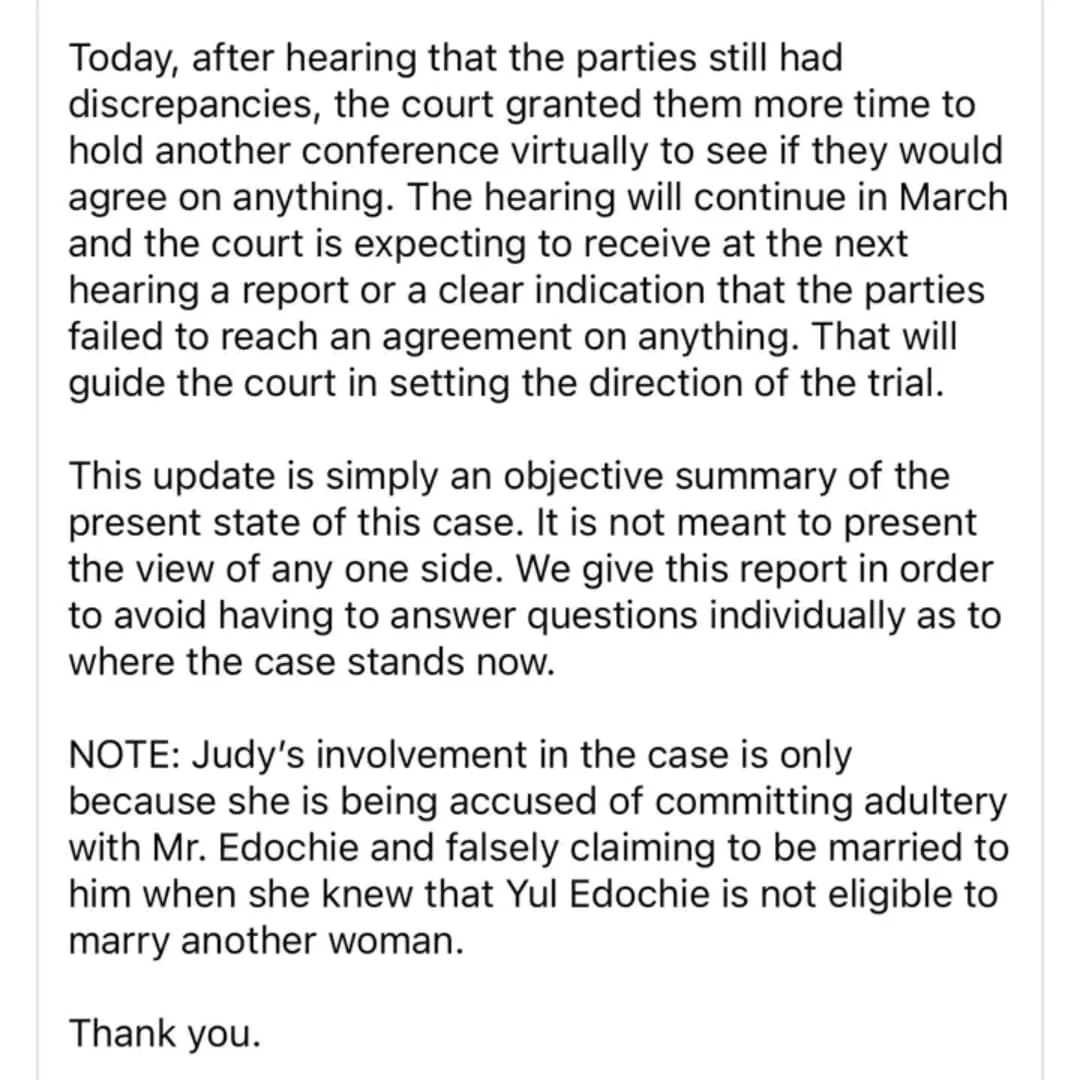
DPA UPDATE ON THE DIVORCE CASE OF MARY YUL-EDOCHIE V. YUL EDOCHIE AND UCHECHUKWU JUDITH MUOGHALU (JUDY AUSTIN)
“The court held a hearing on the case today. The issue before the court was the report of the compulsory conference previously ordered by the judge.
A compulsory or mandatory conference is a requirement in family law proceedings under Nigerian law. It provides an opportunity for the divorcing parties to discuss and attempt to reach agreements on certain aspects of their separation, such as property division and other contested matters. Any agreements reached are then conveyed to the court through a formal report.
However, in the last court session, it was revealed that no conclusive agreement had been reached between Yul and May Edochie. As a result, the court extended the timeframe for further discussions, granting them more time to hold another virtual conference.
The court expects to receive an updated report during the next hearing scheduled for March. If the parties continue to disagree, the court will then decide the direction of the trial.
This latest update comes as May Edochie continues to push for legal resolution regarding her marriage, while Judy Austin’s involvement in the case remains a key point of contention. She stands accused of committing adultery with Yul Edochie and falsely claiming to be married to him despite his legal ineligibility for a second marriage.
With tensions running high, all eyes are now on the next court date to see whether the estranged couple will reach any form of settlement or if the case will escalate into a full-blown courtroom battle.
Stay tuned for more updates on this unfolding legal drama.



-

 celebrity radar - gossips6 months ago
Why Babangida’s Hilltop Home Became Nigeria’s Political “Mecca”
-

 society6 months ago
Power is a Loan, Not a Possession: The Sacred Duty of Planting People
-

 Business6 months ago
Batsumi Travel CEO Lisa Sebogodi Wins Prestigious Africa Travel 100 Women Award
-

 news6 months ago
THE APPOINTMENT OF WASIU AYINDE BY THE FEDERAL GOVERNMENT AS AN AMBASSADOR SOUNDS EMBARRASSING