
society
Why Businesses Fail in South Africa. By Ekos Akpokabayen


Why Businesses Fail in South Africa.
By Ekos Akpokabayen
South Africa, like many emerging markets, experiences a high rate of business failure, particularly among small and medium-sized enterprises (SMEs). Statistics from the Small Enterprise Development Agency (SEDA) and the Global Entrepreneurship Monitor consistently reveal that over 70% of small businesses fail within the first two years of operation. This trend is concerning given that SMEs are vital contributors to economic growth, job creation, and innovation.
As a finance professional and Chief Investment Officer at Ovid Capita, I have closely observed the structural and operational challenges facing businesses in South Africa. Drawing from both analytical frameworks and on-the-ground experience, I will explore the critical reasons businesses fail and offer pragmatic advice to entrepreneurs aspiring to build resilient and sustainable enterprises.
1. Lack of Market Understanding and Strategic Positioning
One of the foundational causes of business failure is inadequate market research and poor strategic positioning. Too often, entrepreneurs are guided by passion, anecdotal evidence, or fleeting market trends rather than grounded, data-driven insights. While enthusiasm is essential, it must be paired with a thorough understanding of customer needs, behavioral patterns, and competitive dynamics.
A robust market analysis should answer essential questions: Who are our customers? What do they value? Who else is serving them, and how can we do better? Unfortunately, many business owners overestimate demand or misjudge pricing sensitivities, resulting in products or services that fail to gain traction.
To thrive, entrepreneurs must prioritize feasibility studies, competitive analysis, and customer validation exercises. Without this due diligence, they risk entering saturated markets, pricing incorrectly, or offering products with no long-term demand.
2. Weak Financial Management and Planning
Financial mismanagement remains one of the most persistent causes of business collapse. Many entrepreneurs lack fundamental financial literacy—unable to distinguish between profit and cash flow, or between gross margins and net income. This lack of understanding leads to poor decision-making, uncontrolled spending, and an inability to budget or forecast.
A successful business must implement sound accounting practices, establish clear financial controls, and adopt budgeting processes that align with strategic objectives. Entrepreneurs should leverage modern accounting software and, where possible, seek guidance from professional advisors or financial consultants.
Moreover, understanding unit economics—how much it costs to acquire a customer versus the lifetime value of that customer—is critical. Without these insights, even high-revenue businesses can fail if their cost structures are inefficient or unsustainable.
3. Cash Flow Constraints and Insufficient Capitalization
Cash flow—the lifeblood of any enterprise—is often misunderstood. Many business owners confuse profitability with liquidity, only to find themselves unable to cover operational expenses such as rent, payroll, or inventory.
This issue is compounded by a failure to raise capital at the right time. In South Africa’s volatile economic climate, unforeseen disruptions—such as load shedding, regulatory changes, or currency volatility—can quickly derail undercapitalized businesses.
Entrepreneurs must adopt a proactive approach to financial planning that accounts for seasonal fluctuations, delayed client payments, and potential economic shocks. Building a capital buffer and securing access to credit or investment capital can significantly increase a business’s resilience.
4. Underestimating the Competitive Landscape
South Africa’s business environment is dynamic and competitive. Many new entrants mistakenly believe their offerings are unique or that existing competitors are unsophisticated. This assumption is often misguided.
Competitor analysis is not a one-time event—it should be an ongoing process. Understanding the pricing models, service delivery mechanisms, customer retention strategies, and marketing approaches of competitors can offer valuable insights for differentiation and strategic agility.
Those who ignore competition risk being undercut on price, outpaced in innovation, or simply forgotten by consumers in a saturated market.
5. Inexperience in Hiring and Managing Talent
Even the most innovative ideas require strong execution—and that depends heavily on people. Unfortunately, many entrepreneurs lack experience in human resource management. Hiring based on convenience, cost, or personal relationships instead of merit and cultural fit can lead to operational inefficiencies and internal discord.
Effective recruitment is not just about filling roles; it’s about building a team that shares the vision, values, and ambition of the enterprise. Furthermore, poor leadership, lack of delegation, and micro-management often demotivate high-performing employees, leading to high turnover and loss of institutional knowledge.
Investing in people—through careful recruitment, team building, and leadership development—is essential to business sustainability.
6. Neglect of Employee Training and Development
In a fast-evolving economic landscape, businesses must constantly adapt to changes in technology, consumer behavior, and regulatory frameworks. Yet, employee training is often seen as a cost rather than an investment.
This mindset is dangerous. Inadequately trained staff can negatively impact customer satisfaction, productivity, and compliance. Conversely, continuous professional development fosters innovation, efficiency, and loyalty.
Entrepreneurs must create a culture of learning. This can be done through formal training programs, peer learning, mentorship initiatives, and access to industry certifications. Knowledge is a competitive advantage—and businesses that invest in human capital tend to outperform their peers.
7. Failure to Build Strategic Networks and Partnerships
In South Africa, many entrepreneurs operate in isolation. They overlook the value of business networks, industry associations, and collaborative ecosystems. However, successful businesses are rarely built in a vacuum.
Networking provides access to partnerships, funding opportunities, mentorship, and market intelligence. Engaging with other business owners, attending industry conferences, or joining business chambers can open doors that would otherwise remain closed.
Moreover, strategic alliances—whether for distribution, marketing, or product development—can reduce costs, increase market reach, and accelerate growth.
Conclusion: From Vulnerability to Viability
The entrepreneurial journey in South Africa is not for the faint-hearted. The economic landscape presents both opportunities and obstacles, and while many businesses begin with promise, too few survive long enough to reach their full potential.
To reverse this trend, entrepreneurs must shift from reactive to strategic thinking. They must invest time in market research, build solid financial foundations, plan for cash flow disruptions, and hire with intentionality. Furthermore, cultivating talent, embracing lifelong learning, and fostering collaborative relationships can significantly enhance business longevity.
At Ovid Capita, we advocate for an integrated approach to entrepreneurship—one that combines passion with planning, and innovation with execution. With the right guidance, tools, and mindset, South African entrepreneurs can overcome the systemic barriers that currently hinder SME growth and unlock the full potential of their ventures.
By addressing these avoidable pitfalls and embracing best practices, we can build a stronger, more inclusive, and sustainable business ecosystem that not only drives economic transformation but also uplifts communities across the country.
Ekos Akpokabayen has an MSc in Finance, and also the Chief Investment Officer at
Ovid Capita








society
Rt Hon Treasure Edwin Inyang Appointed Secretary General to the Government of UKA (Worldwide)

Rt Hon Treasure Edwin Inyang Appointed Secretary General to the Government of UKA (Worldwide)*
January 29, 2026 – A prestigious appointment has been announced in the reign of Emperor Solomon Wining 1st, recognizing Rt Hon Treasure Edwin Inyang as the *Secretary General to the Government of UKA (Worldwide)*. The official certificate, designated STE.001-1 E, was presented to Rt Hon Inyang during a ceremonial investiture.
As Secretary General, Rt Hon Treasure Edwin Inyang will *monitor and coordinate* the implementation of government policies and programmes, serve as an advisory institution to the Government, drive policy formulation, harmonization, and implementation, and oversee the activities of ministries, agencies, and departments.
The appointment was proclaimed by *Emperor Prof. Dr. Solomon Wining*, Emperor of the United Kingdom of Atlantics and Empire Worldwide, and co-signed by *Empress Prof. Dr. Sriwan Kingjun*, Empress of Attica Empire, under the auspices of the 5 Billions Humanitarian Projects Incorporated.
The ceremony underscores the commitment to strengthening governance and humanitarian initiatives within the UKA (Worldwide) jurisdiction, effective immediately in the reign of Emperor Solomon Wining 1st.


GENERAL BULAMA BIU MOURNS BOKO HARAM VICTIMS, CALLS FOR UNITY AND RENEWED EFFORTS FOR PEACE
In a solemn message of condolence and resolve, Major General Abdulmalik Bulama Biu mni (Rtd), the Sarkin Yakin of Biu Emirate, has expressed profound grief over a recent deadly attack by Boko Haram insurgents on citizens at a work site. The attack, which resulted in the loss of innocent lives, has been condemned as a senseless and barbaric act of inhumanity.
The revered traditional and military leader extended his heartfelt sympathies to the bereaved families, the entire people of Biu Emirate, Borno State, and all patriotic Nigerians affected by the tragedy. He described the victims as “innocent, peaceful, hardworking and committed citizens,” whose lives were tragically cut short.
General Biu lamented that the assault represents “one too many” such ruthless attacks, occurring at a time when communities are already engaged in immense personal and collective sacrifices to support government efforts in rebuilding devastated infrastructure and restoring hope.
In his statement, he offered prayers for the departed, saying, “May Almighty Allah forgive their souls and grant them Aljannan Firdaus.” He further urged the living to be encouraged by and uphold the spirit of sacrifice demonstrated by the victims.
Emphasizing the need for collective action, the retired Major General called on all citizens to redouble their efforts in building a virile community that future generations can be proud of. He specifically commended the “silent efforts” of some patriotic leaders working behind the scenes to end the security menace and encouraged all well-meaning Nigerians to join the cause for a better society.
“Together we can surmount the troubles,” he asserted, concluding with a prayer for divine intervention: “May Allah guide and protect us, free us from this terrible situation and restore an enduring peace, security, unity and prosperity. Amin.”
The statement serves as both a poignant tribute to the fallen and a clarion call for national solidarity in the face of persistent security challenges.

When a Nation Outgrows Its Care.
By George Omagbemi Sylvester | Published by SaharaWeeklyNG.com
“Population Pressure, Poverty and the Politics of Responsibility.”
Nigeria is not merely growing. It is swelling and faster than its institutions, faster than its conscience and far faster than its capacity to care for those it produces. In a world already straining under inequality, climate stress and fragile governance, Nigeria has become a living paradox: immense human potential multiplied without the social, economic or political scaffolding required to sustain it.
This is not a demographic miracle. It is a governance failure colliding with cultural denial.
Across the globe, societies facing economic hardship typically respond by slowing population growth through education, access to healthcare and deliberate family planning. Nigeria, by contrast, expands relentlessly, even as schools decay, hospitals collapse, power grids fail and public trust erodes. The contradiction is jarring: a country that struggles to FEED, EDUCATE and EMPLOY its people continues to produce more lives than it can dignify.
And when the inevitable consequences arrive (unemployment, crime, desperation, migration) the blame is conveniently outsourced to government alone, as though citizens bear no agency, no RESPONSIBILITY, no ROLE in shaping their collective destiny.
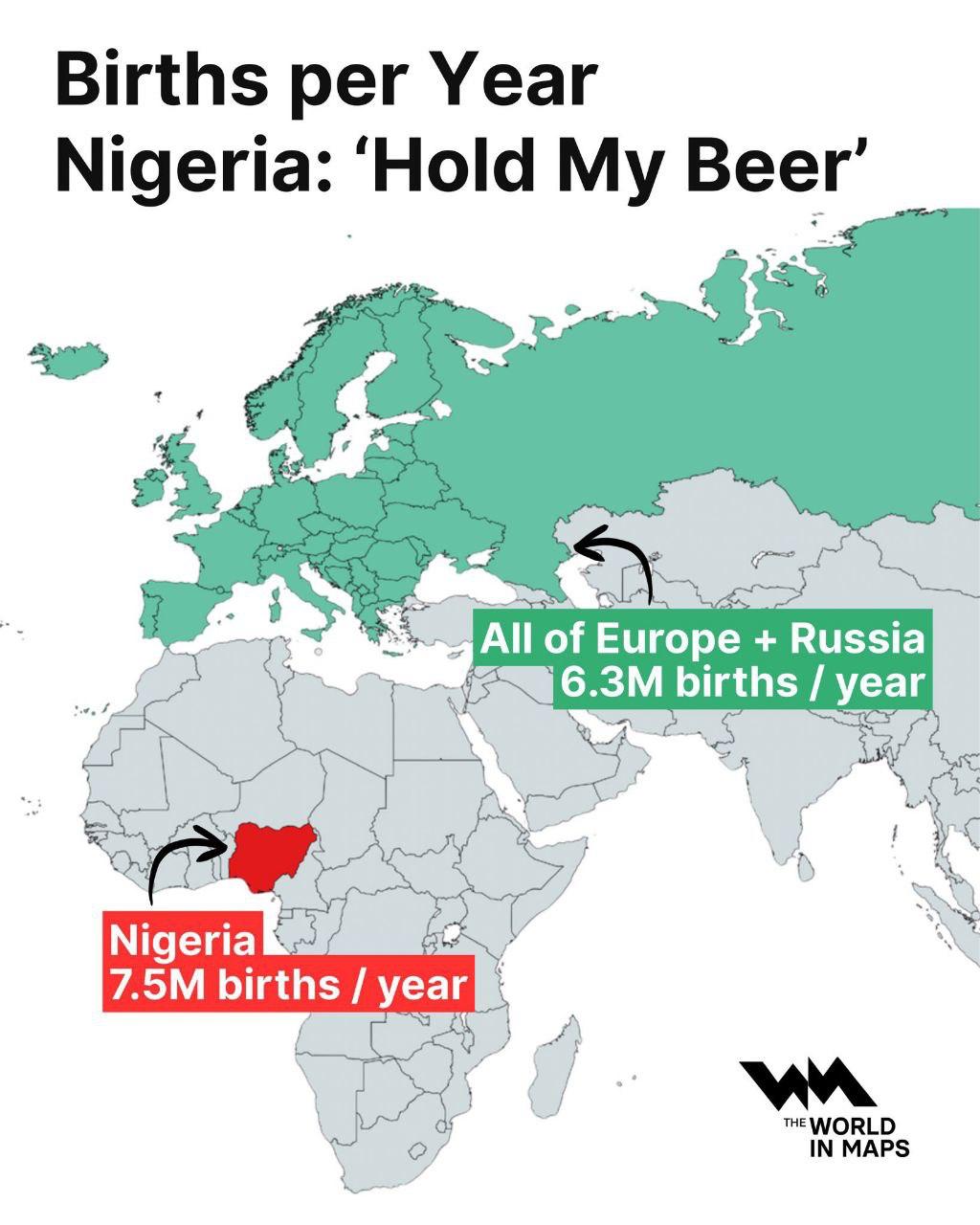
This evasion is at the heart of Nigeria’s crisis.
The political economist Amartya Sen has long said that development is not merely about economic growth but about expanding human capabilities. Nigeria does the opposite. It multiplies human beings while shrinking the space in which they can thrive. The result is a society where life is abundant but opportunity is scarce, where children are born into structural neglect rather than possibility.
Governments matter. Bad governments destroy nations. Though no government, however competent, can sustainably provide for a population expanding without restraint in an environment devoid of planning, infrastructure and accountability.
This is where the conversation becomes uncomfortable and therefore necessary.
For decades, Nigerian leaders have failed spectacularly. Public education has been HOLLOWED out. Healthcare has become a LUXURY. Electricity remains UNRELIABLE. Social safety nets are virtually NONEXISTENT. Public funds vanish into PRIVATE POCKETS with brazen regularity. These are not disputed facts; they are lived realities acknowledged by development agencies, scholars and ordinary citizens alike.
Yet amid this collapse, REPRODUCTION continues unchecked, often CELEBRATED rather than QUESTIONED. Large families persist not as a strategy of hope but as a cultural reflex, untouched by economic logic or future consequence. Children are brought into circumstances where hunger is normalized, schooling is uncertain and survival is a daily contest.
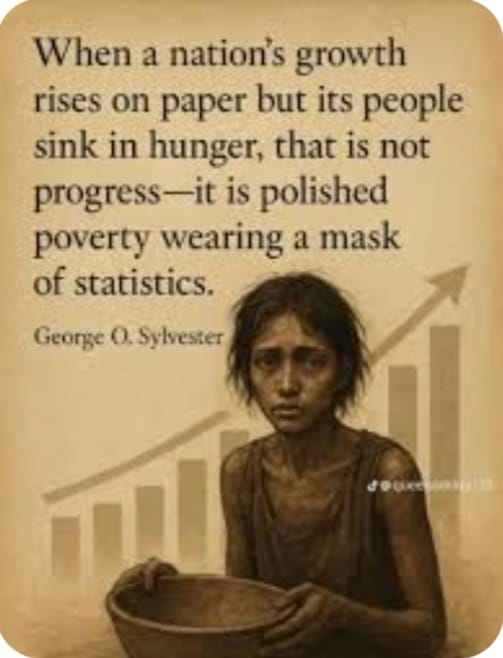
The philosopher Hannah Arendt warned that irresponsibility flourishes where accountability is diffused. In Nigeria, responsibility has become a political orphan. The state blames history, colonialism or global systems. Citizens blame the state. Meanwhile, children inherit the cost of this mutual abdication.
International development scholars consistently emphasize that education (especially of girls) correlates strongly with smaller, healthier families and better economic outcomes. Nigeria has ignored this lesson at scale. Where education is weak, fertility remains high. Where healthcare is absent, birth becomes both risk and ritual. Where women lack autonomy, choice disappears.
This is not destiny. It is policy failure reinforced by social silence.
Religious and cultural institutions, which wield enormous influence, have largely avoided confronting the economic implications of unchecked population growth. Instead, they often frame reproduction as a moral absolute divorced from material reality. The result is a dangerous romanticism that sanctifies birth while neglecting life after birth.
The Kenyan scholar Ali Mazrui once observed that Africa’s tragedy is not lack of resources but lack of responsibility in managing abundance. Nigeria exemplifies this truth painfully. Rich in land, talent and natural wealth, the country behaves as though human life is an infinite resource requiring no investment beyond conception.
This mindset is unsustainable.
Around the world, nations that escaped mass poverty did so by aligning population growth with state capacity. They invested in people before multiplying them. They built systems before expanding demand. They treated citizens not as numbers but as future contributors whose welfare was essential to national survival.
Nigeria has inverted this logic. It produces demand without supply, citizens without systems, lives without ladders.
To say this is not to absolve government. It is to indict both leadership and followership in equal measure. Governance is not a one-way transaction. A society that demands accountability must also practice responsibility. Family planning is not a foreign conspiracy. It is a survival strategy. Reproductive choice is not moral decay. It is economic realism.
The Nigerian sociologist Adebayo Olukoshi has argued that development fails where political elites and social norms reinforce each other’s worst tendencies. In Nigeria, elite corruption meets popular denial, and the outcome is demographic pressure without developmental intent.
This pressure manifests everywhere: overcrowded classrooms, collapsing cities, rising youth unemployment and a mass exodus of talent seeking dignity elsewhere. Migration is not a dream; it is an indictment. People leave not because they hate their country, but because their country has failed to imagine a future with them in it.
And still, the cycle continues.
At some point, honesty must replace sentiment. A nation cannot endlessly reproduce its way out of poverty. Children are not economic policy. Birth is not development. Hope without planning is cruelty.
True patriotism requires difficult conversations. It demands confronting cultural habits that no longer serve collective survival. It insists on shared responsibility between state and citizen. It recognizes that bringing life into the world carries obligations that extend far beyond celebration.
Nigeria does not lack people. It lacks care, coordination and courage. The courage to align birth with dignity, growth with governance and culture with reality.
Until that reckoning occurs, complaints will continue, governments will rotate and generations will be born into a system that apologizes for its failures while reproducing them.
A nation that refuses to plan its future cannot complain when the future overwhelms it.



-

 celebrity radar - gossips6 months ago
Why Babangida’s Hilltop Home Became Nigeria’s Political “Mecca”
-

 society5 months ago
Power is a Loan, Not a Possession: The Sacred Duty of Planting People
-

 Business6 months ago
Batsumi Travel CEO Lisa Sebogodi Wins Prestigious Africa Travel 100 Women Award
-

 news6 months ago
THE APPOINTMENT OF WASIU AYINDE BY THE FEDERAL GOVERNMENT AS AN AMBASSADOR SOUNDS EMBARRASSING