
Politics
NSOFOR (KPAKPANDO NDIGBO) DECLARES FOR SENATE

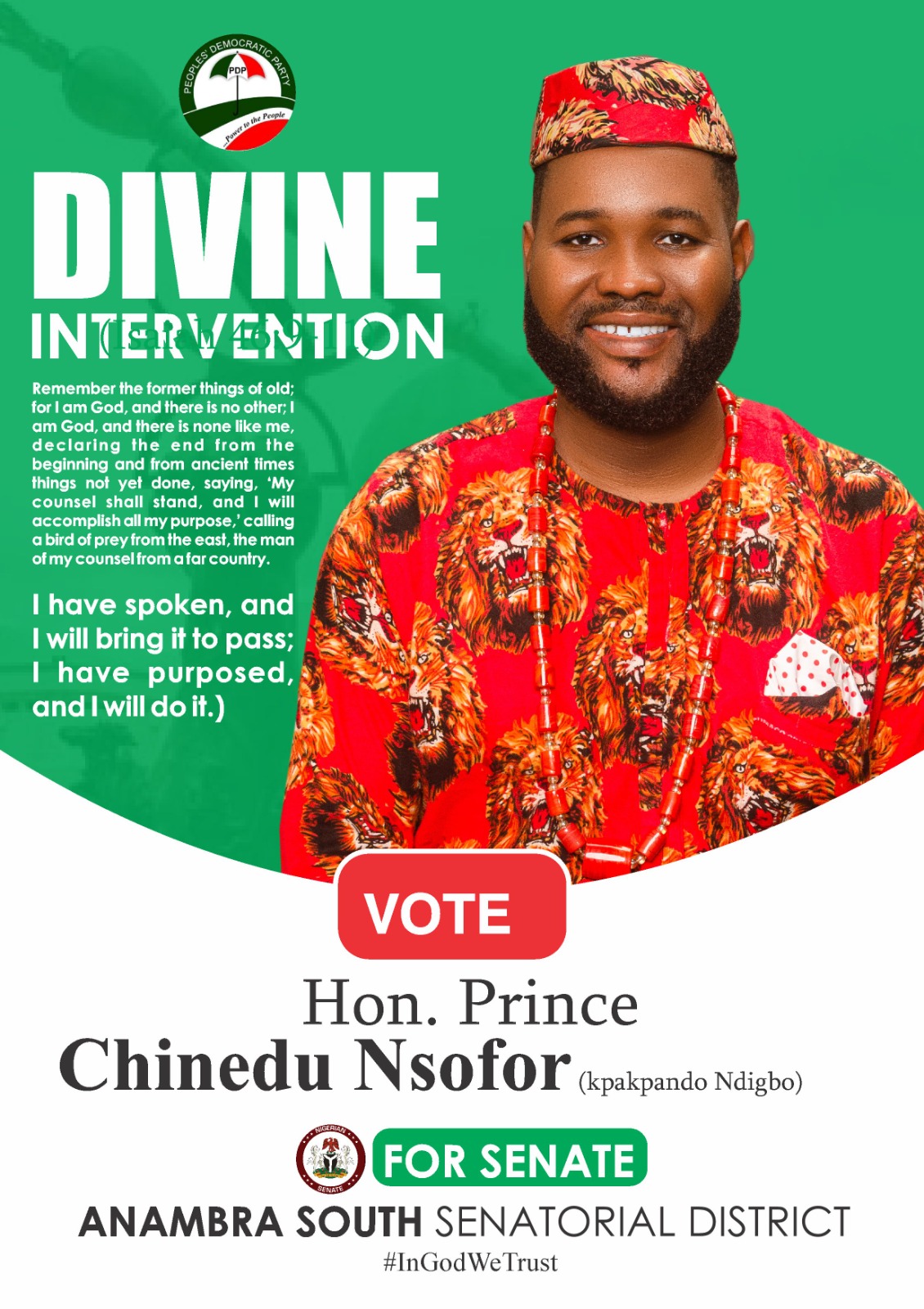
HON. PRINCE CHINEDU NSOFOR (KPAKPANDO NDIGBO) DECLARES FOR SENATE
– (Anambra South Senatorial District)
A New Dawn for Anambra South and the Igbo Nation
“Remember the former things of old; for I am God, and there is no other; I am God, and there is none like me, declaring the end from the beginning and from ancient times things not yet done, saying, ‘My counsel shall stand, and I will accomplish all my purpose,’ calling a bird of prey from the east, the man of my counsel from a far country. I have spoken, and I will bring it to pass; I have purposed, and I will do it” Isaiah 46:9‑12
INTRODUCTION & CONTEXT
It is with profound humility and unwavering faith in God that I, Hon. Prince Chinedu Nsofor(Kpakpando Ndigbo), rise today to declare my intention to serve as Senator for Anambra South Senatorial District. Inspired by God’s leading—”Divine Intervention”—I step forward to harness our collective blessings, talents, and resources for the resurgence of our land and people.
Anambra South comprises seven Local Government Areas—Aguata, Ekwusigo, Ihiala, Nnewi North, Nnewi South, Orumba North, and Orumba South—spanning 108 wards and over 1,669 polling units. I am committed to serving each community, from Achina and Ozubulu to Umunze and Ukpor.
WHO I AM & WHY I STAND OUT
I, Hon. Chinedu Nsofor (Kpakpando Ndigbo), a proud son of Ekwusigo Local Government Area in Anambra State, was born on March 24, 1990. I am a committed public servant, a seasoned technocrat, an International development expert, and a grassroots/community development expert. I hold a B.Sc. (Second-Class Upper) and M.Sc. in Social Work.
Over the years, I have served in several strategic national and international roles, including as the National Coordinator of Igbo Heroes Foundation, MD/CEO of the Work While in School Group, Country Director of RapidHeal International (Malaysia HQ), and Programmes Director of Asia Pacific Sports International. My work has centered on youth empowerment, public health, entrepreneurship, and nation-building, and I have championed numerous programs that have positively impacted thousands of lives across the Southeast and beyond.
In the past decade, I have led more than 30 major national programs and initiatives in partnership with institutions such as the Central Bank of Nigeria, Federal Road Safety Corps, National Commission for Colleges of Education, and several state governments. I pioneered the Work While in School initiative, which now enjoys federal recognition and is being implemented across all colleges of education in Nigeria. As Programme Coordinator for the Innoson Kiara Academy auto-training project, I facilitated vocational training for youths in Imo and Ebonyi states. During the COVID-19 pandemic, I also coordinated safety training for ambulance drivers across Southeast Nigeria.
My passion for service has earned me numerous recognitions, including the University of Nigeria Nsukka (UNN) Leadership Excellence Award, the title of Most Political Student, and inclusion in the UNN Book of Fame for my contributions to student development and university advancement.
What makes me the most suitable candidate for the Anambra South Senatorial seat is not just my experience, but my proven capacity to deliver results. With a vast network of national and international partners and a practical record of grassroots transformation, I am uniquely positioned to turn Anambra South into the center of innovation, industrialization, and youth empowerment. From education reform to building social enterprises and coordinating global partnerships, I have demonstrated the kind of visionary, competent, and community-rooted leadership that Anambra South deserves.
I represent a new generation of effective, responsive, and transformative representation—one that is youthful, prepared, globally connected, and deeply committed to the prosperity of Igbo land.
100 NATIONAL LEGISLATIVE BILLS I WILL PROPOSE ACROSS ALL SECTORS (Implementation Begins in Anambra South)
I do not just see a seat in the Senate—I see a sacred assignment. I see communities transformed, industries rising, and legacies reborn. My legislative vision is not theory; it is a roadmap rooted in our realities. Here are the transformative bills I will champion having Anambra South and the Igbo Nation as the pilot phase:
1. I Will Sponsor A Bill On the Community Needs Assessment & Development Act
I envision a Nigeria where every community’s voice counts. Through this bill, I will initiate a nationwide grassroots needs assessment, beginning with the 110 communities of Anambra South. We will identify problems from within, craft solutions from the people, and implement them through a National Community Solutions Fund. Our communities will not be forgotten—they will become the model for community-driven development across Nigeria.
2. I Will Sponsor A Bill To Establish the Community Production Venture Commission Act
I believe in turning local potential into national prosperity. This bill will create production companies in every community, starting with Anambra South’s 110 towns. Each venture will tap into local raw materials—cassava, palm oil, rice—and produce value-added exports. These ventures will be jointly owned—60% by the government, 40% by the people—and designed to be listed on the Nigerian Stock Exchange within a decade. I see thriving communities, not abandoned farms.
3. I Will Sponsor A Bill To Enforce the Value-Added Raw Materials Optimization Act
No more exporting our wealth in raw form! With this bill, I will put a national ban on the export of unprocessed raw materials. Our palm, rice, cassava—everything—will be transformed into finished goods. This means more jobs, more income, and industrial growth rooted in our land. Anambra South will be the first zone to show Nigeria what’s possible.
4. I Will Sponsor A Bill To Activate the Local Raw Materials Processing Credit Scheme
I want our entrepreneurs to thrive, not struggle. Through this bill, I will empower federal and regional banks to offer low-interest loans, tax holidays, and export grants to grassroots ventures. The first to benefit will be our palm oil cooperatives, cassava processors, and rice growers in Anambra South. When you produce, I will help you profit.
5. I Will Sponsor A Bill To Secure Local Leadership Through the Community-Based CEO Empowerment Act
I trust our people to lead. I will ensure that CEOs of community PPP ventures come from within—local experts who understand our strengths and values. They will be trained, audited, and held to international standards. From Nnewi to Uga, from Ihiala to Oko, our best brains will run our best businesses.
6. I Will Sponsor A Bill To Launch the National State-to-Private Share Transition Act
My Proposed Community PPP ventures should grow into community-owned legacies. My bill will ensure that the government gradually transfers the majority ownership to the private sector—20% every five years—until our people own their economy. I will also establish community stockholding cooperatives to democratize wealth. Anambra South will lead this ownership revolution.
7. I Will Sponsor A Bill To Guarantee Standards Through the Export-Ready Product Certification Bill
Our products deserve global respect. I will create a Federal Export Quality Bureau that certifies and labels all community-made goods, with full traceability—from seed to shipment. Our palm oil, rice, and cassava from Anambra South will bear the stamp of world-class excellence.
8. I Will Sponsor A Bill To Drive Growth with the Community Industrialization Incentives Act
I believe every community can become a factory of innovation. This bill will provide grants, infrastructure, and training to set up industrial clusters and agro-hubs, starting with 110 industrial nodes in Anambra South. We’ll build, produce, and export from the grassroots up.
9. I Will Sponsor A Bill To Establish the Igbo Development Bank
I see finance flowing into the hands of our people. With this bill, I will establish the Igbo Development Bank, headquartered in Nnewi. It will support Igbo businesses, finance exports, and drive diaspora investments. This model will inspire other regional banks like Arewa and Oduduwa, but we will lead first.
10. I Will Sponsor A Bill To Institutionalize Our Heritage Through the Federal Igbo Apprenticeship System Bill
Our apprenticeship model built empires. I will give it the national respect it deserves—with legal protections, standardized curricula, and part-time university access for apprentices. Anambra South will be the cradle of this national model, blending trade and academia for the 21st century.
11. I Will Sponsor A Bill To Establish the Southeast University of Entrepreneurship and Skills Acquisition
I dream of a university built for builders. This will be Nigeria’s first federal institution solely dedicated to entrepreneurship and vocational excellence, with apprenticeship integration, startup incubation, and innovation labs. Its main campus? Anambra South, of course.
12. I Will Sponsor A Bill to Introduce the National Apprenticeship Incentive & Integration Bill
Learning a trade will no longer be underrated. My bill will provide grants, tax credits, and national recognition to all businesses training apprentices. We’ll link technical and vocational education to actual businesses, starting with our hubs in Nnewi and Orumba.
13. I Will Sponsor A Bill To Connect Our People to the World via the National Community Export Development & Innovation Scheme (NCEDIS)
Additional Bills covering national educational reform, healthcare innovation, ICT growth, women’s enterprise development, youth entrepreneurship, constitutional amendments for resource decentralization, and state policing are in the works and will be revealed in subsequent policy papers.
CONSTITUENCY PROJECTS: SECTOR-BY-SECTOR DEVELOPMENT AGENDA
1. Economicsy & Entrepreneurship
I will facilitate the launch of the Igbo Development Bank, a dynamic financial institution to provide microloans and venture capital for aspiring entrepreneurs in Anambra South and beyond.
As the Senator, I will spearhead the Anambra South Industrial Revolution Project in Nnewi, transforming it into Africa’s premier manufacturing hub through global investment partnerships.
I will initiate a Public‑Private‑Community Business Facilitation Framework under the Heroes Foundation, connecting local Igbo entrepreneurs to international business ecosystems.
2. Education & Apprenticeship
I will advocate for the establishment of the Southeast University for Entrepreneurship and Skills Acquisition, a federal institution focused entirely on innovation, trades, and startup incubation.
As the Senator, I will institutionalize the Igbo Apprenticeship System by creating a legal framework that allows apprentices to work while studying—graduating with diplomas in entrepreneurship.
I will expand Work‑While‑In‑School Programs by integrating internships and practical entrepreneurial exposure into secondary and tertiary curricula across Anambra South.
3. Youth & Employment
I will facilitate the legislation that protects apprentices and their masters under a unified national legal framework to safeguard the integrity of the apprenticeship tradition.
As the Senator, I will establish Igbo Social Enterprises within SMEs to generate thousands of sustainable youth jobs across sectors.
I will facilitate the development and execution of a Youth Entrepreneurship Blueprint tailored to combat unemployment and inspire innovation across Anambra South communities.
4. Infrastructure & Industrialization
I will mobilize leading industrialists from Anambra South to co-invest in the region’s largest international mall, The Anambra International Shopping Mall(AISM), serving as a trade gateway and job engine.
As the Senator, I will champion the upgrade of road networks, power supply, and water infrastructure through public-private partnerships to support commerce and comfort.
5. Security & Governance
I will lead and champion the Anambra South Community Security Program, enhancing local security architecture in collaboration with federal and grassroots agencies.
As the Senator, I will launch Constituency Security Councils in each community of Anambra South to aid in policy implementation, intelligence sharing, and early warning systems.
6. Agriculture & Agro-Processing
I will facilitate the establishment of the Palm Oil Venture Hubs in palm-producing communities for industrial-scale processing and exports.
I will facilitate the creation of Cassava Flour Mills in cassava-rich villages, where local harvests are turned into export-ready flour products.
I will initiate Rice Processing Plants in riverine areas to ensure that Anambra-grown rice meets the food needs of the Southeast and global export standards.
7. Community Needs & Project Implecurricula
As the Senator, I will oversee a comprehensive Needs Assessment Program across all ~110 communities in Anambra South to identify and prioritize local challenges and solutions.
I will supervise targeted interventions—clean water systems, rural health clinics, and feeder roads—based on data-driven, community-validated priorities.
8. Financing & Ownership Structures
I will create mechanisms for community members and the diaspora to own equity in community ventures and participate in their governance and profits.
I will support the formation of local cooperative stockholding schemes to ensure inclusive financial participation and wealth retention in each community.
9. Governance & Local Industry Leadership
I will appoint qualified CEOs from each host community to manage PPP ventures—professionals with global business exposure—to lead their local ventures to profitability and innovation.
As the Senator, I will initiate executive training programs and industrial collaboration platforms to strengthen leadership capacity across the state.
10. Export Orientation & Foreign Exchange Growth
I will integrate each community venture into export markets, equipping them with packaging, branding, and international trade compliance support.
I will facilitate foreign partnerships and buyers’ networks, enabling Anambra South to earn substantial foreign exchange and grow the state’s GDP.
11. Sustainable Raw‑Material Management
I will ensure that no raw material leaves Anambra South in unprocessed form. Our goal will be total value addition for local and international markets.
As the Senator, I will promote sustainable farming and extraction techniques, protecting both natural resources and community livelihoods.
12. Youth & Community Development Linkages
I will provide vocational training in palm oil processing, cassava, and rice production to prepare our youth for modern industry.
I will incorporate community-based skill centers into each production venture to ensure a steady pipeline of skilled and employable young people.
13. Private‑Sector Transition Strategy
I will facilitate the implementation of a planned divestment schedule where the state gradually sells off its majority shares, enabling the private sector and local investors to take control.
I will ensure transparency and accountability through strong legal frameworks, third-party audits, and public access to performance reports.
14. Value‑Chain Cluster Development
I will facilitate the development of agro-industrial clusters where farmers, processors, packagers, and logistics companies operate in a shared ecosystem.
As the Senator, I will promote shared utilities and support services such as transport, finance, and technology to reduce cost and boost efficiency.
15. Community‑Based Export Certification
I will facilitate the establishment of local Quality Assurance (QA) and Certification Centers to enable our products meet global safety and packaging standards.
I will ensure that all exports bear the “Made in Anambra South” label—recognized and respected worldwide.
16. Infrastructure Integration
I will coordinate directly with relevant state and federal ministries to align infrastructure investments—roads, electricity, and water—with each community’s industrial project.
As the Senator, I will prioritize projects backed by local need assessments, community feedback, and economic return
17. Anambra South Academic Excellence Fund (ASAEF)
I will facilitate the establishment of the Anambra South Academic Excellence Fund to provide full scholarships for top-performing students in science, law, agriculture, ICT, and engineering from each of the seven LGAs.
I will sponsor over 100 students annually to attend top Nigerian and international universities.
I will create a robust mentorship network linking these students with accomplished diaspora scholars to build long-term intellectual capital and leadership pipelines for the Igbo nation.
18. TVET Reform & Dual Training Education System
I will upgrade the technical colleges in Orumba, Nnewi, and Ihiala to world-class standard through a comprehensive technical and infrastructural overhaul.
I will initiate strategic partnerships with firms in Germany and China to adopt a dual-mode learning system, combining academic training with real-time industrial attachment.
I will support and legislate the Igbo Apprenticeship–University Integration Scheme, allowing young artisans to gain formal diplomas in entrepreneurship while continuing their hands-on training.
19. Agro-Industrial Mega Zones (AIMZs)
I will facilitate to establish an Agro-Industrial Mega Zones across Anambra South to process local crops into high-value exports:
Cassava → Flour and ethanol
Palm Fruits → Oil, soap, cosmetics
Rice → Polished rice and bran
Each AIMZ will act as an anchor employer in every LGA, creating 2,500–3,000 permanent jobs per zone, while strengthening food security and export revenue.
20. “Farm Smart, Earn Big” Agri-Tech Pilot
I will facilitate the launch of high-tech agri-clusters in Ihiala, Aguata, and Orumba for rice, cassava, and palm oil production.
These clusters will be equipped with drones, solar-powered irrigation systems, and real-time digital monitoring tools.
I will facilitate the enrollment of 2,000 youths annually under the Anambra South Agri-Tech Corps, providing them with land access, startup capital, and equipment to become agri-entrepreneurs.
21. Africa International Shopping and Mall (AISM)
I will facilitate the construction of the Africa International Shopping and Mall (AISM) in Nnewi, which will be Southeast Nigeria’s largest export-oriented trade center.
The complex will feature:
1,000+ shops and stalls
A modern packaging center and logistics depots
Duty-free zones for efficient import/export operations
Built under a Public-Private Partnership (PPP) framework, AISM will create over 7,000 jobs and host 500+ indigenous brands.
I will ensure strategic expansion to Ekwusigo and Ihiala for broader market access.
22. Diaspora Investment Accelerator (DIA)
I will facilitate the launch of the Anambra South Diaspora Investment Portal, directly linking Igbo professionals and investors in the diaspora with homegrown startups and scalable businesses.
I will convene the Annual Anambra South Diaspora Investment Summit, collaborating with the Igbo Business Forums in Europe, the USA, and Asia.
My target is to mobilize ₦20 billion in diaspora-led Foreign Direct Investment (FDI) by 2030 to boost local industries and infrastructure.
23. South Tech Innovation Hubs & Digital Skills Centres
I will lead the establishment of Tech Innovation Hubs in Nnewi (as the Tech City Pilot), Ihiala, and Orumba North, with satellite training centers in all seven LGAs.
These hubs will provide comprehensive youth training in:
Artificial Intelligence (AI)
Blockchain Development
Robotics
UI/UX Design
Software Engineering
I will ensure these centers are linked to global innovation networks for remote work, startup incubation, and job outsou


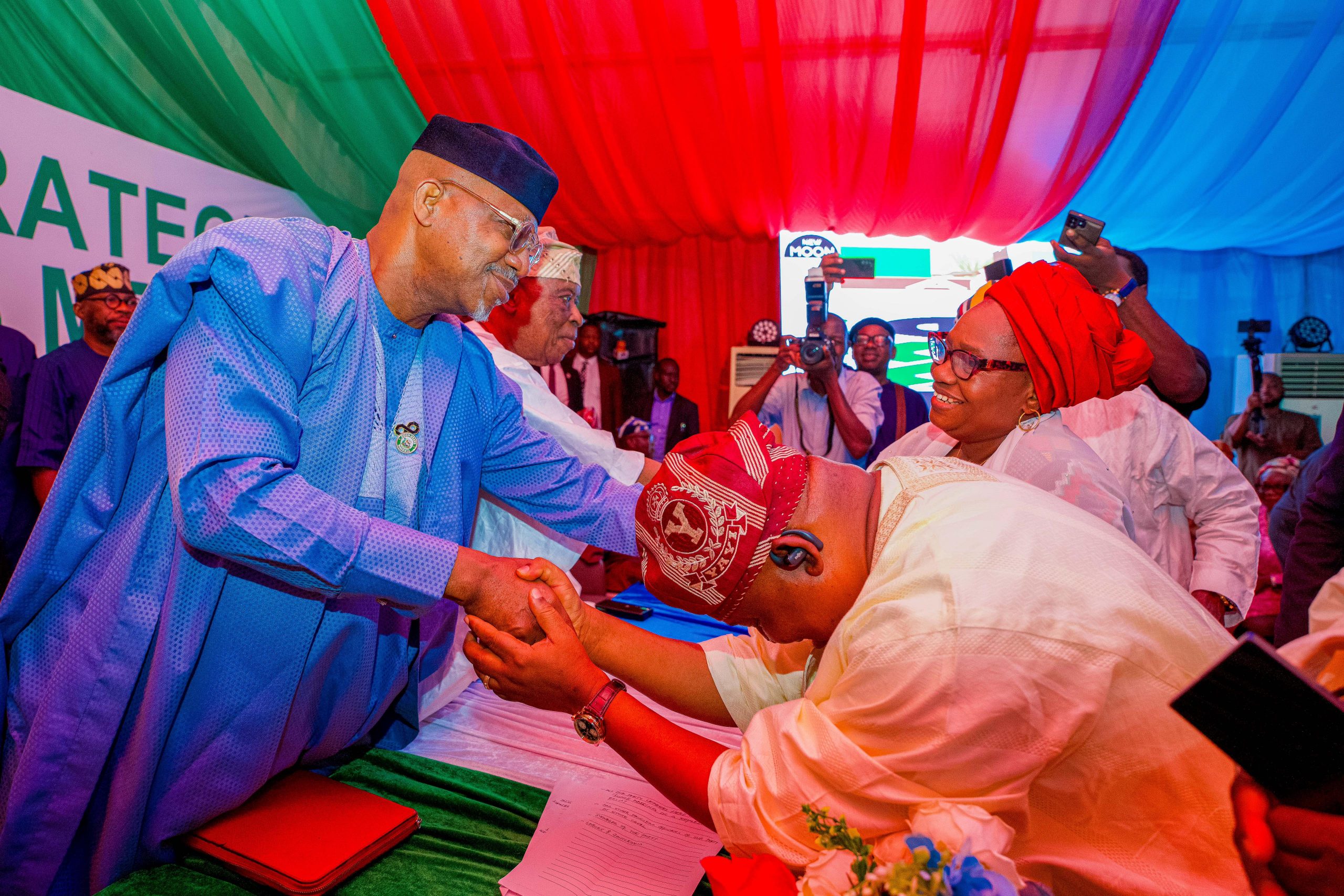
APC Picks Adeola Yayi as Consensus Candidate, Declares ‘New Ogun State Is Born’
ABEOKUTA, OGUN STATE — The Ogun State chapter of the All Progressives Congress (APC) has adopted Solomon Olamilekan Adeola, popularly known as Yayi, as its consensus governorship candidate ahead of the 2027 election.
The decision was announced on Monday, April 13, 2026, during a high-level party congress held in Abeokuta, drawing party leaders and stakeholders from across the state.
Governor Dapo Abiodun, who presided over the gathering, said the consensus arrangement was a strategic move to promote equity and inclusiveness, particularly by addressing what he described as a decades-long marginalisation of Ogun West Senatorial District in the state’s leadership structure.
He noted that the decision reflects a deliberate effort by the party to rotate power fairly among the state’s senatorial zones.
“Nothing will give me more joy than to fulfill the dreams of my predecessors — especially ensuring that Ogun West produces the next governor,” Abiodun said.
“I look forward to a time when I will sit proudly with my successor and my fellow former governors at the swearing-in of a new APC governor.”
Amid applause from party faithful, the governor formally unveiled Adeola as the party’s flagbearer, describing him as the most suitable candidate to lead the state into its next phase of development.
The announcement triggered jubilant reactions, with chants of “Yayi” echoing across the venue.
In his acceptance speech, Adeola expressed gratitude to party leaders and members, describing his emergence as a product of unity, sacrifice, and collective vision.
“I believe in oneness and the unity of our dear state and Ogun West by extension,” he said, pledging to justify the confidence reposed in him.
Adeola highlighted Ogun State’s growing economic relevance, noting its status as one of Nigeria’s most industrialised states. He promised to consolidate existing gains while advancing policies that would further drive development and prosperity.
“I will not let you down. I promise to keep the flag flying and maintain the unity, peace, and progress achieved in Ogun State,” he added.
Using a nautical metaphor, the senator assured party members of steady leadership, saying, “The ship I’m about to take over, I will make sure that it does not derail.”
He also emphasized inclusiveness, pledging to unite all factions within the party and across the state, regardless of political differences.
“By the grace of God, I will do my utmost best to keep every member of our great party together and ensure that we remain one indivisible family,” he said.
Declaring a new chapter for the state, Adeola proclaimed, “A new Ogun State is born,” promising a renewed focus on unity, development, and shared prosperity.
The endorsement, which took place during the APC Strategic Caucus Meeting, is widely seen as a defining moment in Ogun State politics, setting the stage for the 2027 governorship race and signaling strong internal cohesion within the ruling party.


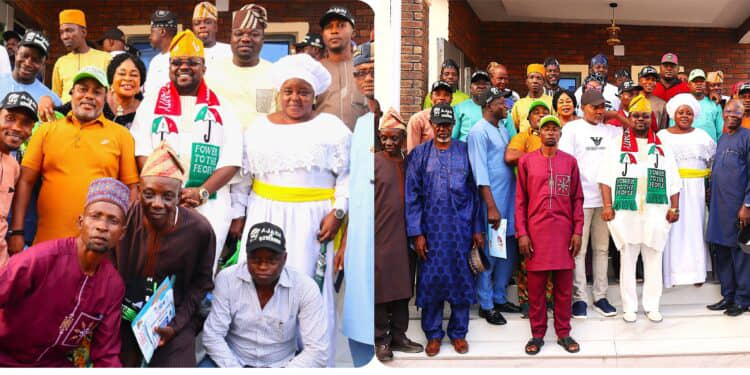
“Ajadi Stabilised Party in Crisis,” Oyo Secretary Forum Hails His Role in PDP Unity
The Oyo State governorship aspirant under the Peoples Democratic Party (PDP), Olufemi Ajadi Oguntoyinbo, on Sunday reaffirmed that his ambition to serve the people of Oyo State is driven by a desire to sustain the developmental strides of Governor Seyi Makinde, whom he described as a “talk-and-do leader.”
He made this known while hosting executive members of the Secretary Forum from the 33 local government areas of the state at his residence in Ibadan.
“Governor Seyi Makinde has done well for Oyo State. I aspire to ensure continuity of this good governance and build on the solid foundation already laid,” Ajadi said.
The PDP gubernatorial aspirant expressed appreciation to the forum for honouring his invitation, despite the short notice, noting that their unity and turnout reflected a shared commitment to the state’s progress.
I thank you all for coming. This kind of unity shows that we are ready to work together for the future of Oyo State,” he added.
Earlier, the Secretary Forum, comprising political appointees across the 33 local governments, pledged support for Ajadi’s ambition, describing him as a unifying figure within the Oyo PDP.
Speaking on behalf of the forum, the forum’s secretary, Mr. Oyelami Joel, commended Ajadi’s role in stabilising the party during its challenging period.
“He came into the party at a time of internal crisis and has worked tirelessly to unite members. His consultations across the state are visible to all,” he noted.
In her remarks, the forum’s coordinator, Mrs. Tope Alice Aworele from Egbeda Local Government, described Ajadi’s political activities as impactful across the state.
“Your efforts are visible in every nook and cranny of Oyo State. We pray that God crowns your work by making you the party’s flag bearer,” she said.
Ahmed Kazeem said members were pleased to honour Ajadi’s invitation despite the short notice, emphasising their political relevance at the grassroots.
“We are all active political stakeholders appointed under Governor Makinde. Some of us are even former local government chairmen. Our presence here today shows our collective strength and interest,” he said.
Kazeem further stressed that the full attendance demonstrated the seriousness of the forum.
Similarly, Kareem Kazeem from Ibadan South-East Local Government highlighted the significance of the turnout and prayed for Ajadi’s success, urging him to emulate Makinde’s governance style if given the party’s ticket.
Other speakers echoed similar sentiments, describing Ajadi as accessible and committed to party unity.
Mrs. Olaniyi Oluwafunke, Secretary from Ogbomoso North, said Ajadi’s track record and outreach had distinguished him among other aspirants.
“No aspirant has engaged us the way Ajadi has done. That is why we are here—to interact with him and understand his vision,” she said.
She added:
“We have one voice. No aspirant has brought us together like this. We are ready to work with Ajadi.”
In his vote of thanks, Alhaji Hammed Hassan Elerukanfila called for inclusive governance, urging Ajadi to prioritise rural development alongside urban planning if elected governor.
Special prayers were offered for the success of Ajadi’s ambition, bringing the gathering to a close on a note of optimism and political solidarity.
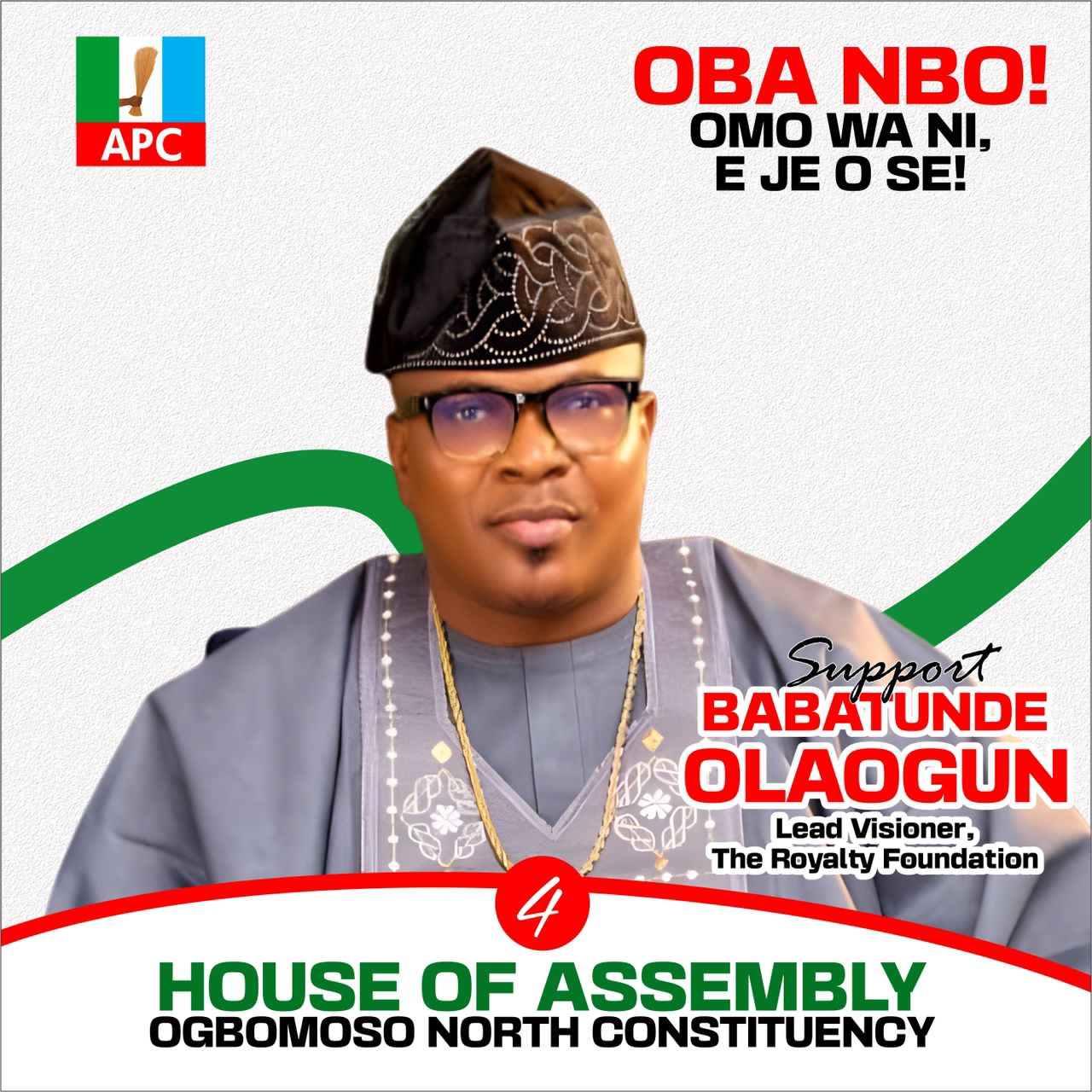
OLAOGUN URGES APC TO PRIORITISE COMPETENCE OVER PROPAGANDA AHEAD OF 2027 POLLS
Ogbomoso, Oyo State — A chieftain of the All Progressives Congress (APC) and aspirant for the Ogbomoso North Constituency, Babatunde Amos Olaogun, has called on party leaders and stakeholders to prioritise competence, capacity, and proven track record over propaganda as preparations intensify for the 2027 general elections.
In a statement addressed to constituents and party stakeholders, Olaogun expressed concern over moves within the party to adopt a consensus candidate, warning that such a process must not undermine merit or the overall interest of the constituency.
While reaffirming his loyalty to the APC and respect for party supremacy, the aspirant stressed that the essence of political participation is to ensure quality representation and effective leadership.
“Consensus must not become an excuse to sacrifice merit on the altar of convenience or propaganda. Our constituency deserves more than slogans,” he said.
Olaogun, who described himself as a scientist, administrator, and entrepreneur, said his diverse professional background positions him to deliver evidence-based leadership, attract developmental projects, and provide responsive representation to the people of Ogbomoso North.
Highlighting his past engagements, he noted that even without holding elective office, he has contributed to the welfare of constituents through medical outreaches, educational scholarships, and the provision of examination forms for students.
He assured constituents that greater impact would be achieved if given the party’s mandate, promising quality legislation, strategic empowerment programmes, and people-oriented governance
The APC aspirant also appealed to party leaders, delegates, and stakeholders to place the interest of Ogbomoso North above all considerations in selecting a candidate.
“Let us choose a candidate who can win and, more importantly, can perform. Let us choose capacity over clout, and track record over empty promises,” he urged.
Olaogun further encouraged constituents to actively engage party leaders in the decision-making process, insisting that the constituency cannot afford another cycle of under-representation.
As political activities gradually build up ahead of 2027, his remarks add to the growing conversation within party ranks on the need for credible and competent candidates to drive grassroots development.


- Afreximbank and Government of St Kitts and Nevis Sign Hosting Agreement for AfriCaribbean Trade and Investment Forum (ACTIF2026) April 14, 2026
- African Energy Chamber: Africa Must ‘Refine, Baby Refine’ as Global Supply Disruptions Expose Need for Downstream Expansion April 14, 2026
- African Mining Week (AMW) to Link Investors to Africa’s Aluminium Prospects Amid Middle East Supply Disruptions April 14, 2026
- President Mahama to launch landmark Free Primary Health Care Programme April 14, 2026
- Eritrea: Effort to expand health care services April 14, 2026
- Arbaete-Asmara Sub-Zone Declared Free of Female Genital Mutilation April 14, 2026
- Senegal Rewrites the Rules of its Hydrocarbon Boom as Minister Birame Soulèye Diop Heads to African Energy Week 2026 in October April 13, 2026
- bp Bets Big on Namibia’s Deepwater Frontier with New Offshore Blocks April 13, 2026
- Merck Foundation declared Gabon First Lady as Ambassador of “More than a Mother” to build healthcare capacity, break infertility stigma, and support girl education April 13, 2026
- Changpeng Zhao (CZ) Releases Freedom of Money, a Memoir Reflecting on the Rise of Crypto and the Story Behind Binance April 13, 2026
- Afreximbank and Government of St Kitts and Nevis Sign Hosting Agreement for AfriCaribbean Trade and Investment Forum (ACTIF2026) April 14, 2026
- African Energy Chamber: Africa Must ‘Refine, Baby Refine’ as Global Supply Disruptions Expose Need for Downstream Expansion April 14, 2026
- African Mining Week (AMW) to Link Investors to Africa’s Aluminium Prospects Amid Middle East Supply Disruptions April 14, 2026
- President Mahama to launch landmark Free Primary Health Care Programme April 14, 2026
- Eritrea: Effort to expand health care services April 14, 2026
- Arbaete-Asmara Sub-Zone Declared Free of Female Genital Mutilation April 14, 2026
- Senegal Rewrites the Rules of its Hydrocarbon Boom as Minister Birame Soulèye Diop Heads to African Energy Week 2026 in October April 13, 2026
-

 news4 months ago
WHO REALLY OWNS MONIEPOINT? The $290 Million Deal That Sold Nigeria’s Top Fintech to Foreign Interests
-

 celebrity radar - gossips3 months ago
Dr. Chris Okafor Returns with Power and Fire of the Spirit -Mounts Grace Nation Altar with Fresh Anointing and Restoration Grace on February 1, 2026
-

 celebrity radar - gossips4 months ago
Prophet Kingsley Aitafo Releases 2026 Prophecy: ‘Nigeria Will Rise, but the World Must Prepare for Turbulence’
-

 celebrity radar - gossips6 months ago
End of an Era: Nigeria Mourns Evangelist Dr. Uma Ukpai, 80