
society
Insecurity: Group Scores Defence Minister Badaru Low on Performance


Insecurity: Group Scores Defence Minister Badaru Low on Performance
The Arewa Action Group (AAG), a civil advocacy coalition based in Kaduna, has issued a damning assessment of Nigeria’s Minister of Defence, Mohammed Badaru Abubakar, accusing him of gross incompetence and declaring his office “technically vacant” in the face of worsening insecurity in the northern region.
In a strongly worded press statement on Sunday signed by the group’s president, Comrade Ibrahim Adamu Bature, the AAG expressed deep frustration over what it described as Badaru’s “utter cluelessness, lack of coordination, and commercial mindset” in handling one of the most sensitive roles in the nation’s security architecture.
“For all practical purposes, the office of the Minister of Defence is vacant. Mr. Badaru has not shown any intellectual capacity, strategic seriousness, or political coordination required to confront the scale of insecurity Nigeria is currently facing. His continued stay in office is a grave disservice to the country and especially to northern communities being slaughtered daily without response,” Bature said.
The group lamented that despite occupying such a critical post, Badaru has failed to provide any concrete roadmap or vision for strengthening Nigeria’s defence posture or synchronising efforts across the armed forces, intelligence services, and the political leadership.
“This is a Minister who behaves more like a merchant of contracts than a custodian of national security. His background in procurement and state-level politics does not qualify him to lead a ministry that should be defining the strategic and operational directions of our military in a time of war,” Bature declared.
According to the Arewa Action Group, the Defence Minister’s lacklustre performance has coincided with a sharp deterioration of security across the north, from Sokoto to Kaduna, Zamfara, Niger, Plateau, and Borno states.
The group said the absence of firm civilian oversight of military operations has created a vacuum being exploited by terrorists, bandits, and insurgents.
“Insecurity has worsened because there is no political leadership at the top of the Defence Ministry. Service chiefs are left to operate in silos. No one is setting a clear agenda or holding anyone accountable. What we are seeing is a Ministry of Defence reduced to the execution of fencing contracts and furniture procurement, not one fit for the battlefield,” the statement added.
The group said while President Tinubu has demonstrated commitment by enhancing military funding and initiating new security collaborations with regional partners, these efforts are being undermined by the “absence of competent civilian leadership” at the Ministry of Defence.
“President Tinubu must act now to rescue the Defence Ministry from the grip of passivity. He needs a serious-minded person who understands strategy, who can liaise with service chiefs, brief the President candidly, engage the National Assembly robustly, and reassure Nigerians that this government is in charge,” Bature urged.
The AAG further warned that with the security architecture failing in the north and morale among soldiers and citizens alike wearing thin, the stakes are too high for mediocrity and political appointments that prioritise loyalty over performance.
“This is not a ceremonial post. Nigerians need a Defence Minister who is present, proactive, and politically mature to align the military’s efforts with civilian expectations,” the group insisted.
In conclusion, group passed a vote of no confidence on Minister Badaru and called on President Tinubu to immediately appoint a more qualified and serious individual with the competence and will to lead the Ministry of Defence.
“Nigeria is at war. This is not the time for trial-and-error leadership. We call on Mr. President to put the interest of Nigerians above politics,” Bature said.









Carry‑On Chaos: Travelers Clash Over Tightened Size Rules in 2026
By George Omagbemi Sylvester | Published by SaharaWeeklyNG
“As airlines worldwide strictly enforce carry‑on dimensions, social media erupts, passengers incur surprise fees, and industry experts warn that confusion and inconsistent policies are straining the travel ecosystem.”
A growing storm of discontent has erupted across social media platforms, particularly on TikTok, as air travelers from the United States to Europe and beyond grapple with the tightening of carry‑on luggage size enforcement in 2026. What began as a viral video warning about changing baggage measurements has ballooned into a widespread debate over airline policies that many passengers say are opaque, inconsistent and financially punitive.
The spark was a clip shared by TikTok user karenschaler, a screenwriter and travel enthusiast, urging fellow flyers to reexamine their carry‑on bags before their next trip. She insisted that “so many carry‑on bags that used to get through fine are now getting pulled, gate checked and you are being charged,” especially if those suitcases have hard shells, bulky wheels, or extended handles that make them technically oversize.
What most passengers didn’t realize until recently is that this isn’t a new rule implemented by governments, there’s no global treaty or international regulator that set new carry‑on dimensions for 2026. Rather, what’s changed is the degree of enforcement by airlines and how they interpret their own size restrictions, which often include wheels and handles in the measurement.
At the centre of the controversy is the 22 x 14 x 9 inches limit (56 x 36 x 23 cm), a standard carried by many U.S. carriers, including American Airlines and others. Under these policies, the size limit now explicitly counts everything on the bag not just the main compartment, but also the wheels and pull handle. Bags exceeding this, even by fractions of an inch, are being flagged at gates and subjected to surprise “gate‑check” fees that can range from around $35 to $65 or more.
A particularly viral incident that fuelled the debate involved an NHS doctor denied boarding on an easyJet flight because her carry‑on (though marketed as compliant) was deemed too large when measured by airline staff at the gate. That moment, widely shared and criticized online, has given tangible form to passenger frustration.
Experts point to multiple forces behind this shift. Airlines are under growing pressure to reduce boarding times and streamline turnaround operations. Flight delays often are caused by bottlenecks at boarding gates when oversized bags are discovered last‑minute. Stricter enforcement, carriers say, helps ensure that baggage physically fits into overhead compartments and that flights depart on schedule.
Dr. Sarah Rodrigues, an aviation policy expert at the Global Transport Institute, explains: “Airlines are trying to balance operational efficiency with passenger convenience. When policies lack clarity and consistency, you inevitably get confusion and frustration and especially when their interpretation varies from one airport or carrier to another.”
Some carriers, like American Airlines, have even removed rigid bag sizers from gate areas, instead training agents to use discretion when assessing bags, with instructions to “err on the side of the customer” for borderline cases. But that discretion itself is part of the confusion, with travelers unsure what will be accepted at one airport and rejected at another.
On TikTok and Reddit threads, travelers have shared anecdotes of bags that flew without issue in 2025 now being denied in 2026. Common complaints include unclear advertising by luggage manufacturers and many still label products as “carry‑on approved” without noting that airline measurements must account for wheels and handles.
One frequent commenter lamented, “We bought a new bag last year to fit requirements now it’s suddenly not good. This is the biggest scam. Every year the airlines seem to change rules for carry‑ons.” Another quipped, “Did the overhead bins shrink?” encapsulating a sentiment that the rules are arbitrary rather than grounded in real capacity needs.
Travel consumer advocate Mark Jenkins, director of the Airline Passenger Rights Foundation, warns: “When airlines tighten enforcement without clear, unified communication, you disenfranchise passengers. Clarity, not ambiguity, should be the lodestar of airline policy.”
Part of the frustration stems from the sheer lack of global standardization. In the U.S., many carriers still adhere to the 22 x 14 x 9 standard, while some, like Southwest Airlines, maintain slightly larger allowances for now. Other parts of the world feature entirely different rules; some European proposals even aim to mandate free hand luggage for passengers, another layer of policy that can run counter to carriers’ current practices.
The result is confusion among passengers who might (without a global regulatory baseline) find their luggage acceptable on one flight and penalized on the next.
Consumer groups advise that travelers measure their luggage carefully (including wheels and handles) and check airline‑specific policies before booking. In an era where ancillary fees contribute significantly to airline revenue, passengers increasingly find themselves navigating a labyrinth of hidden charges.
Dr. Elizabeth Moreno, a transportation economist, notes: “Air travel is no longer just about the ticket price. It’s the sum of every fee (checked bags, carry‑ons, seat selection) and when airlines alter enforcement without uniform messaging, it erodes consumer trust.”
The carry‑on debate of 2026 reflects broader tensions in modern air travel: operational efficiency versus passenger rights, profitability versus transparency, efficiency versus customer experience. As travelers share their frustrations online and industry policies continue to evolve, one thing remains clear, the skies may be busy, but the policies on the ground need greater clarity, cohesion, and fairness if passengers and airlines are to move forward together peacefully.

*BREAKING NEWS*
UKA Shakes Global Digital Finance Space with É-ATC Gold Coins Launch
In a groundbreaking move, the United Kingdom of Atlantis (UKA) has officially launched its É-ATC Gold Coin, backed by a staggering $10 billion gold reserve. This revolutionary cryptocurrency is set to disrupt the global digital finance landscape, boasting a starting market capitalization of $10 billion and a token price of $20.
The launch of the É-ATC Gold Coin marks a significant milestone for UKA, demonstrating its unwavering commitment to innovation, financial stability, and progress. The organization apologizes for recent digital inconsistencies and assures stakeholders that corrective measures are in place to ensure a seamless experience.
Emperor Dr Ugochukwu Christian Esemonu. Emperor incharge of Africa Region, Emperor incharge of Santorini Empire. Also Emperor incharge of Admin to the Global Throne. A man who is standing stronger and stronger inspite of distraction, expressed heartfelt gratitude to the Almighty God, Jehovah, and acknowledged the visionary leadership of Nobilis Solomon Winning, the Father of the Kingdom. The message also recognized the invaluable contributions of esteemed stakeholders, including the Global Emperor Admin of Atlantis, the Head of Government, and the Secretary General to Government.
The É-ATC Gold Coin is designed to rival leading global digital solutions, offering a secure, reliable, and transparent means of financial transaction. UKA citizens and global stakeholders are encouraged to complete their KYC processes and participate in acquiring the coins, becoming part of this historic moment in digital finance history.
“Today, we mark a new chapter in UKA’s journey, one of innovation, growth, and prosperity,” said Emperor Dr. Ugochukwu Christian Esemonu. “We are committed to delivering excellence and driving progress for our citizens and stakeholders.”
UKA’s leadership has called on citizens to unite, move forward in discipline, and peaceful coexistence, as they expand their platforms for business, trade, investment, and exchangeability. The organization is poised to surprise its critics and rise stronger, with a focus on delivering tangible results and driving growth.
The Reigning Monarch Emperor Solomon Winning’s unwavering faith, courage, and tenacity have brought UKA this powerful new beginning. His steadfast leadership has kept the vision alive, even in challenging moments, and has proven to be a beacon of hope for the people of UKA.
The É-ATC Gold Coin is now among the top 12 most powerful market capitalization in the world, a testament to UKA’s commitment to excellence and innovation.
*Key Highlights:*
– É-ATC Gold Coin launched with $10 billion gold backing
– Starting market capitalization: $10 billion
– Token price: $20
– Crypto version designed to compete with leading global digital solutions
– UKA citizens and stakeholders encouraged to participate in acquiring coins
society
Zamfara State Launches Landmark IDP Policy and Action Plan as UNDP, Northwest Forum Pledge Support
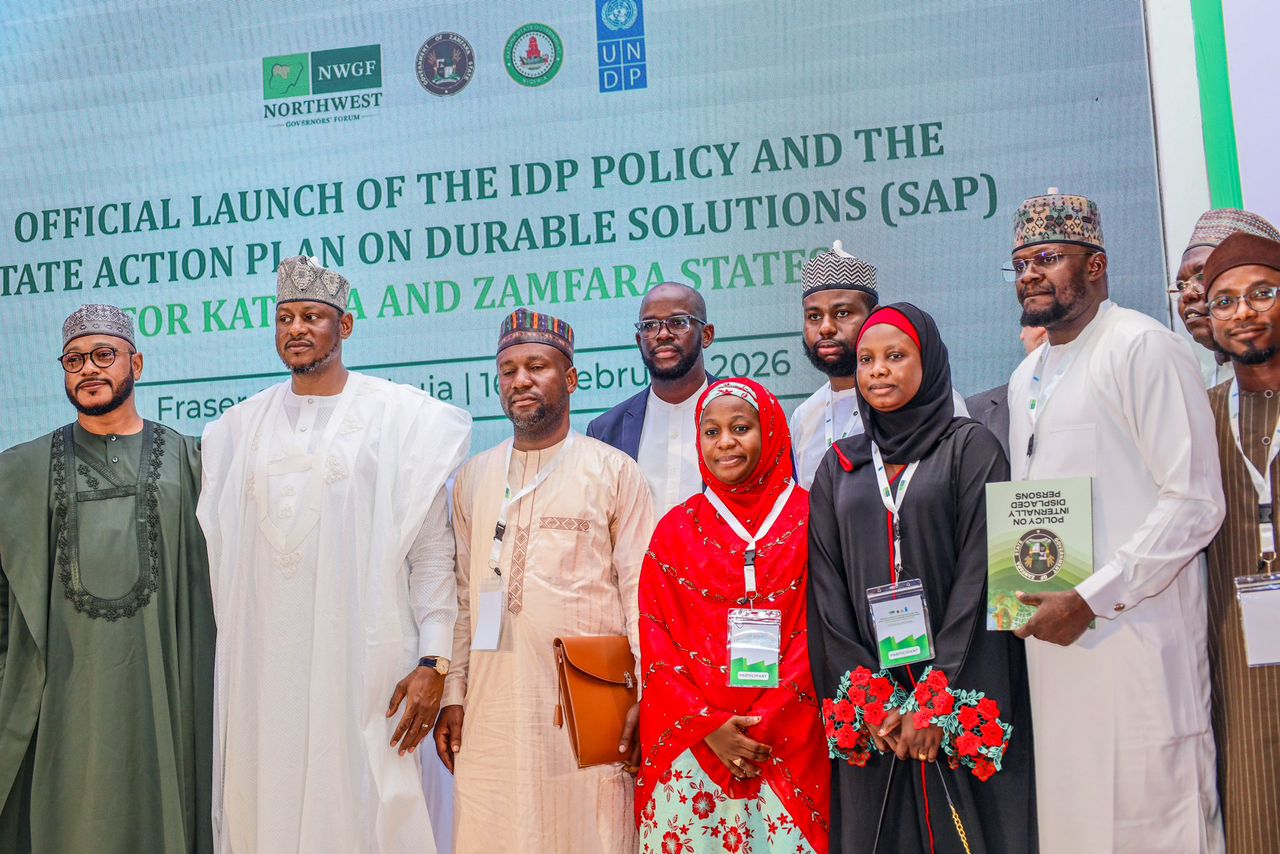
Zamfara State Launches Landmark IDP Policy and Action Plan as UNDP, Northwest Forum Pledge Support
In a significant move to address the humanitarian crisis wrought by banditry and internal displacement, the Executive Governor of Zamfara State, His Excellency Dr. Dauda Lawal, has officially launched a comprehensive policy framework and action plan aimed at delivering durable solutions for internally displaced persons (IDPs) in the state.
The Governor attended the joint launch ceremony for the IDP Policy and the State Action Plan on Durable Solutions, an initiative simultaneously rolled out for both Katsina and Zamfara States in the nations capital Abuja today Feburary 16, 2026. The event marks a pivotal moment in the region’s approach to managing displacement, shifting from emergency response to long-term, sustainable recovery.
The ambitious programme is the product of a strategic collaboration between the Northwest Governors Forum and the United Nations Development Programme (UNDP). This partnership underscores a unified, regional acknowledgment that the challenges of displacement require coordinated, multi-state solutions that address root causes and build lasting resilience.
For Zamfara State, which has borne the brunt of years of insecurity, the new policy is being hailed not merely as a bureaucratic formality, but as a binding social contract with its most vulnerable citizens. It establishes a clear roadmap for restoring the dignity of displaced families, with a laser focus on rebuilding shattered communities and creating viable pathways for safe return, peaceful resettlement, and sustainable reintegration.
The framework goes beyond temporary relief, outlining concrete strategies to help displaced populations not just survive, but ultimately thrive in safety. It seeks to transform the lives of those who have lost their homes and livelihoods by ensuring they are active participants in the state’s recovery.
Speaking at the launch, Governor Lawal reaffirmed the administration’s unwavering commitment to translating the policy document into tangible, measurable impact on the ground. “Under my leadership, we remain committed to ensuring that this framework translates into measurable impact for our people.”
The launch signals a new chapter for Zamfara, one focused on healing and forward momentum. By anchoring the response in a durable solutions framework, the state government aims to build systemic resilience, strengthen the capacity of local institutions to manage future crises, and ultimately, shape a more secure, stable, and inclusive future for all residents of Zamfara State.



-

 celebrity radar - gossips6 months ago
Why Babangida’s Hilltop Home Became Nigeria’s Political “Mecca”
-

 society6 months ago
Power is a Loan, Not a Possession: The Sacred Duty of Planting People
-

 news6 months ago
THE APPOINTMENT OF WASIU AYINDE BY THE FEDERAL GOVERNMENT AS AN AMBASSADOR SOUNDS EMBARRASSING
-

 Business6 months ago
Batsumi Travel CEO Lisa Sebogodi Wins Prestigious Africa Travel 100 Women Award