
society
Cybercrimes Act 2025: Nigeria’s Cybercrimes Act Deepens Inequality, Experts Warn


Cybercrimes Act 2025:
Nigeria’s Cybercrimes Act Deepens Inequality, Experts Warn.
By George Omagbemi Sylvester | Published by Sahara Weekly NG
Introduction
The Federal Government’s passage of the Cybercrimes (Prohibition, Prevention, etc.) (Amendment) Act 2024, now operational in 2025, heralds entrenched contradictions. On paper, the legislation aims to bring digital order and curb online abuses. In reality, however, it magnifies inequality.
Sections criminalizing online harassment (Section 22—mirroring earlier codifications in Section 24 of the 2015 Act) and publishing false or misleading information (Section 19) are presented as noble tools for accountability. When viewed through the lens of enforcement, the story changes: the poor (politically powerless, digitally exposed and legally unprotected) shoulder the blunt force of this law, while the elite effortlessly slip through its cracks.

This is not merely a legal dilemma; it is a question of justice, class and democracy in the digital age.
Part I: What the Law Prescribes.
Online Harassment and Abuse – Section 22
Under the new law, posting rude, vulgar, offensive or indecent content with intent to embarrass or humiliate others is an offense punishable by up to 2years’ imprisonment.
This is not entirely new. The Cybercrime Act of 2015 had already addressed similar conduct under Section 24 (1), which criminalized sending “grossly offensive, pornographic, indecent, obscene or menacing” messages or false communications intended to cause “annoyance, inconvenience, danger, insult or needless anxiety.” The penalty then was 3years’ imprisonment or a fine of up to ₦7 million.

Publishing False or Misleading Information – Section 19
The new provision explicitly targets “fake news.” Anyone who spreads deliberately false or misleading content online now faces up to 2years in prison.
While the intent is to protect society from deception, vague definitions leave room for abuse. What exactly constitutes “FALSE” information in a country where government officials frequently contradict themselves? Whose truth becomes the standard?
Part II: Enforcement and Inequality.
A Resource Gap.
Cybercrime is undeniably a global threat. INTERPOL’s 2025 Africa Cyberthreat Assessment shows cybercrime now constitutes more than 30% of reported crimes in some African states. Yet, 90% of African nations (including Nigeria) admit they lack the training, tools and prosecutorial capacity to handle such sophisticated threats.
Nigeria does have the Nigeria Police Force National Cybercrime Center (NPF-NCCC), which engages in awareness and coordination. The reality is that prosecutions remain sporadic, selective and unequal.

Selective Prosecution
The elite are shielded. Politically connected individuals can hire top lawyers, secure injunctions and navigate courts to avoid consequences.
For the poor, however, the law is deadly literal. A tweet born out of frustration, a WhatsApp broadcast or even a Facebook comment can be twisted into a criminal indictment. Without access to competent legal representation, many are left at the mercy of magistrates and police officers.
The Digital Divide.
Nigeria now boasts over 152 million active internet users. Yet digital literacy remains low. Millions of Nigerians are active online without a clear understanding of the risks posed by the law.
The elite enjoy the privilege of education and access. They know how to carefully word criticism, disguise satire or even hire digital strategists. The poor (especially those posting in anger, in indigenous languages or with limited education) become easy prey.
Thus, the Cybercrimes Act, instead of being an equalizing force, has deepened digital classism.
Part III: Expert Perspectives.
Several respected voices have raised alarms about the trajectory of Nigeria’s cyber legislation:
“The Cybercrimes Act’s broad language, especially its vague definitions of ‘false information,’ ‘cyberstalking,’ and ‘harassment,’ threatens free expression and open digital discourse.”
“The Act remains insufficient in shielding Nigerian citizens from arbitrary criminalization of online expression. Reform grounded in clarity, proportionality and accountability is not only necessary, but urgent.”
“Cybercrime continues to outpace the legal systems designed to stop it. 95% of countries report inadequate training, resource constraints and lack of access to specialized tools.”
These insights underscore the real crisis: misaligned priorities. Instead of investing in capacity to tackle fraud, identity theft and large-scale scams that tarnish Nigeria’s reputation globally, the government prioritizes criminalizing insult, dissent and satire.
Part IV: The Blunt Truth.
This law, stripped of diplomatic language, is crafted to suppress, not protect.
Weaponized Vagueness
Its ambiguous language is a prosecutorial dream but a citizen’s nightmare. Terms like “OFFENSIVE” and “FALSE” are inherently subjective. What offends one politician may simply be satire or truth to the masses.
Enforcement Inequality
Justice in Nigeria is not blind; it peeks. The poor, voiceless and resourceless, face the full fury of the law, while the elite maneuver their way out.
State Surveillance over Protection.
This legislation expands state power rather than defending citizens. By criminalizing broad categories of speech, it grants government a blank check to silence critics under the guise of law.
Blinding Hypocrisy.
Nigeria loses billions annually to cybercrime syndicates; international scams, fraudulent wire transfers and phishing attacks. Yet, instead of focusing on dismantling these sophisticated networks, the government invests energy in jailing youths for Facebook insults.
Cultural and Class Bias.
Nigeria is a multilingual nation. Satirical or colloquial expression in Pidgin, Hausa, Yoruba or Igbo is more likely to be misinterpreted as “ABUSE” by law enforcement steeped in formal English. Thus, class and language again shape how the law is applied.
End Note: A Call for Reform.
Nigeria’s 2025 Cybercrimes Act, birthed from the 2015 foundation, is not the protective shield it claims to be. It is a blunt instrument used less to fight genuine cybercriminals and more to muzzle ordinary citizens.
Three urgent reforms are needed:
Transparency and Clarity: The law must define “HARASSMENT,” “FALSE INFORMATION,” and “OFFENSIVE CONTENT” with surgical precision, leaving no room for abuse.
Equitable Enforcement: Legal aid for the poor, digital literacy programs and clear prosecution guidelines are non-negotiable.
Democratic Oversight: Civil society and the judiciary must act as watchdogs, ensuring that these laws are not weaponized against free expression.
Without these safeguards, the Act will continue to serve as a tool of suppression, a digital whip for the powerless and a shield for the privileged.
The principle is simple yet profound: If laws are not applied equally, they cease to be justice. Nigeria must choose whether it seeks order through fairness or chaos through selective repression.
By George Omagbemi Sylvester
Published by Sahara Weekly NG




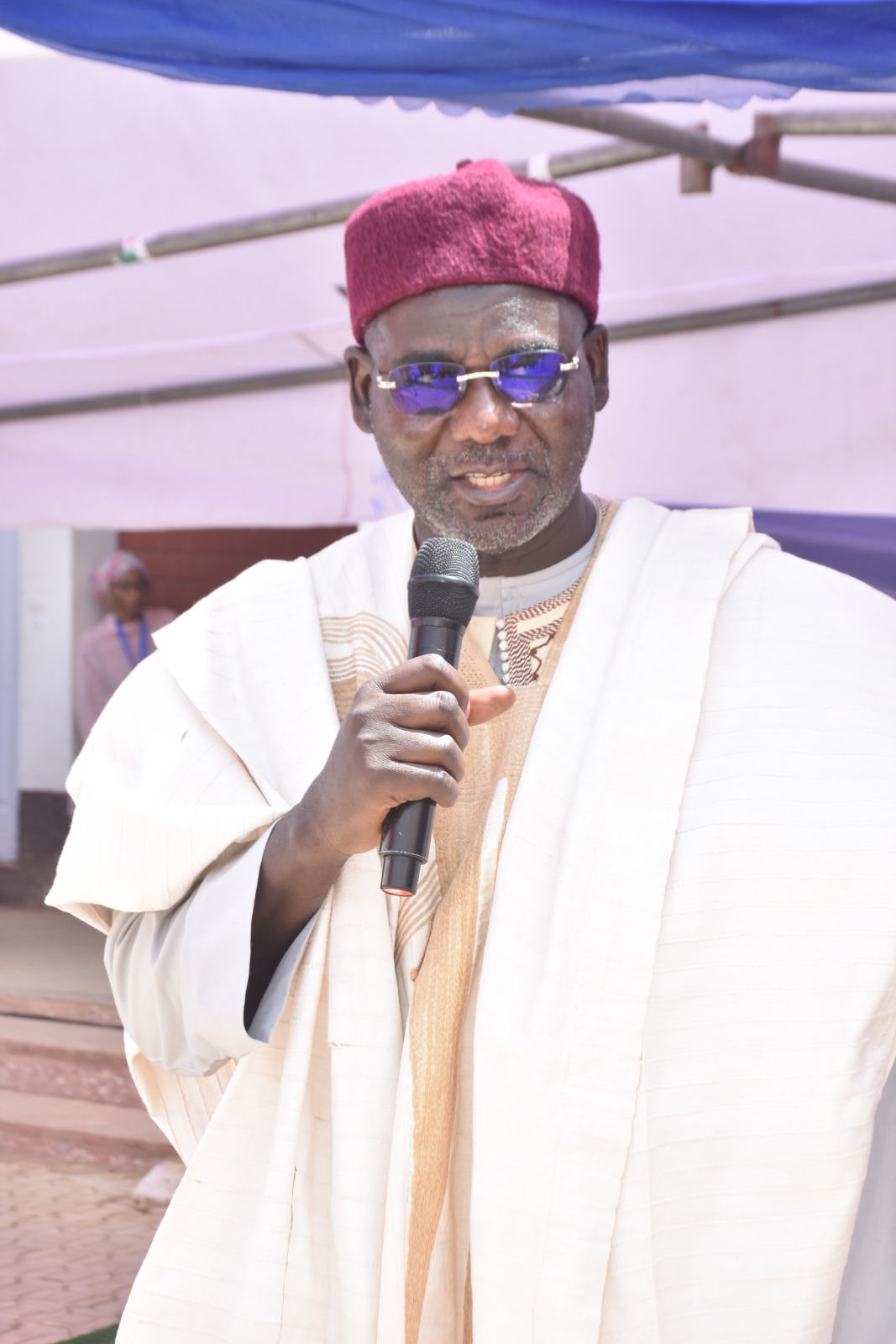
TY BURATAI HUMANITY CARE FOUNDATION CONDOLES WITH BIU EMIRATE OVER TRAGIC ATTACK
In a profound expression of sorrow, the TY Buratai Humanity Care Foundation has extended its heartfelt condolences to the families of the victims and the entire people of Biu Emirate, Borno State, following the recent tragic attack attributed to Boko Haram. This devastating assault, which occurred at a work site in northeastern Nigeria, claimed the lives of dozens, including brave soldiers committed to protecting the nation.
In a statement released to the press and signed by the Chairman of the foundation, Ibrahim Dahiru Danfulani Sadaukin Garkuwan Keffi/Betara Biu, the Grand Patron of the Foundation, His Excellency Amb. Lt. Gen. Tukur Yusufu Buratai CFR (Rtd), former Chief of Army Staff, described the incident as “one too many senseless, barbaric, and ruthless displays of inhumanity.” His Excellency emphasized the heartbreaking impact of such attacks on innocent, hardworking citizens striving to make a positive difference in their communities.
The Grand Patron praised the swift and decisive response of military personnel during this critical time, underscoring their brave commitment to safeguarding the nation. He called upon them to maintain this momentum, commending their courage and sacrifice in the face of adversity. “May Almighty Allah forgive their souls and grant them Aljannah Firdouse,” he remarked, encouraging the nation to honor their spirit of sacrifice as they rally together to rebuild and restore hope across the region.
In his statement, Gen. Buratai highlighted the importance of collective action in overcoming the challenges posed by insecurity, urging concerned citizens to increase their efforts in fostering a virile community that future generations can cherish. “Together, we can surmount these troubles,” he asserted, calling on all patriotic leaders and citizens to unite in the fight against violence and insecurity.
The TY Buratai Humanity Care Foundation remains committed to supporting initiatives that promote peace, security, unity, and prosperity. As the foundation extends its condolences to the bereaved, it also calls upon all segments of society to collaborate in creating a better and safer future. May Allah guide and protect the nation and lead it toward enduring peace. Amen.
society
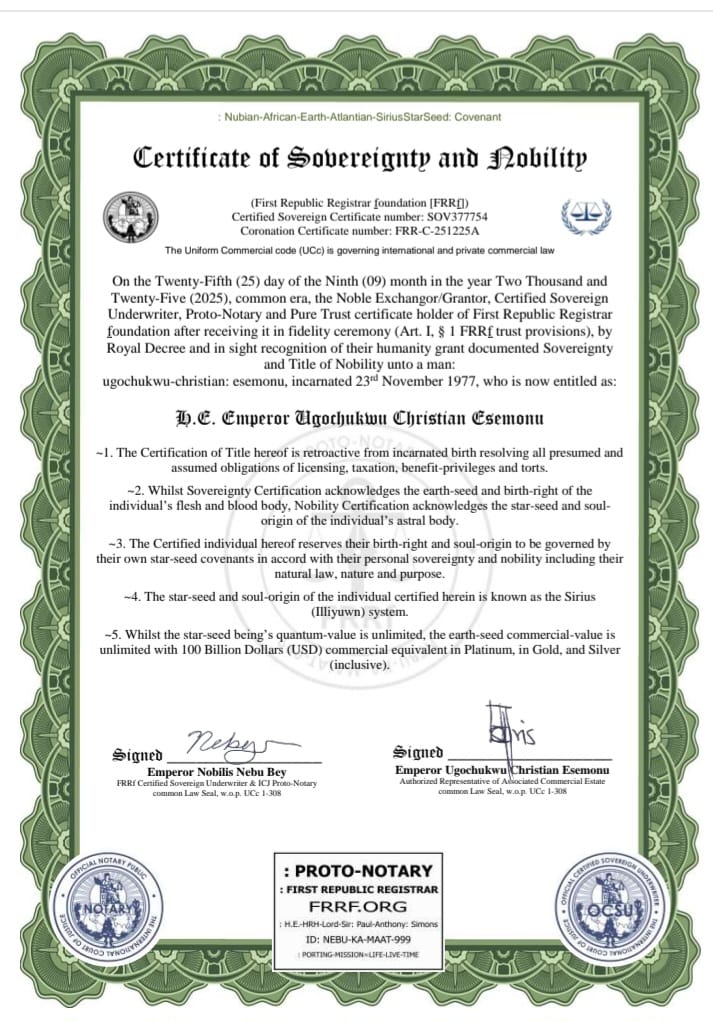
Rt Hon Treasure Edwin Inyang Appointed Secretary General to the Government of UKA (Worldwide)

Rt Hon Treasure Edwin Inyang Appointed Secretary General to the Government of UKA (Worldwide)*
January 29, 2026 – A prestigious appointment has been announced in the reign of Emperor Solomon Wining 1st, recognizing Rt Hon Treasure Edwin Inyang as the *Secretary General to the Government of UKA (Worldwide)*. The official certificate, designated STE.001-1 E, was presented to Rt Hon Inyang during a ceremonial investiture.
As Secretary General, Rt Hon Treasure Edwin Inyang will *monitor and coordinate* the implementation of government policies and programmes, serve as an advisory institution to the Government, drive policy formulation, harmonization, and implementation, and oversee the activities of ministries, agencies, and departments.
The appointment was proclaimed by *Emperor Prof. Dr. Solomon Wining*, Emperor of the United Kingdom of Atlantics and Empire Worldwide, and co-signed by *Empress Prof. Dr. Sriwan Kingjun*, Empress of Attica Empire, under the auspices of the 5 Billions Humanitarian Projects Incorporated.
The ceremony underscores the commitment to strengthening governance and humanitarian initiatives within the UKA (Worldwide) jurisdiction, effective immediately in the reign of Emperor Solomon Wining 1st.
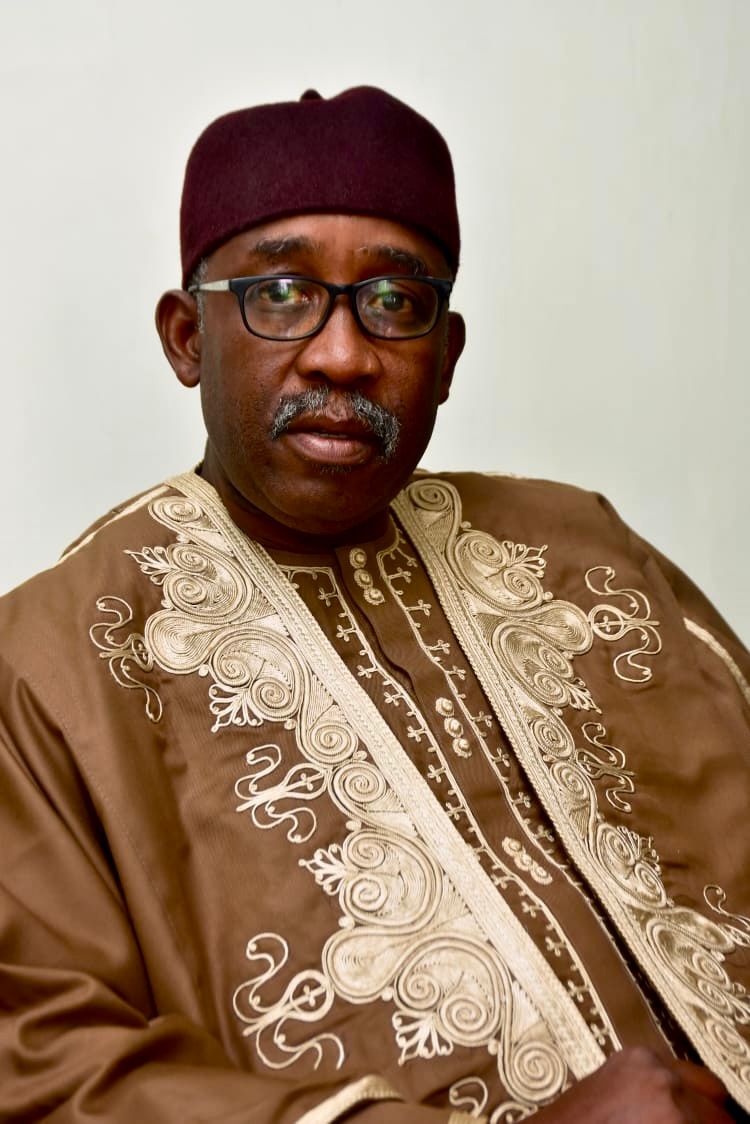
GENERAL BULAMA BIU MOURNS BOKO HARAM VICTIMS, CALLS FOR UNITY AND RENEWED EFFORTS FOR PEACE
In a solemn message of condolence and resolve, Major General Abdulmalik Bulama Biu mni (Rtd), the Sarkin Yakin of Biu Emirate, has expressed profound grief over a recent deadly attack by Boko Haram insurgents on citizens at a work site. The attack, which resulted in the loss of innocent lives, has been condemned as a senseless and barbaric act of inhumanity.
The revered traditional and military leader extended his heartfelt sympathies to the bereaved families, the entire people of Biu Emirate, Borno State, and all patriotic Nigerians affected by the tragedy. He described the victims as “innocent, peaceful, hardworking and committed citizens,” whose lives were tragically cut short.
General Biu lamented that the assault represents “one too many” such ruthless attacks, occurring at a time when communities are already engaged in immense personal and collective sacrifices to support government efforts in rebuilding devastated infrastructure and restoring hope.
In his statement, he offered prayers for the departed, saying, “May Almighty Allah forgive their souls and grant them Aljannan Firdaus.” He further urged the living to be encouraged by and uphold the spirit of sacrifice demonstrated by the victims.
Emphasizing the need for collective action, the retired Major General called on all citizens to redouble their efforts in building a virile community that future generations can be proud of. He specifically commended the “silent efforts” of some patriotic leaders working behind the scenes to end the security menace and encouraged all well-meaning Nigerians to join the cause for a better society.
“Together we can surmount the troubles,” he asserted, concluding with a prayer for divine intervention: “May Allah guide and protect us, free us from this terrible situation and restore an enduring peace, security, unity and prosperity. Amin.”
The statement serves as both a poignant tribute to the fallen and a clarion call for national solidarity in the face of persistent security challenges.


-

 celebrity radar - gossips6 months ago
Why Babangida’s Hilltop Home Became Nigeria’s Political “Mecca”
-

 society6 months ago
Power is a Loan, Not a Possession: The Sacred Duty of Planting People
-

 Business6 months ago
Batsumi Travel CEO Lisa Sebogodi Wins Prestigious Africa Travel 100 Women Award
-

 news6 months ago
THE APPOINTMENT OF WASIU AYINDE BY THE FEDERAL GOVERNMENT AS AN AMBASSADOR SOUNDS EMBARRASSING