
society
Multilateralism’s Moment: The Johannesburg Declaration and the Case That Cooperation Can (and Must) Deliver


Multilateralism’s Moment: The Johannesburg Declaration and the Case That Cooperation Can (and Must) Deliver.
By George Omagbemi Sylvester | Published by saharaweeklyng.com
“The adoption of the G20 Leaders Declaration in Johannesburg is more than ceremony; it is a practical rebuke to cynicism; a binding message that well-crafted, inclusive multilateralism remains humanity’s best instrument for solving shared crises.”
When leaders gathered in Johannesburg on 22–23 November 2025 for the first G20 summit ever held on African soil, something very plain and very consequential happened: they adopted a Leaders Declaration that speaks to the core question of our time; can the world still govern itself cooperatively when so many forces push it toward fragmentation? The short answer, emphatically, is YES. The Johannesburg declaration sends a clear signal that multilateralism can and must deliver, and that signal matters because the alternatives (unilateralism, great-power rivalry, and competitive isolation) are already proving ruinous for ordinary people everywhere.
Why does a declaration matter? Because multilateralism is not a SLOGAN; it is a set of instruments (institutions, financial arrangements, commitments and follow-through) that, when working, translate global consensus into local gains. The Johannesburg text does not pretend to solve every problem in a single paragraph. It does, however, marshal consensus on immediate, measurable priorities: accelerating renewable energy and a just energy transition, catalysing finance for developing economies, strengthening disaster resilience and post-disaster reconstruction, and re-energising efforts to tackle inequality and food insecurity. Those are not abstract goals; they are policy blueprints that require joint financing, coordinated regulation and institutional reform; the very machinery that only multilateral cooperation can provide at scale.
The politics around the summit illustrate the stakes. Washington’s absence (a high-profile boycott of the leaders sessions) made headlines and revealed the limits and frictions of global diplomacy. But the fact that a broadly representative group of G20 members nonetheless adopted a joint declaration underscores the resilience of collective action even when one major power steps back. The adoption by consensus; and the willingness of participants to anchor the declaration to concrete financing and reform proposals — demonstrates that multilateral outcomes can be both pragmatic and principled. It is the practical capacity to deliver that gives multilateralism its moral force.
South Africa’s Presidency framed the summit with a theme that was more than rhetorical: “SOLIDARITY, EQUALITY and SUSTAINABILITY.” In his opening address, President Cyril Ramaphosa put it bluntly: “The adoption of the declaration from the summit sends an important signal to the world that multilateralism can and does deliver.” That line matters not as flattery but as a public affirmation; a promise that the commitments on the page will be turned into funding, institutional changes and measurable outcomes for countries that have too often been left on the margins.
Nor is this moment detached from long-standing calls for reform. The United Nations recent “PACT FOR THE FUTURE” and the Summit of the Future discussions have argued for a multilateral system that is “FIT FOR THE PRESENT AND THE FUTURE” more representative, more democratic and more capable of rapid collective action. António Guterres has repeatedly warned that “we are here to bring multilateralism back from the brink,” a refrain echoed across policy platforms and echoed in Johannesburg by leaders and experts who see reform and delivery as two sides of the same coin. If institutions are to be strengthened, they must also show deliverables; climate finance disbursed, debt vulnerabilities addressed, supply chains stabilized, and social protections scaled.
Economic justice is central to credibility. The Johannesburg Declaration does more than nod to inequality; it foregrounds the necessity of mobilising trillions in finance (concessional lending, catalytic private finance and innovative instruments) to help developing countries invest in both DECARBONISATION and INDUSTRIALISATION. The G20’s own advisory workstreams, including an Extraordinary Committee on Global Inequality chaired by Nobel laureate Joseph Stiglitz, have produced evidence that inequality corrodes growth and that coordinated global policy can make redistribution and sustainable growth mutually reinforcing. Multilateralism’s delivery, in practice, will be measured by whether these financial pledges translate into affordable capital for infrastructure, energy access for isolated communities, and fiscal space for social investment.
Sceptics will say declarations are cheap; what matters is implementation. They are right to demand results. That is why the Johannesburg outcome matters: it links declaratory politics to institutional mechanisms and to an agenda for reform of the international financial architecture. The leaders did not simply declare a wish; they pointed toward the Sevilla Commitment and a set of G20 workstreams intended to create pipelines of bankable projects, reform multilateral development bank practices, and coordinate post-disaster reconstruction financing. In short, the declaration is a roadmap (heavy on specifics) for turning CONSENSUS into CAPITAL and CAPITAL into CAPACITY.
Although delivery will require more than good intentions. It will require political will at home and patience abroad. It will require democratic legitimacy for multilateral institutions (which means involving civil society, parliaments and subnational governments in oversight) and it will require INNOVATIVE ACCOUNTABILITY: CLEAR MILESTONES, TRANSPARENT MONITORING and INDEPENDENT EVALUATION. As IMF analysts and leading economists have argued, the multilateral system needs to become “INCENTIVE COMPATIBLE” so that every participant sees visible, near-term benefits alongside longer-term structural gains. That blend of incentives and oversight is how the system will survive the fractures of our multipolar age.
The Johannesburg declaration is also political theatre with policy teeth. It shows that when countries are willing to compromise and to prioritise collective gain over zero-sum signalling, they can put in place a common platform to tackle shared threats: climate shocks, food insecurity, pandemics, technology risks and violent conflict. These are not problems a single state can solve alone. They require interoperable rules, pooled financing, and coordinated action. The Johannesburg leaders’ document is an admission that the old adage remains true: sovereignty is protected, not weakened, when nations cooperate to reduce risks that respect no borders.
So what should we expect next? First, rigorous follow-up: project pipelines must be created, funded and monitored. Second, reform: the G20 and other institutions must accelerate the hard work of reforming governance structures (including representation and voice) so that developing countries have meaningful agency in decisions that affect their futures. Third, accountability: civil society, academia and parliamentary institutions must be empowered to hold leaders to the commitments they signed in Johannesburg. And finally, results: more renewable capacity deployed in Africa, debt relief and restructuring where necessary, and tangible reductions in vulnerability for the poorest communities.
If Johannesburg teaches us anything, it is that multilateralism’s moral claim rests on its practical performance. As Joseph Stiglitz and other leading scholars emphasize, multilateral action is both economically sensible and politically necessary; without it, inequity and instability will deepen. António Guterres’ plea to “bring multilateralism back from the brink” is not a rhetorical flourish; it is an agenda that demands both reform and delivery. The Johannesburg Declaration is a constructive step along that path. Now the real test begins: turning WORDS into WORK, and COMMITMENTS into CHANGE.
History will judge Johannesburg not simply by the eloquence of its statements but by whether the summit’s promises are lived out in schools with power, hospitals with supplies, farms with drought resilience, and economies with inclusive jobs. That is the only defensible yardstick for multilateralism: performance that improves lives. The declaration says it can be done. The world must now prove it — quickly, transparently and with fierce resolve. The future of cooperative global governance depends on nothing less.




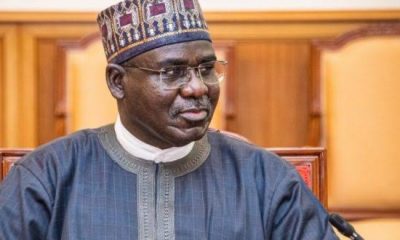






Life Patron Gen. Buratai Congratulates Newly Elected Lady Captain of TYBGRCC
ABUJA – The Tukur Yusufu Buratai Golf Resort and Country Club (TYBGRCC) has ushered in a new era of leadership with the election of Ms. Jumai Hajara Adamu as its Lady Captain.
The club’s Life Patron, Lt Gen Tukur Yusufu Buratai (Rtd) CFR, former Chief of Army Staff, has extended his warm congratulations and full endorsement. “As the Life Patron, I am immensely proud to see a leader of your calibre step forward,” he stated. “Please be assured of my full and unwavering support throughout your tenure. I have every confidence that your leadership will be marked by significant achievements.”
The election, conducted by the club’s Board of Trustees and membership, highlights a unanimous confidence in Ms. Adamu’s vision and dedication to the sport and the club’s community.
In her acceptance address, the newly elected Lady Captain outlined a forward-looking agenda anchored on three key pillars: Unity, Development, and Inclusiveness. “I believe that golf is not just a sport but a powerful platform for friendship, discipline, mentorship, and community,” she stated, pledging to strengthen member bonds, encourage greater participation among ladies and youth, and enhance the club’s facilities.
Ms. Jumai Hajara Adamu, a respected member known for her active participation and organizational acumen, succeeds a line of distinguished past Lady Captains. She has pledged to build upon their legacy with transparency, teamwork, and accountability, ensuring every member feels heard and represented.
This appointment is seen as a significant step for the TYBGRCC, reinforcing its commitment to excellence, growth, and fostering a vibrant sporting community in the heart of the nation’s capital. The club anticipates a dynamic and prosperous term under her guidance.
About Tukur Yusufu Buratai Golf Resort and Country Club (TYBGRCC):
Located in Abuja, TYBGRCC is a premier golfing destination dedicated to promoting the sport of golf, fostering camaraderie, and encouraging a healthy lifestyle among its members and guests. It stands as a testament to world-class sporting and recreational facilities.
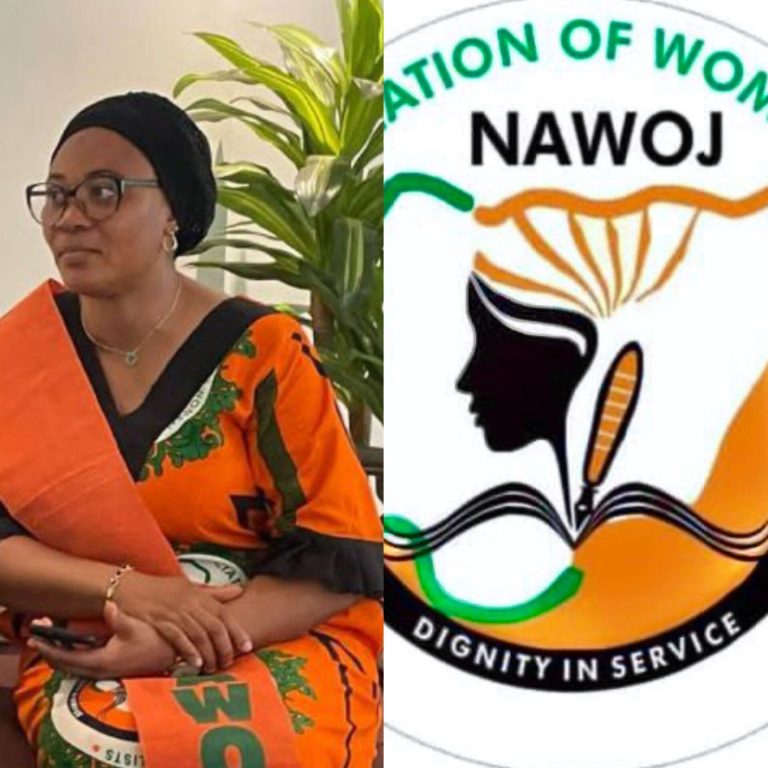
NAWOJ: SEKINAT, CHARITY GETS VOTE OF CONFIDENCE
The Nigeria Association of Women Journalists,(NAWOJ), Ogun State Chapter Executives has unanimously passed a vote of confidence on Chairman NAWOJ SEKINAT Salam and the Financial Secretary, Charity James, saying that, their leadership reflect the ideal and objectives of NAWOJ.
This was revealed in a communique issued at an Emergency meeting of the Executive held at the NUJ State Council, Iwe-Iroyin in Abeokuta.
The vote of confidence on the Leadership of NAWOJ was unanimously signed by all the five executive members that attended the meeting with the vice chairperson taking apology for official engagement outside the state capital.
According to the communique ” Consequently, NAWOJ Ogun State Chapter, reaffirms it’s unwavering support and confidence in the Chairperson and the Financial Secretary, Sekinat Salam and Charity James respectively, Urge them to continue in their commitment to purposeful leadership in the best interest of the association and the society at large”.
Speaking briefly with Journalists after the emergency Executive meeting, the Chairperson, Nigeria Association of Woman Journalists (NAWOJ), Com. Sekinat Salam, said the meeting was necessary as the news of her suspension was laughable and insulting because it is like a pot calling a kettle black in this case, saying that the Leadership of the State Council, Com. Wale Olanrewaju has no local standing to suspend her or any executive member, even he cannot be a judge in his own case.
According to her” The Leadership of the Nigeria Union of Journalists, Ogun State led by Wale Olanrewaju has always been misusing power without recourse to the constitution of this noble Union, hence has no local standing to suspend me or any executive member “.
She said only the Central Working Committee (CWC) has the constitutional rights to sanction or suspend any members found wanting after due process has been followed.
While calling on members to stay calm, Com. Sekinat Salam assured members of positive representation of NAWOJ at both the State and National level, adding the success recorded under her administration cannot be overemphasized.
She therefore called on the National leadership of NUJ to critically look into the matter, either by setting up independent committee to investigate the issues and resolve the matter as quickly as possible.
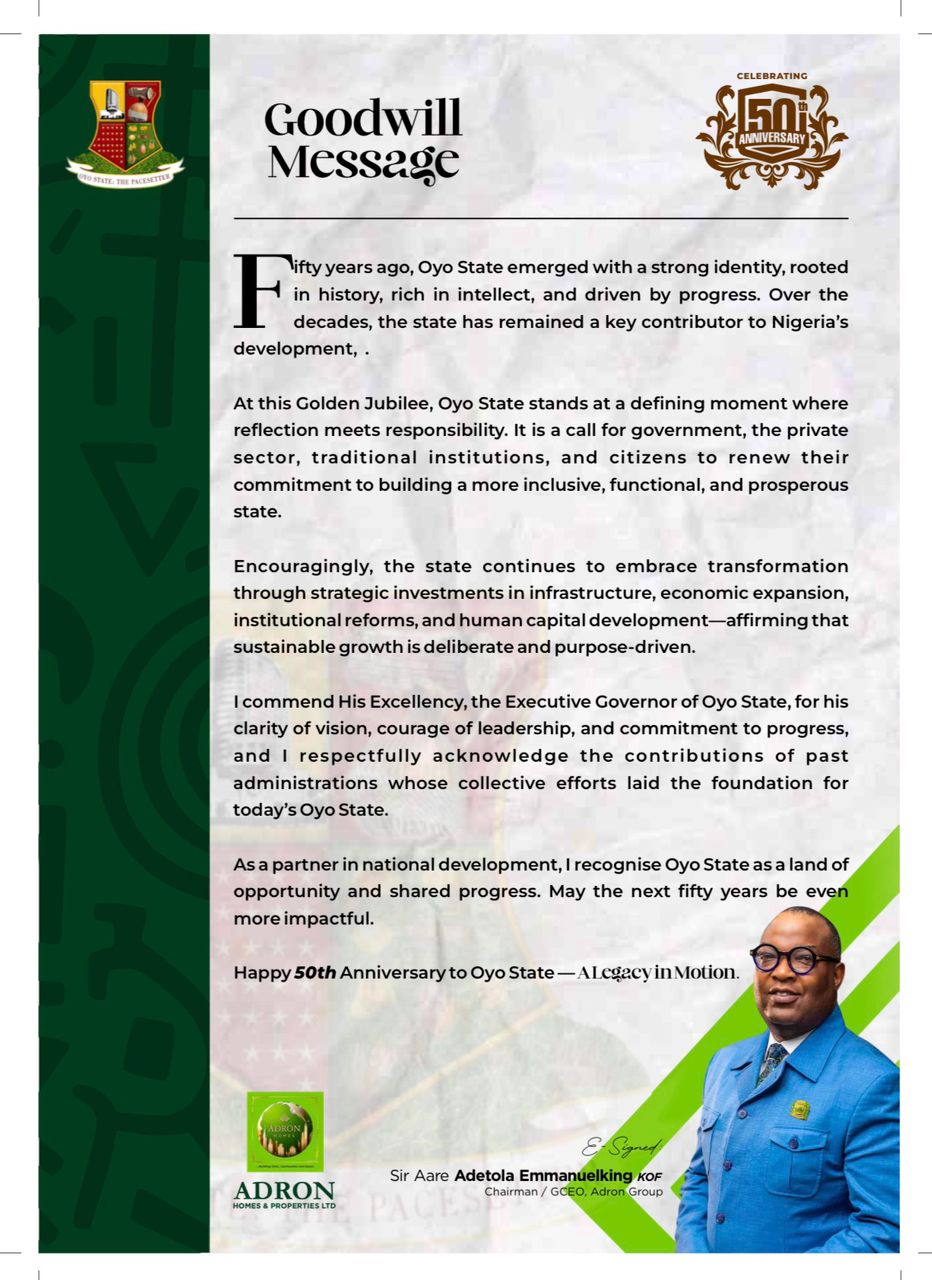
Adron Homes Chairman Congratulates Oyo State on 50 Years of Progress
The Chairman and Chief Executive Officer of Adron Homes and Properties Limited, Aare Adetola Emmanuelking, has congratulated the Government and people of Oyo State as the state marks its 50th anniversary, describing the occasion as a celebration of resilience, cultural pride, and sustained progress.
He noted that since its creation, Oyo State has remained a strong contributor to Nigeria’s socio-economic and cultural development, emerging as a hub of commerce, education, and innovation.
According to him, the Golden Jubilee offers a moment for reflection and renewed commitment by government, private sector players, traditional institutions, and citizens toward building a more inclusive and prosperous state.
Aare Emmanuelking commended the state’s ongoing transformation through investments in infrastructure, economic expansion, and human capital development, adding that sustainable growth is deliberate and must remain purpose-driven.
He also praised the leadership of the current administration while acknowledging the contributions of past leaders whose efforts laid the foundation for today’s Oyo State.
Reaffirming Adron Homes’ commitment to national development, he described Oyo State as a land of opportunity. He wished the state continued peace and prosperity, expressing confidence that the next fifty years will bring even greater achievements for the Pace Setter State and its people.


-

 celebrity radar - gossips6 months ago
Why Babangida’s Hilltop Home Became Nigeria’s Political “Mecca”
-

 society6 months ago
Power is a Loan, Not a Possession: The Sacred Duty of Planting People
-

 Business6 months ago
Batsumi Travel CEO Lisa Sebogodi Wins Prestigious Africa Travel 100 Women Award
-

 news6 months ago
THE APPOINTMENT OF WASIU AYINDE BY THE FEDERAL GOVERNMENT AS AN AMBASSADOR SOUNDS EMBARRASSING