
society
Holding You Against Your Will: Why Our Freedom Truly Matters.

Holding You Against Your Will: Why Our Freedom Truly Matters.
By George Omagbemi Sylvester | Published by saharaweeklyng.com
“How the denial of liberty crushes dignity, opportunity and progress and why reclaiming freedom is the first, last and only path to justice.”
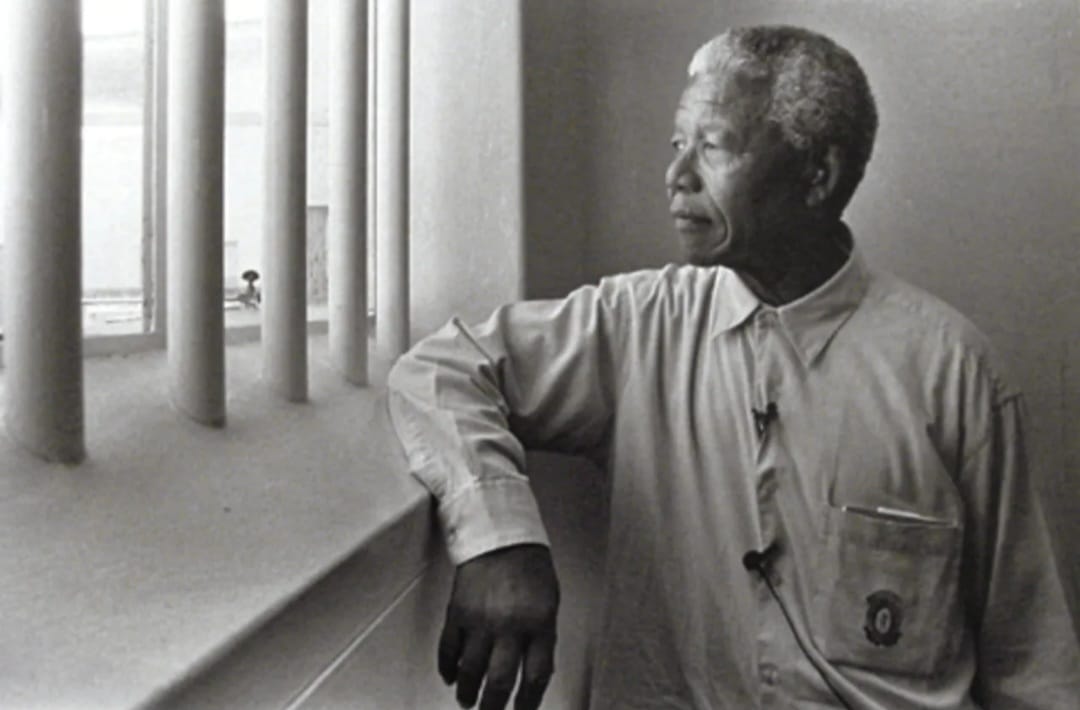
Freedom is not a decorative privilege or a political gift bestowed by those in power. It is the core substance of human dignity, the foundation upon which every modern society is built, and the indispensable right that determines whether a human being is treated as a person or as a possession. To be held against your will — whether through physical detention, economic oppression, legislative injustice, or deliberate bureaucratic cruelty — is to be stripped of the very oxygen of humanity. This essay exposes the many faces of unfreedom, including one of the most shameful contemporary examples: the arrest and detention of foreign nationals for documentation the host country itself refuses to issue.
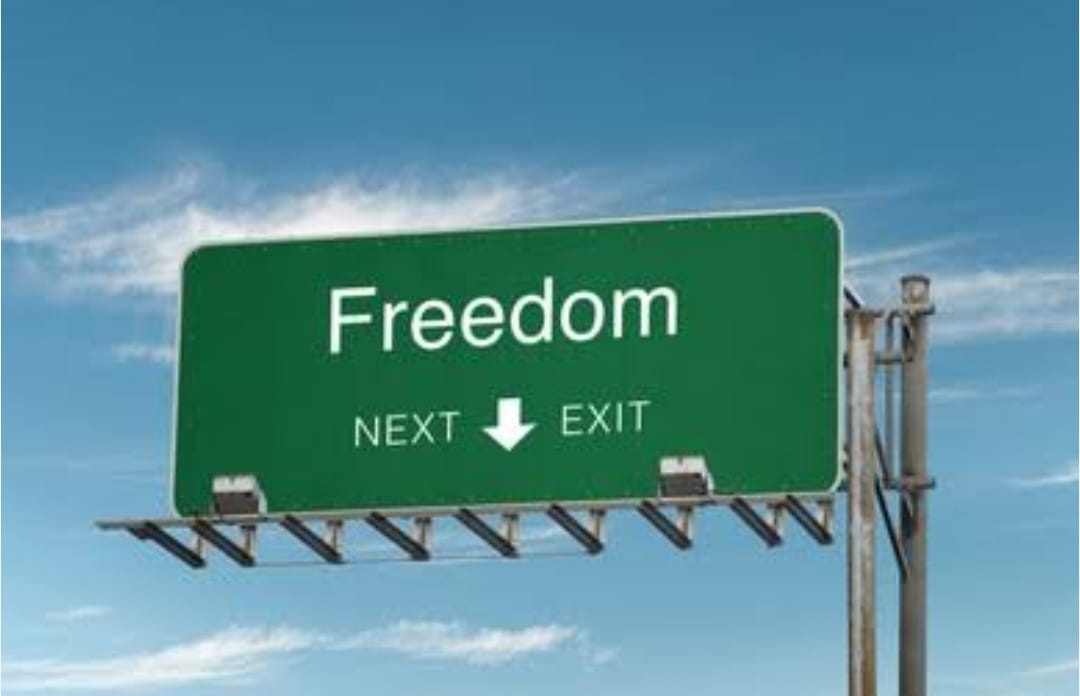
At the moral level, freedom is non-negotiable. The Universal Declaration of Human Rights states unequivocally: “All human beings are born free and equal in dignity and rights.” This is not poetic language — it is a binding ethical standard. Any government or institution that undermines liberty undermines the global moral order and breaks faith with the universal principles that hold civilization together. When a person is confined, coerced, or punished unjustly, the offense goes beyond the individual; it is an assault on humanity’s shared dignity.
Freedom as the Engine of Human Development
Nobel laureate Amartya Sen provides one of the most powerful frameworks for understanding why freedom matters beyond emotion. In Development as Freedom, he argues that liberties — political, social, and economic — are the mechanisms through which societies progress. Freedom is not a luxury; it is the engine of development, innovation, and social harmony. When people can choose, speak, work, move, and organize without fear, possibilities expand. When these freedoms are constrained, societies stagnate, talent dies, and poverty deepens.
This is why the denial of documentation to foreign nationals — followed by their arrest for lacking the same documents — is one of the most grotesque modern forms of unfreedom. It is a deliberate entrapment, a manufactured criminality, and a violation of the fundamental human right to liberty.
When You Are Arrested for Papers the Host Country Refuses to Provide
Across various countries, especially in regions struggling with immigration policy, migrants and foreign nationals face an unconscionable paradox:
They are expected to possess valid documentation, yet the same governments often refuse, delay, or frustrate the issuance or renewal of these documents.
Then comes the nightmare:
They are arrested, detained, or threatened with deportation for not having the very papers the state intentionally withholds.
This is not law enforcement — this is systemic harassment.
This is not immigration management — this is state-induced vulnerability.
This is not justice — this is engineered captivity.
Respected migration scholars have described this phenomenon as “administrative violence” — the use of bureaucracy to punish, immobilize, and control individuals without the transparency or accountability that accompanies normal legal processes. Criminologist Dr. Didier Fassin calls such practices “the criminalization of mere existence.”
To arrest a person for a document they cannot obtain is to hold them against their will in the purest and most destructive sense.
The Psychological and Social Violence of Forced Detention
Detention — especially unjust detention — destroys more than physical freedom. It erodes dignity, shatters mental stability, and silences potential. Philosopher John Stuart Mill’s powerful declaration remains timeless: “Over himself, over his own body and mind, the individual is sovereign.” When a state violates that sovereignty, the result is humiliation, broken trust, and civic alienation.
Foreign nationals who are detained for documentation issues experience more than temporary confinement:
They lose jobs and income.
Their children suffer educational and emotional trauma.
Their mental health deteriorates through fear, uncertainty, and stigma.

They become targets of xenophobia and public suspicion.
They are treated as criminals without having committed a crime.
The injustice is compounded by the knowledge that their only “offense” is being trapped by a system designed to fail them.
The Political and Economic Cost of Denying Freedom
Societies that weaponize documentation or manipulate immigration laws pay a heavy price:
They lose the contributions of skilled workers.
They drive innovation and entrepreneurship out of their borders.
They weaken social cohesion.
They damage international reputation and diplomatic credibility.
They create cycles of resentment, fear, and hostility.
Freedom House reports that societies restricting personal liberties or targeting minorities with arbitrary detention experience higher instability, weaker economies, and declining democratic ratings. Political repression does not produce safety — it produces fragility.
Freedom Is Never Voluntarily Given
In Letter from Birmingham Jail, Martin Luther King Jr. wrote:
“Freedom is never voluntarily given by the oppressor; it must be demanded by the oppressed.”
This applies not only to citizens but also to migrants, asylum seekers, and foreign nationals living under unjust administrative structures. Freedom must be insisted upon — legally, socially, diplomatically, and morally.
Freedom Is Responsibility, Not Chaos
Nelson Mandela reminds us:
“To be free is not merely to cast off one’s chains, but to live in a way that respects and enhances the freedom of others.”
True freedom thrives in societies where:
Laws protect, not persecute.
Institutions serve, not suffocate.
Documentation systems enable, not entrap.
Immigration frameworks respect human dignity, not exploit vulnerability.
What Must Be Done
To prevent people from being held against their will — physically or administratively — societies must:
Guarantee transparent and fair documentation processes for migrants and foreign nationals.
End detention for documentation the state refuses to issue.
Establish independent oversight to prevent abuse.
Ensure that immigration enforcement aligns with international human rights standards.
Educate the public to dismantle the xenophobic narratives that justify these injustices.
Hold leaders and institutions accountable for policies that violate human dignity.
Summative Insight: Freedom Is Humanity’s Most Sacred Asset
Being held against your will (whether in a jail cell, a detention center, or inside the invisible cage of bureaucratic oppression) is the most brutal violation of human dignity. Freedom is not optional; it is the priceless heartbeat of existence. When states arrest people for documents they themselves refuse to provide, they are not ENFORCING LAW; they are MANUFACTURING INJUSTICE.
A society that cannot protect liberty will never achieve peace, progress, or prosperity.
And a people who do not defend their freedom will eventually lose it.
Freedom is the one inheritance we cannot afford to bargain away. It must be defended, protected, insisted upon, and expanded — for ourselves and for everyone who calls our society home.







Life Patron Gen. Buratai Congratulates Newly Elected Lady Captain of TYBGRCC
ABUJA – The Tukur Yusufu Buratai Golf Resort and Country Club (TYBGRCC) has ushered in a new era of leadership with the election of Ms. Jumai Hajara Adamu as its Lady Captain.
The club’s Life Patron, Lt Gen Tukur Yusufu Buratai (Rtd) CFR, former Chief of Army Staff, has extended his warm congratulations and full endorsement. “As the Life Patron, I am immensely proud to see a leader of your calibre step forward,” he stated. “Please be assured of my full and unwavering support throughout your tenure. I have every confidence that your leadership will be marked by significant achievements.”
The election, conducted by the club’s Board of Trustees and membership, highlights a unanimous confidence in Ms. Adamu’s vision and dedication to the sport and the club’s community.
In her acceptance address, the newly elected Lady Captain outlined a forward-looking agenda anchored on three key pillars: Unity, Development, and Inclusiveness. “I believe that golf is not just a sport but a powerful platform for friendship, discipline, mentorship, and community,” she stated, pledging to strengthen member bonds, encourage greater participation among ladies and youth, and enhance the club’s facilities.
Ms. Jumai Hajara Adamu, a respected member known for her active participation and organizational acumen, succeeds a line of distinguished past Lady Captains. She has pledged to build upon their legacy with transparency, teamwork, and accountability, ensuring every member feels heard and represented.
This appointment is seen as a significant step for the TYBGRCC, reinforcing its commitment to excellence, growth, and fostering a vibrant sporting community in the heart of the nation’s capital. The club anticipates a dynamic and prosperous term under her guidance.
About Tukur Yusufu Buratai Golf Resort and Country Club (TYBGRCC):
Located in Abuja, TYBGRCC is a premier golfing destination dedicated to promoting the sport of golf, fostering camaraderie, and encouraging a healthy lifestyle among its members and guests. It stands as a testament to world-class sporting and recreational facilities.
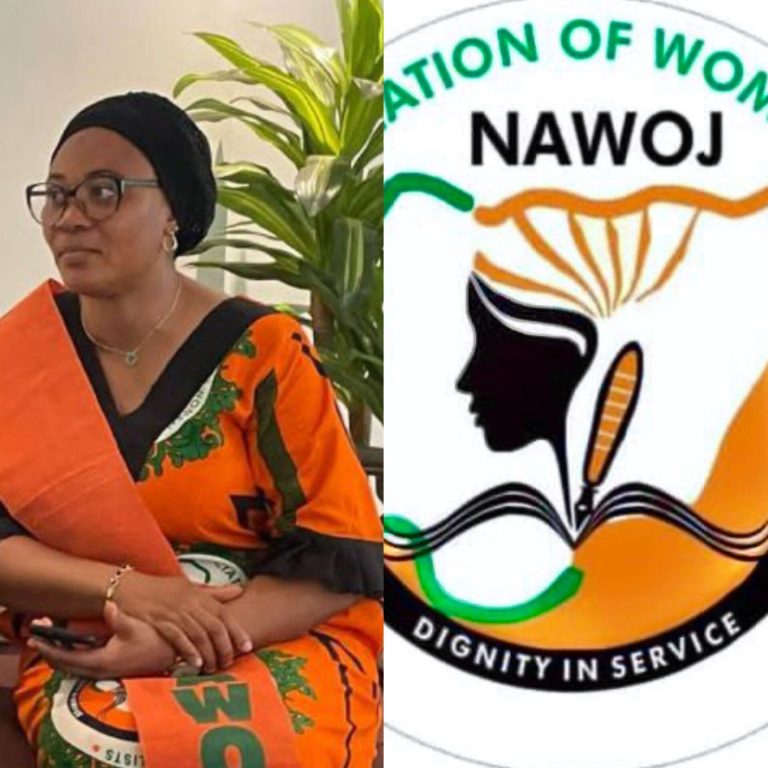
NAWOJ: SEKINAT, CHARITY GETS VOTE OF CONFIDENCE
The Nigeria Association of Women Journalists,(NAWOJ), Ogun State Chapter Executives has unanimously passed a vote of confidence on Chairman NAWOJ SEKINAT Salam and the Financial Secretary, Charity James, saying that, their leadership reflect the ideal and objectives of NAWOJ.
This was revealed in a communique issued at an Emergency meeting of the Executive held at the NUJ State Council, Iwe-Iroyin in Abeokuta.
The vote of confidence on the Leadership of NAWOJ was unanimously signed by all the five executive members that attended the meeting with the vice chairperson taking apology for official engagement outside the state capital.
According to the communique ” Consequently, NAWOJ Ogun State Chapter, reaffirms it’s unwavering support and confidence in the Chairperson and the Financial Secretary, Sekinat Salam and Charity James respectively, Urge them to continue in their commitment to purposeful leadership in the best interest of the association and the society at large”.
Speaking briefly with Journalists after the emergency Executive meeting, the Chairperson, Nigeria Association of Woman Journalists (NAWOJ), Com. Sekinat Salam, said the meeting was necessary as the news of her suspension was laughable and insulting because it is like a pot calling a kettle black in this case, saying that the Leadership of the State Council, Com. Wale Olanrewaju has no local standing to suspend her or any executive member, even he cannot be a judge in his own case.
According to her” The Leadership of the Nigeria Union of Journalists, Ogun State led by Wale Olanrewaju has always been misusing power without recourse to the constitution of this noble Union, hence has no local standing to suspend me or any executive member “.
She said only the Central Working Committee (CWC) has the constitutional rights to sanction or suspend any members found wanting after due process has been followed.
While calling on members to stay calm, Com. Sekinat Salam assured members of positive representation of NAWOJ at both the State and National level, adding the success recorded under her administration cannot be overemphasized.
She therefore called on the National leadership of NUJ to critically look into the matter, either by setting up independent committee to investigate the issues and resolve the matter as quickly as possible.
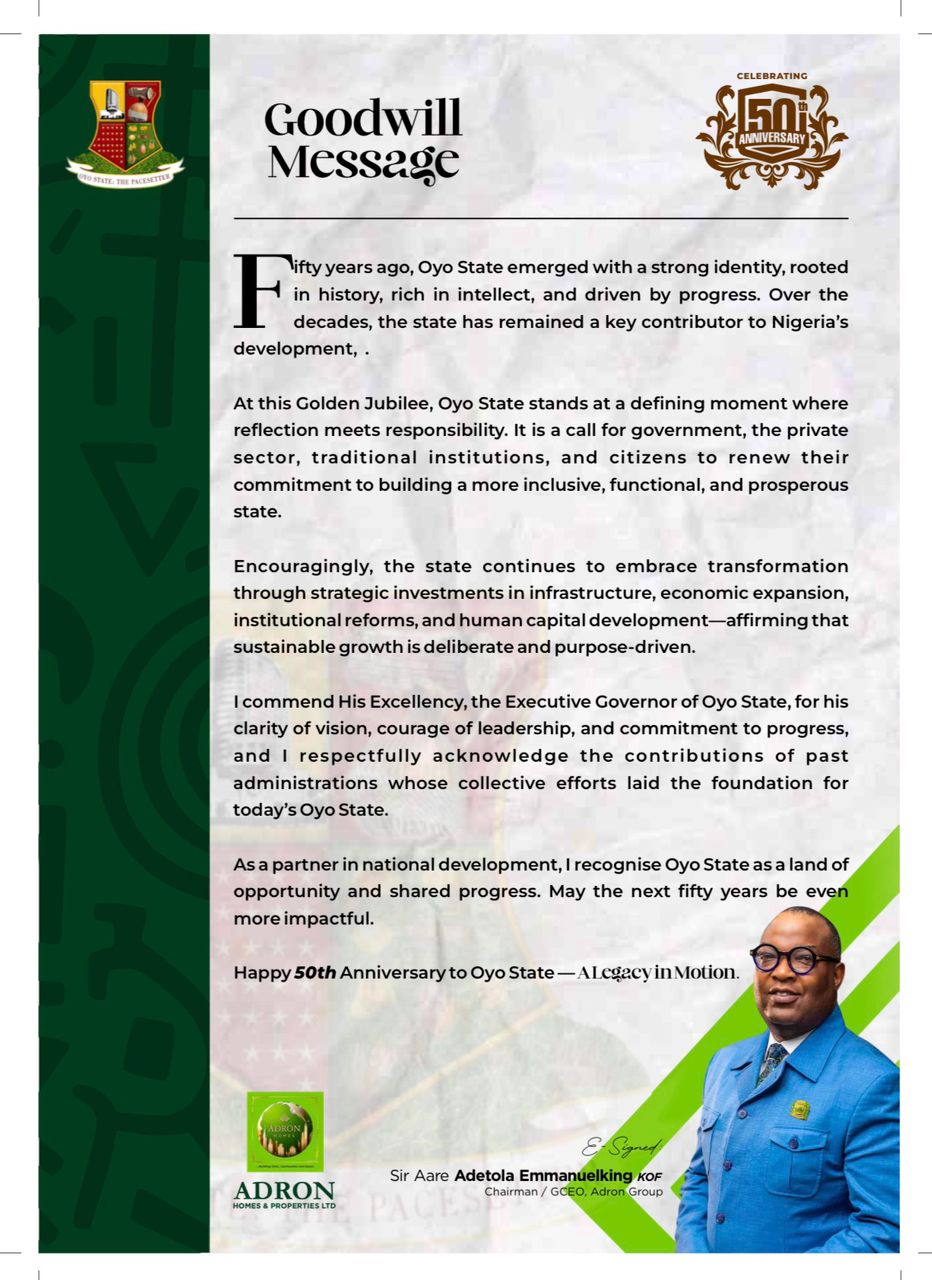
Adron Homes Chairman Congratulates Oyo State on 50 Years of Progress
The Chairman and Chief Executive Officer of Adron Homes and Properties Limited, Aare Adetola Emmanuelking, has congratulated the Government and people of Oyo State as the state marks its 50th anniversary, describing the occasion as a celebration of resilience, cultural pride, and sustained progress.
He noted that since its creation, Oyo State has remained a strong contributor to Nigeria’s socio-economic and cultural development, emerging as a hub of commerce, education, and innovation.
According to him, the Golden Jubilee offers a moment for reflection and renewed commitment by government, private sector players, traditional institutions, and citizens toward building a more inclusive and prosperous state.
Aare Emmanuelking commended the state’s ongoing transformation through investments in infrastructure, economic expansion, and human capital development, adding that sustainable growth is deliberate and must remain purpose-driven.
He also praised the leadership of the current administration while acknowledging the contributions of past leaders whose efforts laid the foundation for today’s Oyo State.
Reaffirming Adron Homes’ commitment to national development, he described Oyo State as a land of opportunity. He wished the state continued peace and prosperity, expressing confidence that the next fifty years will bring even greater achievements for the Pace Setter State and its people.


-

 celebrity radar - gossips6 months ago
Why Babangida’s Hilltop Home Became Nigeria’s Political “Mecca”
-

 society6 months ago
Power is a Loan, Not a Possession: The Sacred Duty of Planting People
-

 Business6 months ago
Batsumi Travel CEO Lisa Sebogodi Wins Prestigious Africa Travel 100 Women Award
-

 news6 months ago
THE APPOINTMENT OF WASIU AYINDE BY THE FEDERAL GOVERNMENT AS AN AMBASSADOR SOUNDS EMBARRASSING