
society
A Tentative Recovery — OR WINDOW DRESSING? Nigeria’s GDP Grows 3.98% in Q3 2025: What the Number Hides and What Must Be Done

A Tentative Recovery — OR WINDOW DRESSING?
Nigeria’s GDP Grows 3.98% in Q3 2025: What the Number Hides and What Must Be Done.
By George Omagbemi Sylvester | Published by saharaweeklyng.com
“Separating Statistical Progress from Everyday Reality in Africa’s Most Complex Economy.”
Nigeria’s economy grew by 3.98% year-on-year in real terms in the third quarter of 2025, according to the National Bureau of Statistics (NBS). At first glance the figure looks like PROGRESS and it is PROGRESS of a kind. But beneath the tidy percentage lie a tangle of uneven sectoral performance, fragile price stability, fiscal strain and a persistent failure to translate macroeconomic numbers into better daily lives for ordinary Nigerians. This piece pulls apart the headline, explains what drove the expansion, flags the risks and offers an unvarnished judgment about what policymakers must do next.
What drove the 3.98% growth? The NBS report shows that the expansion in Q3 was BROAD-BASED but led by the non-oil economy (notably services and agriculture) even as the oil sector staged a modest recovery. Services accounted for the largest share of output and recorded one of the stronger growth rates, while agriculture returned to positive territory after weaker stretches in 2024. In aggregate, the non-oil sector contributed roughly 96% of GDP, underscoring how far Nigeria’s output composition has shifted away from hydrocarbons. Those structural shifts matter because they change the policy levers that actually move the economy.
The oil sector did record positive growth (helped by higher crude production) but its share of aggregate GDP remains small, a signal that oil is less of a direct growth engine than it used to be. In other words: while higher production matters for foreign exchange and government revenues, the day-to-day purchasing power and job creation that lift millions of households are overwhelmingly determined by non-oil activity.
Why the number is both WELCOME and WORRYING.
A WELCOME sign: sustained quarterly growth after a weak patch signals momentum. The World Bank has itself noted “POSITIVE ECONOMIC MOMENTUM” in 2025 and cautioned that reforms are beginning to yield results, while urging that gains be translated into tangible welfare improvements for the poor. As Mathew Verghis, World Bank Country Director for Nigeria, put it: “The Nigerian government has taken bold steps to stabilize the economy, and these efforts are beginning to yield results.” But the World Bank’s central caveat is crucial: macro stabilization is necessary but not sufficient; the poor still face high food inflation and widespread vulnerability.
The WORRYING side is immediate and stark. Inflation remains painfully high (double-digit and food inflation especially elevated) and borrowing costs are still punitive despite modest easing from earlier peaks to conditions that throttle business expansion and household welfare. Financial market and monetary policy improvements will not help families who spend the bulk of their income on food if the price of the basic food basket keeps rising. In short: GROWTH WITHOUT DISINFLATION AND REDISTRIBUTION IS A HOLLOW VICTORY. Sahara and other analysts reported inflation pressures and pointed to a still-high policy rate as part of the context for Q3 figures.
Central Bank Governor Olayemi Cardoso has repeatedly insisted that credible, predictable policy will attract investment: “Stability is at the core of advancing Nigeria’s policy framework through inflation targeting. You do not need to beg anyone to invest.” That prescription is true, but only if the rest of the policy apparatus (fiscal discipline, supply-side fixes for food and energy, social protection) follows through. Stability without structural reform will not deliver jobs or lower the cost of living.
The fiscal and external backdrop. Growth does not occur in isolation. The Federal Government’s fiscal plans for 2026 (including a draft budget and medium-term fiscal framework) point to continued pressure on public finances, a SIZEABLE DEFICIT and RISING DEBT SERVICE OBLIGATIONS. The cabinet’s fiscal framework projects large budgetary needs, indicting the reality that public investment will be constrained unless revenue mobilization improves. In short: the state needs fiscal headroom to invest in the power, transport and logistics that convert growth into livable livelihoods.
On the external side, stronger oil production and higher non-oil exports have improved foreign exchange reserves and the external position compared with the crisis years. Those improvements matter: reserves and a more functional FX market reduce panic, allow imports of critical inputs and lower premium pressures. Yet, the gains remain delicate and reversible if confidence weakens or global commodity prices swing.
Where the gains must land: three urgent priorities
Tame inflation, especially food inflation. The World Bank and Nigerian policymakers agree: the single biggest tax on the poor is food price inflation. Targeted supply-side fixes (agricultural inputs, storage, logistics and trade measures) combined with a credible monetary framework, are indispensable. Without this, headline GDP growth will keep feeling distant from household reality.
Restore fiscal space and spend smarter. The 2026 fiscal framework highlights a difficult trade-off: service large debt obligations or invest in growth-enhancing infrastructure. Nigeria must tighten revenue collection, eliminate leakages, and prioritize public spending that directly boosts productivity (power, roads, ports, irrigation). Otherwise, growth will be cyclical and shallow.
Translate macro stability into real investment and jobs. As CBN Governor Cardoso has argued, predictable, transparent policy attracts investors. But to convert investment into jobs, governments must fix regulatory uncertainty, unblock transport bottlenecks, and support SMEs with affordable credit and market access. A solid monetary stance alone will not produce mass employment.
A candid verdict. A 3.98% growth rate is not a tragedy, it is evidence the economy is moving in the right direction after years of dislocations. But it is also a warning: growth that does not reduce costs for ordinary citizens, create stable jobs, and expand social protection is a fragile and politically toxic victory. The leadership in Abuja must stop treating statistics as an end in themselves and embrace a people-centered economic strategy that combines stabilization with direct interventions for food security, job creation and fiscal transparency.
If policymakers act with urgency (tightening the link between macro stability and social outcomes, spending smartly, and fixing supply bottlenecks) Nigeria can convert this modest momentum into sustained, inclusive growth. If they do not, the headline percentages will become yet another number that comforts elites while ordinary Nigerians continue to pay the price.
My Final note. Numbers matter and the NBS’s Q3 figure is worth acknowledging. But the measure of success is whether mothers can afford food, whether small businesses can borrow without choking on interest, and whether young people can find dignified work. Until those metrics improve, a 3.98% GDP print remains a TENTATIVE step and NOT a TRIUMPH.






US-Based Society Lady, Fehintola-Brat Extends Eid-El-Kabir Greetings To Muslims
United States based fahionista of class, Chief (Mrs) Ayoola Fehintola-Brat has extended a warm greetings to Muslim faithful all over the world on the occasion of the 2026 Eid-El-Kabir celebration.
Fehintola-Brat who is the Balogun Egbe Obaneye Obinrin Akile Ijebu, and the Yeye Asofin of Idenaland in her message to Journalists urged Muslim to continually uphold the enduring values of sacrifice, obedience, faith, and compassion, which are central to the significance of Eid-El-Kabir festival.
A quiet philantropist whose humanitarian services has won her several laurels urged Muslims to use the spiritual occasion to pray for the peace co-existence of Nigerians regardless of religious, social and political leanings stressing that the oneness of the country should not be underplay.
In a related development, she expressed her felicitations to all sons and daughters of Ijebuland on the forthcoming Ojude Oba 2026 celebration, tasking age-groups otherwise known as Regbregbe to be more proactive in giving back to their immediate communities.
According to her, the beauty of the age-groups in Ijebuland is the need to contribute immensely to the development of the land in no small means. “This we will continue to achieve with God on our side”, she concluded.
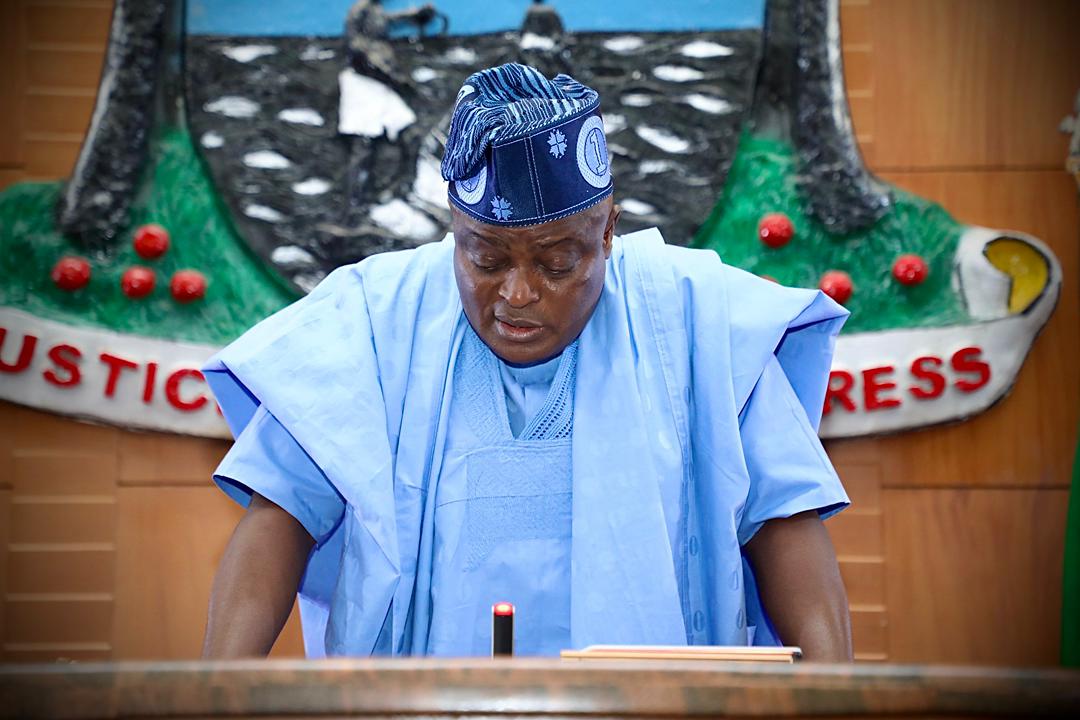
Sallah: Obasa Felicitates Muslim Ummah, Commends Nigerians for APC Primaries Turnout
The Speaker of the Lagos State House of Assembly, Rt. Hon. Mudashiru Obasa has extended warm felicitations to Muslims in Lagos State and across Nigeria on the occasion of Eid al-Adha.
In a statement released by his Chief Press Secretary, Mr. Dave Agboola, Obasa described the festival as a season of sacrifice, reflection, and gratitude, urging the faithful to continue to uphold the values of peace, unity, and love that strengthen the nation.
He noted that the celebration of Eid al-Adha is not only a spiritual milestone but also a reminder of the importance of togetherness and collective responsibility in building a stronger society.
He, likewise, emphasized that the festival provides an opportunity for Nigerians to renew their commitment to national progress and to support leadership that prioritizes development and prosperity.
Obasa, however, commended Nigerians, particularly members of the All Progressives Congress (APC), for their massive turnout during the recently concluded party primaries. He described the participation as a clear demonstration of the people’s confidence in the government of President Bola Ahmed Tinubu and their belief in the administration’s vision for a greater Nigeria.
“The APC primaries have shown the resilience of our democracy and the confidence Nigerians have in the leadership of President Bola Ahmed Tinubu and the Renewed Hope Agenda. This is a strong message that our people are ready to continue supporting policies that will drive growth and prosperity,” Obasa stated.
The Speaker further encouraged Muslims to celebrate responsibly, stressing that the joy of Eid should be accompanied by prayers for the continued peace and progress of Lagos State and Nigeria.
“As you celebrate with family and loved ones, may this season bring joy, peace, and prosperity to your homes. Let us remain united in our resolve to build a stronger nation,” he added.
On behalf of the Lagos State House of Assembly, Obasa wished all Muslims a happy and fulfilling Eid al-Adha celebration.

ABEOKUTA FILM FESTIVAL AT ILEYA
Kayshow Multimedia a filmmaking and Media organization this year 2026 holds its annual Abeokuta film festival at the Ake Palace in Abeokuta.
Alake of Egba land, Ọba Michael Adedotun Arẹmu Gbadebo has graciously endorsed the Free Training of Egba Youths on Film and Arts and the Entertainment of the the People with a FREE FILM SHOW at the AKE PAVILION. as part of the ABEOKUTA FILM FESTIVAL 2.0.
The Convener of the Film Festival Honorable Kehinde Soaga says this year’s event promises to be more exciting as distinguished personalities are sure to attend.
This includes the honorable Minister for Art Culture and Creative Economy in Nigeria, Barr. Hannatu Musa Musawa, Ààrẹ Lai Labode, Sen. Ibikunle Amosun and other special guests.
The event will feature Film, Cultural Dance Cultural foods and Award Ceremony.
The general public is hereby invited to the Free film show at the Abeokuta film festival at the Alake Palace Pavilion on Thursday 28th of May 2026 by 4:00 p.m.
Only well dressed is the Entry. The Abeokuta Film Festival is an annual event taking place in the capital city of Ogun State state.


- Qrent says delaying Information Technology (IT) refresh cycles may be increasing operational risk for businesses in Africa May 27, 2026
- Dentons’ Iyunola Adekanye Appointed to African Mining Week (AMW) Advisory Board May 27, 2026
- United Nations (UN) Women Liberia and Partners Convene for Spotlight Initiative 2.0 Women’s Economic Empowerment Inception Meeting May 27, 2026
- African Mining Week (AMW) to Host Central Bank Governors Roundtable as Monetary Authorities Deepen Role in Mining Sector Growth May 27, 2026
- Eritrea: Diaspora Nationals Celebrate Independence Day Anniversary May 27, 2026
- Africa Unveils Landmark Humanitarian Coordination Platform to Strengthen aligned Response to Humanitarian Crises May 27, 2026
- Seychelles: President Herminie Engages with Police and Fire Services on Praslin May 27, 2026
- Issue 3 of Mining Review Africa now available for free download May 27, 2026
- NOV Joins African Energy Week (AEW) 2026 as Gold Sponsor Amid Africa’s Offshore Expansion Push May 26, 2026
- African Union of Broadcasting (AUB) and United Nations University Institute for Water, Environment and Health (UNU-INWEH) Launch Landmark Webinar Series on Africa’s Water Crisis, Starting June 2, 2026 May 26, 2026
- Qrent says delaying Information Technology (IT) refresh cycles may be increasing operational risk for businesses in Africa May 27, 2026
- Dentons’ Iyunola Adekanye Appointed to African Mining Week (AMW) Advisory Board May 27, 2026
- United Nations (UN) Women Liberia and Partners Convene for Spotlight Initiative 2.0 Women’s Economic Empowerment Inception Meeting May 27, 2026
- African Mining Week (AMW) to Host Central Bank Governors Roundtable as Monetary Authorities Deepen Role in Mining Sector Growth May 27, 2026
- Eritrea: Diaspora Nationals Celebrate Independence Day Anniversary May 27, 2026
- Africa Unveils Landmark Humanitarian Coordination Platform to Strengthen aligned Response to Humanitarian Crises May 27, 2026
- Seychelles: President Herminie Engages with Police and Fire Services on Praslin May 27, 2026
-

 news5 months ago
WHO REALLY OWNS MONIEPOINT? The $290 Million Deal That Sold Nigeria’s Top Fintech to Foreign Interests
-

 society3 weeks ago
SOCIAL MEDIA IS NOT A BATTLEFIELD COMMAND – WHY THE NIGERIAN ARMY’S ACTION AGAINST JUSTICE CRACK IS A NATIONAL SECURITY IMPERATIVE
-

 celebrity radar - gossips4 months ago
Dr. Chris Okafor Returns with Power and Fire of the Spirit -Mounts Grace Nation Altar with Fresh Anointing and Restoration Grace on February 1, 2026
-

 celebrity radar - gossips6 months ago
Prophet Kingsley Aitafo Releases 2026 Prophecy: ‘Nigeria Will Rise, but the World Must Prepare for Turbulence’