
celebrity radar - gossips
AJEGUNLE AND AMBODE’S DISCRIMINATORY LEADERSHIP STYLE? By Ikenna Asomba

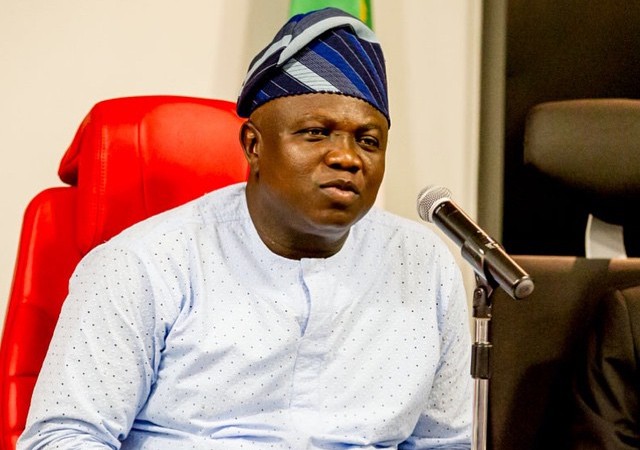

By May 29, 2018, some 90 days from now, our amiable and very distinguished Executive Governor of Lagos State, His Excellency Governor Akinwunmi Ambode, would have spent three years in office.
As a resident of Lagos, I must religiously say that the performance of Governor Akinwunmi Ambode as it concerns the general governance in the Centre of Excellence, Lagos, has been averagely inspiring but daunting.
Governor Ambode, has no doubt trailed the developmental path of former Governor Babatunde Raji Fashola, particularly with his Legacy projects such as the New Oshodi Transport Interchange, a Legacy Project aimed at redesigning the traffic flow, as well as transforming the aesthetics of the area with iconic infrastructure; and also the use of the Lagos Local Government Areas, LGA Funds to further open the inner-city access roads in Lagos communities.

I must commend Governor Ambode for using the Local Government Funds, to build solid and standard inter-locked roads, with kerbs, pedestrian walk-ways and street lights across the 20 Local Government Areas (LGAs) and 37 Local Council Development Areas (LCDAs). These roads have no doubt contributed immensely to further opening Lagos. However, a lot more still need to be done.
In 2015, Governor Ambode used the Local Government Areas Funds to build 114 roads across the 57 Council Areas- two roads in each of the council areas. These landmark legacy projects were completed and commissioned in August 2016.
Perhaps for paucity of funds caused by the economic recession which hit Nigeria in 2016, the expected 2016 phase of the annual roads project couldn’t be achieved in 2017.
So, this 2018, it is commendable that work is about to commence across the 57 Council Areas, as 181 inner-city access roads across the council areas of the state are under-way.
AJEGUNLE IN FOCUS
Ajegunle is the popular ghetto area in Lagos State with over 946, 400 residents, second to Alimosho LGA with 1, 817, 200 residents.
Ajegunle houses the Ajeromi-Ifelodun Local Government Area and major parts of the Ifelodun Local Council Development Area.
Former Head of State, Gen. Yakubu Gowon, had once described Ajegunle as the melting point of Nigeria. Reason: Ajegunle is a community that is made up of almost all the ethnic groups in Nigeria. There is barely any ethnic group or tribe that is not resident in Ajegunle.
Despite this melting point feature, residents here have remained largely peaceful and co-existing without tribal or ethnic clashes for many years. Not even the OPC/Ijaw or the OPC/Hausa clashes of those hey days were able to tear apart the peaceful cohabitation of the various ethnic nationalities in Ajegunle. Kudos must be given to the people, as well as the successive leaderships of the Ajeromi-Ifelodun LGA and Ifelodun LCDA for this lasting peace in Ajegunle.
A WAKE UP CALL FOR AMBODE
Be that as it may, it has become very imperative to draw the attention of His Excellency Governor Akinwunmi Ambode to what many a residents have described as his Discriminatory Style of Leadership against the people of Ajegunle (Ajeromi-Ifelodun LGA and Ifelodun LCDA), particularly in terms of appointments and road projects siting.
I have religiously followed the politics of appointments and siting of projects in Lagos State, particularly on the issue of roads construction, I must say that the Lagos State Government under the leadership of Governor Ambode has not favoured the good people of Ajegunle.
Since coming on board on May 29, 2015, no single road has been built by the state government in Ajegunle. The four roads built in Ajeromi-Ifelodun LGA and Ifelodun LCDA respectively were built with the Local Council Funds under the control of the State Government. I stand to be corrected. If these funds are under the firm control of the Local Council Government, with close supervision by the state government, I am certain more than four roads would have been built since 2015.
Since 2015, the four roads that have been built in Ajegunle with the Local Council funds under the control of the state government are: Molade and Temidire Streets (Ajeromi-Ifelodun LGA); Iludun Street, Amukoko and Itire Road, Alaba-Oro (Ifelodun LCDA). I reiterate, no road has been built by the State Government with its own funds.
On the other hand, among the 181 Roads under-way, to be facilitated with the Local Council funds, the two council areas in Ajegunle were allocated two roads each. They are: Uzor and Akogun Streets in (Ajeromi-Ifelodun LGA) and Adekoya/Owoyemi and Adejiyan Streets in (Ifelodun LCDA). This is even as most council areas were allocated three roads each.
On appointments, in 2015, nobody from Ajegunle was deemed fit to be appointed a Commissioner by Governor Ambode. Not even Special Adviser was deemed fit for anyone from Ajegunle.
Again, there was reshuffling of his cabinet in January 2018, nobody was deemed fit to be appointed Commissioner in Ajegunle. Even Special Adviser, nobody from Ajegunle was deemed fit to be appointed. This is ridiculous.
It is also expedient to recall that in the 8 years administration of former Governor Babatunde Raji Fashola- May 29, 2007- May 29, 2015,
just three major road projects were sited in Ajegunle by the administration.
They were the 0.265km dualization of the Alaba/Cemetary Road awarded to Banci Nigeria Limited and the construction of 1.210km Rotimi-Okulaja-Koripamo-Sholade-Salimonu Bakare Streets, awarded to Lopek Engineering & Construction Limited.
One of the two projects which were ongoing but stalled owing to inadequate funds as at when Fashola left office was the construction of 1.1km Ojoku-Ohuntan Streets awarded to Rojo Engineering & Construction Limited. It is completed now.
Unfortunately, the Grading and Surface Dressing done on the 0.8km Onishapa-Akogun Streets awarded to Wallways Tech Limited had since been washed away by flood, as the street is now impassable to the chagrin of pedestrians and motorists alike.
The Akogun Street has been re-awarded again. Perhaps, when completed, its residents can heave a sigh of relief.
Dear Governor Akinwunmi Ambode Ajegunle community has over 400 streets not tarred since the existence of the community.
These streets and roads also lack proper drainage channels, medians, walk-ways and street lights, unlike their counterparts in communities such as Surulere, Lagos Mainland, Apapa and Lagos which had the highest number of completed road projects under the last administration.
According to statistics from the Lagos State Ministry of Works and Infrastructure, the last administration in eight years, completed 229 new roads amounting to 118.159km, as well as did Grading and Surface Dressing on 80 roads amounting to 46.191km.
Ongoing road projects at the twilight of Fashola’s administration were 201 amounting to 237.771km, while there was Grading and Surface Dressing on 71 roads amounting to 76.740km.
In Fashola’s eight years, unlike Ajegunle, top beneficiaries of completed and ongoing road projects according to a summary by the works ministry were: Alimosho- completed (31) ongoing (16); Lagos Mainland- completed (29) ongoing (3); Surulere- completed (26) ongoing (37); Kosofe- completed (25) ongoing (29); Ifako Ijaiye- completed (22) ongoing (13); Mushin- completed (20) ongoing (3); Ikorodu- completed (17) ongoing (8).
Pathetically, Ajegunle, comprising wo council areas got a paltry 3 Roads in 8 years.
From investigations, it is said that the Lagos State Government jettisons Ajegunle in its road infrastructure plan because the residents don’t massively vote for the ruling party in the State.
Assuming this is true, one wonders if Ajegunle is not part of Lagos. One wonders if the State Government don’t collect tax from residents here. One wonders if what took place during elections should be used to determine the amount of projects to be attracted to Ajegunle.
Against the backdrop of inequality in the siting of road projects, I join millions of other residents in Ajegunle to call on Governor Akinwunmi Ambode, to urgently declare a state of emergency on roads in Ajegunle community.
It is imperative to remind Governor Ambode of one of his campaign promises, during a Town Hall meeting at Eagle Club, Surulere, to build 5,000 roads in four years, if elected. May 29, 2019 is just some 15 months from now, can Ambode meet up with the fulfillment of these 5,000 roads?
Dear Governor Ambode, the four major roads in Ajegunle community are riddled with pot-holes, shallow drainage channels, lack of median, walk-ways and no street-lights. The deplorable state of these roads cause excruciating pains to motorists, motorcyclists and tricyclists. The four major roads are: Boundary-Aiyetoro-Ojo Road-Alaba Suru; Boundary-Baale-Mba-Cardoso-Otto Woff; Boundary-Tolu-Kirikiri-Berger Suya and Ojoku-Idewu-Industrial Avenue.
Please, enough of the excuses that some of these roads are Federal Government Trunk Roads.
Governor Ambode must not wait for the Federal Government to fix these roads to standard. I trust his verified capacity in building standard roads. Lagos is a pacesetter state when it comes to building standard roads with good drainage channels, walk-ways, kerbs, median and street-lights.
As 2018 ticks, and ahead of the 2019 Governorship election in Lagos State, I am certain that Governor Ambode would be re-elected for a Second Term, to consolidate on his legacy projects.
Going forward, these are some of the deplorable roads Governor Ambode should fix to put smiles on the faces of Ajegunle residents. These roads are important inner-city access roads. They include but not limited to: Ekundayo, Osho Drive, Kekere Ogun, Okito, Uzor (underway), Akerele, Omowunmi, Chidi, Dada Onijama, Odudu, James Igbe, Ashafa, Oluwa, Mensah, Baba Sule, Akimbo, Taiwo, Wowo, Temidire, Adeolu, Apena, Apikirin, Isikalu, Silver, Ugbewankwo, Okorogbo, Akatapko, Abukuru, Babani, Goriola, Rashidi, Ladipo, Otuniyo, Ezeagu, Adekeye, Ligali, Aiyenero, Mosalashi, Olowosu, Ladega, Akogun (under-way), Ibafon, Emodi, Fasasi, Kudaisi, Alhaji Adebola, Bolaji Oloro, Jones Waribi and Jejeliaye.
Others are Togunde Igbaja, Sadiku, Trinity Close, Dele Bakare, Abiola Oluwa, Alhaji Kareem Akande, Kola Akin-Tepede Close, Cemetery Road, Palace Road, George, New Creature Avenue, Arowo Iyabuno, Iyakudima Lane, Chuka Ben Avenue, Adetola Lane, Chief Titus Ufondu, Ben Onyeka, Ola Badmus, Deliverance, Barr. Ahmed Musa, Odofin Akinsanya, Raufu Olaiya, Abiodun, Queen, Otakoya, Olowa, Emmanuel Avenue, John Okorie, Ishaga among others.
No doubt, Ajegunle is still a sprawling slum and ghetto city. If Governor Akinwunmi Ambode declares a state of emergency on inner-city roads in Ajegunle, the residents here would have no option but to give his party their massive votes and support at subsequent elections. The Discriminatory Style of Leadership would thus be a thing of the past. For one good turn deserves another.
Going forward, when these road projects are done, the Council Administration should take charge in its maintenance. A situation where slight pot-holes on roads are allowed to degenerate should seize. This is corruption. Also, a situation where residents litter refuse on these roads, channel their wastes on these roads should stop.
This is my one penny advice to His Excellency, Governor Akinwunmi Ambode, if his party is to further make in-roads, with ease in Ajegunle.
Ikenna Asomba is a Social Commentator.




celebrity radar - gossips
Adron Homes Celebrates Visionary Chairman, Aare Adetola Emmanuel King, at 51
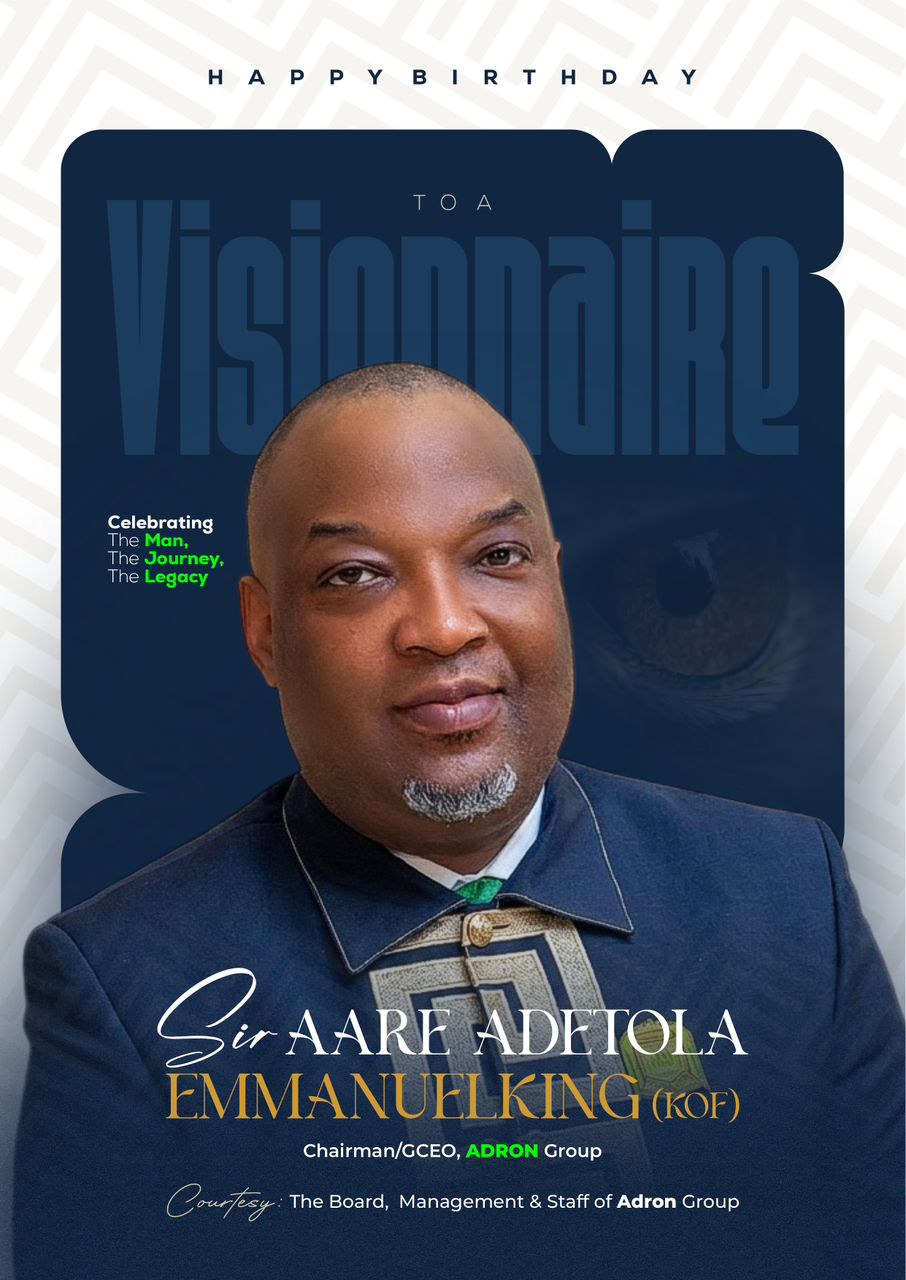
Adron Homes Celebrates Visionary Chairman, Aare Adetola Emmanuel King, at 51
The management and staff of Adron Homes and Properties Limited have joined family, friends, associates, and well-wishers across the globe to celebrate their Chairman and Chief Executive Officer, Aare Adetola EmmanuelKing, as he marks his 51st birthday.

In a statement released by the company, the milestone was described as a celebration of an exceptional leader whose vision, resilience, and entrepreneurial brilliance have not only transformed Adron Homes into a household name in Nigeria’s real estate sector but have also redefined affordable housing across the country.
Under his dynamic leadership, Adron Homes has continued to expand its footprint, delivering value-driven residential solutions while empowering thousands of Nigerians with opportunities for home ownership. His commitment to excellence, innovation, and customer satisfaction has remained the driving force behind the company’s sustained growth and industry leadership.
The statement further highlighted Aare EmmanuelKing’s passion for nation-building and community development, noting his significant contributions to job creation, youth empowerment, and the promotion of socio-economic development through real estate investments.
“As a leader, mentor, and visionary, Aare Adetola EmmanuelKing has consistently inspired a culture of excellence, integrity, and dedication within the organization. His ability to turn bold ideas into reality continues to position Adron Homes as a trailblazer in the industry,” the statement read.
The company expressed profound gratitude for his steadfast leadership and prayed for continued wisdom, strength, and sound health as he embarks on another year of impactful achievements.
As he celebrates his 51st birthday, the entire Adron Homes family proudly honours a man whose legacy continues to shape the future of real estate in Nigeria.
Happy 51st Birthday, Aare Adetola EmmanuelKing!
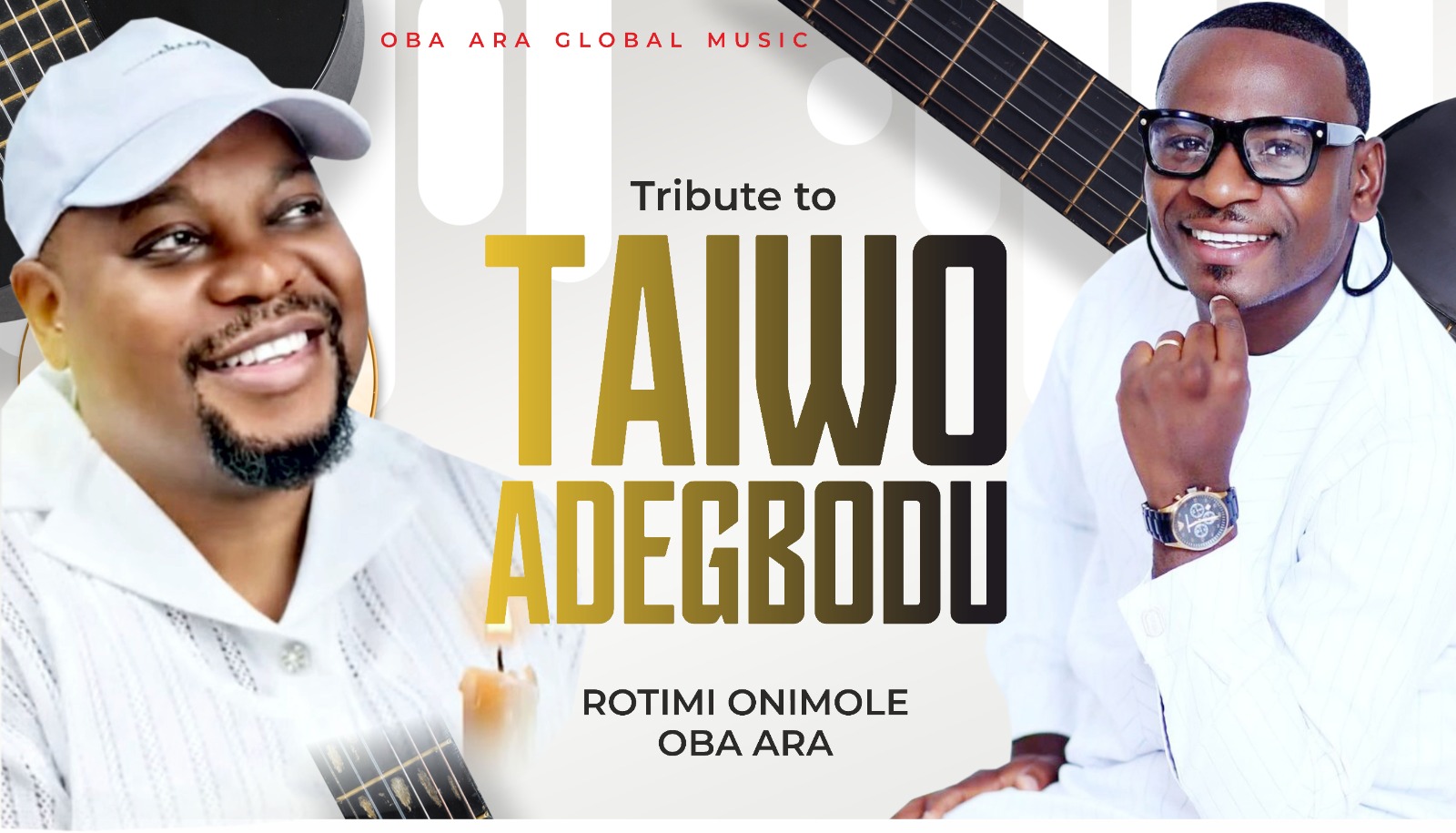
Oba Ara Releases Emotional Tribute to Late Taiwo Adegbodu
Taofik Afolabi
The gospel music community continues to grieve the painful loss of Taiwo Adegbodu, a beloved figure whose sudden departure left a deep void among fans, colleagues, and loved ones. In response to this loss, renowned gospel minister Rotimi Onimole, popularly known as Oba Ara, has released a moving tribute song that captures both the sorrow of the moment and the enduring legacy of the late singer.
Oba Ara, a proud son of Isale Eko, channels raw emotion throughout the song, using heartfelt lyrics and soul-stirring melodies to reflect on his personal connection with Taiwo Adegbodu. In the tribute, he openly expresses how deeply the news of Adegbodu’s passing shook him, describing it as a painful and unexpected loss that is difficult to come to terms with.
The song goes beyond mourning, it celebrates the life, ministry, and impact of Taiwo Adegbodu. Oba Ara highlights the late artist’s dedication to spreading the gospel through music, his inspiring voice, and the spiritual influence he had on many within and beyond Nigeria. Through powerful verses, he paints a picture of a man who lived for God and touched countless lives through his ministry.
Listeners have described the tribute as both comforting and deeply emotional, as it resonates with the collective grief of the gospel music community. It serves as a reminder that although Taiwo Adegbodu is no longer physically present, his music, message, and legacy will continue to live on.
In honoring his late colleague, Oba Ara not only pays his respects but also offers a source of healing for fans and fellow ministers, using music as a tool to process grief and celebrate a life well lived.
celebrity radar - gossips
Buratai, Fagbemi , Shagaya, Olofa, Others Eulogise Olowu Kuta’s Olori On 60th Birthday, Foundation Launch
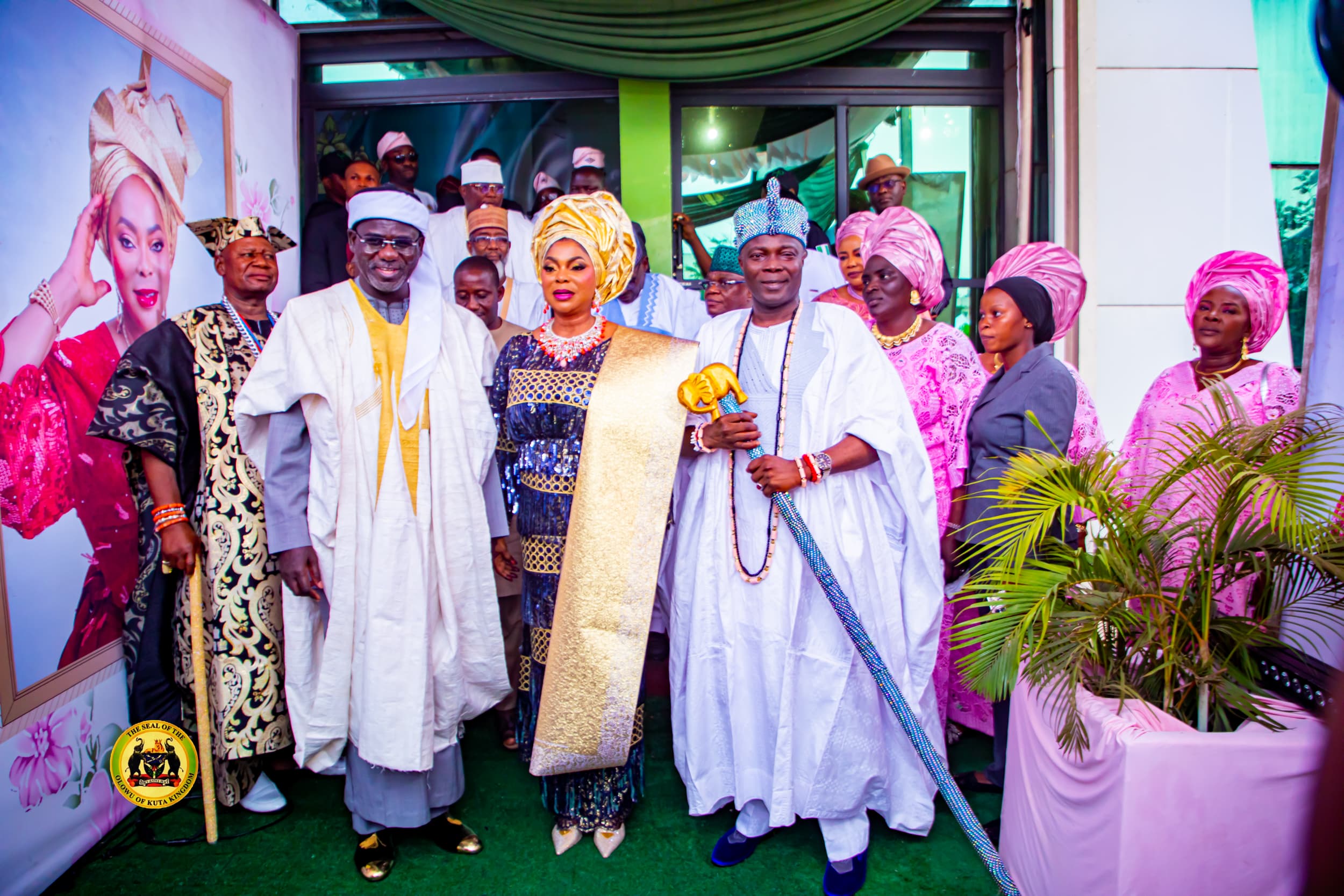
Buratai, Fagbemi , Shagaya, Olofa, Others Eulogise Olowu Kuta’s Olori On 60th Birthday, Foundation Launch
Eminent personalities across the Nigeria stormed the TFK Event Centre, Bala Mohammed Way, Guzape, Abuja, to celebrate the 60th birthday of Olowu Kuta’s Olori, Queen Jumai Amoke and her Foundation Launch on Saturday 28, March 2026.

From former Chief of Army Staff, Lt Gen TY Buratai rtd, to the Minister of Justice and Attorney-General of the Federation, Prince Lateef Fagbemi; Olofa of Offa, HRM Oba Mufutau Gbadamosi. Even top businesswoman and socialite, Chief (Mrs) Bola Shagaya, was in attendance.


Other dignitaries were newly promoted Deputy Inspector-General of Police and former AIG Zone 2 , Lagos , Adegoke Fayoade, Major General Abdumalik, Major General Samuel Adebayo rtd (Fmr CDI);
Major General Anthony Omozoje rtd (Fmr Copp);
Alhaji Tajudeen Owoyemi (Asiwaju of Offa and CEO Radisson Hotel Nigeria;
Dr Waheed Olagunju, former managing director of Bank of Industry, Oniba of Iba, Lagos State, HRM Oba Dr Suleiman Raji ;
Justice Falola, Olu of Ile-Ogbo , Oba Adetoyese amongst many traditional rulers and captains of industry too numerous to mention.
Speaking at the occasion, the Chief Host, Olowu of Kuta, HRM Oba Dr Adekunle Oyelude Makama, CON , Tegbosun iii, who is also the husband of the celebrant commended Queen Jumai for ‘ her slender arms full of kindness’ to establish such humanitarian Foundation, ‘Amoke Children and mother in Need Foundation’ at a time Nigerians are going through economic crisis occassioned by the global meltdown.
Olowu also commended her steadfastness and love for the less privileged and downtrodden.
The monarch refrenced the task before his wife’s humanitarian gesture said her best is yet to come.
” Olori Amoke Jumai, I celebrate you. You will celebrate 70, 80, 90 and continue to shine as you continue to put a smile on people’s faces. I love you, “Olowu Kuta added.
To Lt Gen Buratai, a former army chief and former Nigerian Ambassador to Benin Republic, the reward of hard work is more work.
Buratai, who also doubles as Balogun Agba of Owu Kuta, a chieftaincy title reserved for a generalismo congratulated Queen Jumai for attaining the age of 60 in good health.
The retired army General said he’s not surprised by the turn out of eminent personalities across the country to celebrate the Olowu Kuta’s Olori because she merited it through her hospitality to all, adding that Allah the most merciful, most beneficial would accept all her act of ibadah.
The minister of Justice, Prince Fagbemi, was full of praises for Queen Jumai for deeming it fit to have a place in her heart to accommodate the needy and less privileged in ‘our society.’
Prince Fagbemi urged the guests to contribute generously to support the Foundation in order to continue to alleviate poverty and put a smile on the faces of the people.
” I congratulate you on your 60th birthday and Foundation Launch. I wish you many happy returns of the day and many more fruitful services to the country and motherland”, Prince Fagbemi added.
The celebrant, Queen Jumai who was grining from ear to ear thankfully said she was excited by the turn out and the response of the people to her foundation.
Queen Jumai, however, promised to continue to use her resources and donations received for the good of the needy and less privileged in the society.
” I want to appreciate my own Kabiesi Olofa of Offa , for his presence and im I’m using him as a point of contact to all other Kabiesis present here, the minister of justice and Attorney-General, you’re welcome, sir; Mrs Bola Shagaya, I salute your enterprise, Lt Gen Buratai, I’m grateful, sir; DIG Fayoade, Justice Falola and other dignitaries too numerous to mention, I thank you, all. To my darling husband, Kabiesi Olowu , I thank you immensely for your support. And to my family and friends, I thank you , all. E se pupo!”, she said.


-

 society7 months ago
Religion: Africa’s Oldest Weapon of Enslavement and the Forgotten Truth
-

 news4 months ago
WHO REALLY OWNS MONIEPOINT? The $290 Million Deal That Sold Nigeria’s Top Fintech to Foreign Interests
-

 society6 months ago
“You Are Never Without Help” – Pastor Gebhardt Berndt Inspires Hope Through Empower Church (Video)
-

 celebrity radar - gossips2 months ago
Dr. Chris Okafor Returns with Power and Fire of the Spirit -Mounts Grace Nation Altar with Fresh Anointing and Restoration Grace on February 1, 2026
You must be logged in to post a comment Login
You must log in to post a comment.