
Politics
Bayo Onanuga’s Garbage Not Good For Tinubu By:Olakunle Adelaja

Bayo Onanuga’s Garbage Not Good For Tinubu
By:Olakunle Adelaja
Before he was appointed the Special Adviser to the President on Information and Strategy, Bayo Onanuga had already proven he would be a liability to President Bola Tinubu’s administration. As one of the spokespersons of his presidential campaign, Onanuga was unhinged. He had no restrain, and lacked the speech finesse of an image maker that his assignment demanded.
Onanuga effectively alienated Nigerians who did not support Tinubu during the electioneering campaign with his pugnacious and hateful statements, many thought were unbefitting of a man in his position. And because of that, supporters of President Tinubu secretly wished he would not appoint Onanuga as his presidential spokesman.
This was why the appointment of Ajuri Ngelale as the special adviser to the president on media was welcomed by many Nigerians, including Tinubu supporters. Ngelale did not have the type of moral and political baggage that Onanuga carried on his head. He looks more sober and more circumspect than the combative Onanuga.
President Tinubu also appeared to have been aware of Onanuga’s shortcoming when he eventually gave him appointment as the special adviser on Information and strategy, which many believed was an afterthought. The statement announcing his appointment gave his job description “as part of efforts to prioritise effective and efficient working synergy between the Presidency and Federal Ministries.”
In essence, he was appointed a presidential liaison officer that should be shuttling between the presidency and MDAs, and away from the media. But Onanuga likes the limelight and he found a way to insert himself into the presidential media structure. He issues statements once in a while, much to the consternation of Ngelale who understandably loathed him. He deliberately set himself in competition with Ngelale and did everything to undermine the man who eventually had to quit last week.
After scheming Ngelale’s exit from the villa, Onanuga has now found the latitude to run riot again like a dog that broke from a leash. He is now breathing fresh air in the villa now that the man who held him in check had left.
On Tuesday he issued one of his incendiary statements that must have caused even ardent supporters of the administration to shake their heads in obvious discomfort. The statement, entitled “Nigeria, a country governed by law, categorically denies any human rights abuse,” was simply meant to correct any wrong impression the Trade Union Congress of the United Kingdom may have had about the Tinubu administration due to the arrest of NLC president, Joe Ajaero, by the DSS last Monday.
But in his characteristic manner, he went beyond his brief to attack the NLC and the TUC for opposing government policies. But he found no particular policy to mention except labour’s opposition to the sale of Nigeria’s refineries to Aliko Dangote in 2007!
Onanuga wrote: “Seventeen years after the labour movement forced the successor government of Umar Yar’ Adua to cancel the sale of the two refineries, none of the four government-owned refineries worked. In the obverse, Mr. Aliko Dangote, one of the promoters of Bluestar, has built the largest single-train refinery in the world. In a twist of fate, the same Labour Movement that fiercely opposed Dangote from taking over the two refineries in 2007 hailed him on completing his 650,000-bpd refinery in Lagos.”
What was the need to bring up the opposition to the sale of NNPC refineries to Dangote in a statement meant to set the records straight on Tinubu administration’s human rights record? Or was he trying to vindicate Dangote?
Well, everyone knows his paper, PM News, has supported Dangote in his battle with the NNPCL over supply of crude to his refinery and over pricing of his products, especially petrol. It’s even believed that he’s among the media owners on the payroll of Dangote in his battle with the Tinubu administration.
Tinubu is the minister of petroleum resources and it is surprising that a man who claims to work as information and strategy adviser to the president acts without any strategic thinking! Dangote has single-handedly embarrassed the Tinubu administration by spewing half-truths and obvious lies against Nigeria’s oil and gas sector operations to gain undue public empathy.
In July, when Dangote appeared before the House of Representatives Joint Committee on Petroleum Resources (downstream and midstream), he lied to make a case for the products of his refinery. It was his response to regulatory authorities who had questioned the quality of products coming from his refinery located at the Lekki Free Trade Zone.
He had said, “Some of the terminals, some of the NNPC people and some traders have opened blending plants somewhere off Malta. We all know these areas. We know what they are doing, “adding that the NNPCL had been importing substandard fuel.
Of course, the claim rattled the Tinubu administration since the president is also the petroleum minister, and the smooth operation of the sector rests squarely on his shoulders. He is also responsible for what the NNPCL does and doesn’t do.
But it was the Group Chief Executive Officer, Mele Kyari, who appeared to understand Dangote’s game, that broke the ice for the administration. Kyari challenged Dangote to publicly declare the names of NNPC personnel who operate a blending plant in Malta.
Kyari, in a post on X, asked Dangote “To clarify the allegations regarding blending plant, I do not own or operate any business directly or by proxy anywhere in the world with the exception of a local mini Agric venture. Neither am I aware of any employee of the NNPC, that owns or operates a blending plant in Malta or anywhere else in the world…”
Kyari also made it clear that a blending plant in Malta or any part of the world has no influence over NNPC’s business operations and strategic actions. He challenged Dangote to declare in public and report to relevant security agencies if he knew anyone in NNPCL who was involved in what he alleged.
Of course, Dangote never did any of that. He simply moved on from one blackmail to the other. But it was President Tinubu that was wounded more by Dangote’s false narratives, which suggested that the president had personal stakes in refineries outside the country because his nephew, Wale Tinubu, operates in the oil and gas industry. It was an angle to which the opposition latched on to further undermine the Tinubu administration.
This is the man that Onanuga has elevated in a presidential statement! How strategic was that?
On August 22, presidential candidate of the Peoples Democratic Party (PDP) in the 2023 election, Atiku Abubakar, latched on to Dangote’s lies to accuse Tinubu of integrating his business interests into Nigeria’s interests. A statement released by Atiku alleged that “Just as Alpha Beta, Primero, and others act as Tinubu’s proxies in Lagos, managing critical sectors and generating revenue for him and his family, he has begun to replicate this at the federal level.”
Attacking the NLC and the TUC for opposing privatisation of the refineries is also tactless, considering the role Tinubu played while in the opposition. Tinubu was one of the opposition leaders who kicked against privatising the refineries at the time. So, Onanuga was effectively condemning the role his principal played at the time which is what NLC and others are now doing.
This lack of strategic thinking had sunk Onanuga in his first public assignment as the Managing Director of the News Agency of Nigeria (NAN) in 2016 under ex-president Muhammadu Buhari. But his appointment was not renewed in 2019 following dispute between him and staff of the organisation over his management style. No one heard anything about him again until 2023 when was appointed one of the spokespersons for Tinubu campaign.
But if anyone thought Onanuga would have become more cultivated and refined, that expectation has been dashed with the way he has carried on his assignment so far. There’s every reason to believe that Onanuga has become a burden that Tinubu is unwilling to shed because of past friendship. But the president would have to quickly make a decision on a suitable role for Onanuga in his administration.
It’s obvious he’s not cut for the current job that has been given to him. He is a poor researcher and had goofed several times in the past on data and facts. He regularly deleted his tweets after realising he made careless errors. Like when he claimed that Tinubu secured an $600 million investment commitment from Maersk, a global shipping firm during the World Economic Forum in Saudi Arabia in April. He later deleted the post after it generated controversy.
As a supporter of President Tinubu, I hope he doesn’t allow him to replace Ngelale as his spokesman. That would be a disaster. Onanuga should be tucked away from public view because he’s a public irritant. Tinubu needs people who can promote his administration, not those who would undermine it.
The president will not lose anything if Onanuga if fired today. Enough of his garbage.



Lagos Politics: APC Elevates Sonayan-James, Strengthens 2027 Governorship Ticket
LAGOS — The All Progressives Congress has boosted its preparations for the 2027 Lagos State governorship election with the unveiling of Damilola Sonayan-James as its deputy governorship candidate, a move party leaders say is aimed at strengthening the party’s electoral prospects.

The announcement positions Sonayan-James as a key figure in the party’s campaign structure as the APC intensifies efforts to consolidate its political dominance in the state ahead of the polls.
Party officials described her emergence as the outcome of extensive consultations and a strategic decision to present a ticket that reflects competence, grassroots engagement and inclusive leadership.
Speaking on the development, APC leaders said Sonayan-James had demonstrated commitment to the party’s ideals and possessed the experience required to contribute meaningfully to governance if elected.
Her nomination is also expected to bolster the party’s appeal among women, youths and grassroots supporters, given her track record in community development and political mobilisation.
Political observers believe the decision underscores the APC’s determination to field a balanced ticket capable of sustaining its influence in Lagos while responding to the evolving expectations of the electorate.
With the unveiling concluded, attention is expected to shift to statewide mobilisation and engagement with stakeholders as the party prepares for what is anticipated to be a keenly contested governorship election in 2027.
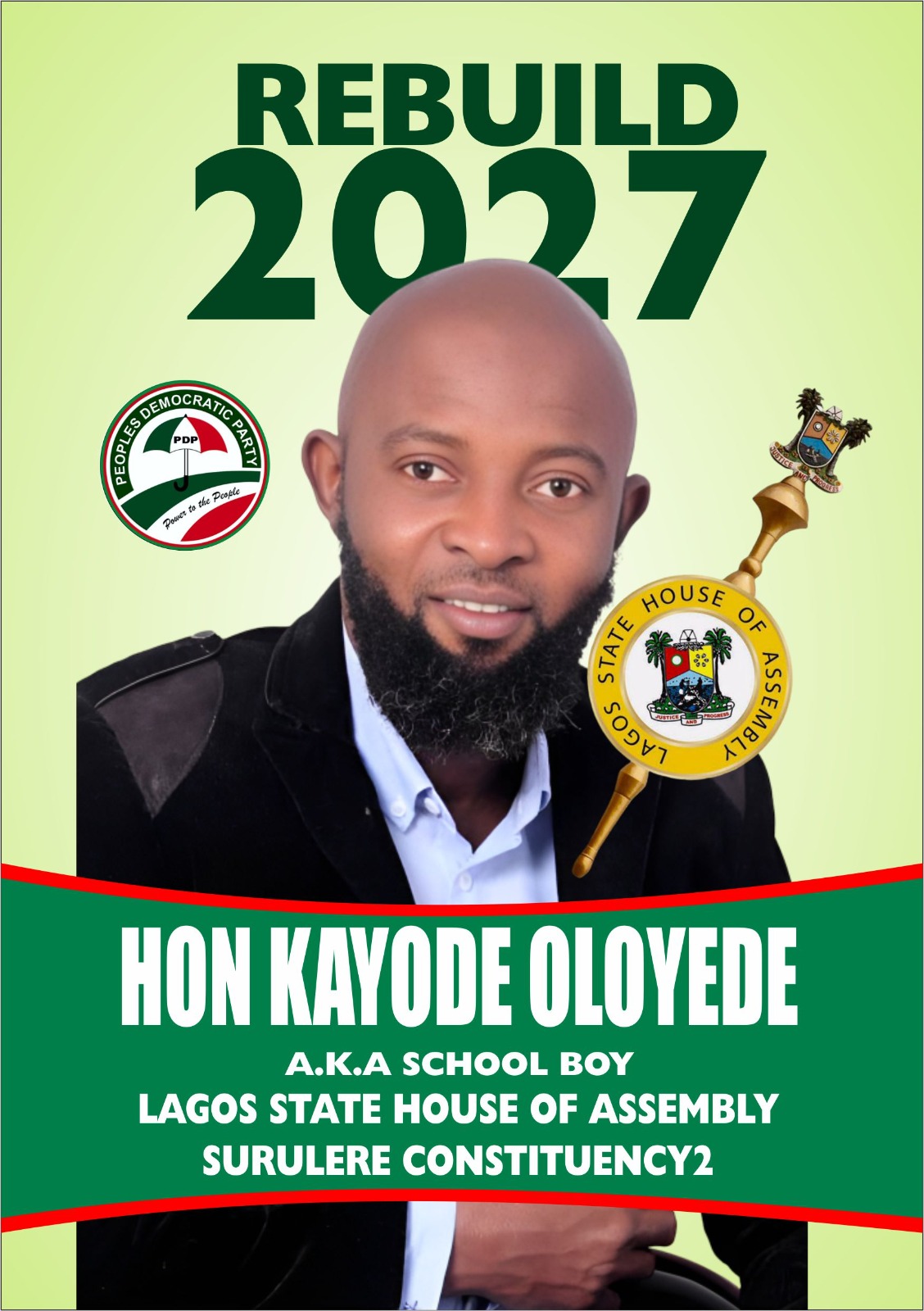
2027 Assembly Race: ‘School Boy’ Sparks Fresh Hope for Surulere Constituency II
LAGOS – As political activities gradually gather momentum ahead of the 2027 general elections, growing support is emerging in Surulere Constituency II for the Peoples Democratic Party (PDP) House of Assembly aspirant, Hon. Kayode Oloyede, popularly known as “School Boy.”
Running on the campaign theme, “Rebuild 2027,” Oloyede is positioning himself as an alternative voice for residents seeking a new direction in legislative representation and grassroots development.
A Vision Anchored on Four Pillars
The aspirant has built his campaign around a four-point agenda designed to address the concerns of constituents:
People First: Prioritising the welfare and everyday needs of residents above partisan considerations.
Transparent Leadership: Promoting accountability in legislative activities, constituency projects, and public resource management.
Inclusive Governance: Encouraging broad participation in decision-making by ensuring every segment of the constituency has a voice.
Sustainable Development: Advocating long-term investments in infrastructure, youth empowerment, education, and human capital development.
Growing Grassroots Appeal
Political observers say Oloyede’s grassroots engagement strategy and community-focused messaging have resonated with many residents who desire more accessible and responsive representation.
His campaign consistently emphasises the need to bridge the gap between elected representatives and the people, with a promise to build “a better, stronger, and more prosperous Surulere Constituency II.”
A community leader, who requested anonymity, said many residents are looking beyond political rhetoric and seeking leadership that understands their daily challenges.
“We need someone who genuinely understands the struggles of ordinary people and is prepared to serve the community. For many of us, the call to rebuild is not just a campaign slogan but a reflection of our aspirations for meaningful development,” the source said.
A Competitive Political Landscape
As the countdown to the 2027 elections continues, Oloyede has urged constituents to embrace a vision centred on progress, accountability, and community-driven governance.
While Surulere remains a politically competitive constituency with established structures and influential stakeholders, analysts believe the increasing visibility of the “School Boy” movement could make the contest one of the closely watched legislative races in Lagos State.
Ultimately, political observers note that while grassroots mobilisation is a significant factor, electoral outcomes will likely depend on a combination of candidate credibility, party strength, voter turnout, campaign organisation, and the prevailing political climate as the 2027 elections approach.
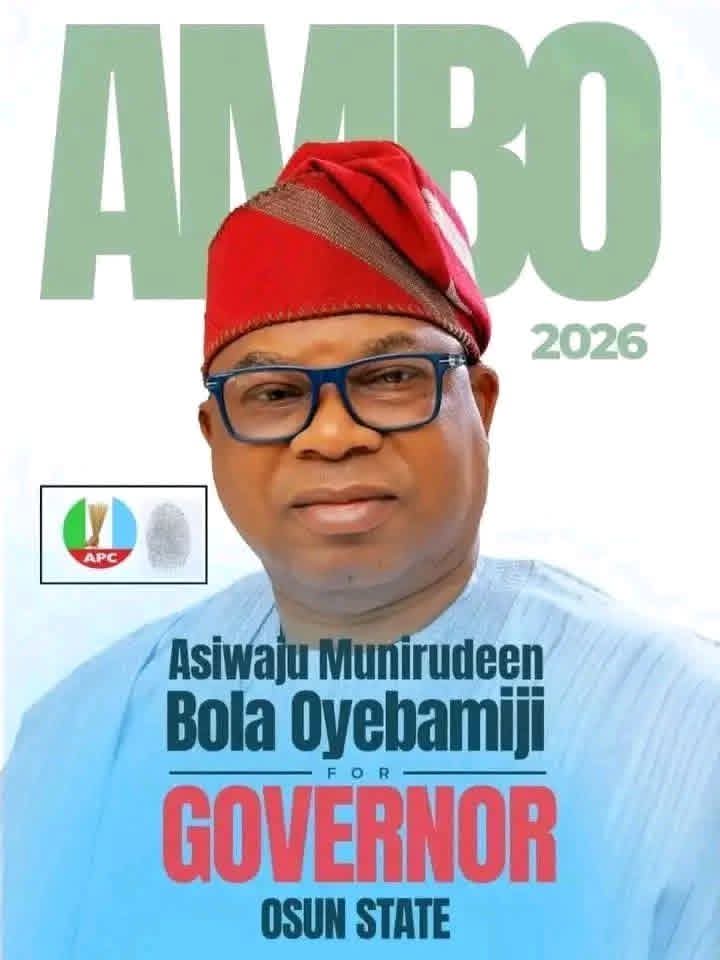
AMBO and the Osun Governorship Race: Assessing the Man, the Politics and the Vision
As political activities gather momentum ahead of the 2026 Osun State governorship election, a public affairs commentator, Oluseyi Olonade, has described the emergence of Asiwaju Munirudeen Bola Oyebamiji, popularly known as AMBO, as a significant development in the state’s political landscape.
In an article titled “Oyebamiji: The Man, The Politics and The Aspiration,” Olonade argued that the All Progressives Congress governorship hopeful possesses the character, experience and vision needed to reposition Osun State for sustainable growth.
According to the writer, Oyebamiji’s appeal stems from his extensive background in the banking sector, where he spent nearly three decades working with institutions including Wema Bank, Trans International Bank, Spring Bank and Enterprise Bank.
A native of Ikire in Irewole Local Government Area, Oyebamiji was described as a technocrat whose experience in corporate governance, finance and risk management has shaped his approach to public administration.
The article noted that his public service journey gained prominence in 2012 when he was appointed to oversee the then Osun State Investment Company Limited. Under his leadership, the organisation was reportedly restructured and transformed into Omoluabi Holdings Limited.
The writer further highlighted Oyebamiji’s tenure as Commissioner for Finance under successive APC administrations, where he was credited with managing the state’s finances during challenging economic periods.
Olonade also referenced Oyebamiji’s appointment as Managing Director of the National Inland Waterways Authority, describing it as further evidence of his administrative and leadership capabilities.
The article contrasted Oyebamiji’s governance philosophy with that of the current administration in Osun State, arguing that the APC aspirant favours institutional reforms, economic diversification and fiscal discipline.

According to the writer, Oyebamiji’s proposed agenda includes strengthening transparency in government spending, expanding internally generated revenue, attracting private-sector investments and promoting industrial and agricultural development.
The article also highlighted youth empowerment, entrepreneurship development and digital skills acquisition as key components of his vision for the state.
Olonade concluded that the forthcoming governorship election would present voters with a choice between different approaches to governance, expressing confidence that Oyebamiji’s experience and developmental agenda make him a strong contender in the race.


- Gwede Mantashe Joins African Energy Week (AEW) 2026 as South Africa's Petroleum Reforms Open the Orange Basin to Drilling June 8, 2026
- Inspiring Tomorrow's Leaders: Senator Dr. Rasha Kelej Launches her First Virtual Mentorship and Leadership Platform June 8, 2026
- ExxonMobil and National Basketball Association (NBA) Africa interactive Science, Technology, Engineering, and Mathematics (STEM) Showcase and a Jr. NBA Clinic June 8, 2026
- Africa Centres for Disease Control and Prevention (Africa CDC) Welcomes Pandemic Fund’s US$220m Support for Bundibugyo Virus Outbreak Response June 8, 2026
- Africa Centres for Disease Control and Prevention (Africa CDC) and World Health Organization (WHO) Launch Joint Continental Ebola Response Plan June 8, 2026
- Statement of the Catholic Bishops of Africa on the Tragic Killing of Most Rev. Osório Citora Afonso, Bishop of Quelimane and Apostolic Administrator of the Archdiocese of Beira June 8, 2026
- Journal of Public Health in Africa Expands with New Rapid Communications, Policy and News Sections June 8, 2026
- Mining Review Africa expands coverage to include global mining news June 8, 2026
- 13,000 Hectare Wild Coast Conservation Property Comes to the Market in the Eastern Cape June 8, 2026
- President Isaias Afwerki Departs for Egypt June 7, 2026
- Gwede Mantashe Joins African Energy Week (AEW) 2026 as South Africa's Petroleum Reforms Open the Orange Basin to Drilling June 8, 2026
- Inspiring Tomorrow's Leaders: Senator Dr. Rasha Kelej Launches her First Virtual Mentorship and Leadership Platform June 8, 2026
- ExxonMobil and National Basketball Association (NBA) Africa interactive Science, Technology, Engineering, and Mathematics (STEM) Showcase and a Jr. NBA Clinic June 8, 2026
- Africa Centres for Disease Control and Prevention (Africa CDC) Welcomes Pandemic Fund’s US$220m Support for Bundibugyo Virus Outbreak Response June 8, 2026
- Africa Centres for Disease Control and Prevention (Africa CDC) and World Health Organization (WHO) Launch Joint Continental Ebola Response Plan June 8, 2026
- Statement of the Catholic Bishops of Africa on the Tragic Killing of Most Rev. Osório Citora Afonso, Bishop of Quelimane and Apostolic Administrator of the Archdiocese of Beira June 8, 2026
- Journal of Public Health in Africa Expands with New Rapid Communications, Policy and News Sections June 8, 2026
-

 news6 months ago
WHO REALLY OWNS MONIEPOINT? The $290 Million Deal That Sold Nigeria’s Top Fintech to Foreign Interests
-

 society1 month ago
SOCIAL MEDIA IS NOT A BATTLEFIELD COMMAND – WHY THE NIGERIAN ARMY’S ACTION AGAINST JUSTICE CRACK IS A NATIONAL SECURITY IMPERATIVE
-

 celebrity radar - gossips4 months ago
Dr. Chris Okafor Returns with Power and Fire of the Spirit -Mounts Grace Nation Altar with Fresh Anointing and Restoration Grace on February 1, 2026
-

 celebrity radar - gossips6 months ago
Prophet Kingsley Aitafo Releases 2026 Prophecy: ‘Nigeria Will Rise, but the World Must Prepare for Turbulence’