
Education
COVID-19: EKITI PRIMARY AND SECONDARY SCHOOLS REOPEN SEPT 21 ….. TERTIARY INSTITUTIONS TO RESUME OCT 2

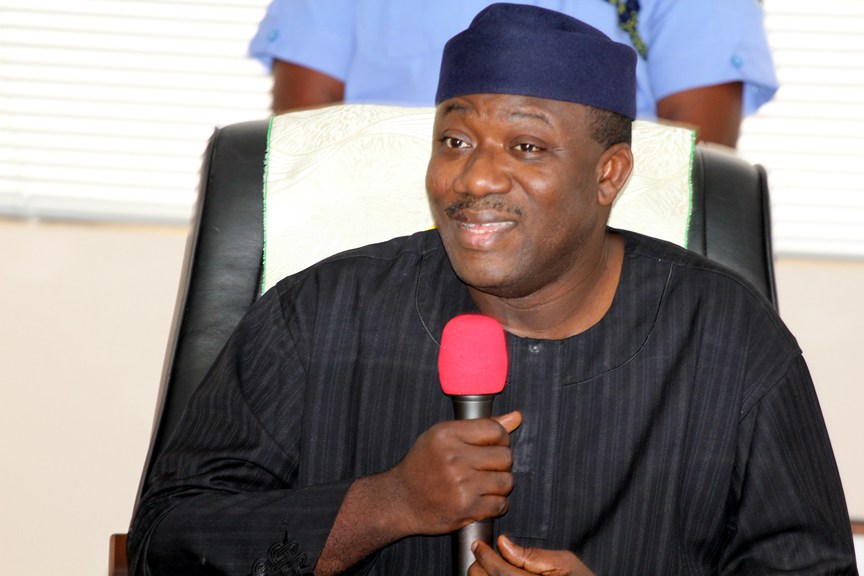
Ekiti State Governor, Dr Kayode Fayemi has announced September 21 date for reopening of primary and secondary schools in the state, ending months of school closure occasioned by the Covid-19 pandemic.
Dr. Fayemi who disclosed this in a state-wide broadcast on Sunday evening also directed that tertiary institutions in the state be opened to students from October 2, subject to each institution’s Governing Council decision and strict adherence to safety protocols to curb the spread of COVID-19.
The Governor stressed that the authorities of the tertiary institutions are to liaise with the Ekiti COVID-19 Task Force for guidance on the appropriate measures to be put in place before reopening.
Specifically, the Governor said students in SSS II, JSS III and Primary 6 are to resume on September 21, while students in SSS I, JSS II and Primary 5 and 4 are to resume from September 28.
Students in JSS I and Primary 1-3 are to resume on October 19, while pupils in Kindergarten and Nursery Schools are expected to resume on November 2, when more assurances of safety for their age bracket would have been established.
The Governor noted that the decision to open more classes was taken because there has been no spike traceable to students in exit classes who are writing their certificate examinations saying: “This shows that our preventive measures to safeguard them from being infected has been effective.”
On worship centres, Dr Fayemi disclosed that they can henceforth hold two services on Fridays, Saturdays and Sundays while midweek services and night vigils are still prohibited.
He said: “After a careful review and advice by the experts, I am glad to announce that worship centres can now hold two services on Friday, Saturday or Sunday as the case may be but mid-week activities and night vigils remain suspended for now. Other protocols and regulations concerning worship centres reopening still subsist.”
Reprieve also came for residents of the state on social activities especially the ones taking place in halls and event centres with owners of such facilities now mandated to rent them to users on condition that they should not contain more than 50 per cent of their normal capacities.
Dr. Fayemi said: “Owners of halls and event centres may now be allowed to rent out their facilities but under no condition should such a facility contain more than 50 per cent of its normal capacity.
“This is to allow for social distancing. Events centres are expected to observe all protocols prescribed for religious centres and to obtain certificate of readiness before opening.”
The Governor, however, expressed concern on flouting of social distancing rules and non-use of face masks saying enforcement will also be scaled up to ensure compliance with COVID-19 regulations.
The Governor added: “While we have progressively responded to the initial lockdown with gradual relaxation in line with the progress made, we must remain vigilant as we cannot afford to indulge ourselves such that a spike may recur as a result of flagrant disobedience to the established protocol
“We cannot afford to go back into another round of lockdown with its attendant repercussions. This point needs to be emphasized; though, there is a national decline in number of cases, there has been a noticeable upsurge in Ekiti.
“One proof of this is the unpleasant but consistent figures that we have recorded in the last month. As at the time I addressed you on August 5, 2020, there were only 152 confirmed cases in Ekiti.
“Today we have recorded a total of 299 cases which means we recorded 147 new cases within a month. You would recall that the total recorded cases from March to August were 152. This suggests that from August to date, we have had near 100 percent new cases, even while national number has maintained a stable decline.
“It is in view of this, that I have issued a new directive to the law enforcement agencies to ramp up their enforcement activities. We should not delude ourselves that we are out of the pandemic until there is a reliable vaccine in place.
“Even as we continue to evaluate situations and act promptly, I urge you to take personal measures and responsibility by adhering to all existing protocols, as not doing so, could jeopardize our collective wellbeing”
Speaking on empowerment, the Governor said his administration was doing everything possible to support entrepreneurs, artisans and self employed residents.
He disclosed that over 200 businesses accessed the COVID loans from CBN through the Microfinance and Enterprise Development Agency (MEDA) while Ekiti residents should expect to benefit from the multiple initiatives from the Federal Government to support the economy, including the recently launched COVID Survival Fund.
The Governor thanked the state’s medical and health workers in the front line and the COVID-19 Response Resource Mobilisation Team as well as all donors to the COVID-19 Support Fund.
He urged residents to keep safe in all fronts especially with more rains coming adding that “we must not only keep safe in terms of COVID-19 prevention, we must also ensure that the drainages are kept free to forestall flooding, just as our drivers must keep safe to avoid accidents in these last quarter as we move towards the end of the year.”




Education
GIRAU INTERNATIONAL SCHOOL, MILLENNIUM CITY KADUNA, OPENS ADMISSION FOR THE 2025/2026 ACADEMIC SESSION

*GIRAU INTERNATIONAL SCHOOL, MILLENNIUM CITY KADUNA, OPENS ADMISSION FOR THE 2025/2026 ACADEMIC SESSION
Girau International School (GIS), a premier educational institution located in the heart of Millennium City, Kaduna, has officially announced the commencement of admissions for the forthcoming academic year. The school invites applications for its comprehensive educational streams: *Early Years, Primary, Secondary, and Islamiyya*.
Renowned for its unwavering commitment to academic excellence and holistic development, GIS stands as a beacon of learning in Northern Nigeria. The institution is built on a foundational philosophy dedicated to providing *world-class education* that meets international standards while being firmly rooted in positive cultural and moral values.
The school’s mission extends beyond conventional academics. With a dedicated focus on *nurturing young minds and shaping future leaders* of tomorrow, GIS employs a curated blend of innovative teaching methodologies, a blended curriculum, and state-of-the-art facilities. The environment is meticulously designed to ensure that every student excels *academically, socially, and morally*, preparing them to thrive in a dynamic global landscape.
*A CAPACITY FOR EXCELLENCE*
GIS boasts significant capacity to deliver on its promises:
* *Modern Infrastructure:* The campus features purpose-built, technologically integrated classrooms, advanced science and computer laboratories, expansive sports facilities, and dedicated learning spaces for creative and performing arts.
* *Qualified Faculty:* The school employs a team of highly trained, experienced, and passionate educators who are specialists in child-centered and participatory learning.
* *Blended Curriculum:* The academic programme seamlessly integrates the Nigerian/British curriculum ensuring international best practices, complemented by a strong emphasis on character building, leadership skills, and Islamic ethical teachings in its Islamiyya section.
* *Secure and Conducive Environment:* Situated within the serene and secure Millennium City layout, the school provides a safe, inclusive, and stimulating atmosphere ideal for learning and personal growth.
Prospective parents and guardians seeking an educational partnership that prioritizes excellence, discipline, and comprehensive development for their wards are encouraged to secure a place.
Admission forms are available at the school’s administration office. Early application is advised due to limited vacancies across all classes.



NIGERIA’S EDUCATION STRIDES, GLOBAL ACKNOWLEDGMENT: When Evidence Travels from Jigawa
…as President Tinubu set to commission Africa’s largest schools complex in Lagos
By O’tega Ogra
There is a quiet shift happening in Nigeria’s education system. You will not find it in speeches neither will you find it in long policy documents. But if you look closely, you will see it in something far more difficult to dismiss. Evidence.
Last week in San Francisco, at the Comparative and International Education Society (CIES) conference, data from classrooms in Jigawa State was presented before a global audience. Not projections. Not estimates. A record of what is happening inside a public system in Nigeria. 
That distinction matters. For years, much of what the world has understood about education in countries like ours has been assembled from a distance. National averages. Modelled estimates and reports written long after the fact. What was presented this time came from within. Attendance tracked daily. Teachers reassigned based on need. Classrooms observed as they function. All under a digitalised ecosystem.
In Jigawa, under the JigawaUNITE foundational learning digital programme, the numbers tell a simple story. Within roughly 150 days of implementation which commenced at the end of 2024, 95 previously understaffed schools were fully staffed. Pupil teacher ratio moved from 114:1 to 70:1. Daily attendance rose from 39 per cent to 77 per cent. This remarkable improvement was not achieved by expanding the workforce. It came from reorganising what already existed under a digital umbrella.
There is something instructive in that. Nigeria has never lacked policy. What we have often lacked is the discipline of execution. The ability to take what already exists and make it work as intended. That is where the real shift is beginning to show.
But it would be too convenient to reduce this to one programme.
At the federal level, the direction has also been adjusting. The Minister of Education, Dr. Maruf Tunji Alausa, has placed measurable outcomes, foundational learning, and teacher quality back at the centre of policy. UBEC, the Federal Government’s Universal Basic Education body, continues to drive national interventions around school improvement and teacher development, even as it insists that reform must remain system-led and not fragmented.
The First Lady’s education interventions, through the Renewed Hope Initiative, have reinforced education as a national priority, particularly around access, learning materials, and inclusion. These are different levers, but they are part of the same ecosystem.
And then there is the fiscal reality.
Recent reforms under President Bola Ahmed Tinubu have increased allocations to subnational governments, creating more room for states to act. In a federation like Nigeria, that matters. Because education is not delivered from Abuja. It is delivered in states. In schools. In classrooms.
What Jigawa has done is to use that room and the Executive Governor of the state, the State Universal Basic Education Board, and their partners on the JigawaUNITE project, New Globe, must be given kudos.
However, Jigawa is not alone in this journey.
In Kwara, efforts to align teaching with actual learning levels are beginning to correct a structural mismatch in classrooms. In Lagos and Edo, structured pedagogy and closer monitoring are improving consistency in teaching. Across the entire ecosystem, state governments, federal institutions like UBEC, and delivery partners like NewGlobe are pushing at the same question from different angles.
How do children actually learn better?
In a prior reflection, Ifeyinwa Ugochukwu, VP at NewGlobe, captured the urgency clearly. With the right tools, training, and use of data, foundational learning outcomes can improve at scale. The real risk, she noted, is delay, allowing learning gaps to become permanent.
That warning should not be ignored because the context remains difficult. Nigeria still carries one of the largest out of school populations in the world. Learning gaps remain. Progress in one state does not resolve a national challenge, but it does something else.
It proves that movement is possible.
What was presented in Washington did not claim success. It demonstrated function. It showed that a Nigerian sub-national can generate evidence that holds up in a global room. That reform does not always require something new. Sometimes it requires using what already exists more honestly and more efficiently.
The real question now is whether this remains an exception.
Or whether it becomes a pattern.
Because reform at scale is never built on isolated wins. It is built on systems that can reproduce them.
And perhaps that is why the timing matters.
This week, another subnational, Lagos State, is expected to commission the Tolu Schools Complex in Ajegunle, a sprawling 36-school integrated facility spread across 11.7 hectares, designed to serve over 20,000 students, and described as the largest school community in Africa. 
There is a connection here that should not be missed.
On one hand, a classroom system in Jigawa is learning how to organise itself better. On the other, a state like Lagos is building the physical scale required to carry thousands of learners at once.
One is structure. The other is capacity.
Real progress sits where both meet because education reform is not only about what we build, it is about how well what we build actually works.
For once, the data was not explaining Nigeria from the outside.
It was coming from within.
And it carried weight.

FAB Luxury Court Sets A Rare Benchmark For Excellence In Africa
~By Oluwaseun Fabiyi
Fab Luxury Court distinguishes itself as the premier choice for reliable investors and proactive developers in Nigeria and Africa.While numerous real estate entities operate within the country, Fab Luxury Court stands out for its exceptional honesty and integrity, delivering on the promises showcased on its social media page to distinguished customers globally.
As of now, no investors, whether domestic or international, have expressed regret over investing in or partnering with Fab Luxury Court. The company’s commitment to accessibility, accountability, and transparent financial reviews sets it apart from its contemporaries, rendering it a prized asset among its extensive clientele worldwide. Thousands of customers continue to patronize Fab Luxury Court due to its impeccable integrity and visionary approach.
*Why is Fab Luxury Court a worthwhile investment that warrants prompt consideration rather than hesitation?*
Fab Luxury Court’s security measures are exemplary and deserving of commendation, providing investors with capital protection through a robust structured framework, transparent reporting, and comprehensive legal documentation, thereby guaranteeing outstanding and secure returns.
Fab Luxury Court has further cemented its position as a leading developer and real estate powerhouse in Nigeria and Africa, currently managing several high-end estates in Maryland, Ikeja, Lagos and its surrounding areas.Fab Luxury Court demonstrates its unwavering commitment to excellence in Nigeria’s real estate sector through its best-selling estates in Ikeja.
Undoubtedly, partnering with and patronizing Fab Luxury Court will significantly contribute to securing your future; as you plan to associate with them in 2027, we encourage you to maintain a positive outlook and unwavering confidence in your future wealth.


- Global Energy Bodies Converge at African Energy Week (AEW) 2026 to Shape the Continent’s Energy Future May 11, 2026
- Junior Achievement (JA) Africa and ExxonMobil Foundation Launch Science, Technology, Engineering, and Maths (STEM) Africa 2.0 to Equip the Next Generation of African Innovators May 11, 2026
- Merck Foundation Chief Executive Officer (CEO), Senator Dr. Rasha Kelej Champions Girl Education as the Foundation of Women Empowerment May 11, 2026
- Youth Charter Marks International Coaching Week with Global Call for a New Generation of “Social Coaches” Inspired by the Legacy of Muhammad Ali and the United Nations (UN) Sustainable Development Goals May 11, 2026
- Africa’s next energy boom will be won through infrastructure, not exploration alone May 11, 2026
- President El-Sisi Heads to Kenya to Participate in the Africa–France Summit May 11, 2026
- Telecoming Strengthens Its Presence in Africa with the Launch of DCB Software South Africa May 11, 2026
- From Megawatt (MW) to Gigawatt (GW): Why Africa Must Think in Grid-Scale Power to Compete in the Artificial Intelligence (AI) Economy May 11, 2026
- Enlit Africa 2026 makes 20 May the Commercial and Industrial (C&I) delivery day across power, water and clean energy hubs May 11, 2026
- Africa Centres for Disease Control and Prevention (Africa CDC) and Ethiopia Officially Launch Conference on Public Health in Africa (CPHIA) 2026 to Advance Africa’s Health Security and Sovereignty Agenda May 10, 2026
- Global Energy Bodies Converge at African Energy Week (AEW) 2026 to Shape the Continent’s Energy Future May 11, 2026
- Junior Achievement (JA) Africa and ExxonMobil Foundation Launch Science, Technology, Engineering, and Maths (STEM) Africa 2.0 to Equip the Next Generation of African Innovators May 11, 2026
- Merck Foundation Chief Executive Officer (CEO), Senator Dr. Rasha Kelej Champions Girl Education as the Foundation of Women Empowerment May 11, 2026
- Youth Charter Marks International Coaching Week with Global Call for a New Generation of “Social Coaches” Inspired by the Legacy of Muhammad Ali and the United Nations (UN) Sustainable Development Goals May 11, 2026
- Africa’s next energy boom will be won through infrastructure, not exploration alone May 11, 2026
- President El-Sisi Heads to Kenya to Participate in the Africa–France Summit May 11, 2026
- Telecoming Strengthens Its Presence in Africa with the Launch of DCB Software South Africa May 11, 2026
-

 news5 months ago
WHO REALLY OWNS MONIEPOINT? The $290 Million Deal That Sold Nigeria’s Top Fintech to Foreign Interests
-

 society1 week ago
SOCIAL MEDIA IS NOT A BATTLEFIELD COMMAND – WHY THE NIGERIAN ARMY’S ACTION AGAINST JUSTICE CRACK IS A NATIONAL SECURITY IMPERATIVE
-

 celebrity radar - gossips4 months ago
Dr. Chris Okafor Returns with Power and Fire of the Spirit -Mounts Grace Nation Altar with Fresh Anointing and Restoration Grace on February 1, 2026
-

 celebrity radar - gossips5 months ago
Prophet Kingsley Aitafo Releases 2026 Prophecy: ‘Nigeria Will Rise, but the World Must Prepare for Turbulence’