
Politics
COVID-19: Gov Abiodun suspends carnivals, cross-over gatherings …orders workers to stay at home till January 4


COVID-19: Gov Abiodun suspends carnivals, cross-over gatherings- Ogun State Governor, Prince Dapo Abiodun has called for restraint in celebrations during the Christmas and New Year festivities as he announced the suspension of street carnivals, crowded cross-over night service, parties and similar gatherings in the Stat, amidst an increase in COVID-19 infections across the nation.
The governor on Wednesday also directed all civil servants and other government workers in the State to proceed on Christmas and New Year holiday from Thursday, December 24.
According to the Chief Press Secretary to the Governor, Mr Kunle Somorin, the directives were issued on Wednesday after a meeting between the state government and religious leaders from the League of Imams and the Christian Association of Nigeria as well as community leaders as part of the measures and guidelines for public health as the state prepares for a second wave of the coronavirus pandemic.
The Governor directed that all Schools in the State are to remain closed until January 18, 2021, while all bars, nightclubs, pubs and event centres, recreational centres in the state have also been closed down indefinitely.
The Governor further directed that the all markets are to open strictly between 8am and 4pm while maintaining social distancing and observing all COVID-19 protocols, including the use of face mask, provision of hand sanitizer and/or hand-washing equipment at every strategic point within their malls, shops, business premises etc.
Gov Abiodun further directed that religious and worship centres should not exceed 50 per cent of their capacity. All services must also be in compliance with all COVID-19 protocols.
In order to stem, the spread of the second wave of the disease, Gov. Abiodun advised that “there should be no gatherings of more than 50 people at any event or ceremonies, such as conferences, congresses, office events, concerts, seminars, sporting activities, cross-over nights, end of year parties, weddings, naming, birthdays, anniversaries, street carnivals, etc until further notice”.
He also called on motorcycle (okada), tricycle, bus, car, taxi and other transport operators to not to carry passengers above 50 percent of their capacity, in compliance with social distancing rules.
While urging citizens to celebrate in moderation, Gov. Abiodun wished the people a Merry Christmas and prosperous 2021, saying they should take personal responsibilities and stay within their residences and not embark on travels within and outside the State to ensure they neither transmit nor contract the virus.
For religious centres, the League of Imams and the Christian leaders adopted the earlier positions taken in the wake of COVID-19 earlier in the year such as:
1. All worship activities must be observed by not more than 50percent of capacity
2. All congregants must wear their face masks appropriately (that is, No facemask, No entry)
3. There should be reliable sources of running water
4. Worship centres should be adequately cleaned and disinfected before and after services
5. Household bleach solution should be adequately prepared for disinfectations
6. There should be adequate provision and supervision of multiple Veronica Buckets for handwashing (fully automated handwashing machines are preferable)
7. There should be provision of alcohol-based sanitiser which must be used before and at intervals of every 20 minutes as well as after service
8. Worship centre should provide adequate toilet facilities with water
9. It is paramount for Muslims to perform ablution at home and go to Mosque with their personal praying mats
10. Qualified Medical Practitioners or trained personnels should check the temperature of worshippers with infrared thermometer before allowing them to enter worship centres
11..There should be adequate medical support for sick persons
12. All services on Friday/Sunday and other week days must adhere strictly to COVID-19 Guidelines
13. There should be pre-designated standing position/sitting points to ensure not less than 2 meter distancing
14. The duration of religious services should not be more than one hour. In addition, same duration must be observed at intervals, where there are multiple services
15. The use of Air-conditioners should be discouraged while worship centres should be well ventilated with the use of fans
16. There should not be any handshake/hugs by worshippers
17. Proper awareness of the susceptibility of the aged and people with signs of ill-health should be adequately created among worshippers at all times
18. Constant sensitisation of COVID-19 and its dangers should be included in sermon and goodwill messages
19. Provision of isolation rooms is mandatory in all worship centres or facilities
20. Religious services and events should be recorded with digital camera for record purposes
21. Government will not hesitate to impose severe sanctions (including, but not limited to lockdown) on any Worship Centre that fails to comply with the laid down guidelines
22. No social gathering should exceed 50 people while 2 meters social distancing must be observed in such gatherings
23..Disposable elements should be used during Holy Communion instead of sharing cups





Huge Turnout As Obasa Secures House of Reps Ticket
A massive crowd of party faithful thronged Agege on Saturday, May 16, as the Speaker of the Lagos State House of Assembly, Rt. Hon. Mudashiru Obasa, secured his place as the All Progressives Congress (APC) consensus candidate for the Agege Federal Constituency seat in the House of Representatives.
The hitch-free primary exercise saw card-carrying members in their numbers validate his candidacy, underscoring the strength of his grassroots support.
The development comes just days after Obasa’s May 13 declaration at a stakeholders’ meeting in Agege, where he announced his ambition to contest for the federal seat.
At that earlier event, he explained that his decision was driven by calls from party leaders and stakeholders who believed he could serve Agege more effectively at the national level.
“I answered the call of our leaders and stakeholders who believe I can serve Agege better. We must present candidates with capacity, loyalty, and commitment to the progress of Agege,” Obasa had said.
At the primary election, Obasa expressed gratitude for the overwhelming support from his constituency.
“I am deeply humbled by the confidence reposed in me by our leaders and members. Today’s validation is not just about me; it is about our collective resolve to continue building Agege and Lagos State on the foundation of progress and development,” he remarked.
He further pledged to remain people-focused in his representation: “My commitment has always been to serve with integrity, to amplify the voices of our people, and to ensure that Agege continues to stand tall in the comity of constituencies. This validation strengthens my resolve to deliver more dividends of democracy.”
Party officials praised the peaceful conduct of the exercise, noting that it reflected the unity and discipline within the APC in Agege.
Observers also pointed to Obasa’s earlier endorsement of Hon. Ganiyu Egunjobi for Agege Constituency I and Hon. Azeez Oladapo Yusuf Ninolowo for Agege Constituency II as evidence of his broader strategy to consolidate party cohesion.
With the primary now concluded, Obasa is set to fly the APC flag in the forthcoming general election, a move that many believe will further entrench the party’s influence in Agege.

Ajadi Backs PDP–APM Alliance, Expresses Confidence in Oyo Central Senate Victory
The senatorial candidate of the Peoples Democratic Party (PDP) and Allied Peoples Movement (APM) alliance for Oyo Central Senatorial District, Olufemi Ajadi Oguntoyinbo, has described the newly formed political alliance between the two parties in Ibadan as a major step toward strengthening democratic participation ahead of the 2027 general elections.
He spoke on Thursday at Mapo Hall shortly after the political gathering where Seyi Makinde declared his intention to contest the 2027 presidential election and unveiled the alliance between the PDP and APM.
Addressing journalists at the event, Ajadi said the coalition signaled renewed hope for democracy and political inclusiveness in Oyo State, noting that the partnership had energized supporters across the state.
According to him, the alliance was not only strategic for electoral success but also a demonstration that democratic values would prevail despite political uncertainties.
“To tell the general public that today’s alliance with APM party with PDP is a great one because when they planned all their plans believing that democracy will not exist, but God has made every possible best to make a provision,” Ajadi said.
He added that the visible turnout at the rally reflected the acceptance of the coalition among residents and supporters throughout the state.
“That is the reason you can see the nook and cranny of Oyo State that everyone is well happy because democracy must remain,” he said.
The event attracted thousands of party faithful, political stakeholders and supporters from across Oyo State, marking one of the earliest major political gatherings linked to the 2027 election cycle in the South-West.
Ajadi, who is seeking to represent Oyo Central in the Senate, also used the occasion to restate his confidence in securing victory at the polls, saying his political ambition was rooted in service and a commitment to deliver meaningful representation.
“My aspiration is total victory because I know what I have for my people and my people know me very well,” he said.
He promised that if elected, he would demonstrate effective legislative leadership and practical representation that would directly benefit constituents across the senatorial district.
“By the grace of God when I assume the office of the Senate, I will demonstrate what it takes to show the general public that there is capacity, and I will definitely show it,” Ajadi added.
Political analysts say the emerging partnership between the PDP and APM in Oyo could alter the configuration of alliances in the state ahead of 2027, especially as discussions intensify over succession politics and opposition realignments.
The alliance announcement came as Governor Seyi Makinde formally entered the presidential race, a move that may further elevate Oyo’s influence in national political calculations as parties begin early consultations toward the next general election.
Politics
Hon. Olusegun Amore Clears APC Screening for Ogun Assembly Race, Promises Purposeful Representation for Yewa South
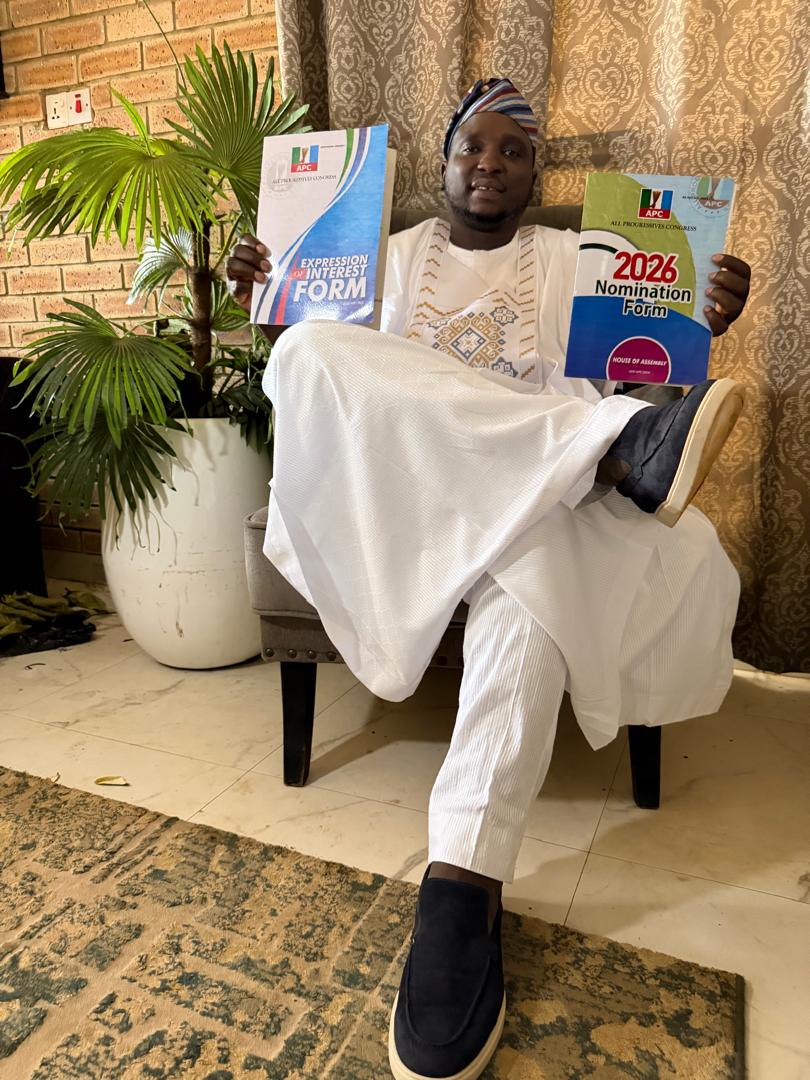
Hon. Olusegun Amore Clears APC Screening for Ogun Assembly Race, Promises Purposeful Representation for Yewa South
ABEOKUTA, OGUN STATE, NIGERIA – In a bold and strategic move towards deepening quality representation, grassroots development, and people-oriented governance, Hon. Olusegun Olugbemileke Amore has officially obtained and successfully passed the screening exercise of the All Progressives Congress (APC) to contest for the Yewa South Local Government State Constituency seat at the Ogun State House of Assembly.
This development has continued to generate excitement, hope, and widespread acceptance among party faithful, political stakeholders, youths, women groups, and residents across Yewa South, many of whom see Hon. Amore as a vibrant, visionary, and grassroots-oriented leader with the competence, capacity, and character required to deliver purposeful representation.
Hon. Amore, who is widely respected for his humility, accessibility, leadership qualities, and unwavering commitment to community development, explained that his decision to join the race was driven by his passion to serve the people, attract meaningful development, and become a strong voice for the aspirations of Yewa South at the state legislative level.
According to him, the time has come for a new era of responsive representation anchored on youth inclusion, infrastructural advancement, educational support, empowerment initiatives, and people-centered legislation capable of positively impacting every ward and community within the constituency.
Speaking shortly after successfully scaling through the APC screening exercise, Hon. Amore expressed appreciation to party leaders, members, supporters, political associates, and well-wishers for their encouragement, trust, and overwhelming support.
He reaffirmed his loyalty and commitment to the ideals and progressive philosophy of the APC, while promising to run an issue-based, peaceful, and inclusive campaign that would further unite the people and strengthen the party ahead of the forthcoming elections.
Hon. Amore further stressed that Yewa South deserves quality representation that will prioritize youth empowerment and employment opportunities, improved educational support and scholarship initiatives, better road infrastructure and rural development, agricultural and economic advancement, enhanced healthcare delivery, and effective legislative advocacy capable of attracting greater government presence and developmental projects to the constituency.
As consultations, mobilization, and political engagements continue across Yewa South, many supporters have expressed confidence that Hon. Olusegun Olugbemileke Amore possessed the experience, credibility, leadership capacity, and political will needed to effectively represent the interests of the constituency and contribute meaningfully to the continued progress and development of Ogun State.
Indeed, the journey towards a greater, stronger, and more prosperous Yewa South appears to have gained renewed momentum with the emergence of Hon. Olusegun Olugbemileke Amore as a formidable aspirant under the progressive banner of the APC.
Political observers and supporters have also described Hon. Amore’s aspiration as a welcome development, citing his longstanding relationship with the grassroots, dedication to humanitarian causes, and passion for community growth and political inclusiveness.
The Ogun State House of Assembly remains the legislative arm responsible for lawmaking, oversight functions, and the promotion of effective governance across the state.


- Mali: Group for the Support of Islam and Muslims (GSIM) must observe international humanitarian law and ensure safety of civilians as Bamako is under siege May 16, 2026
- Merck Foundation advances Healthcare Capacity through 2600+ Medical Scholarships across 52 Countries with African and Asian First Ladies May 16, 2026
- West African Development Bank (BOAD) and International Finance Corporation (IFC) Announce Landmark Reciprocal Euro and West African CFA franc (EUR-XOF) Facilities to Boost Local Currency Financing in West Africa May 15, 2026
- Eritrea: Seminar for female members of the Defense Forces May 15, 2026
- Guinea-Bissau takes another step toward a polio-free future May 15, 2026
- International Monetary Fund (IMF) Staff Completes the 2026 Article IV Consultation and Reaches Staff-Level Agreement with Ghana on the Sixth Review under the Extended Credit Facility Arrangement and on a 36-month Policy Coordination Instrument Request May 15, 2026
- Call for Urgent Regional Coordination Meeting Following Ebola Virus Disease Outbreak in Ituri Province, Democratic Republic of the Congo (DRC) May 15, 2026
- Seychelles and Maldives reaffirm bilateral ties as Foreign Ministers meet in Malé May 15, 2026
- Cross Switch Strengthens Senior Leadership Across the Board as Pan-African Expansion Accelerates May 15, 2026
- A Economic Community of West African States (ECOWAS) youth forum on artificial intelligence to build digital skills and foster innovation May 15, 2026
- Mali: Group for the Support of Islam and Muslims (GSIM) must observe international humanitarian law and ensure safety of civilians as Bamako is under siege May 16, 2026
- Merck Foundation advances Healthcare Capacity through 2600+ Medical Scholarships across 52 Countries with African and Asian First Ladies May 16, 2026
- West African Development Bank (BOAD) and International Finance Corporation (IFC) Announce Landmark Reciprocal Euro and West African CFA franc (EUR-XOF) Facilities to Boost Local Currency Financing in West Africa May 15, 2026
- Eritrea: Seminar for female members of the Defense Forces May 15, 2026
- Guinea-Bissau takes another step toward a polio-free future May 15, 2026
- International Monetary Fund (IMF) Staff Completes the 2026 Article IV Consultation and Reaches Staff-Level Agreement with Ghana on the Sixth Review under the Extended Credit Facility Arrangement and on a 36-month Policy Coordination Instrument Request May 15, 2026
- Call for Urgent Regional Coordination Meeting Following Ebola Virus Disease Outbreak in Ituri Province, Democratic Republic of the Congo (DRC) May 15, 2026
-

 news5 months ago
WHO REALLY OWNS MONIEPOINT? The $290 Million Deal That Sold Nigeria’s Top Fintech to Foreign Interests
-

 society2 weeks ago
SOCIAL MEDIA IS NOT A BATTLEFIELD COMMAND – WHY THE NIGERIAN ARMY’S ACTION AGAINST JUSTICE CRACK IS A NATIONAL SECURITY IMPERATIVE
-

 celebrity radar - gossips4 months ago
Dr. Chris Okafor Returns with Power and Fire of the Spirit -Mounts Grace Nation Altar with Fresh Anointing and Restoration Grace on February 1, 2026
-

 celebrity radar - gossips5 months ago
Prophet Kingsley Aitafo Releases 2026 Prophecy: ‘Nigeria Will Rise, but the World Must Prepare for Turbulence’