
Business
“Cyber Crime Act Empowers Those Libeled” + Why Journalist , Bloggers fall victim to scandals – Barrister Monday Ubani


Monday Ubani, a legal practitioner and Principal Partner of Ubani & Co., in a chat with Sahara Weekly, sheds light on the provisions of the new Cyber Crime Act, its scope, and why journalists and bloggers need to be more cautious in what they report about others
Q: In recent times there has been an increase in cases of harassment of journalists by government officials and influential individuals over the issues of blogging and cyber crime. What’s your take on this?
Ubani: The position of the law is defamation. You can sue someone who has defamed your character in civil suit and ask for damages to be paid. The law of defamation is about the reputation of an individual. If you succeed and have proven that the person has defamed your character, the person will be made liable to pay damages. You can also make it a criminal offence but many people haven’t been using criminal aspect in addressing defamation, not until recently when the new Cyber Crime Act was passed by the National Assembly and presented to ex-President Goodluck Jonathan. Even before then, libel was still a crime if proved that it tends to lower the character of the person involved. And there are special places where you can be convicted. If they do it ordinarily without making any demand on the victim, you can go in for either six months, or one month when there’s no money involved or the person chooses to do it in a criminal aspect. But if you make a demand, you have the plan of extorting from the person and that comes with a higher penalty under the criminal law. The new Cyber Crime Law has made it easier for any publication of the social media that tends to defame which involves extortion, to be punished under the Cyber Crime Act.
This has opened the eyes of many. It used to be called junk journalism then and most people didn’t seek redress for publications against them but now, the new Act has actually opened their eyes and empowered those offended. So when you write any rubbish and publish or re-publish it, you are going to be held. It is now very easy to hold bloggers who defame the characters of personalities. Instead of them pursuing the civil remedy, they use the criminal aspect. They arrest you, detain you, and punish you even when the matter goes the court. That shows you a lesson and that is why most bloggers are falling into criminal prosecution. People no longer pursue the civil remedy now that the criminal aspect carries more punishment on the offenders.
Can you educate us on what cyber-lock crime means?
There is a lot of crime committed using the internet and you know the social media is a new development. There has been an amendment in the constitution to accommodate this new development in science & technology in order to make sure it’s easier to present such cases in court because if it is not in our law book, no one can be held liable for such offence. So that’s why we have the cyber-lock crime to address crime that comes from the internet and social media. You have so many freedoms – freedom of information, freedom of movement, freedom to be defended, e.t.c. But you also have limitations too, knowing that your own rights stop where others’ begin, you will be careful in your own discharge of responsibility. It’s not victimisation




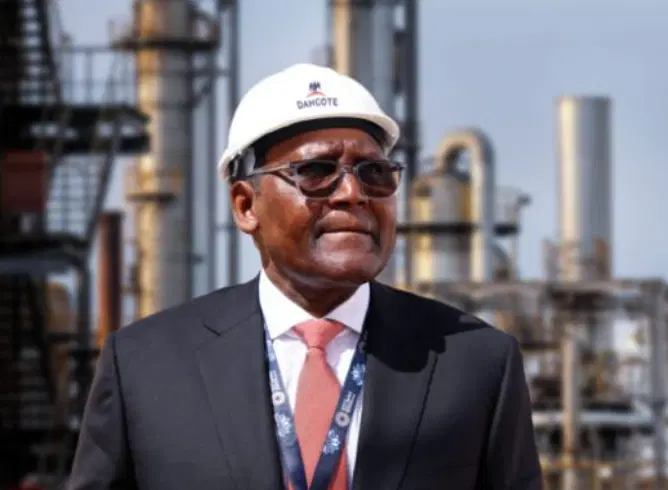
S&P: Dangote Refinery Driving Nigeria’s Economic Resurgence
The Dangote Petroleum Refinery & Petrochemicals is emerging as a major driver of Nigeria’s improving economic outlook, following the country’s sovereign credit rating upgrade by S&P Global Ratings.
In its latest assessment, S&P upgraded Nigeria’s long term foreign and local currency sovereign credit ratings to “B” from “B-”, citing stronger economic growth, improved external balances, rising oil production, and expanded domestic refining capacity as key factors supporting the country’s recovery.
The global ratings agency specifically identified the operational ramp up of the 650,000 barrels per day Dangote Petroleum Refinery & Petrochemicals as a major contributor to Nigeria’s improving balance of payments position and broader economic resilience.
According to S&P, the refinery’s full capacity operations are helping to strengthen Nigeria’s current account surplus, reduce dependence on imported refined petroleum products, and improve foreign exchange liquidity.
“Significant refining capacity is now also online; Dangote Industries Ltd.’s large scale refinery and petrochemical complex has ramped up to near its maximum capacity of 650,000 barrels per day,” the report stated.
S&P projected that Nigeria’s current account surplus would improve to 5.8 per cent of GDP in 2026 from 4.8 per cent in 2025, supported partly by increased domestic refining and hydrocarbon exports.
The report noted that the refinery is helping to ensure the availability of refined fuel, gas, and fertiliser for the domestic market, while also providing a buffer against global supply disruptions triggered by ongoing geopolitical tensions in the Middle East.
The agency further stated that Nigeria’s improving external position has been supported by reduced fuel import dependence, the removal of fuel subsidies, exchange rate liberalisation, and higher oil production.
Foreign exchange reserves, according to S&P, have risen significantly from about $33 billion in 2023 to nearly $50 billion by early 2026, aided partly by lower import demand for refined petroleum products following the commencement of operations at the Dangote Refinery.
The report also highlighted the refinery’s broader role in supporting Africa’s industrialisation ambitions, noting that Nigeria is transitioning from being primarily a crude oil exporter to an emerging producer and exporter of refined petroleum products.
S&P disclosed that Dangote Industries has already unveiled plans to undertake feasibility studies aimed at expanding refining capacity to about 1.4 million barrels per day from the current 650,000 barrels per day.
The agency said the planned expansion, alongside the rehabilitation of other local refineries, could further strengthen Nigeria’s economy and deliver additional gains to the country’s balance of payments position over the next few years.
While acknowledging that global crude oil prices and market driven pricing continue to influence domestic fuel costs, S&P maintained that the increased local refining capacity provides Nigeria with greater energy security and reduced exposure to external supply shocks.
The report also linked Nigeria’s improving macroeconomic outlook to reforms undertaken since 2023, including exchange rate liberalisation, fiscal reforms, higher petroleum revenue remittances, and efforts to improve oil production through enhanced security in the Niger Delta.
S&P said Nigeria’s economic growth is expected to remain firm despite inflationary pressures, with reforms continuing to support investor confidence and non-oil sector expansion.
The stable outlook, according to the agency, reflects a balance between Nigeria’s improving external position and continuing structural challenges such as a narrow tax base, high inflation, and low formal employment levels.
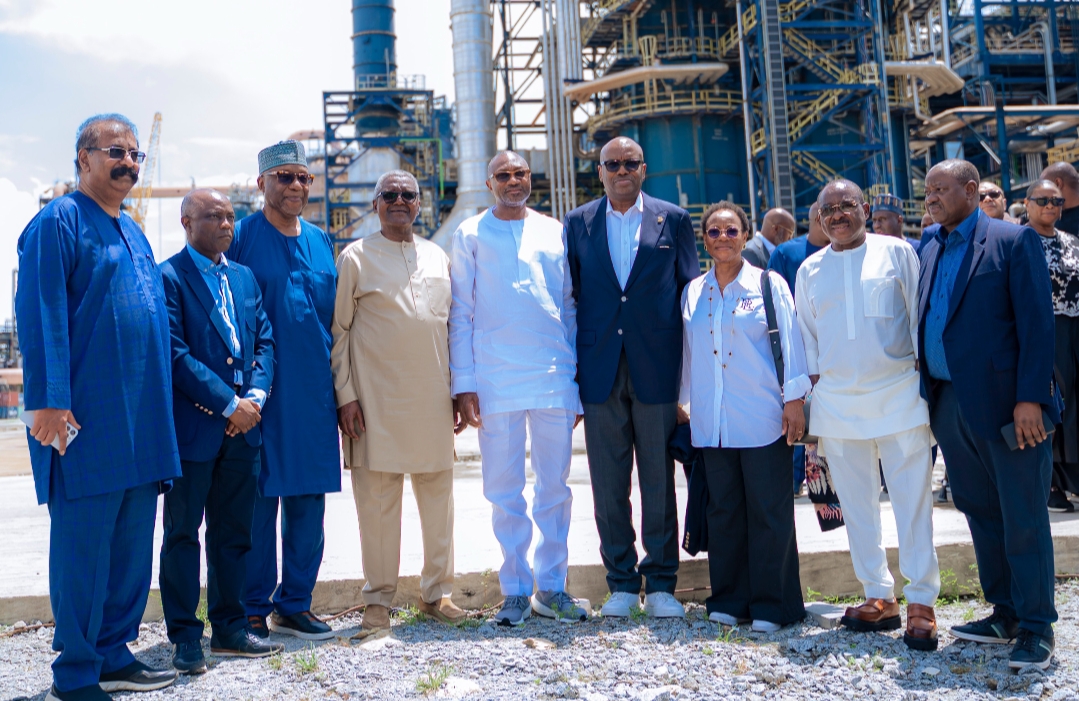
First HoldCo Group Companies’ Boards and Management teams visit Dangote Refinery
…All Nigerians will have access to the Refinery’s IPO and be part-owners-Dangote
Chairman of FirstHoldCo, Femi Otedola, has appealed to the President of Dangote Group, Aliko Dangote, to allocate $100 million worth of shares to him in the proposed listing of Dangote Petroleum Refinery & Petrochemicals. He disclosed that he divested his stake in Geregu Power Plc specifically to position himself for investment in the refinery’s initial public offering (IPO), which he described as a transformative industrial platform helping to free Africa from decades of reliance on imported petroleum products.
Otedola made these remarks during a visit by the FirstHoldCo leadership team to the 650,000 barrels-per-day refinery and Dangote Fertiliser Limited in Ibeju Lekki, Lagos, where he commended Dangote for building the world’s largest single-train refinery and accelerating Africa’s industrial transformation.
“He is a genius and one of the greatest men to emerge from Africa. What he has achieved is helping to liberate the continent from economic dependency and import reliance,” Otedola said. “I have visited this refinery more than 25 times, and I have consistently appealed for $100 million worth of shares during the private placement. That informed my decision to sell my stake in Geregu so I can reinvest in the Dangote Petroleum Refinery.”
Otedola also expressed strong confidence in the Group’s planned expansion of refining capacity to 1.4 million barrels per day, noting that Africa’s growing demand for refined petroleum products clearly supports further investment in domestic refining infrastructure.


In his remarks, President of Dangote Group, Aliko Dangote, assured that the refinery’s IPO would be broadly inclusive, enabling ordinary Nigerians to become part-owners and benefit from its value creation. He emphasised that the Group is committed to democratising access to investment opportunities by opening participation to retail investors across Nigeria and the African continent.
“We want ordinary Africans to participate in the value being created,” Dangote said. “What companies like Amazon and Apple achieved globally in terms of wealth creation is what we seek to replicate in Africa. We want people to invest, grow with us, and share in the prosperity.”
Dangote further disclosed plans for a proposed East Africa refinery with a projected capacity of 700,000 barrels per day, alongside polypropylene and base oil production facilities. According to him, the project could commence within the next three to four years once construction begins. He noted that the initiative was not originally captured in the Group’s Vision 2030 strategy, underscoring the company’s trajectory toward exceeding its long-term growth targets.
Chief Executive Officer of FirstBank Group, Olusegun Alebiosu, described the refinery as a symbol of vision, courage, and industrial ambition capable of inspiring similar investments across Africa.
“If you see this refinery and realise that an individual conceived and delivered a project of this magnitude, already helping to stabilise energy supply across Africa, you cannot help but be inspired,” Alebiosu said. “We have delegates here from the United Kingdom and several African countries who will return home with renewed commitment to building industries that can transform their economies. It is about building Africa together.”
Dangote also highlighted the Group’s sustained leadership across its core businesses over the past five years, including cement operations in 11 African countries, alongside significant investments in refining, petrochemicals, and fertiliser production. He noted that cement capacity has expanded to 55 million tonnes per annum, supported by the development of clinker export terminals to strengthen regional trade.
“We have built businesses that address Africa’s critical needs and create long-term value for the continent,” Dangote said. “Africa must stop exporting raw materials and importing finished goods. That amounts to exporting jobs and importing poverty.”
He added that investor appetite for the refinery’s listing on the Nigerian Exchange has remained exceptionally strong, with demand for the private placement already exceeding $2 billion.
“There is significant interest in both the IPO and the private placement,” he said. “While we are not able to meet all requests, the strong demand reflects investors’ confidence in the refinery and in Africa’s industrial future.”

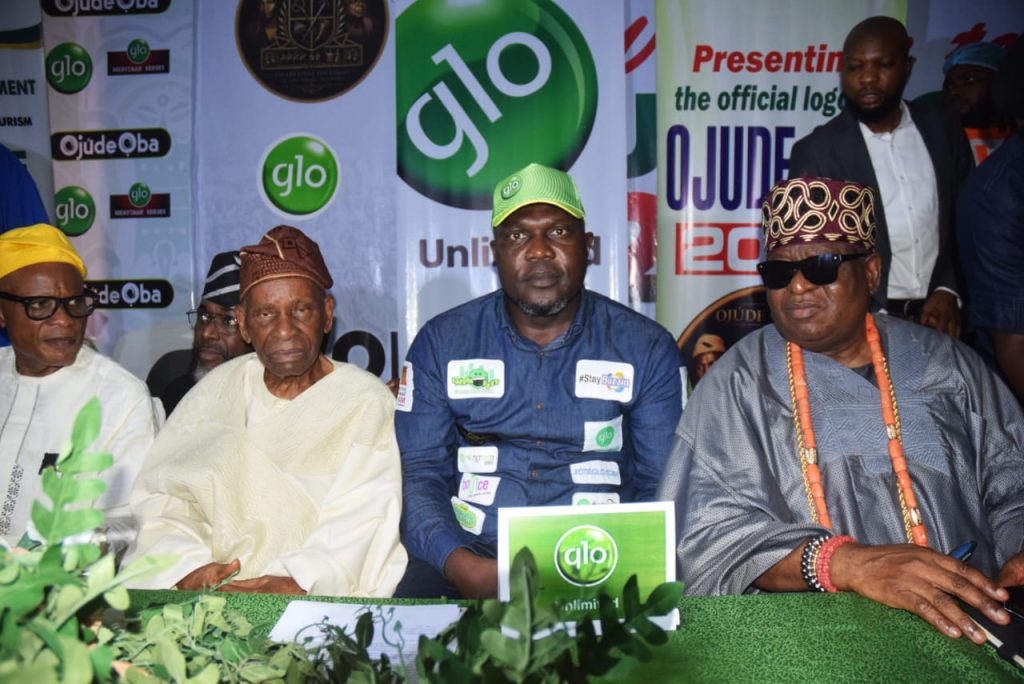
Globacom Marks 21 Years Of Ojude Oba Festival Sponsorship
Nigeria’s leading indigenous digital solutions company, Globacom, has reaffirmed its support for cultural preservation with the announcement of its headline sponsorship of the 2026 Ojude Oba Festival, marking 21 consecutive years of partnership with the people of Ijebuland.
Speaking at the festival’s pre-event press conference in Ijebu-Ode, Globacom’s representative, Mr. Olumide Orojimi, described the milestone as a testament to the company’s commitment to promoting culture, unity, and national identity.
“This edition represents a defining milestone for us,” he stated. “For twenty-one unbroken years, Globacom has walked this cultural journey with the people of Ijebuland.
“Beyond sponsorship, this partnership symbolises our deep respect for tradition, community, and the enduring spirit of our heritage.
“To commemorate this historic anniversary, we are committed to making this year’s celebration even more colourful, memorable, and impactful for Ijebu sons and daughters across the world.”
He noted that the company’s longstanding collaboration with the festival has helped enhance its profile as a globally recognised cultural and tourism event, adding that culture remains “the invisible architecture of a people’s soul.”
The 2026 edition, themed “Ojude Oba: Celebration of Culture Beyond Borders,” will also honour the legacy of the late Awujale of Ijebuland, Oba Sikiru Kayode Adetona, whose reign significantly shaped the festival’s growth and prominence.
Globacom disclosed that winners in the age-grade competitions will receive cash prizes of ₦750,000, ₦600,000, and ₦500,000 for first, second, and third places respectively. Festival attendees will also have access to a range of Globacom products and devices during the event.
In his remarks, the Coordinator of the Ojude Oba Festival Organising Committee, Chief Fassy Adetokunbo Yusuff, described Globacom as “the Pacesetter in the sponsorship of Ojude Oba” and commended the company for its unwavering support over the past 21 years.
Said he, ” this festival serves as a major catalyst for economic growth and commercial activities throughout Ijebuland, “as he gave kudos to Globacom for raising the bar of the event.


- Statement of the International Contact Group for the Great Lakes (ICG) on the situation in the eastern Democratic Republic of the Congo (DRC) May 24, 2026
- Eritrea: Messages of Congratulations May 24, 2026
- African Development Bank (AfDB) – 2026 Annual Meeting: Full live coverage on Africa 24 May 24, 2026
- Countries in the Horn of Africa and Yemen recommit to ending variant poliovirus May 23, 2026
- Seychelles: President Visits Police and Fire Services in Final Stop on La Digue Tour May 23, 2026
- United Nations World Food Programme (WFP) scales up emergency Ebola response in eastern Democratic Republic of the Congo (DRC) to contain risk of regional crisis May 23, 2026
- Economic Community of West African States (ECOWAS) Inspection Team Visits ECOWAS Stabilisation Support Mission in Guinea Bissau May 23, 2026
- Member States advance regional coordination on Bundibugyo Ebola response May 23, 2026
- World Health Organization (WHO) Supports Zambia to Strengthen Access to Mental Health Medicines and Services May 23, 2026
- Brazzaville 2026 African Development Bank Group (AfDB) Annual Meetings to focus on mobilising Africa’s development financing at scale May 22, 2026
- Statement of the International Contact Group for the Great Lakes (ICG) on the situation in the eastern Democratic Republic of the Congo (DRC) May 24, 2026
- Eritrea: Messages of Congratulations May 24, 2026
- African Development Bank (AfDB) – 2026 Annual Meeting: Full live coverage on Africa 24 May 24, 2026
- Countries in the Horn of Africa and Yemen recommit to ending variant poliovirus May 23, 2026
- Seychelles: President Visits Police and Fire Services in Final Stop on La Digue Tour May 23, 2026
- United Nations World Food Programme (WFP) scales up emergency Ebola response in eastern Democratic Republic of the Congo (DRC) to contain risk of regional crisis May 23, 2026
- Economic Community of West African States (ECOWAS) Inspection Team Visits ECOWAS Stabilisation Support Mission in Guinea Bissau May 23, 2026
-

 news5 months ago
WHO REALLY OWNS MONIEPOINT? The $290 Million Deal That Sold Nigeria’s Top Fintech to Foreign Interests
-

 society3 weeks ago
SOCIAL MEDIA IS NOT A BATTLEFIELD COMMAND – WHY THE NIGERIAN ARMY’S ACTION AGAINST JUSTICE CRACK IS A NATIONAL SECURITY IMPERATIVE
-

 celebrity radar - gossips4 months ago
Dr. Chris Okafor Returns with Power and Fire of the Spirit -Mounts Grace Nation Altar with Fresh Anointing and Restoration Grace on February 1, 2026
-

 celebrity radar - gossips5 months ago
Prophet Kingsley Aitafo Releases 2026 Prophecy: ‘Nigeria Will Rise, but the World Must Prepare for Turbulence’
You must be logged in to post a comment Login
You must log in to post a comment.