
society
EFCC: AS THE NATION AWAITS THE SUPREME COURT By Tunde Nasir

EFCC: AS THE NATION AWAITS THE SUPREME COURT
By Tunde Nasir
Since the new EFCC Chairman, Olanipekun Olukoyede assumed office about one year ago, the fight against corruption, financial and cyber crimes, has taken a new heightened and reinvigorated dimension to the admiration of those who are genuinely concerned about fighting the cankerworm of corruption that has bedeviled our nation almost to a standstill.
Ola Olukoyede, a Pastor, seems to be following the Biblical injunction, as he declared from the outset his intention to combat the evil of corruption vigorously as a means of fostering economic development of the nation.
Perhaps, following the promise of God in Joel 2:25: “I shall restore to you the years of the locust, the cankerworm and the caterpillar have eaten…”
However, knowing the certification, experience, prowess and international connection that Olukoyede was armed with and bringing into the office, it was not surprising that opposition to his appointment started as soon as his name was announced by President Tinubu on October 12, 2023 and his confirmation by the Senate on October 18, 2023. Those who did not object to Olukoyede’s previous appointments as Chief of Staff to the Chairman of EFCC and also as a Secretary to the Commission, suddenly turned around to say that he was not qualified to be appointed as chairman!
However, Olukoyede has continued to soldier-on, delivering on his mandate, undeterred and undaunted. Within 12 months, a record 3,455 convictions were secured and monetary recoveries from October 2023
to September 2024 stood at
N248,750,049,365.52 (Two Hundred and Forty-Eight Billion, Seven Hundred and Fifty Millon, Forty- Nine Thousand, Three hundred and Sixty-Five Naira, Fifty-Two Kobo), $105,423,190.39 (One Hundred and Five Million, Four Hundred and Twenty-Three Thousand, One Hundred and Ninety Dollars, Thirty-Nine Cents) and £53,133.64 (Fifty-Three Thousand, One Hundred and Thirty- Three Pounds, Sixty-Four Pence); apart from recoveries in other foreign currencies.
On the Issue of corruption trials, Olukoyede revived or initiated court cases against high-profile politically-exposed persons, including former Ministers and Governors. Among the politically-exposed personalities who were hitherto considered untouchable and now on trial for corruption are former governors Yahaya Adoza Bello(Kogi), Abdulfatah Ahmed (Kwara), and Darius Dickson Ishaku (Taraba). Former Ministers Saleh Mamman and Olu Agunloye have been put on trial too.
Correspondingly, the Commission has faced the biggest ever campaign of calumny, blackmail, public protests by sponsored NGOs, simulated attacks in the media and well-oiled, sponsored litigations to undermine the operations of the Commission and its unrelenting Chairman.
Chief among the litigations against Commission is the lawsuit initiated at the Supreme Court by Kogi State Government challenging the establishment and constitutionality of the EFCC. The suit, according to the plaintiff, posited that the establishment of EFCC was an affront on principles of federalism.
About 15 other states reportedly joined Kogi State in the suit and asked that their grievances against the EFCC be consolidated. There have also been comments and actions for and against the court action instituted by Kogi State Government and its collaborating governors.
A former President of the Nigerian Bar Association (NBA), Dr. Olisa Agbakoba (SAN), has written to the National Assembly about constitutional issues related to anti-corruption agencies in Nigeria and factors inhibiting the government’s objective of abolishing corruption, as stated in Section 13 of the Constitution.
In two separate letters to the Senate and House of Representatives, dated October 14, 2024, he said the Economic and Financial Crimes Commission (EFCC) was “an unlawful organisation that he believed was unconstitutionally established.”
However, in the contrary, respected lawyer and Senior Advocate of Nigeria, Femi Falana (SAN), countered Agbakoba. Falana said: “For me, the ICPC and the EFCC like the Code of Conduct Tribunal (CCT) have come to stay. What we should be demanding are measures to make these institutions autonomous and not under the control of any government,”
He added: “And the Supreme Court has maintained rather repeatedly concerning the EFCC and ICPC, that these are crime fighting bodies, and should not be under the control of the Federal Government. They are agencies to fight economic crimes in our country, to fight financial crimes in our country, to fight corruption in our country.”
However, with the controversy generated by the Kogi State’s suit against the EFCC and its discussion in the court of public opinion, some states who initially applied to join the suit have beaten a quick retreat, applying to the Supreme Court to withdraw from the suit. Among the states that have withdrawn are Jigawa, Anambra, Adamawa, Ebonyi and Benue states, who have separately filed motions before the Supreme Court, saying they are no longer interested.
In the case of Benue State, Governor Hyacinth Alia suspended the State’s Attorney-General and Commissioner for Justice, Bemsen Mnyim, for acting “unilaterally in joining the suit without the approval of his principal.”
The development came on the heels of the declaration by the Zamfara State Governor, Dauda Lawal, that the state was neither aware nor part of the suit challenging the legality of EFCC.
In the case of Ogun State, the Attorney-General and Commissioner for Justice, Mr. Oluwashina Ogungbade denied ever initiating any case or being part of Kogi State’s suit against the EFCC.
Speaking to newsmen in Abeokuta, Ogungbade wondered why some sections of the media continued to include Ogun state in the list of the states in court against the EFCC.
“We don’t have a suit against EFCC. We never filed any action against EFCC challenging its constitutionality. We already issued a statement to that effect clarifying that we never had any suit attacking the EFCC’s constitutionality and that we did not join the suit filed at the Supreme Court filed by some other states in that regard. So, I am surprised that some media outlets are still running reports that include and mention Ogun State as one of the states challenging the EFCC’s existence when that is not the case.“
According to the statement by Ogun State government, “the constitutionality of the EFCC and the Independent Corrupt Practices Commission (ICPC) had since been determined by the Supreme Court, and Ogun State considers discussions on the issue closed.”
The Ogun State government stated that it had “no factual reason or recent development to reopen the question of the EFCC’s constitutionality.”
It added that “as a federating unit with law enforcement agencies of its own, it had no desire to undermine the Federal Government’s law and order objectives.”
One of the vociferous anti-corruption groups, the Vanguard for Credible Representation (VCR) has lauded those states that have withdrawn from the Kogi’s suit against EFCC at the Supreme Court. In a statement signed by VCR’s Head of Mission, Onche Ugbabe, the group said it was “heartwarming that some state governors were dissociating themselves from the suit and lending their support to the fight against corruption.”
The statement reads: “It is heartwarming that Governors Hyacinth Alia and Dauda Lawal have publicly dissociated themselves from the suspicious move orchestrated by some state governments. We also commend the Governments of Anambra, Adamawa and Ebonyi states for heeding the voice of reason and withdrawing from the suit.”
The group hailed erudite lawyers like Mr. Femi Falana SAN and Kayode Oladele who have faulted the suit and its backers.
“It is highly gratifying that erudite lawyers like Mr. Femi Falana SAN and Hon. Kayode Oladele have publicly condemned the unpopular move, citing a plethora of judicial decisions of the Supreme Court on the legality of the anti-corruption agencies.
“It is in the light of this that all well-meaning individuals and institutions should lend their support to the war against corruption and not seek to thwart it by any scheme or schism,” the group said.
As the nation awaits the Supreme Court verdict, it is expected that more Governors will see reasons and withdraw like others who are not participating, or have withdrawn from the suit. As at now, there are more state governments that have distanced themselves from the suit than those who are before the Supreme Court. The bell ticks!
Tunde Nasiru, a Public Policy Advocate based in Abuja, sent this through [email protected]




FOPCHEN Seeks Wider Engagement As Court Defers Hearing
OTA, OGUN STATE — The High Court of Ogun State, Ota Division, on Thursday resumed hearing in the ongoing matter involving cultural and societal concerns, before adjourning proceedings till Thursday, July 2, 2026, for continuation of hearing.
At the resumed sitting on May 28, 2026, counsel representing the various parties revisited key issues in the case and made further submissions before the court.
The matter, which has continued to generate public interest across different sectors, again drew attention from legal observers and stakeholders who described the case as one with significant implications for societal values, cultural identity and constitutional interpretation.
Speaking after the proceedings, the Foundation for the Protection of Cultural Heritage in Nigeria, popularly known as FOPCHEN, renewed its appeal for dialogue and constructive engagement among Nigerians, stressing that sensitive cultural and moral issues should not be left entirely within the confines of the courtroom.
According to the group, broader conversations involving traditional institutions, civil society organisations, religious leaders and policy stakeholders remain necessary in addressing issues relating to national values and social responsibility.
Legal analysts at the court premises noted that arguments being canvassed by parties in the suit could shape future legal interpretations surrounding cultural and moral questions in the country.
Following submissions by counsel, the presiding judge adjourned the matter till Thursday, July 2, 2026, to enable parties further prepare and respond to issues raised during the hearing.
The development has continued to spark reactions among observers, with many Nigerians closely monitoring the proceedings ahead of the next hearing date.

US-Based Society Lady, Fehintola-Brat Extends Eid-El-Kabir Greetings To Muslims
United States based fahionista of class, Chief (Mrs) Ayoola Fehintola-Brat has extended a warm greetings to Muslim faithful all over the world on the occasion of the 2026 Eid-El-Kabir celebration.
Fehintola-Brat who is the Balogun Egbe Obaneye Obinrin Akile Ijebu, and the Yeye Asofin of Idenaland in her message to Journalists urged Muslim to continually uphold the enduring values of sacrifice, obedience, faith, and compassion, which are central to the significance of Eid-El-Kabir festival.
A quiet philantropist whose humanitarian services has won her several laurels urged Muslims to use the spiritual occasion to pray for the peace co-existence of Nigerians regardless of religious, social and political leanings stressing that the oneness of the country should not be underplay.
In a related development, she expressed her felicitations to all sons and daughters of Ijebuland on the forthcoming Ojude Oba 2026 celebration, tasking age-groups otherwise known as Regbregbe to be more proactive in giving back to their immediate communities.
According to her, the beauty of the age-groups in Ijebuland is the need to contribute immensely to the development of the land in no small means. “This we will continue to achieve with God on our side”, she concluded.
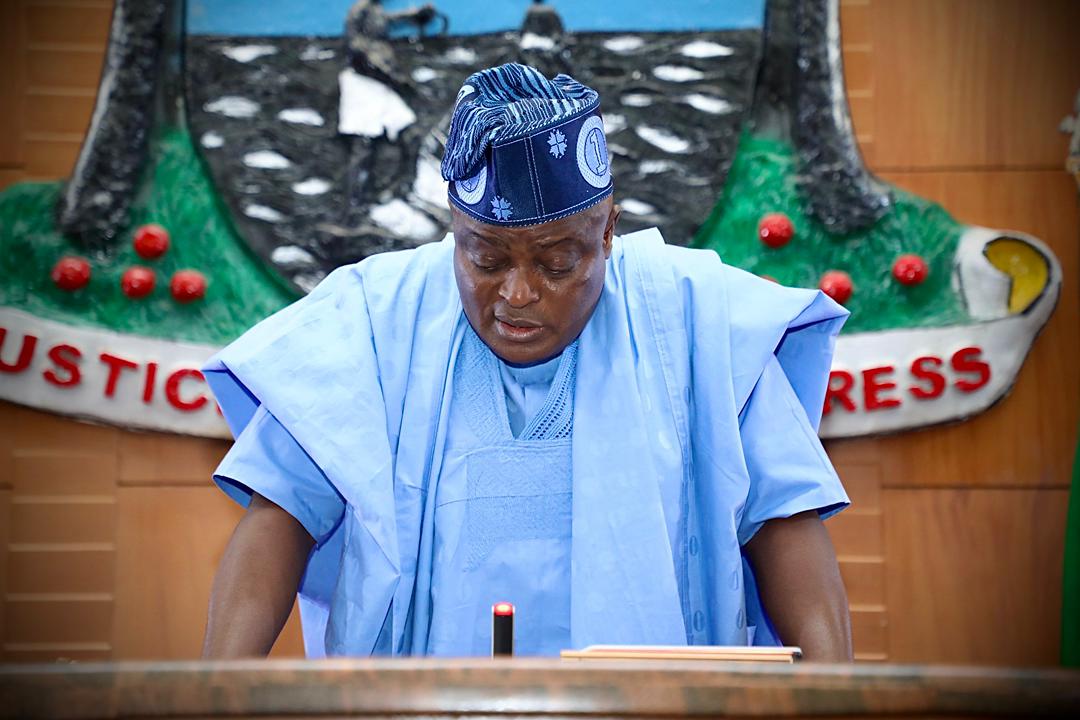
Sallah: Obasa Felicitates Muslim Ummah, Commends Nigerians for APC Primaries Turnout
The Speaker of the Lagos State House of Assembly, Rt. Hon. Mudashiru Obasa has extended warm felicitations to Muslims in Lagos State and across Nigeria on the occasion of Eid al-Adha.
In a statement released by his Chief Press Secretary, Mr. Dave Agboola, Obasa described the festival as a season of sacrifice, reflection, and gratitude, urging the faithful to continue to uphold the values of peace, unity, and love that strengthen the nation.
He noted that the celebration of Eid al-Adha is not only a spiritual milestone but also a reminder of the importance of togetherness and collective responsibility in building a stronger society.
He, likewise, emphasized that the festival provides an opportunity for Nigerians to renew their commitment to national progress and to support leadership that prioritizes development and prosperity.
Obasa, however, commended Nigerians, particularly members of the All Progressives Congress (APC), for their massive turnout during the recently concluded party primaries. He described the participation as a clear demonstration of the people’s confidence in the government of President Bola Ahmed Tinubu and their belief in the administration’s vision for a greater Nigeria.
“The APC primaries have shown the resilience of our democracy and the confidence Nigerians have in the leadership of President Bola Ahmed Tinubu and the Renewed Hope Agenda. This is a strong message that our people are ready to continue supporting policies that will drive growth and prosperity,” Obasa stated.
The Speaker further encouraged Muslims to celebrate responsibly, stressing that the joy of Eid should be accompanied by prayers for the continued peace and progress of Lagos State and Nigeria.
“As you celebrate with family and loved ones, may this season bring joy, peace, and prosperity to your homes. Let us remain united in our resolve to build a stronger nation,” he added.
On behalf of the Lagos State House of Assembly, Obasa wished all Muslims a happy and fulfilling Eid al-Adha celebration.


- Société Nationale des Pétroles du Congo (SNPC) Chief Ominga to Speak at African Energy Week (AEW) 2026 as Congo Accelerates Gas Expansion May 29, 2026
- South Africa: Deputy President Mashatile arrives in India for a Working Visit May 29, 2026
- Seychelles: President Visits Key Development Sites on Coetivy Island May 29, 2026
- Accelerating regional action to advance mental health care in Africa May 29, 2026
- President of the Republic of Seychelles Meets Young La Digue Talent Ahead of London Showcase May 29, 2026
- United Nations Economic Commission for Africa (ECA) launches regional initiative to accelerate women’s digital entrepreneurship across four African countries May 29, 2026
- Ethiopia: International community must act to safeguard press freedom ahead of national election May 29, 2026
- CORRECTION: Annual Meetings 2026 (AM2026): African Development Bank (AfDB) 2025 Trade Finance Report Highlights Resilience of African Financial Institutions After Covid-19 May 29, 2026
- Why Big Tech Could Become Nigeria’s New Gas Partner May 29, 2026
- African Energy Chamber (AEC)-Venezuela Alliance Accelerates Pathways into South-South Energy Expansion May 29, 2026
- Société Nationale des Pétroles du Congo (SNPC) Chief Ominga to Speak at African Energy Week (AEW) 2026 as Congo Accelerates Gas Expansion May 29, 2026
- South Africa: Deputy President Mashatile arrives in India for a Working Visit May 29, 2026
- Seychelles: President Visits Key Development Sites on Coetivy Island May 29, 2026
- Accelerating regional action to advance mental health care in Africa May 29, 2026
- President of the Republic of Seychelles Meets Young La Digue Talent Ahead of London Showcase May 29, 2026
- United Nations Economic Commission for Africa (ECA) launches regional initiative to accelerate women’s digital entrepreneurship across four African countries May 29, 2026
- Ethiopia: International community must act to safeguard press freedom ahead of national election May 29, 2026
-

 news6 months ago
WHO REALLY OWNS MONIEPOINT? The $290 Million Deal That Sold Nigeria’s Top Fintech to Foreign Interests
-

 society4 weeks ago
SOCIAL MEDIA IS NOT A BATTLEFIELD COMMAND – WHY THE NIGERIAN ARMY’S ACTION AGAINST JUSTICE CRACK IS A NATIONAL SECURITY IMPERATIVE
-

 celebrity radar - gossips4 months ago
Dr. Chris Okafor Returns with Power and Fire of the Spirit -Mounts Grace Nation Altar with Fresh Anointing and Restoration Grace on February 1, 2026
-

 celebrity radar - gossips6 months ago
Prophet Kingsley Aitafo Releases 2026 Prophecy: ‘Nigeria Will Rise, but the World Must Prepare for Turbulence’