
Business
EXPOSED!!!The Stupendous wealth Bukola Saraki acquired as Gov. of Kwara + The Many Assets His wife and Children Possess


Akure— The President of the Nigerian Senate, Bukola Saraki, currently facing corruption charges, was worth N10 billion (by current exchange rate) at the time he assumed office as governor of Kwara State in 2003.
While his entire assets, including cash, landed properties and shares in Nigeria and abroad stood at about N8 billion, those of his wife totalled N1.8 billion and his four children N202 million.
These are contained in the asset declaration form and the affidavit Mr. Saraki deposed to before an Ilorin High Court and submitted to the Code of Conduct Bureau on September 16, 2003.
The document entitled “Form CCB 1: Asset Declaration Form for Public Officers,” was exclusively obtained by PREMIUM TIMES.
Mr. Saraki was on September 18 this year docked at the Code of Conduct Tribunal on a 13-count charge bordering on alleged corruption and false declaration of assets.
He was specifically accused of deliberately manipulating the asset declaration form he submitted prior to his assumption of his current position as senate president.
Although he pleaded not guilty to the charges, claiming his ordeal was politically motivated, the CCT adjourned the case to October 21, 22 and 23 for further hearing.
His wife had earlier been invited by the Economic and Financial Crimes Commission over alleged complicity in shady contract deals during her husband’s tenure as governor between 2003 and 2011.
The assets declaration form showed that Mr. Saraki, who was a little over 40 years at the time he assumed office, had only N2.5 million cash at hand and a total of N51 million in various Nigerian banks at the time he filed the document.
He was also worth a total of £2.9 million and $400,000 lodged in some foreign banks at the time. That was besides owning landed and movable assets running into billions of naira and pound sterling in Nigeria and London.
He also held a substantial number of shares in a number of local and foreign companies valued at millions of naira and pounds.
Mr. Saraki said while he had N11,050,000 in the defunct Societe Generale Bank, where his family had interest, he had N350,000, N3 million and N390,000 in EcoBank, Guaranty Trust Bank and the defunct Citizen Bank, respectively, all in Lagos.
Besides, one of Mr. Saraki’s companies – Better Foods Ltd – had N600,000 and N23 million in Citizen Bank, Broad Street, Lagos and Societe Generale Bank, Oke Arin Street, Lagos, respectively.
Two other companies, namely Carlisle Properties & Investment Limited and BAS Trading and Manufacturing Ltd had N10.2 million and N2.9 million in accounts domiciled in EcoBank and Guaranty Trust Bank.
The senate president, in Appendix 2 of the document, declared a total of £905 million in one of his offshore accounts domiciled in Coutts & Co. 440 Strand, London.
Tyberry Corporation, another of his companies, had £2 million in Forte Bank, Camoile Street, London.
He also opened an account for his company, Eficaz Ltd, at Northern Trust International Banking Corporation Merrill Lynch Pierce Fenner, where he had $400,000 at the time he declared the assets.
In Appendix 3 of the form, Mr. Saraki also detailed eight landed property scattered in various parts of Lagos and Abuja which he said he acquired between December 1991 and March 2000, all valued at N2.3 billion.
According to him, a plot of land in Lekki, Lagos that he acquired in February 1992 was valued at N7 million while another one in Ajah he got in November 1992 was valued at N5 million.
Yet in November 1996, he acquired a plot in the Maitama District at N160 million.
Other properties he declared are those owned by his companies – a N750 million property at 42 Gerrard Road, Ikoyi owned by Skyview Properties Ltd; a N500 million property at 19 Ruxton road, Ikoyi, Lagos by Skyview Properties Ltd; and a N100 million property at 62 Awolowo Road, Ikoyi.
He declared the rental value of the property as N110 million, N65 million and N6 million per annum, respectively.
One of his companies, Carlisle Properties Ltd owned a property worth N160 million at No 15A & 15B McDonald Road, Ikoyi while BAS Trading owned a property on Musa Yar’Adua Street, Victoria Island, also in Lagos, valued at N700 million.
The rental income of the latter was N96 million per annum. He did not disclose that of the former.
Outside Nigeria, Mr. Saraki had landed property worth $12.9 million, all of which he listed in Appendix 5.
The properties, according to the document, were all located in London, UK.
According to him, the value of the properties at 123 Ashley Gardens, Thirlebey Road, London, (acquired in April 1990), 54 Ashley Road Gardens, Ambrasden Avenue ( acquired in January 1995) and 70 Bourne Street, London SW 1 (acquired in January 2002), were valued at $750,000, $2.55 million and $4.8 million, respectively.
He also declared some properties as belonging to his companies.
The property at 56 Cheque Road, London (valued at $900,000) and another located at Ormond House, Crimond Street, London SW 1 (valued at $400,000) were owned by European & America Trading Company.
Three others located at 53, 54 and 141 Ashley Gardens, London, were owned by Tyberry Corporation. The values were $2.5 million, $2.5 million and $600,000.
In Appendix 4, Mr. Saraki listed 15 various movable assets, mainly motor vehicles which he acquired between 1997 and 2002 all at a total value of N263.4 million.
The vehicles and their prices are a Mercedes S320 valued at N16 million; Mercedes S500 (N20 million); Mercedes G500 (N18 million); Mercedes V220 (N6million); Mercedes 300 E (N2 million); Ferrari 456 GT (N25 million); Navigator (N15 million); Mercedes ML 240 (N8.5 million); Peugeot 406 (N2.9 million); Mercedes CLK 320 (N9 million).
Others are Mercedes E320 (N11 million); Mercedes 500 (Bullet Proof), N45 million; Mercedes S500 (Bullet Proof), N30 million; Lexus Jeep (Bullet Proof), N30 million; and Lincoln Navigator (Bullet Proof), N25 million.
He said he acquired the cars proceeds of “Business” and “Savings.”
Mr. Saraki also declared a number of shares he held in different companies in Nigeria and abroad.
For instance, in Nigeria, the senate president said at the time he became governor he had a total of 1,204,653 shares in four companies valued at N2.2 million.
The companies were African Petroleum, UNIPETROL, Airline Catering and Central Petroleum.
Other organisations where he held huge shares were GTB where he had 100,000 worth N425,000.
These shares in the bank were however bought in his son’s name, Seni.
Outside Nigeria, Mr. Saraki declared he had shares in five companies, namely Gensoft, All African Media Coy, Merrill BBH Fund, Mundernet Fund and Izorch Inc.
The 100,000 shares he held at Gensoft were valued at €2.6 million while the total number of shares in the remaining four companies was worth $6.1 million.
His company, HAUSSMAN, however held 160 units of shares with a total value of $1.5 million in some foreign companies. It had 25,000 shares valued at $100,000 in Mundernet Fund, 10,000 valued at $400,000 in Eaton Vanice Fund, 50,000 shares valued at $700,000 in PIMCO Fund and 75,000 shares worth $300,000 in Merrill BBH.
Wife
He stated in the assets declaration form that his wife held an account in EcoBank Broad Street, Lagos, where she had N1.5 million at the time he became governor.
She also maintained an account in Coutts & Co Strand, London where she owned £450,000 and $125,000.
She also had $3 million in Northern Trust International Banking Corporation Merrill Lynch Pierce Fenner.
Mrs. Saraki also maintained substantial shares in European and American Trading Company, Tyberry Corporation and EFICAZ Ltd.
Other property the senate president listed against his wife’s name were a plot of land at Lekki valued at N5 million which he said was a gift he received in January 1989.
She also had a property at 15 Bryanston Square, London W1 and 69 Bourne Street, London.
While the first, whose rental income he put at £48,000 with a value of £900,000, was acquired in January 1989, the second, whose value was £2m and had rental value of £150,000 was acquired for business in April 2000.
Mr. Saraki also declared that his wife held 500,000 shares, valued at £500,000, at P.C.C (U.K) Ltd.
He was silent on the number of shares the former first lady had in HAUSSMANN and TINY TEE (Nig) Ltd.
Children
In APPENDIX 1 of the form, the senate president also detailed the property owned by his four children, whose names he gave as Tosin, Seni, Teniola and Teniayo.
According to the document, Tosin had N700,000 in the family bank, Societe Generale Bank while Seni had N400,000 in the same family bank.
Outside Nigeria, Tosin and Seni jointly maintained an account in Northern Trust International Banking Corporation Merrill Lynch Pierce Fenner, where they had £400,000 while Teniola and Teniayo had £250,000 in the same bank at the time.
In Coutts & Co. 440 Strand, London, Tosin and Seni had £1000 and £500, respectively.
Saraki’s Case At Code of Conduct Bureau
In what some interpreted as political persecution, Mr. Saraki was arraigned last month before the CCT for false declaration of assets seven years after he concluded his two terms as governor.
In one of the 13-count charge, the senate president was accused of making anticipatory declaration of asset, thus breaching the Code of Conduct Bureau and Tribunal Act, Cap C15, Laws of the Federation of Nigeria, 2004.
The charge reads, “That you, Dr. Olubukola Abubakar Saraki, while being the Executive Governor of Kwara State on or about 16th September, 2003 within the jurisdiction of this Hon. Tribunal, did make a false declaration in assets declaration form for public officers on assumption of office as Governor of Kwara State by making an anticipatory asset declaration in that you claimed to have owned and acquired No. 15A and N0. 15B McDonald Ikoyi, Lagos through your company Carlisle Properties Limited in the year 2006 when the said property was in actual fact sold by the Implementation Committee on Federal Government landed property in the year 2006 to your companies Tiny Tee Limited and Vitti Oil Limited for the aggregate sum of N396, 150, 000 and you hereby committed an offence under Section 15 of the Code of Conduct Bureau and Tribunal Act, Cap C15, Laws of the Federation of Nigeria, 2004 and incorporated under Paragraph 11(1) and (2) of Part 1, 5th Schedule to the Constitution of the Federal Republic of Nigeria 1999 (as amended) and punishable under Section 23(2) of the Code of Conduct Bureau and Tribunal Act and incorporated under Paragraph 18 of part 1, 5th Schedule to the Constitution of the Federal Republic of Nigeria 1999 (as amended).”
Career History
Mr. Saraki, a medical doctor, assumed office as governor on May 29, 2003.
He served as medical officer for about one year at Rush Green Hospital, London between 1988 and 1989.
He later served as Director of SGB, owned by his late father, Olusola, between 1990 and 2000. In 2000, former President Olusegun Obasanjo named him his special assistant on budget.
He also served on the Economic Policy Coordination Committee, where he had the task of formulating and implementation key economic policies for the country.
In 2003, he ran for the office of governor of Kwara State on the platform of the Peoples Democratic Party and won.
Societie Generale Bank, the bank in which he was director, became insolvent around the same time, with several depositors losing their savings.
He was re-elected in 2007. During his second tenure, he served as chairman of the Nigerian Governors’ Forum.
Mr. Saraki later showed interest in running for president in 2011 but was excluded alongside two others from the presidential race by the Adamu Ciroma-led Northern Political Leaders Forum, which picked a former vice president, Atiku Abubakar, as its consensus candidate.
That year, he was however elected into the Senate to represent Kwara Central senatorial District on the platform of the PDP.
He was re-elected in 2015 on the platform of the APC. He had led some other PDP senators to defect to the party in early 2014.
He emerged senate president on June 9 against the wishes of his party and some of its leading chieftains.
SOURCE : PREMIUM TIMES




Business
TRADEMARK INFRINGEMENT—Federal High Court Abuja Stops Mamuda Beverages from Further Producing its Pop Power Energy Drink in Its Present Bottle Design
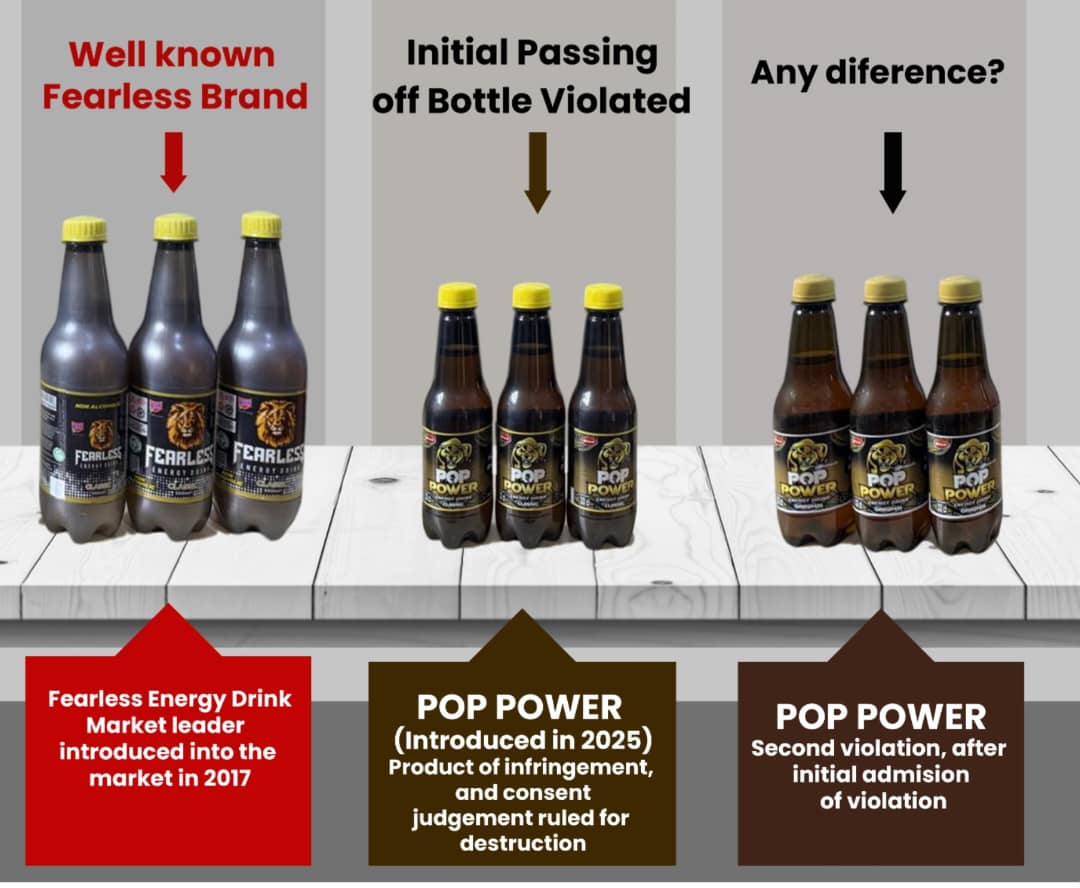
TRADEMARK INFRINGEMENT—Federal High Court Abuja Stops Mamuda Beverages from Further Producing its Pop Power Energy Drink in Its Present Bottle Design
In keeping with a clear understanding of conducting business within the confines of the rules, the Federal High Court in Abuja has again ordered Mamuda Beverages Nigeria Limited (“Mamuda”) to stop producing its Pop Power Energy Drink, which infringes on the trademark of the popular Fearless Energy Drink brand of Rite Foods Limited.
This rulings on Mamuda’s Notice of Preliminary Objection and Rite Foods’ Motion for interlocutory injunction were delivered by Hon. Justice B.F.M. Nyako, on Friday, 22nd May 2026, in the Suit No. FHC/ABJ/CS/705/2025. At the proceeding of the day, Mamuda’s Notice of Preliminary Objection was refused and dismissed, while Rite Foods’ application for injunctive reliefs prohibiting Mamuda from further trademark infringement was granted.
In the court’s ruling, Hon. Justice Nyako refused Mamuda’s Notice of Preliminary Objection which had challenged the suit on the basis of abuse of court process and held that Rite Foods’ present complaint of infringement of its intellectual property is distinct from an earlier suit between the parties, wherein Rite Foods had complained about a different act of infringement.
The court further held that it appears on its face that Mamuda’s newly introduced bottle design, manufactured, still bears a striking resemblance to Rite Foods’ established Fearless Energy Drink product. Therefore, the court granted an order restraining Mamuda from further production of its Pop Power Energy Drink product, pending the final determination of the suit.
Accordingly, the court ordered Mamuda to cease production of the product forthwith, destroy all existing products, and directed the court Bailiff, in conjunction with the parties, to undertake an inventory of the products slated for destruction and file the same.
The court further ordered that the injunction shall remain in force until the end of the year or pending the determination of the substantive suit.
Consequently, the court adjourned the suit to Wednesday, 23rd September 2026, for the hearing of the substantive suit.
This order follows an earlier suit against Mamuda in January 2025, where Rite Foods sued the company for infringing on the trademark and design of its iconic Fearless Energy Drink through the launch of a lookalike product, Pop Power Energy Drink.
However, Mamuda, in an apparent admittance of guilt, sought a settlement, and terms of settlement were agreed and filed, and the court entered same as its consent judgment. Some of the terms of settlement included that Mamuda would desist from further violation of Fearless Energy Drink trademark and identity pass-off. It also agreed to destroy all infringing products and pledged to change its design and avoid any form of identity imitation.
In an unexpected turn, Mamuda subsequently reintroduced Pop Power into the market, with only cosmetic adjustments to its appearance. Rite Foods maintains that these changes are minor and do little to address the original issues of consumer confusion. Reports from the market indicate that the new Pop Power continues to be informally referred to as “small Fearless,” reinforcing concerns that the revised product may not only breach the spirit of the earlier agreement but could also undermine consumer clarity and brand differentiation.
While reaffirming its position, Rite Foods stressed its continued commitment to protecting its brand and the principles of innovation and fair competition in Nigeria’s marketplace.
The company emphasized that genuine business growth must be anchored on originality and respect for intellectual property, rather than imitation and fraudulent business practices.
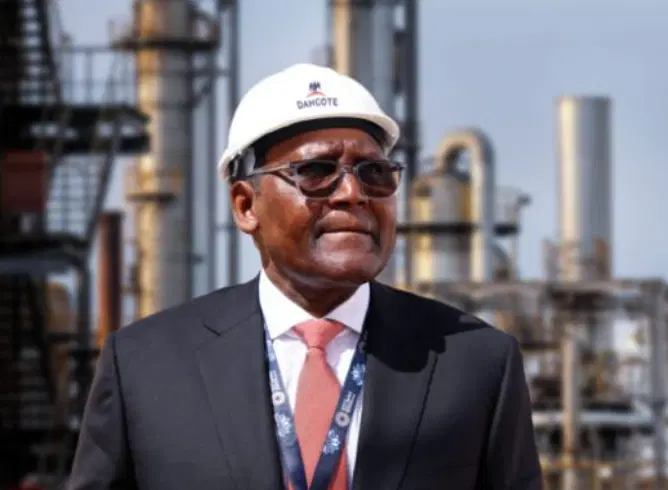
S&P: Dangote Refinery Driving Nigeria’s Economic Resurgence
The Dangote Petroleum Refinery & Petrochemicals is emerging as a major driver of Nigeria’s improving economic outlook, following the country’s sovereign credit rating upgrade by S&P Global Ratings.
In its latest assessment, S&P upgraded Nigeria’s long term foreign and local currency sovereign credit ratings to “B” from “B-”, citing stronger economic growth, improved external balances, rising oil production, and expanded domestic refining capacity as key factors supporting the country’s recovery.
The global ratings agency specifically identified the operational ramp up of the 650,000 barrels per day Dangote Petroleum Refinery & Petrochemicals as a major contributor to Nigeria’s improving balance of payments position and broader economic resilience.
According to S&P, the refinery’s full capacity operations are helping to strengthen Nigeria’s current account surplus, reduce dependence on imported refined petroleum products, and improve foreign exchange liquidity.
“Significant refining capacity is now also online; Dangote Industries Ltd.’s large scale refinery and petrochemical complex has ramped up to near its maximum capacity of 650,000 barrels per day,” the report stated.
S&P projected that Nigeria’s current account surplus would improve to 5.8 per cent of GDP in 2026 from 4.8 per cent in 2025, supported partly by increased domestic refining and hydrocarbon exports.
The report noted that the refinery is helping to ensure the availability of refined fuel, gas, and fertiliser for the domestic market, while also providing a buffer against global supply disruptions triggered by ongoing geopolitical tensions in the Middle East.
The agency further stated that Nigeria’s improving external position has been supported by reduced fuel import dependence, the removal of fuel subsidies, exchange rate liberalisation, and higher oil production.
Foreign exchange reserves, according to S&P, have risen significantly from about $33 billion in 2023 to nearly $50 billion by early 2026, aided partly by lower import demand for refined petroleum products following the commencement of operations at the Dangote Refinery.
The report also highlighted the refinery’s broader role in supporting Africa’s industrialisation ambitions, noting that Nigeria is transitioning from being primarily a crude oil exporter to an emerging producer and exporter of refined petroleum products.
S&P disclosed that Dangote Industries has already unveiled plans to undertake feasibility studies aimed at expanding refining capacity to about 1.4 million barrels per day from the current 650,000 barrels per day.
The agency said the planned expansion, alongside the rehabilitation of other local refineries, could further strengthen Nigeria’s economy and deliver additional gains to the country’s balance of payments position over the next few years.
While acknowledging that global crude oil prices and market driven pricing continue to influence domestic fuel costs, S&P maintained that the increased local refining capacity provides Nigeria with greater energy security and reduced exposure to external supply shocks.
The report also linked Nigeria’s improving macroeconomic outlook to reforms undertaken since 2023, including exchange rate liberalisation, fiscal reforms, higher petroleum revenue remittances, and efforts to improve oil production through enhanced security in the Niger Delta.
S&P said Nigeria’s economic growth is expected to remain firm despite inflationary pressures, with reforms continuing to support investor confidence and non-oil sector expansion.
The stable outlook, according to the agency, reflects a balance between Nigeria’s improving external position and continuing structural challenges such as a narrow tax base, high inflation, and low formal employment levels.
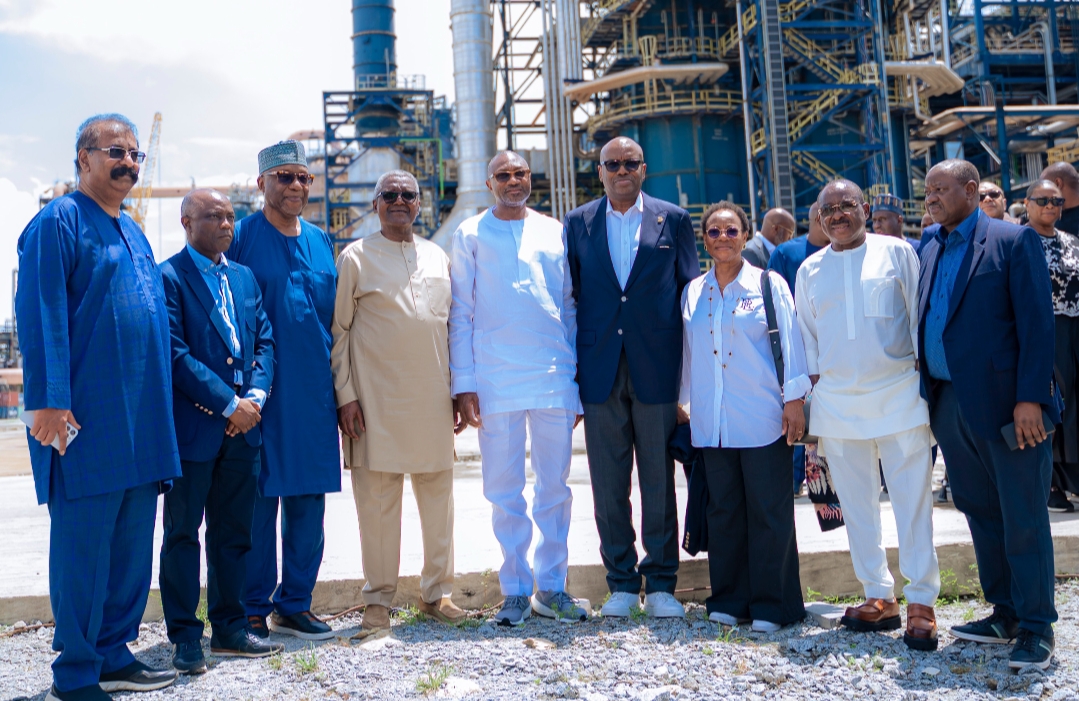
First HoldCo Group Companies’ Boards and Management teams visit Dangote Refinery
…All Nigerians will have access to the Refinery’s IPO and be part-owners-Dangote
Chairman of FirstHoldCo, Femi Otedola, has appealed to the President of Dangote Group, Aliko Dangote, to allocate $100 million worth of shares to him in the proposed listing of Dangote Petroleum Refinery & Petrochemicals. He disclosed that he divested his stake in Geregu Power Plc specifically to position himself for investment in the refinery’s initial public offering (IPO), which he described as a transformative industrial platform helping to free Africa from decades of reliance on imported petroleum products.
Otedola made these remarks during a visit by the FirstHoldCo leadership team to the 650,000 barrels-per-day refinery and Dangote Fertiliser Limited in Ibeju Lekki, Lagos, where he commended Dangote for building the world’s largest single-train refinery and accelerating Africa’s industrial transformation.
“He is a genius and one of the greatest men to emerge from Africa. What he has achieved is helping to liberate the continent from economic dependency and import reliance,” Otedola said. “I have visited this refinery more than 25 times, and I have consistently appealed for $100 million worth of shares during the private placement. That informed my decision to sell my stake in Geregu so I can reinvest in the Dangote Petroleum Refinery.”
Otedola also expressed strong confidence in the Group’s planned expansion of refining capacity to 1.4 million barrels per day, noting that Africa’s growing demand for refined petroleum products clearly supports further investment in domestic refining infrastructure.


In his remarks, President of Dangote Group, Aliko Dangote, assured that the refinery’s IPO would be broadly inclusive, enabling ordinary Nigerians to become part-owners and benefit from its value creation. He emphasised that the Group is committed to democratising access to investment opportunities by opening participation to retail investors across Nigeria and the African continent.
“We want ordinary Africans to participate in the value being created,” Dangote said. “What companies like Amazon and Apple achieved globally in terms of wealth creation is what we seek to replicate in Africa. We want people to invest, grow with us, and share in the prosperity.”
Dangote further disclosed plans for a proposed East Africa refinery with a projected capacity of 700,000 barrels per day, alongside polypropylene and base oil production facilities. According to him, the project could commence within the next three to four years once construction begins. He noted that the initiative was not originally captured in the Group’s Vision 2030 strategy, underscoring the company’s trajectory toward exceeding its long-term growth targets.
Chief Executive Officer of FirstBank Group, Olusegun Alebiosu, described the refinery as a symbol of vision, courage, and industrial ambition capable of inspiring similar investments across Africa.
“If you see this refinery and realise that an individual conceived and delivered a project of this magnitude, already helping to stabilise energy supply across Africa, you cannot help but be inspired,” Alebiosu said. “We have delegates here from the United Kingdom and several African countries who will return home with renewed commitment to building industries that can transform their economies. It is about building Africa together.”
Dangote also highlighted the Group’s sustained leadership across its core businesses over the past five years, including cement operations in 11 African countries, alongside significant investments in refining, petrochemicals, and fertiliser production. He noted that cement capacity has expanded to 55 million tonnes per annum, supported by the development of clinker export terminals to strengthen regional trade.
“We have built businesses that address Africa’s critical needs and create long-term value for the continent,” Dangote said. “Africa must stop exporting raw materials and importing finished goods. That amounts to exporting jobs and importing poverty.”
He added that investor appetite for the refinery’s listing on the Nigerian Exchange has remained exceptionally strong, with demand for the private placement already exceeding $2 billion.
“There is significant interest in both the IPO and the private placement,” he said. “While we are not able to meet all requests, the strong demand reflects investors’ confidence in the refinery and in Africa’s industrial future.”


- Statement of the International Contact Group for the Great Lakes (ICG) on the situation in the eastern Democratic Republic of the Congo (DRC) May 24, 2026
- Eritrea: Messages of Congratulations May 24, 2026
- African Development Bank (AfDB) – 2026 Annual Meeting: Full live coverage on Africa 24 May 24, 2026
- Countries in the Horn of Africa and Yemen recommit to ending variant poliovirus May 23, 2026
- Seychelles: President Visits Police and Fire Services in Final Stop on La Digue Tour May 23, 2026
- United Nations World Food Programme (WFP) scales up emergency Ebola response in eastern Democratic Republic of the Congo (DRC) to contain risk of regional crisis May 23, 2026
- Economic Community of West African States (ECOWAS) Inspection Team Visits ECOWAS Stabilisation Support Mission in Guinea Bissau May 23, 2026
- Member States advance regional coordination on Bundibugyo Ebola response May 23, 2026
- World Health Organization (WHO) Supports Zambia to Strengthen Access to Mental Health Medicines and Services May 23, 2026
- Brazzaville 2026 African Development Bank Group (AfDB) Annual Meetings to focus on mobilising Africa’s development financing at scale May 22, 2026
- Statement of the International Contact Group for the Great Lakes (ICG) on the situation in the eastern Democratic Republic of the Congo (DRC) May 24, 2026
- Eritrea: Messages of Congratulations May 24, 2026
- African Development Bank (AfDB) – 2026 Annual Meeting: Full live coverage on Africa 24 May 24, 2026
- Countries in the Horn of Africa and Yemen recommit to ending variant poliovirus May 23, 2026
- Seychelles: President Visits Police and Fire Services in Final Stop on La Digue Tour May 23, 2026
- United Nations World Food Programme (WFP) scales up emergency Ebola response in eastern Democratic Republic of the Congo (DRC) to contain risk of regional crisis May 23, 2026
- Economic Community of West African States (ECOWAS) Inspection Team Visits ECOWAS Stabilisation Support Mission in Guinea Bissau May 23, 2026
-

 news5 months ago
WHO REALLY OWNS MONIEPOINT? The $290 Million Deal That Sold Nigeria’s Top Fintech to Foreign Interests
-

 society3 weeks ago
SOCIAL MEDIA IS NOT A BATTLEFIELD COMMAND – WHY THE NIGERIAN ARMY’S ACTION AGAINST JUSTICE CRACK IS A NATIONAL SECURITY IMPERATIVE
-

 celebrity radar - gossips4 months ago
Dr. Chris Okafor Returns with Power and Fire of the Spirit -Mounts Grace Nation Altar with Fresh Anointing and Restoration Grace on February 1, 2026
-

 celebrity radar - gossips5 months ago
Prophet Kingsley Aitafo Releases 2026 Prophecy: ‘Nigeria Will Rise, but the World Must Prepare for Turbulence’
You must be logged in to post a comment Login
You must log in to post a comment.