
society
From Skill to Wealth: Why Mastery, Not Luck, Creates Financial Freedom


From Skill to Wealth: Why Mastery, Not Luck, Creates Financial Freedom.
By George Omagbemi Sylvester | SaharaWeeklyNG.com
Wealth is not a miracle, nor is it a product of luck. It is the fruit of discipline, skill, foresight and relentless determination. The road to financial freedom is paved not with shortcuts but with the bricks of hard work, sacrifice and mastery. Every empire we admire today (from global retail chains to family-built enterprises) was birthed from knowledge applied with consistency. One must understand that wealth creation is not a mystical event; it is a DELIBERATE PROCESS that can be learned, replicated and expanded.
The Four Stages of Wealth Building.
The framework of wealth creation can be summarized in four simple yet profound steps:

Your skill earns you money.
Your money buys you assets.
Your assets bring you wealth.
Your wealth brings you freedom. At the core of this sequence is skill. If you do not come from a family with generational wealth or established business connections, your best entry point into financial stability and eventual prosperity is through acquiring a skill. Skill is the tool that transforms poverty into possibility.
As management guru Peter Drucker once said: “Knowledge has to be improved, challenged and increased constantly or it vanishes.” Without skill, money slips through your fingers like water. With skill, you create value and value, in turn, attracts wealth.
Why Skill Is the Cornerstone of Wealth. Many young people mistakenly believe that capital alone builds businesses. This is a dangerous illusion. The foundation of every great company is not money but knowledge applied to solve problems.

Colin du Plessis, the founder of Talisman Hire, did not start with immense wealth. He began as a mechanic with deep knowledge of machines and the hire industry. In 1993, with little more than his skill and determination, he started Talisman Hire. Today, the company has grown into a leading equipment rental business in South Africa.
The story of WeBuyCars follows the same principle. The Fouché brothers, Dirk and Faan, did not inherit millions. They inherited knowledge (the art of mechanics) from their father. With skill as their currency, they built WeBuyCars into South Africa’s dominant pre-owned car buying and selling empire.

Even Shoprite, Africa’s largest retail giant, was not born out of endless capital. Whitey Basson, often regarded as South Africa’s greatest retailer, acquired just eight small stores in 1979. Through strategic foresight, hands-on experience and a deep understanding of retail dynamics, he transformed Shoprite into a massive retail chain employing over 140,000 people across Africa.
These stories emphasize one timeless truth: skill and mastery, not luck or inheritance, are the real engines of wealth creation.
The Harsh Reality: Wealth Demands Excellence. One indisputable fact must be hammered into the consciousness of every aspiring entrepreneur: Wealth is not built by mediocrity. You cannot stumble your way to financial freedom.
If you are a carpenter, you must strive to be the carpenter whose craftsmanship speaks louder than words. If you are a teacher, you must be so effective that your name commands respect. If you are a business owner, you must understand your industry so deeply that you can predict its shifts before they occur.

As Aristotle famously said, “We are what we repeatedly do. Excellence, then, is not an act but a habit.”
The marketplace is ruthless. Customers will not reward incompetence. Investors will not fund ignorance. Only those who rise above the ordinary by excelling in their craft can reap the benefits of wealth.
Skill as an Equalizer: The Path for the Ordinary Person. We live in a world where inequality is vast and opportunities are often distributed unfairly. Skill is the equalizer. You may not inherit a trust fund, but you can learn coding, carpentry, medicine, mechanics or entrepreneurship.
Robert Kiyosaki, author of Rich Dad, Poor Dad, put it plainly: “Wealth is a person’s ability to survive so many number of days forward; if I stopped working today, how long could I survive?” That ability to survive and thrive in the absence of daily labor depends entirely on how you convert your skill into assets and ultimately, into wealth.
If you lack the resources to launch a business today, do not despair. Begin with skill. Master it, monetize it and reinvest the earnings.
The Role of Knowledge in Business Expansion. A business is not a lottery ticket; it is a battlefield of ideas, strategy and execution. Without profound knowledge, businesses collapse like houses built on sand.
Consider this: statistics from the Small Business Administration (SBA) reveal that 20% of businesses fail in the first year, 50% within five years and 70% within ten years. The common denominator among failures is not just lack of funding but lack of knowledge, poor planning and weak execution.

Renowned economist Adam Smith once declared: “The real tragedy of the poor is the poverty of their aspirations.” But aspirations alone are insufficient. Aspiration must be married with preparation and execution.
This is why every successful entrepreneur invests heavily in continuous learning. Elon Musk, the world’s richest man, taught himself rocket science before founding SpaceX. Warren Buffett, one of the greatest investors alive, spends 80% of his day reading. Knowledge is the compass that guides wealth creation.
Wealth and Freedom: The Ultimate Goal. Money, by itself, is not wealth. Wealth is the ownership of assets that generate income whether you work or not. True wealth gives birth to freedom; the freedom to live life on your terms, the freedom to walk away from toxic jobs, the freedom to provide generational security for your family.
Thomas Jefferson, one of the founding fathers of the United States, warned: “Never spend your money before you have earned it.” This advice remains relevant today. Acquiring assets (real estate, stocks, businesses or intellectual property) ensures that your wealth compounds while you sleep.
Wealth is not just about personal luxury; it is about impact. As Andrew Carnegie said, “The man who dies rich, dies disgraced.” Wealth becomes meaningful only when it is used to uplift others, create opportunities and transform society.
Practical Steps to Begin Your Journey. Acquire a skill. It could be digital, vocational or entrepreneurial.
Master your craft. Excellence makes you indispensable.
Earn and save. Avoid unnecessary consumption; reinvest profits.
Buy assets, not liabilities. Assets generate wealth; liabilities drain it.
Expand your knowledge. Read, research and forecast industry trends.
Build systems. Create businesses that function beyond your presence.
Give back. Use your wealth to uplift others and strengthen communities.
Final Word: Your Destiny Is in Your Hands. Whether you inherit a business or start from scratch with a skill, the path is equally honorable. Do not allow lack of capital, lack of support or fear of failure to cripple you. History has shown us that the greatest wealth builders were not always the richest at the beginning; they were simply those who mastered their craft and persisted.
As Confucius wisely said: “The man who moves a mountain begins by carrying away small stones.”
So, start today. Acquire a skill. Build assets. Seek knowledge. And remember, wealth is not an end; it is the means to freedom.




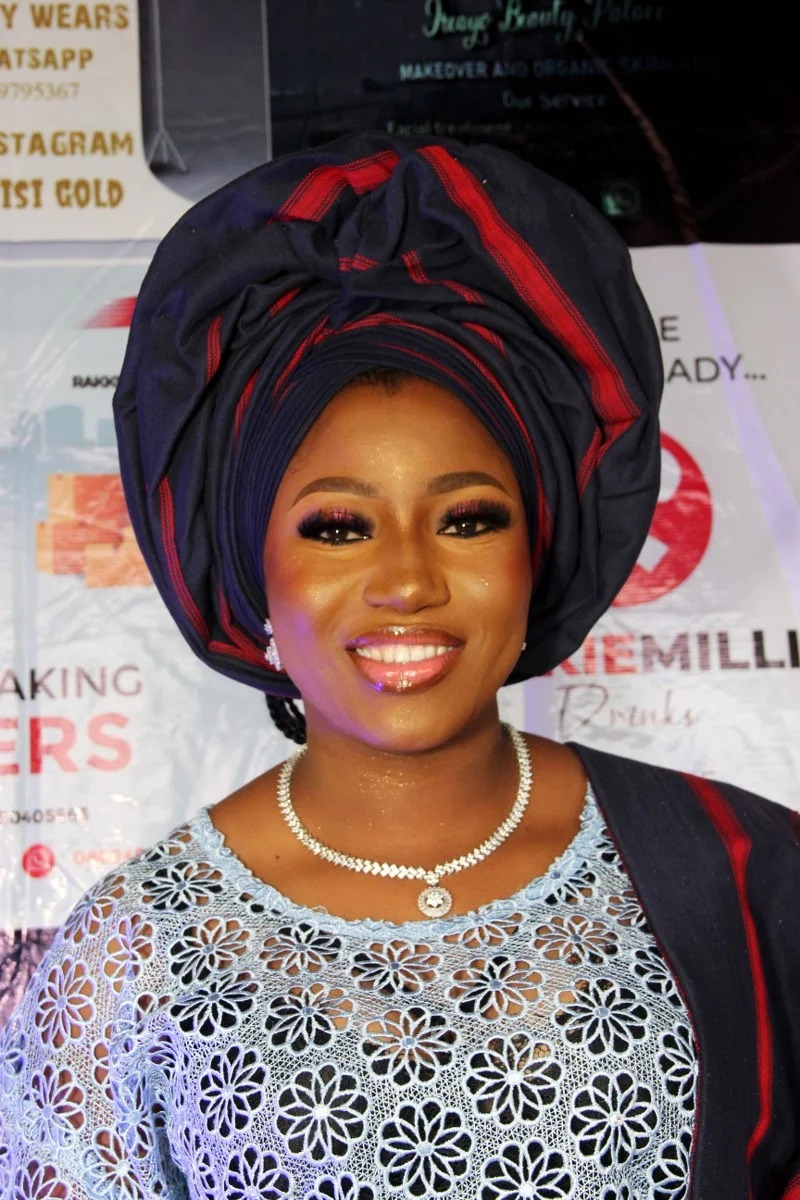
US-Based Society Lady, Fehintola-Brat Extends Eid-El-Kabir Greetings To Muslims
United States based fahionista of class, Chief (Mrs) Ayoola Fehintola-Brat has extended a warm greetings to Muslim faithful all over the world on the occasion of the 2026 Eid-El-Kabir celebration.
Fehintola-Brat who is the Balogun Egbe Obaneye Obinrin Akile Ijebu, and the Yeye Asofin of Idenaland in her message to Journalists urged Muslim to continually uphold the enduring values of sacrifice, obedience, faith, and compassion, which are central to the significance of Eid-El-Kabir festival.
A quiet philantropist whose humanitarian services has won her several laurels urged Muslims to use the spiritual occasion to pray for the peace co-existence of Nigerians regardless of religious, social and political leanings stressing that the oneness of the country should not be underplay.
In a related development, she expressed her felicitations to all sons and daughters of Ijebuland on the forthcoming Ojude Oba 2026 celebration, tasking age-groups otherwise known as Regbregbe to be more proactive in giving back to their immediate communities.
According to her, the beauty of the age-groups in Ijebuland is the need to contribute immensely to the development of the land in no small means. “This we will continue to achieve with God on our side”, she concluded.
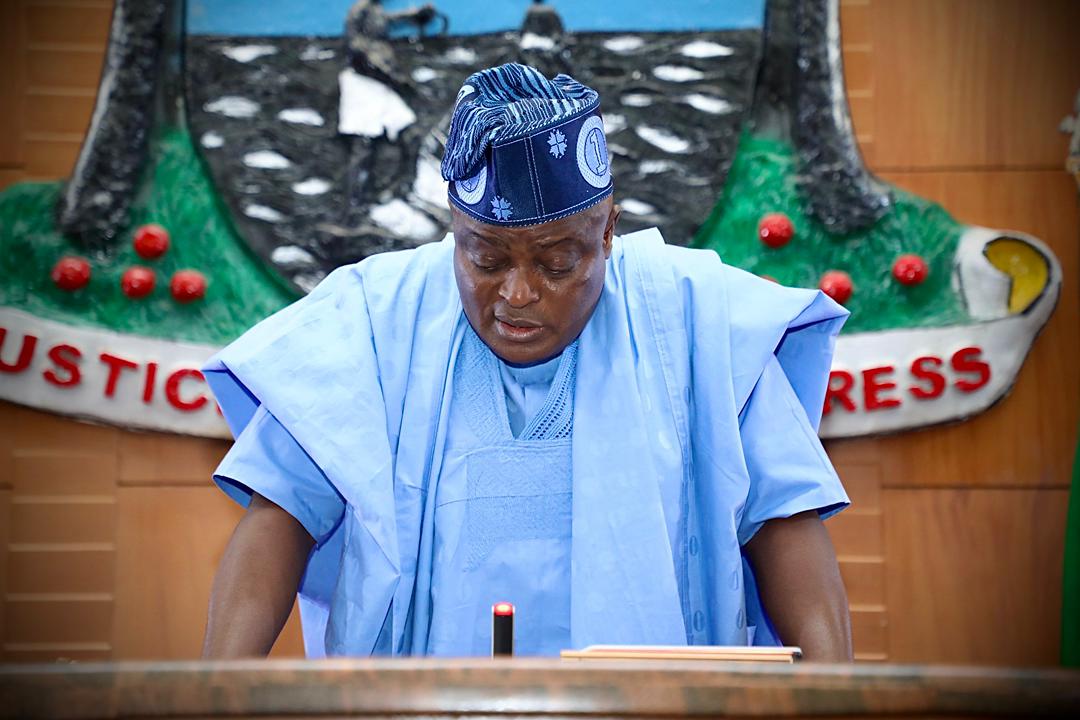
Sallah: Obasa Felicitates Muslim Ummah, Commends Nigerians for APC Primaries Turnout
The Speaker of the Lagos State House of Assembly, Rt. Hon. Mudashiru Obasa has extended warm felicitations to Muslims in Lagos State and across Nigeria on the occasion of Eid al-Adha.
In a statement released by his Chief Press Secretary, Mr. Dave Agboola, Obasa described the festival as a season of sacrifice, reflection, and gratitude, urging the faithful to continue to uphold the values of peace, unity, and love that strengthen the nation.
He noted that the celebration of Eid al-Adha is not only a spiritual milestone but also a reminder of the importance of togetherness and collective responsibility in building a stronger society.
He, likewise, emphasized that the festival provides an opportunity for Nigerians to renew their commitment to national progress and to support leadership that prioritizes development and prosperity.
Obasa, however, commended Nigerians, particularly members of the All Progressives Congress (APC), for their massive turnout during the recently concluded party primaries. He described the participation as a clear demonstration of the people’s confidence in the government of President Bola Ahmed Tinubu and their belief in the administration’s vision for a greater Nigeria.
“The APC primaries have shown the resilience of our democracy and the confidence Nigerians have in the leadership of President Bola Ahmed Tinubu and the Renewed Hope Agenda. This is a strong message that our people are ready to continue supporting policies that will drive growth and prosperity,” Obasa stated.
The Speaker further encouraged Muslims to celebrate responsibly, stressing that the joy of Eid should be accompanied by prayers for the continued peace and progress of Lagos State and Nigeria.
“As you celebrate with family and loved ones, may this season bring joy, peace, and prosperity to your homes. Let us remain united in our resolve to build a stronger nation,” he added.
On behalf of the Lagos State House of Assembly, Obasa wished all Muslims a happy and fulfilling Eid al-Adha celebration.
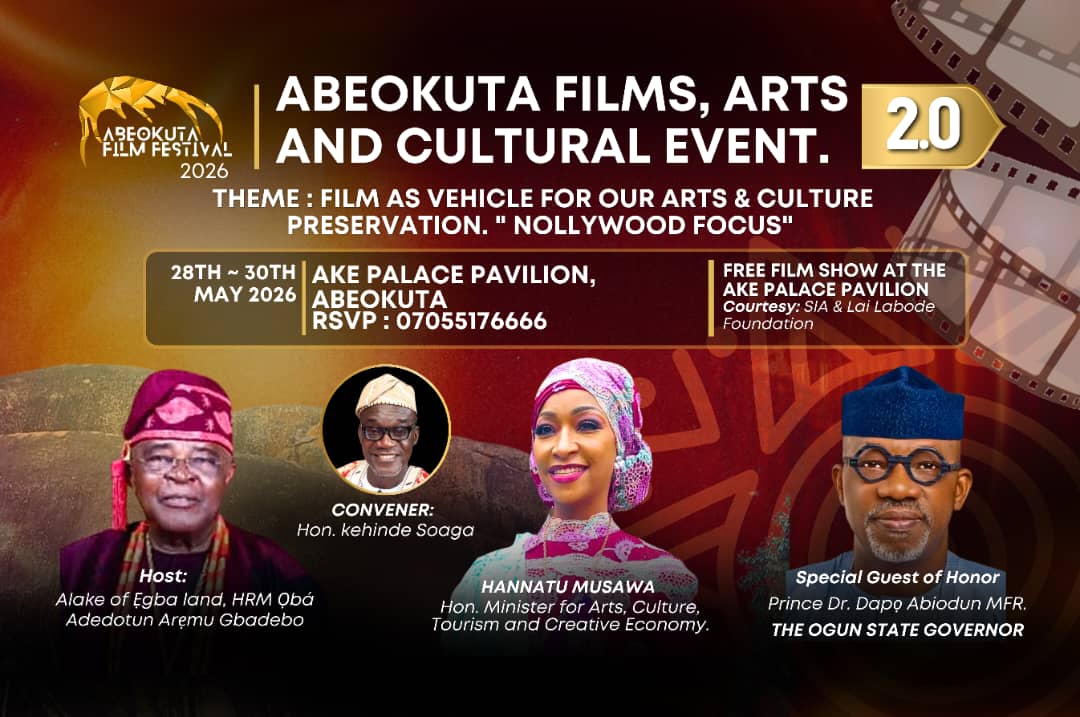
ABEOKUTA FILM FESTIVAL AT ILEYA
Kayshow Multimedia a filmmaking and Media organization this year 2026 holds its annual Abeokuta film festival at the Ake Palace in Abeokuta.
Alake of Egba land, Ọba Michael Adedotun Arẹmu Gbadebo has graciously endorsed the Free Training of Egba Youths on Film and Arts and the Entertainment of the the People with a FREE FILM SHOW at the AKE PAVILION. as part of the ABEOKUTA FILM FESTIVAL 2.0.
The Convener of the Film Festival Honorable Kehinde Soaga says this year’s event promises to be more exciting as distinguished personalities are sure to attend.
This includes the honorable Minister for Art Culture and Creative Economy in Nigeria, Barr. Hannatu Musa Musawa, Ààrẹ Lai Labode, Sen. Ibikunle Amosun and other special guests.
The event will feature Film, Cultural Dance Cultural foods and Award Ceremony.
The general public is hereby invited to the Free film show at the Abeokuta film festival at the Alake Palace Pavilion on Thursday 28th of May 2026 by 4:00 p.m.
Only well dressed is the Entry. The Abeokuta Film Festival is an annual event taking place in the capital city of Ogun State state.


- Qrent says delaying Information Technology (IT) refresh cycles may be increasing operational risk for businesses in Africa May 27, 2026
- Dentons’ Iyunola Adekanye Appointed to African Mining Week (AMW) Advisory Board May 27, 2026
- United Nations (UN) Women Liberia and Partners Convene for Spotlight Initiative 2.0 Women’s Economic Empowerment Inception Meeting May 27, 2026
- African Mining Week (AMW) to Host Central Bank Governors Roundtable as Monetary Authorities Deepen Role in Mining Sector Growth May 27, 2026
- Eritrea: Diaspora Nationals Celebrate Independence Day Anniversary May 27, 2026
- Africa Unveils Landmark Humanitarian Coordination Platform to Strengthen aligned Response to Humanitarian Crises May 27, 2026
- Seychelles: President Herminie Engages with Police and Fire Services on Praslin May 27, 2026
- Issue 3 of Mining Review Africa now available for free download May 27, 2026
- NOV Joins African Energy Week (AEW) 2026 as Gold Sponsor Amid Africa’s Offshore Expansion Push May 26, 2026
- African Union of Broadcasting (AUB) and United Nations University Institute for Water, Environment and Health (UNU-INWEH) Launch Landmark Webinar Series on Africa’s Water Crisis, Starting June 2, 2026 May 26, 2026
- Qrent says delaying Information Technology (IT) refresh cycles may be increasing operational risk for businesses in Africa May 27, 2026
- Dentons’ Iyunola Adekanye Appointed to African Mining Week (AMW) Advisory Board May 27, 2026
- United Nations (UN) Women Liberia and Partners Convene for Spotlight Initiative 2.0 Women’s Economic Empowerment Inception Meeting May 27, 2026
- African Mining Week (AMW) to Host Central Bank Governors Roundtable as Monetary Authorities Deepen Role in Mining Sector Growth May 27, 2026
- Eritrea: Diaspora Nationals Celebrate Independence Day Anniversary May 27, 2026
- Africa Unveils Landmark Humanitarian Coordination Platform to Strengthen aligned Response to Humanitarian Crises May 27, 2026
- Seychelles: President Herminie Engages with Police and Fire Services on Praslin May 27, 2026
-

 news5 months ago
WHO REALLY OWNS MONIEPOINT? The $290 Million Deal That Sold Nigeria’s Top Fintech to Foreign Interests
-

 society3 weeks ago
SOCIAL MEDIA IS NOT A BATTLEFIELD COMMAND – WHY THE NIGERIAN ARMY’S ACTION AGAINST JUSTICE CRACK IS A NATIONAL SECURITY IMPERATIVE
-

 celebrity radar - gossips4 months ago
Dr. Chris Okafor Returns with Power and Fire of the Spirit -Mounts Grace Nation Altar with Fresh Anointing and Restoration Grace on February 1, 2026
-

 celebrity radar - gossips6 months ago
Prophet Kingsley Aitafo Releases 2026 Prophecy: ‘Nigeria Will Rise, but the World Must Prepare for Turbulence’