
society
From Visa Bans to Value Chains: Why Europe must structure sovereign mobility for growth


*From Visa Bans to Value Chains: Why Europe must structure sovereign mobility for growth*
By Babatunde Aduloju
The recent visa restrictions introduced by the United Kingdom government on nationals connected to Saint Lucia’s Citizenship by Investment (CBI) program have triggered an important policy moment, not just for the UK, but for the broader European Union.
At first glance, this may appear to be a routine tightening of immigration controls. It signals something deeper: a growing discomfort within Europe about how to manage the intersection of global mobility, private capital, and economic sovereignty.
But the current response, restrictions, fragmentation, and reactive regulation, misses the bigger opportunity.
Global mobility is no longer just about movement. It is about capital, consumption, and economic influence.
And right now, Europe is under-leveraging one of the most powerful drivers of modern economic growth: the Sovereign Mobility Investor.
*The Economic Reality Europe Cannot Ignore*
Globally mobile investors are not passive travelers. They are active economic participants who inject capital across multiple sectors simultaneously.
To understand the scale:
• Global tourism receipts reached approximately $1.5 trillion annually, with Europe capturing nearly 50% of international tourist arrivals.
• High-net-worth individuals (HNWIs) account for a disproportionate share of premium travel and luxury consumption, often spending 5–10x more per trip than average travelers.
• The global luxury tourism and hospitality market is projected to exceed $1 trillion in the next decade, driven significantly by cross-border wealth mobility.
• International real estate investment linked to mobility programs contributes hundreds of billions of euros annually, particularly in gateway cities and emerging tourism destinations.
But these figures only scratch the surface.
A single Sovereign Mobility Investor family typically contributes across five interconnected economic layers:


-. Travel & Aviation
• First- and business-class international flights
• Private aviation and charter services
• Frequent cross-border movement generating recurring airline revenues
-. Hospitality & Tourism
• Luxury hotels, extended stays, branded residences
• High-value tourism experiences (medical tourism, cultural tourism, leisure travel)
• Destination spending across restaurants, entertainment, and services
-. Real Estate & Infrastructure
• Acquisition of residential and commercial property
• Participation in resort and mixed-use developments
• Investment in urban regeneration and tourism infrastructure
-. Financial Services & Capital Markets
• Banking relationships across jurisdictions
• Portfolio diversification into European assets
• Participation in private equity, venture capital, and structured investment vehicles
-. Lifestyle & Consumption Economies
• Luxury retail (fashion, automotive, art, jewelry)
• Education (private schools, universities)
• Healthcare systems (private care, specialized treatment)
This is not migration. This is an integrated economic ecosystem.
*The Rise of the Sovereign Mobility Investor*
Over the last decade, a structural shift has taken place.
High-net-worth individuals from Africa, Asia, and the Middle East, particularly from countries like Nigeria, India, South Africa, and Lebanon, have increasingly turned to second citizenship and residency programs as tools for:
• global market access,
• risk diversification,
• family security,
• business scalability,
• and participation in international economies.
In Africa alone, outbound investment migration has grown significantly, with Nigerians consistently ranking among the top participants in global mobility programs.
Contrary to outdated narratives, these individuals are not fleeing instability, they are strategically positioning themselves within global value chains.
They are:
• founding companies in multiple jurisdictions,
• investing in global startups,
• participating in cross-border trade,
• and contributing to international tax and consumption systems.
They are, in effect, informal ambassadors of transnational economic integration.
*Europe’s Policy Challenge: Fragmentation vs. Strategy*
Despite benefiting from global capital flows, Europe’s approach to sovereign mobility remains inconsistent.
Across the European Union:
• Some countries have scaled back or eliminated investor visa programs (e.g., golden visa reforms).
• Others maintain independent frameworks with varying standards.
• Regulatory bodies emphasize risk, compliance, and reputational concerns, often without unified economic strategy.
The result is a fragmented system that:
• discourages high-quality investors,
• creates policy uncertainty,
• and weakens Europe’s global competitiveness relative to regions like the Middle East and Asia, where mobility-linked investment is aggressively structured and incentivized.
The UK’s decision regarding Saint Lucia reflects this tension: a necessary concern for oversight, but an incomplete solution for economic engagement.
*The Strategic Opportunity: A Tiered Sovereign Mobility Framework*
Europe has an opportunity to lead, not by restricting mobility, but by structuring it.
At HOC Capital Club, we propose a Three-Tier Sovereign Mobility Engagement Framework:
Tier 1: Compliance, Governance & Trust Infrastructure
Establish a unified European baseline for mobility-linked engagement:
• Cross-border AML and KYC integration
• Shared intelligence platforms between EU and partner jurisdictions
• Standardized due diligence for CBI and residency-linked investors
• Digital identity verification systems
• Policy alignment between immigration, finance, and security agencies
Objective: Remove opacity and build trust.
Tier 2: Economic Participation & Sector Alignment
Link mobility access directly to economic contribution:
• Minimum investment thresholds tied to priority sectors
• Structured investment pathways in:
o tourism and hospitality,
o green energy,
o healthcare infrastructure,
o digital economy and fintech,
o logistics and supply chain ecosystems
• Regional development incentives for underinvested EU zones
Objective: Convert mobility into measurable economic output.
Tier 3: Strategic Sovereign Mobility Partnerships
Integrate investors into Europe’s long-term economic vision:
• Co-investment platforms with governments and development banks
• Public-private partnerships for infrastructure and tourism
• Innovation ecosystem participation (tech hubs, venture ecosystems)
• Policy dialogue platforms connecting investors and regulators
Objective: Transform investors into long-term economic partners.
*The Financial Multiplier Effect*
What Europe must recognize is the compounding nature of sovereign mobility capital.
A €2 million investment does not remain €2 million.
It triggers:
• construction jobs,
• tourism revenue,
• local business growth,
• tax contributions,
• secondary investments,
• and long-term economic activity.
For example:
• A luxury resort backed by mobility-linked capital can generate tens of millions annually in tourism revenue.
• A single high-net-worth investor relocating partially to Europe can contribute €200,000–€500,000 annually in direct consumption.
• Portfolio investments in startups and SMEs can unlock innovation-driven growth across sectors.
When aggregated across thousands of investors, the impact becomes systemic.
*Why Europe Is at Risk of Losing This Opportunity*
Other regions are moving faster.
• The Middle East is aggressively positioning itself as a hub for global mobility capital.
• Asia is integrating investment migration with innovative ecosystems.
• Caribbean nations continue to refine their CBI frameworks as economic tools.
If Europe continues to approach sovereign mobility primarily through restriction:
• capital will be redirected,
• investors will seek alternative jurisdictions,
• and Europe’s influence over global mobility standards will decline.
*The Role of HOC Capital Club*
This is where HOC Capital Club becomes critical.
We are building a platform that connects:
• policymakers,
• sovereign mobility investors,
• institutional capital,
• and global economic ecosystems.
Through our Sovereign Mobility Investor Program, we provide:
• structured investor engagement frameworks,
• policy advisory for governments and institutions,
• curated investment pipelines aligned with national priorities,
• and governance-driven platforms for cross-border collaboration.
We position sovereign mobility not as a loophole, but as a lever for structured economic growth.
*A Call to Action for Europe*
The decision by the United Kingdom government on Saint Lucia should not end the conversation.
It should begin a new one.
Europe must decide:
Will it remain reactive, closing doors and managing risk?
Or will it lead, designing the frameworks that define the future of global mobility?
Because the reality is clear:
• Capital is mobile.
• Talent is mobile.
• Opportunity is mobile.
The regions that succeed will not be those that stop movement.
They will be those that structure it, govern it, and align it with growth.
*Conclusion: Building Economies Without Borders*
Sovereign mobility is not a threat to Europe.
It is an opportunity, if properly structured.
The future global economy will not be defined by static borders, but by connected systems of capital, policy, and people.
Europe has the regulatory strength, institutional depth, and economic scale to lead this transformation.
But leadership requires a shift in mindset:
-From restriction to strategy.
-From fragmentation to coordination.
-From control to structured collaboration.
At HOC Capital Club, we stand ready to partner with Europe in building that future.
Because the next era of global growth will not be built within borders.
It will be built across them.
Aduloju is the Director, Policy & Strategic Development, HOC Capital Club




FOPCHEN Seeks Wider Engagement As Court Defers Hearing
OTA, OGUN STATE — The High Court of Ogun State, Ota Division, on Thursday resumed hearing in the ongoing matter involving cultural and societal concerns, before adjourning proceedings till Thursday, July 2, 2026, for continuation of hearing.
At the resumed sitting on May 28, 2026, counsel representing the various parties revisited key issues in the case and made further submissions before the court.
The matter, which has continued to generate public interest across different sectors, again drew attention from legal observers and stakeholders who described the case as one with significant implications for societal values, cultural identity and constitutional interpretation.
Speaking after the proceedings, the Foundation for the Protection of Cultural Heritage in Nigeria, popularly known as FOPCHEN, renewed its appeal for dialogue and constructive engagement among Nigerians, stressing that sensitive cultural and moral issues should not be left entirely within the confines of the courtroom.
According to the group, broader conversations involving traditional institutions, civil society organisations, religious leaders and policy stakeholders remain necessary in addressing issues relating to national values and social responsibility.
Legal analysts at the court premises noted that arguments being canvassed by parties in the suit could shape future legal interpretations surrounding cultural and moral questions in the country.
Following submissions by counsel, the presiding judge adjourned the matter till Thursday, July 2, 2026, to enable parties further prepare and respond to issues raised during the hearing.
The development has continued to spark reactions among observers, with many Nigerians closely monitoring the proceedings ahead of the next hearing date.

US-Based Society Lady, Fehintola-Brat Extends Eid-El-Kabir Greetings To Muslims
United States based fahionista of class, Chief (Mrs) Ayoola Fehintola-Brat has extended a warm greetings to Muslim faithful all over the world on the occasion of the 2026 Eid-El-Kabir celebration.
Fehintola-Brat who is the Balogun Egbe Obaneye Obinrin Akile Ijebu, and the Yeye Asofin of Idenaland in her message to Journalists urged Muslim to continually uphold the enduring values of sacrifice, obedience, faith, and compassion, which are central to the significance of Eid-El-Kabir festival.
A quiet philantropist whose humanitarian services has won her several laurels urged Muslims to use the spiritual occasion to pray for the peace co-existence of Nigerians regardless of religious, social and political leanings stressing that the oneness of the country should not be underplay.
In a related development, she expressed her felicitations to all sons and daughters of Ijebuland on the forthcoming Ojude Oba 2026 celebration, tasking age-groups otherwise known as Regbregbe to be more proactive in giving back to their immediate communities.
According to her, the beauty of the age-groups in Ijebuland is the need to contribute immensely to the development of the land in no small means. “This we will continue to achieve with God on our side”, she concluded.
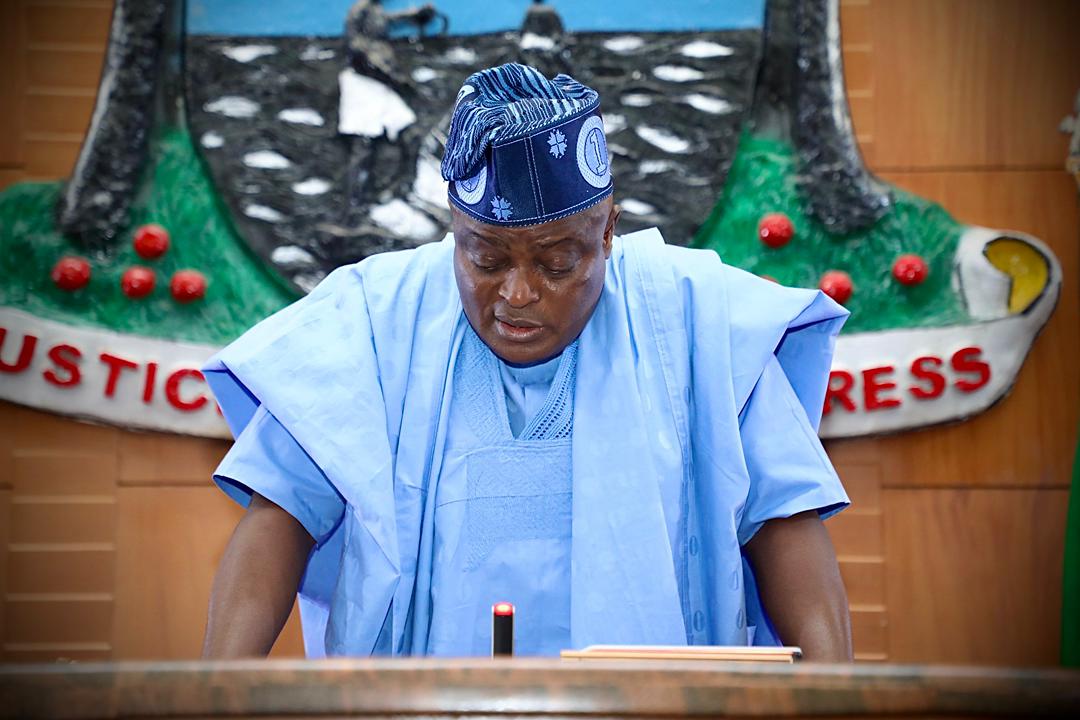
Sallah: Obasa Felicitates Muslim Ummah, Commends Nigerians for APC Primaries Turnout
The Speaker of the Lagos State House of Assembly, Rt. Hon. Mudashiru Obasa has extended warm felicitations to Muslims in Lagos State and across Nigeria on the occasion of Eid al-Adha.
In a statement released by his Chief Press Secretary, Mr. Dave Agboola, Obasa described the festival as a season of sacrifice, reflection, and gratitude, urging the faithful to continue to uphold the values of peace, unity, and love that strengthen the nation.
He noted that the celebration of Eid al-Adha is not only a spiritual milestone but also a reminder of the importance of togetherness and collective responsibility in building a stronger society.
He, likewise, emphasized that the festival provides an opportunity for Nigerians to renew their commitment to national progress and to support leadership that prioritizes development and prosperity.
Obasa, however, commended Nigerians, particularly members of the All Progressives Congress (APC), for their massive turnout during the recently concluded party primaries. He described the participation as a clear demonstration of the people’s confidence in the government of President Bola Ahmed Tinubu and their belief in the administration’s vision for a greater Nigeria.
“The APC primaries have shown the resilience of our democracy and the confidence Nigerians have in the leadership of President Bola Ahmed Tinubu and the Renewed Hope Agenda. This is a strong message that our people are ready to continue supporting policies that will drive growth and prosperity,” Obasa stated.
The Speaker further encouraged Muslims to celebrate responsibly, stressing that the joy of Eid should be accompanied by prayers for the continued peace and progress of Lagos State and Nigeria.
“As you celebrate with family and loved ones, may this season bring joy, peace, and prosperity to your homes. Let us remain united in our resolve to build a stronger nation,” he added.
On behalf of the Lagos State House of Assembly, Obasa wished all Muslims a happy and fulfilling Eid al-Adha celebration.


- Société Nationale des Pétroles du Congo (SNPC) Chief Ominga to Speak at African Energy Week (AEW) 2026 as Congo Accelerates Gas Expansion May 29, 2026
- South Africa: Deputy President Mashatile arrives in India for a Working Visit May 29, 2026
- Seychelles: President Visits Key Development Sites on Coetivy Island May 29, 2026
- Accelerating regional action to advance mental health care in Africa May 29, 2026
- President of the Republic of Seychelles Meets Young La Digue Talent Ahead of London Showcase May 29, 2026
- United Nations Economic Commission for Africa (ECA) launches regional initiative to accelerate women’s digital entrepreneurship across four African countries May 29, 2026
- Ethiopia: International community must act to safeguard press freedom ahead of national election May 29, 2026
- CORRECTION: Annual Meetings 2026 (AM2026): African Development Bank (AfDB) 2025 Trade Finance Report Highlights Resilience of African Financial Institutions After Covid-19 May 29, 2026
- Why Big Tech Could Become Nigeria’s New Gas Partner May 29, 2026
- African Energy Chamber (AEC)-Venezuela Alliance Accelerates Pathways into South-South Energy Expansion May 29, 2026
- Société Nationale des Pétroles du Congo (SNPC) Chief Ominga to Speak at African Energy Week (AEW) 2026 as Congo Accelerates Gas Expansion May 29, 2026
- South Africa: Deputy President Mashatile arrives in India for a Working Visit May 29, 2026
- Seychelles: President Visits Key Development Sites on Coetivy Island May 29, 2026
- Accelerating regional action to advance mental health care in Africa May 29, 2026
- President of the Republic of Seychelles Meets Young La Digue Talent Ahead of London Showcase May 29, 2026
- United Nations Economic Commission for Africa (ECA) launches regional initiative to accelerate women’s digital entrepreneurship across four African countries May 29, 2026
- Ethiopia: International community must act to safeguard press freedom ahead of national election May 29, 2026
-

 news6 months ago
WHO REALLY OWNS MONIEPOINT? The $290 Million Deal That Sold Nigeria’s Top Fintech to Foreign Interests
-

 society4 weeks ago
SOCIAL MEDIA IS NOT A BATTLEFIELD COMMAND – WHY THE NIGERIAN ARMY’S ACTION AGAINST JUSTICE CRACK IS A NATIONAL SECURITY IMPERATIVE
-

 celebrity radar - gossips4 months ago
Dr. Chris Okafor Returns with Power and Fire of the Spirit -Mounts Grace Nation Altar with Fresh Anointing and Restoration Grace on February 1, 2026
-

 celebrity radar - gossips6 months ago
Prophet Kingsley Aitafo Releases 2026 Prophecy: ‘Nigeria Will Rise, but the World Must Prepare for Turbulence’