
Politics
Gov Fubara And One Year of His Signature in Rivers By Nath Odili

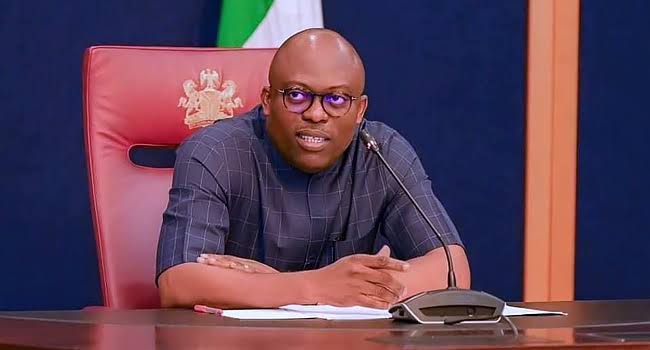
Gov Fubara And One Year of His Signature in Rivers
By Nath Odili
Going by the recent comment by His Excellency, Siminalayi Fubara, Executive Governor of Rivers State that his administration started in February 2024, it would be right to say that he’s just four months old in office. However, the record books won’t accept such a position. This is not the first time such is happening in Rivers State.
It would be recalled that in 2007, Rt. Hon Rotimi Amaechi took over the mantle of leadership when his colleagues in other States were already 5 months into their tenure. He had to forfeit the time spent by his immediate predecessor, Chief Celestine Omehia for peace to reign and by May 29th 2011, it was assumed or believed that Amaechi had spent 4 years in office, when in a real sense, he had three and a half.
The case of Governor Fubara is peculiar, though. Unlike Amaechi, Fubara was in office but not in power. While he was there as the figurehead, the levers and fulcrum of power resided somewhere else and being wielded, controlled, manipulated and exercised by someone who stayed miles away. Someone who was once in the driver’s seat but was reckless in driving. Someone who had the opportunity to lead but decided to rule with pride and arrogance. A mortal man who equated himself with God.
So in an attempt to x-ray the giant strides of the people’s governor within the last year, we must be mindful of other events that have shaped the administration as there’s a saying that “no event, no history”. Yes, the last year has been eventful and one of the biggest achievements of Gov. Fubarais his ability to wrestle and rescue Rivers from the shackles of those who kidnapped the State and held her and her abundant resources hostage for their gains.
During the electioneering campaign and his early days in office, not much was expected of a Fubara administration as he was seen as a stooge and puppet of the immediate past administration. The people of Rivers were expecting another four years of hellish experience, of brutal governance spiced with arrogance. They had made up their minds to live with another “bull in a Chinese shop”.
A government that will seize their ancestral lands and confiscate their cherished properties without reason talk more of compensation. A government that invites you to the government house, you expect feedback and good explanations to take back to your people but what you get is insults and humiliation right before the cameras and by the time you get home, everyone is already aware of your bitter experience as it was live on national televisions.
The governor who can change this narrative and take away this shame from the land and reproach from the people would be said to have done more than enough. This was exactly what Fubara achieved in his first seven months in office and because it’s not physical infrastructure that can be seen or touched, the governor is not impressed with himself. The people experiencing this new breath of fresh air blowing through the State are exceedingly grateful though. Without being a member of the Omoyele Sowore RevolutionNow “take-it-back” squad, Governor Fubara has taken back power on behalf of the good people of Rivers State and has now settled down to work for the good of the electorate and the land.
If the above looks abstract to the outsider and those who are not physically there in Rivers to experience the relief on the faces of the people on the streets, well, the governor also felt the same way and is probably not counting it as one of his numerous achievements. When he rolled out his scorecard and account of his stewardship in Port Harcourt to commemorate his one year in office, he referred to the political crisis he wriggled through as vicious and existential and assured the people that the worst was over as he said he has defended his rights to govern the oil-rich State without compromise.
Governor Fubara who said he inherited a project debt of over ₦225 Billion from his predecessor, promised to continue with any of those projects that have a direct bearing on the lives of the people despite the desperate efforts by his detractors to sabotage his government. He said he inherited 34 abandoned projects spread across 13 Council Areas but is committed to their completion.
He cited examples of how a cartel incited a contractor of an abandoned project to go to court and frustrated his efforts to complete the project. He also said the cartel went all out to persuade dignitaries and resource persons invited to the Rivers Economic and Investment Summit not to attend the programme or associate with his government but got disappointed when they decided not to politicize issues of the economy.
The former Accountant General of Rivers said his government has awarded contracts for nine new roads with a combined sum totalling over ₦534 Billion.
He said he established an “Internally Generated Revenue Investment Advisory Committee” chaired by himself that has greatly improved the internally generated revenue of the State.
From the ₦12 Billion monthly IGR he inherited in May 2023, he said the monthly generated revenue now fluctuates between ₦17 during the off-peak to ₦28 Billion in peak periods. It also goes to show how most of the State’s revenue was being diverted into private accounts before he regained control of the treasury. Those benefitting from this malfeasance were using the proceeds of this crime to foment trouble and destabilize the State.
To encourage investors and support small-scale businesses, the government has kept tax rates very low and has completely frozen taxes on small businesses. The government is partnering with the Bank of Industry to support micro and small-scale businesses and about ₦4 Billion has been committed to this cause. It is aimed at empowering about 3,000 businesses that can create jobs with multiplier effects on the job market. The money will be disbursed at a single-digit interest rate with a 5-year repayment plan.
The administration awarded the 50-kilometre Port Harcourt Dual Carriage Ring Road with six flyovers, a river crossing and street lights which run across six local government areas to Julius Berger Nigeria PLC for ₦195 Billion and made a down payment of ₦150 Billion which represents 77% of the total sum. Julius Berger has never had it so good in Nigeria. Though the agreed completion period is 36 months, work is proceeding from six different points and there’s every likely hold that they will beat the time.
There’s also the 34-kilometre Elele-Omoku road awarded at the cost of almost ₦81 Billion with a completion period of 24 months. 50% of the contract sum has already been paid to the contractor. The projects are been financed from internally generated revenue and allocation from the Federation Account as an additional loan burden on the State is not the priority of the government at the moment.
In the area of education, Government Secondary Schools in Bokori, Eneka, Emohua, Okrika, Ataba, Community Secondary Schools in Kunusha, Tai, Rumuepirikom and many other secondary schools have experienced the Fubara touch. The government paid about ₦612 Billion for the furnishing of the convocation ground at the University of Port Harcourt, a federal university and also committed over ₦700 million for the construction of a twin hostel at the Nigerian Law School, Yenagoa Campus. This is apart from the ₦2 Billion released to the Universal Basic Education Board, UBEC as a counterpart fund for the upgrading and standardisation of Basic Schools in Rivers State.
Honestly, some of the figures being released by the Rivers State government to a single agency sound like the annual budget of ministries in other states. That’s the Fubara way. Emergency ambulance services have been revived in Rivers State and the Rivers State University Teaching Hospital is being equipped to improve tertiary healthcare services in the State, most especially to handle referrals. Already, 35 Primary Healthcare Centres have been upgraded to attend to the immediate health needs of rural dwellers.
In one year, which many believe is just a few months, Fubara is already imposing his signature and stamping his authority on the State and it’s becoming visibly clear he’s only out to serve his people. Many won’t mind if he continues on this path even if he steps on the toes of those who have held back the State for so long and become huddles on his way.
The founding fathers of the State and critical stakeholders who are only interested in the well-being and prosperity of the State are solidly behind Governor Fubara and the solitary he enjoys from these Elder Statemen is enough encouragement that could spur him to do more in his remaining years in office.
Now, the Rivers people are hungry for more and the man who killed the “Rivers lion” with his bare hands is now ready to confront any Goliath that stands to defile his people.
Odili wrote this piece from Port Harcourt.


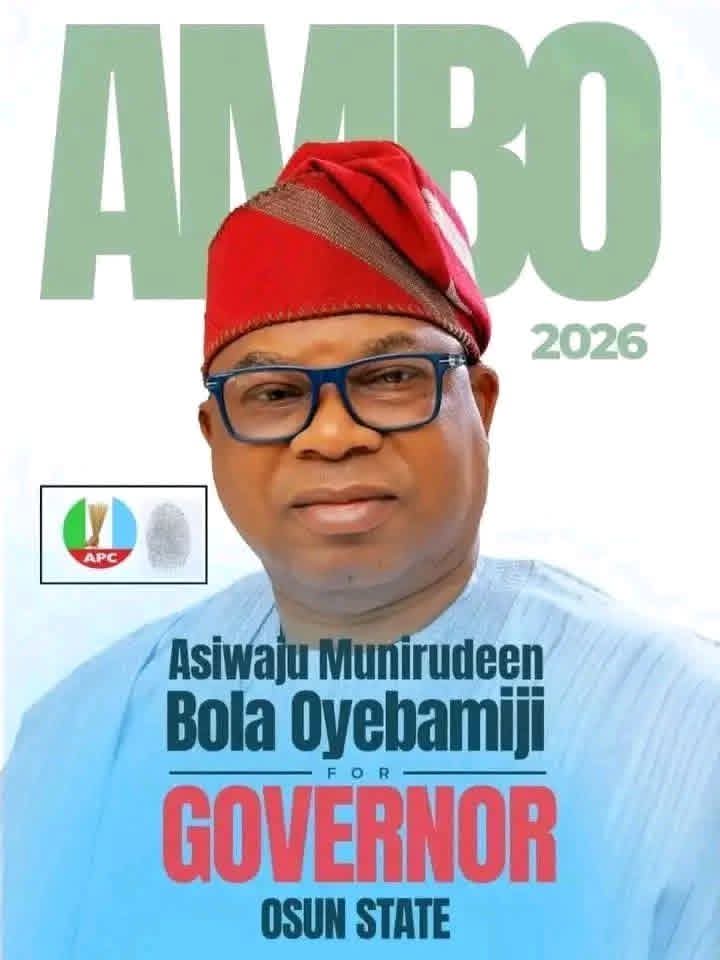
AMBO and the Osun Governorship Race: Assessing the Man, the Politics and the Vision
As political activities gather momentum ahead of the 2026 Osun State governorship election, a public affairs commentator, Oluseyi Olonade, has described the emergence of Asiwaju Munirudeen Bola Oyebamiji, popularly known as AMBO, as a significant development in the state’s political landscape.
In an article titled “Oyebamiji: The Man, The Politics and The Aspiration,” Olonade argued that the All Progressives Congress governorship hopeful possesses the character, experience and vision needed to reposition Osun State for sustainable growth.
According to the writer, Oyebamiji’s appeal stems from his extensive background in the banking sector, where he spent nearly three decades working with institutions including Wema Bank, Trans International Bank, Spring Bank and Enterprise Bank.
A native of Ikire in Irewole Local Government Area, Oyebamiji was described as a technocrat whose experience in corporate governance, finance and risk management has shaped his approach to public administration.
The article noted that his public service journey gained prominence in 2012 when he was appointed to oversee the then Osun State Investment Company Limited. Under his leadership, the organisation was reportedly restructured and transformed into Omoluabi Holdings Limited.
The writer further highlighted Oyebamiji’s tenure as Commissioner for Finance under successive APC administrations, where he was credited with managing the state’s finances during challenging economic periods.
Olonade also referenced Oyebamiji’s appointment as Managing Director of the National Inland Waterways Authority, describing it as further evidence of his administrative and leadership capabilities.
The article contrasted Oyebamiji’s governance philosophy with that of the current administration in Osun State, arguing that the APC aspirant favours institutional reforms, economic diversification and fiscal discipline.

According to the writer, Oyebamiji’s proposed agenda includes strengthening transparency in government spending, expanding internally generated revenue, attracting private-sector investments and promoting industrial and agricultural development.
The article also highlighted youth empowerment, entrepreneurship development and digital skills acquisition as key components of his vision for the state.
Olonade concluded that the forthcoming governorship election would present voters with a choice between different approaches to governance, expressing confidence that Oyebamiji’s experience and developmental agenda make him a strong contender in the race.
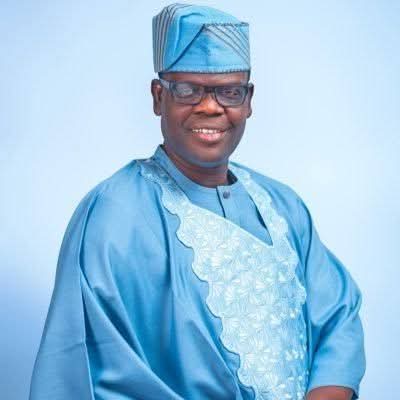
*Oselu Tiwa nTiwa Endorses Oriyomi Hamzat for Oyo Governorship*
A sociopolitical support group in Oyo State, Oselu Tiwa nTiwa, has declared its support for Alhaji Oriyomi Hamzat as the authentic governorship candidate of the Accord Party ahead of the forthcoming governorship election in the state.
The group made its position known in a statement jointly signed by its President, Mr. Adewale Oluwaseyi and Secretary, Alh. Adebayo Oyewole, on Thursday, describing Hamzat as a grassroots figure with strong connection to the people and a track record of humanitarian interventions across Oyo State.

According to the group, the endorsement followed what it described as careful observation of Hamzat’s leadership qualities, compassion and dedication to the welfare of ordinary citizens.
“Oriyomi Hamzat has consistently demonstrated empathy, courage and selfless commitment to humanity. Through his numerous interventions in the lives of ordinary citizens, he has become a symbol of hope to many families and communities,” the statement read.
Oselu Tiwa nTiwa also appealed to the national leadership of the Accord Party to prioritise the long-term future and electoral growth of the party in its decision-making process.
The group noted that Hamzat’s candidacy presents an opportunity for the party to strengthen its grassroots support base and expand its political relevance across Oyo State.
“We respectfully appeal to the National Leadership of the Accord Party to look beyond immediate political calculations and consider the bigger picture, the future growth, stability and electoral success of the party in Oyo State and beyond,” the statement added.
The group further expressed confidence in the leadership of the party, saying it believes the party’s national officers and stakeholders would take decisions that reflect fairness, inclusiveness and the collective interest of members.
While calling on party loyalists to remain calm and united, Oselu Tiwa nTiwa said continued consultations among stakeholders would help strengthen the Accord Party ahead of the election.
Signed:
Alh. Adebayo Oyewole,
Secretary.
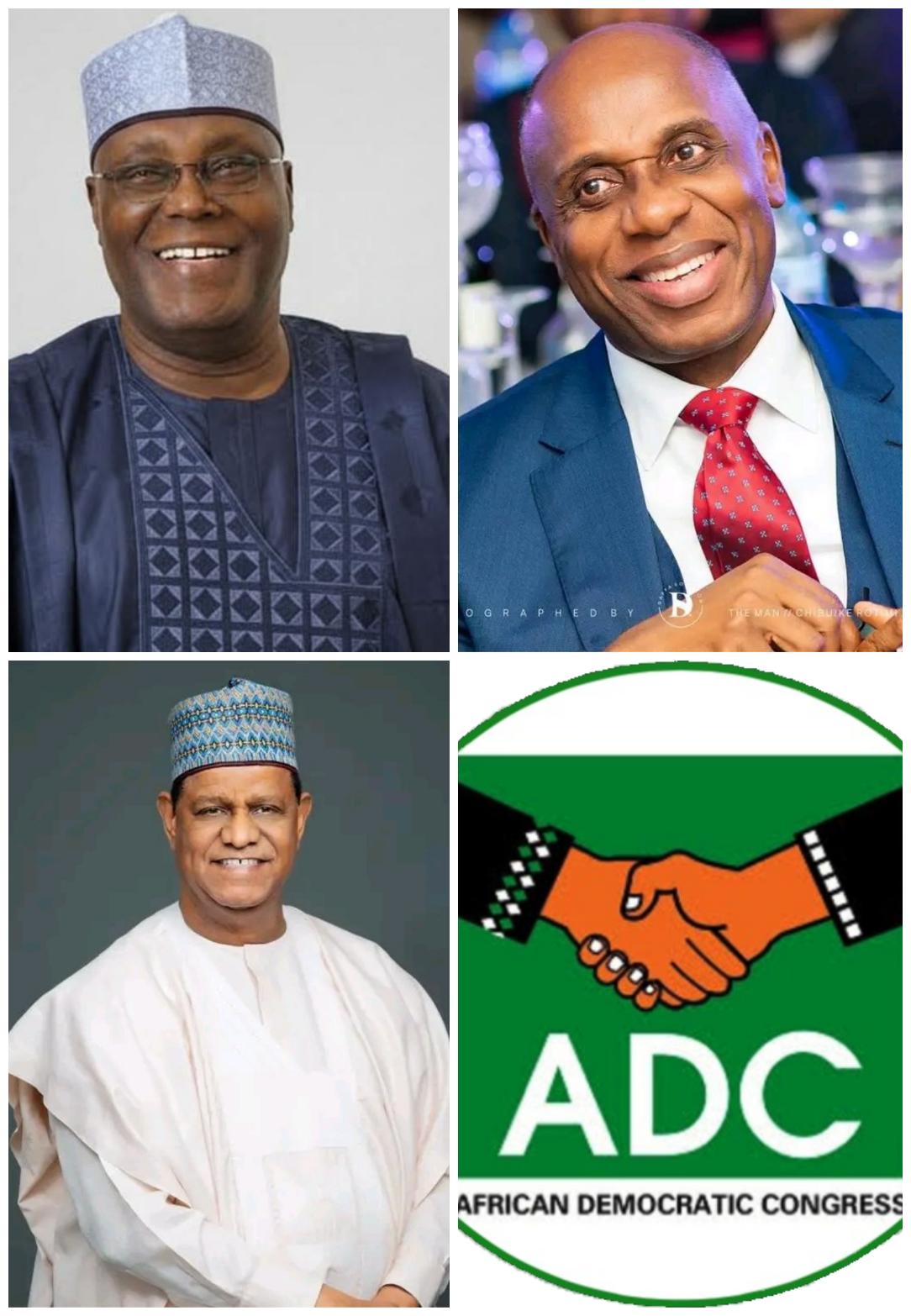
Atiku Set To Clinch ADC Presidential Ticket, Leads Amaechi, Hayatu-Deen In 34 States
Former Vice President of Nigeria and frontline presidential aspirant of the African Democratic Congress (ADC), Atiku Abubakar, is projected to emerge winner of the party’s presidential primaries, according to impeccable sources in Abuja.
The primaries, conducted across over 8,000 wards in the 36 states of the federation and the Federal Capital Territory, reportedly placed Atiku far ahead of his closest rivals — former Rivers State Governor, Rotimi Amaechi, and former Chairman of the Nigerian Economic Summit Group, Mohammed Hayatu-Deen.

Highly placed party insiders disclosed that Atiku is currently leading in 34 states, including the FCT, after securing dominance across the 19 Northern states, the five South-East states, and the six South-West states, while also maintaining a strong showing in at least three states in the South-South geopolitical zone.
The sources added that the outcome reflects what they described as “an overwhelming nationwide acceptance” of the former vice president within the opposition party ahead of the 2027 general election.
Meanwhile, the ADC leadership has invited members of the press to the official announcement of the final collated results scheduled for 11:00 a.m. on Tuesday, May 26, 2026, in Abuja.
The declaration of results is expected to be broadcast live on ARISE Television and two other major television stations, while also being livestreamed on the party’s official social media platforms on X and Facebook.
Speaking ahead of the announcement, the founding National Chairman of the ADC, Chief Ralph Nwosu, said the decision to televise the exercise live was aimed at promoting transparency and democratic accountability.
“We want millions of Nigerians at home and in the Diaspora to witness democracy in action,” Nwosu said.
He further revealed that the party leadership would encourage all three presidential aspirants to publicly embrace a peace accord and commit themselves to working together in unity for the party’s success.
According to him, the move is necessary to strengthen internal cohesion and position the ADC for victory in the presidential election scheduled for January 16, 2027.
Details later.


- Junior Achievement (JA) Africa Delivers 1.6 Million Learning Experiences in a Single Year, Marking Twelve-Fold Growth in Five Years June 5, 2026
- United Nations Mission in South Sudan (UNMISS) helps plant hope among youth on World Environment Day June 5, 2026
- Afreximbank Deepens Engagement with Jamaica to Drive Trade, Investment and Industrialisation June 5, 2026
- World Health Organization (WHO) supports reactive yellow fever vaccination campaign and Bundibugyo virus disease (BVD) preparedness in Liberia June 5, 2026
- Uganda: Museveni pushes for wealth creation through development programmes June 5, 2026
- Africa: UNAIDS calls for renewed global solidarity as UN Secretary-General’s report warns that AIDS is not over and fragile gains are at risk June 4, 2026
- Eritrea: Vocational training provided to college students June 4, 2026
- World Bank Group Launches Ten-Year Strategy to Drive Jobs and Prosperity in Uganda June 4, 2026
- Prof Oramah’s appointments to the Royal African Society Patronage and Kenya’s National Infrastructure Fund herald continued recognition of his global leadership and pan-African impact June 4, 2026
- Africa Finance Corporation Raises Record US$2 Billion Syndicated Loan in Landmark Show of Confidence in Transformational Infrastructure Strategy June 4, 2026
- Junior Achievement (JA) Africa Delivers 1.6 Million Learning Experiences in a Single Year, Marking Twelve-Fold Growth in Five Years June 5, 2026
- United Nations Mission in South Sudan (UNMISS) helps plant hope among youth on World Environment Day June 5, 2026
- Afreximbank Deepens Engagement with Jamaica to Drive Trade, Investment and Industrialisation June 5, 2026
- World Health Organization (WHO) supports reactive yellow fever vaccination campaign and Bundibugyo virus disease (BVD) preparedness in Liberia June 5, 2026
- Uganda: Museveni pushes for wealth creation through development programmes June 5, 2026
- Africa: UNAIDS calls for renewed global solidarity as UN Secretary-General’s report warns that AIDS is not over and fragile gains are at risk June 4, 2026
- Eritrea: Vocational training provided to college students June 4, 2026
-

 news6 months ago
WHO REALLY OWNS MONIEPOINT? The $290 Million Deal That Sold Nigeria’s Top Fintech to Foreign Interests
-

 society1 month ago
SOCIAL MEDIA IS NOT A BATTLEFIELD COMMAND – WHY THE NIGERIAN ARMY’S ACTION AGAINST JUSTICE CRACK IS A NATIONAL SECURITY IMPERATIVE
-

 celebrity radar - gossips4 months ago
Dr. Chris Okafor Returns with Power and Fire of the Spirit -Mounts Grace Nation Altar with Fresh Anointing and Restoration Grace on February 1, 2026
-

 celebrity radar - gossips6 months ago
Prophet Kingsley Aitafo Releases 2026 Prophecy: ‘Nigeria Will Rise, but the World Must Prepare for Turbulence’