
Politics
Governors vs. Grassroots: Supreme Court’s Local Government Autonomy Ruling Faces Sabotage


Governors vs. Grassroots: Supreme Court’s Local Government Autonomy Ruling Faces Sabotage
Nearly nine months after the Supreme Court granted full financial autonomy to Nigeria’s 774 local government areas (LGAs), implementation of the historic judgment is being quietly sabotaged—this time from within.
Investigations by The PUNCH have uncovered a deepening standoff between the Federal Government and several state governors, many of whom have allegedly resorted to intimidation, threats, and policy delays to prevent local government chairmen from opening designated Central Bank of Nigeria (CBN) accounts for direct allocation payments.
“Our governor has threatened us not to open accounts with the CBN for the direct payment of our allocation,” a visibly frustrated LGA chairman from a South-East state told The PUNCH, requesting anonymity out of fear of political retaliation.
According to the Supreme Court ruling, LGAs are to receive their monthly allocations directly from the Federation Account, a long-sought step towards grassroots development and financial independence. However, several chairmen across the country claim they are being coerced into compliance with governors’ preferences—including proposals to return 50% of their allocations in exchange for the right to open the accounts.
Federal Push, State Resistance
In response to the court ruling, the Federal Government set up a high-level implementation panel, which directed the CBN to open individual accounts for all LGAs. The Accountant-General of the Federation, Attorney-General Lateef Fagbemi (SAN), and key stakeholders have also been in negotiations to iron out implementation logistics.
But The PUNCH has learned that the CBN process has been sluggish, with only Delta State LGAs having submitted full account details to date. Compounding the delays are what sources describe as “stringent requirements” from the apex bank—such as the submission of two-month bank statements—posing logistical challenges for many LGAs.
An LGA chairman in the South-West explained, “All council areas here can’t meet up with the conditions because, frankly, governors have control of the accounts. They give us whatever they feel like.”
In Benue, a chairman revealed, “They (the governors) are pushing for us to open accounts in commercial banks instead. They know once it’s the CBN, they lose access to our funds.”
Federal Silence, Fragmented Compliance
The vacuum in presidential clarity is further muddying the waters. Though governors reportedly met with President Bola Tinubu to lobby for commercial bank accounts over CBN accounts, it remains unclear where the presidency stands.
In Nasarawa, where officials claim all CBN accounts are opened, the state’s NULGE chairman, Adamu Sharhabilu, expressed frustration: “We have yet to receive direct allocations. The money is still sent to Joint State-LGA Accounts.”
Another Nasarawa chairman contradicted this optimism, blaming the Federal Government for failure to bypass state structures and send allocations directly. “We have so many accounts ready to receive the money, but they won’t send it,” he lamented.
A Patchwork of Responses Nationwide
Across the country, compliance is uneven. In Kwara, NULGE boss Seun Oyinlade said, “We’re not aware any of our 16 LGAs have opened CBN accounts. We’ll only know when funds are paid.”
In Yobe, March salaries were reportedly still paid through the Ministry of Local Government, with no trace of direct payment implementation.
In Zamfara, ALGON chairman Alhaji Samaila Moriki admitted no accounts had been opened yet, citing the need for “further instructions.”
Meanwhile, in Jigawa, ALGON chairman Prof. Abdulrahman Salim insisted the process is “progressing,” with most administrative steps completed and biometric registration pending. But a NULGE source cast doubt, warning that governors could “change the process entirely” at will.
Even in Kano, where 44 LGAs await CBN verification, no accounts have been activated. “We’ve read about it in the newspapers,” said Garko LGA chairman Saminu Garko, highlighting the information vacuum between federal institutions and local authorities.
A Standoff with National Implications
The Supreme Court ruling had sparked hope for true devolution of power, ending decades of financial strangulation of LGAs by state governments. Yet, the fierce pushback from governors now threatens to render the landmark judgment toothless.
One chairman summarized the national mood:
“What’s the point of autonomy on paper if governors still hold the purse strings?”
As grassroots development stalls, pressure is mounting on the Federal Government to enforce compliance and on the CBN to ease its procedural barriers.
But unless decisive action is taken soon, the dream of an empowered third tier of government may remain just that—a dream.



Lagos Politics: APC Elevates Sonayan-James, Strengthens 2027 Governorship Ticket
LAGOS — The All Progressives Congress has boosted its preparations for the 2027 Lagos State governorship election with the unveiling of Damilola Sonayan-James as its deputy governorship candidate, a move party leaders say is aimed at strengthening the party’s electoral prospects.

The announcement positions Sonayan-James as a key figure in the party’s campaign structure as the APC intensifies efforts to consolidate its political dominance in the state ahead of the polls.
Party officials described her emergence as the outcome of extensive consultations and a strategic decision to present a ticket that reflects competence, grassroots engagement and inclusive leadership.
Speaking on the development, APC leaders said Sonayan-James had demonstrated commitment to the party’s ideals and possessed the experience required to contribute meaningfully to governance if elected.
Her nomination is also expected to bolster the party’s appeal among women, youths and grassroots supporters, given her track record in community development and political mobilisation.
Political observers believe the decision underscores the APC’s determination to field a balanced ticket capable of sustaining its influence in Lagos while responding to the evolving expectations of the electorate.
With the unveiling concluded, attention is expected to shift to statewide mobilisation and engagement with stakeholders as the party prepares for what is anticipated to be a keenly contested governorship election in 2027.

2027 Assembly Race: ‘School Boy’ Sparks Fresh Hope for Surulere Constituency II
LAGOS – As political activities gradually gather momentum ahead of the 2027 general elections, growing support is emerging in Surulere Constituency II for the Peoples Democratic Party (PDP) House of Assembly aspirant, Hon. Kayode Oloyede, popularly known as “School Boy.”
Running on the campaign theme, “Rebuild 2027,” Oloyede is positioning himself as an alternative voice for residents seeking a new direction in legislative representation and grassroots development.
A Vision Anchored on Four Pillars
The aspirant has built his campaign around a four-point agenda designed to address the concerns of constituents:
People First: Prioritising the welfare and everyday needs of residents above partisan considerations.
Transparent Leadership: Promoting accountability in legislative activities, constituency projects, and public resource management.
Inclusive Governance: Encouraging broad participation in decision-making by ensuring every segment of the constituency has a voice.
Sustainable Development: Advocating long-term investments in infrastructure, youth empowerment, education, and human capital development.
Growing Grassroots Appeal
Political observers say Oloyede’s grassroots engagement strategy and community-focused messaging have resonated with many residents who desire more accessible and responsive representation.
His campaign consistently emphasises the need to bridge the gap between elected representatives and the people, with a promise to build “a better, stronger, and more prosperous Surulere Constituency II.”
A community leader, who requested anonymity, said many residents are looking beyond political rhetoric and seeking leadership that understands their daily challenges.
“We need someone who genuinely understands the struggles of ordinary people and is prepared to serve the community. For many of us, the call to rebuild is not just a campaign slogan but a reflection of our aspirations for meaningful development,” the source said.
A Competitive Political Landscape
As the countdown to the 2027 elections continues, Oloyede has urged constituents to embrace a vision centred on progress, accountability, and community-driven governance.
While Surulere remains a politically competitive constituency with established structures and influential stakeholders, analysts believe the increasing visibility of the “School Boy” movement could make the contest one of the closely watched legislative races in Lagos State.
Ultimately, political observers note that while grassroots mobilisation is a significant factor, electoral outcomes will likely depend on a combination of candidate credibility, party strength, voter turnout, campaign organisation, and the prevailing political climate as the 2027 elections approach.
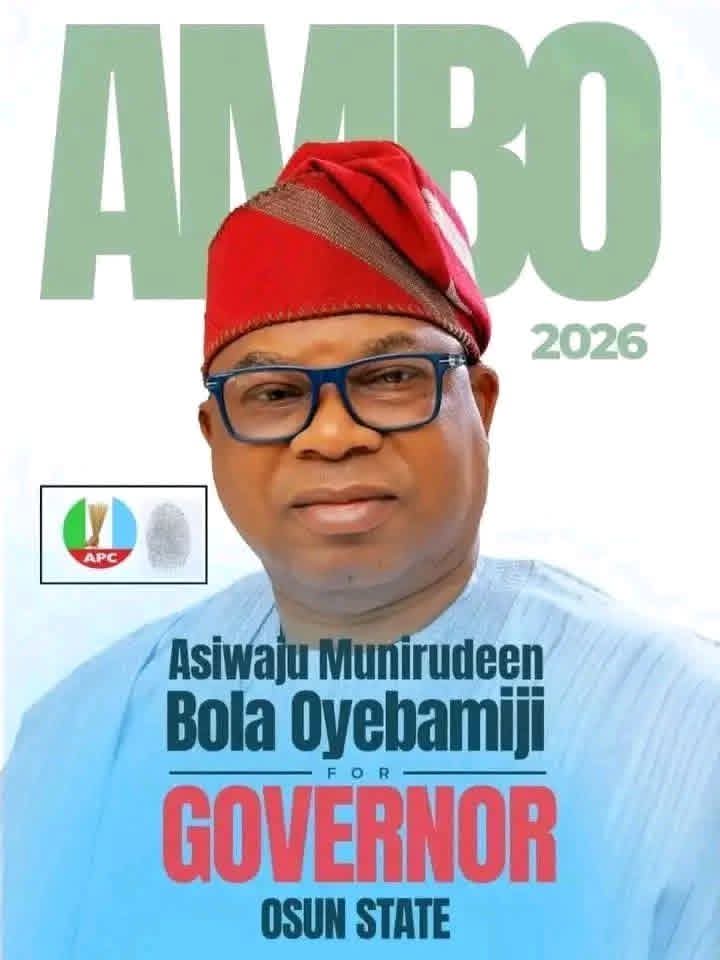
AMBO and the Osun Governorship Race: Assessing the Man, the Politics and the Vision
As political activities gather momentum ahead of the 2026 Osun State governorship election, a public affairs commentator, Oluseyi Olonade, has described the emergence of Asiwaju Munirudeen Bola Oyebamiji, popularly known as AMBO, as a significant development in the state’s political landscape.
In an article titled “Oyebamiji: The Man, The Politics and The Aspiration,” Olonade argued that the All Progressives Congress governorship hopeful possesses the character, experience and vision needed to reposition Osun State for sustainable growth.
According to the writer, Oyebamiji’s appeal stems from his extensive background in the banking sector, where he spent nearly three decades working with institutions including Wema Bank, Trans International Bank, Spring Bank and Enterprise Bank.
A native of Ikire in Irewole Local Government Area, Oyebamiji was described as a technocrat whose experience in corporate governance, finance and risk management has shaped his approach to public administration.
The article noted that his public service journey gained prominence in 2012 when he was appointed to oversee the then Osun State Investment Company Limited. Under his leadership, the organisation was reportedly restructured and transformed into Omoluabi Holdings Limited.
The writer further highlighted Oyebamiji’s tenure as Commissioner for Finance under successive APC administrations, where he was credited with managing the state’s finances during challenging economic periods.
Olonade also referenced Oyebamiji’s appointment as Managing Director of the National Inland Waterways Authority, describing it as further evidence of his administrative and leadership capabilities.
The article contrasted Oyebamiji’s governance philosophy with that of the current administration in Osun State, arguing that the APC aspirant favours institutional reforms, economic diversification and fiscal discipline.

According to the writer, Oyebamiji’s proposed agenda includes strengthening transparency in government spending, expanding internally generated revenue, attracting private-sector investments and promoting industrial and agricultural development.
The article also highlighted youth empowerment, entrepreneurship development and digital skills acquisition as key components of his vision for the state.
Olonade concluded that the forthcoming governorship election would present voters with a choice between different approaches to governance, expressing confidence that Oyebamiji’s experience and developmental agenda make him a strong contender in the race.


- Gwede Mantashe Joins African Energy Week (AEW) 2026 as South Africa's Petroleum Reforms Open the Orange Basin to Drilling June 8, 2026
- Inspiring Tomorrow's Leaders: Senator Dr. Rasha Kelej Launches her First Virtual Mentorship and Leadership Platform June 8, 2026
- ExxonMobil and National Basketball Association (NBA) Africa interactive Science, Technology, Engineering, and Mathematics (STEM) Showcase and a Jr. NBA Clinic June 8, 2026
- Africa Centres for Disease Control and Prevention (Africa CDC) Welcomes Pandemic Fund’s US$220m Support for Bundibugyo Virus Outbreak Response June 8, 2026
- Africa Centres for Disease Control and Prevention (Africa CDC) and World Health Organization (WHO) Launch Joint Continental Ebola Response Plan June 8, 2026
- Statement of the Catholic Bishops of Africa on the Tragic Killing of Most Rev. Osório Citora Afonso, Bishop of Quelimane and Apostolic Administrator of the Archdiocese of Beira June 8, 2026
- Journal of Public Health in Africa Expands with New Rapid Communications, Policy and News Sections June 8, 2026
- Mining Review Africa expands coverage to include global mining news June 8, 2026
- 13,000 Hectare Wild Coast Conservation Property Comes to the Market in the Eastern Cape June 8, 2026
- President Isaias Afwerki Departs for Egypt June 7, 2026
- Gwede Mantashe Joins African Energy Week (AEW) 2026 as South Africa's Petroleum Reforms Open the Orange Basin to Drilling June 8, 2026
- Inspiring Tomorrow's Leaders: Senator Dr. Rasha Kelej Launches her First Virtual Mentorship and Leadership Platform June 8, 2026
- ExxonMobil and National Basketball Association (NBA) Africa interactive Science, Technology, Engineering, and Mathematics (STEM) Showcase and a Jr. NBA Clinic June 8, 2026
- Africa Centres for Disease Control and Prevention (Africa CDC) Welcomes Pandemic Fund’s US$220m Support for Bundibugyo Virus Outbreak Response June 8, 2026
- Africa Centres for Disease Control and Prevention (Africa CDC) and World Health Organization (WHO) Launch Joint Continental Ebola Response Plan June 8, 2026
- Statement of the Catholic Bishops of Africa on the Tragic Killing of Most Rev. Osório Citora Afonso, Bishop of Quelimane and Apostolic Administrator of the Archdiocese of Beira June 8, 2026
- Journal of Public Health in Africa Expands with New Rapid Communications, Policy and News Sections June 8, 2026
-

 news6 months ago
WHO REALLY OWNS MONIEPOINT? The $290 Million Deal That Sold Nigeria’s Top Fintech to Foreign Interests
-

 society1 month ago
SOCIAL MEDIA IS NOT A BATTLEFIELD COMMAND – WHY THE NIGERIAN ARMY’S ACTION AGAINST JUSTICE CRACK IS A NATIONAL SECURITY IMPERATIVE
-

 celebrity radar - gossips4 months ago
Dr. Chris Okafor Returns with Power and Fire of the Spirit -Mounts Grace Nation Altar with Fresh Anointing and Restoration Grace on February 1, 2026
-

 celebrity radar - gossips6 months ago
Prophet Kingsley Aitafo Releases 2026 Prophecy: ‘Nigeria Will Rise, but the World Must Prepare for Turbulence’