
celebrity radar - gossips
Herbert Wigwe’s Pragmatic Ideology and Post Covid-19 Banking Strides

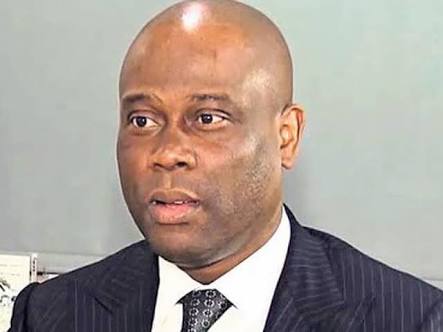
Apparently misconstruing the bank MD/CEO’s core message, the media recently alleged that Access Bank Plc, one of Africa’s largest retail bank by retail customer base was embarking on mass sack of workers and closure of branches. This ‘misinformation’ has been appropriately repudiated. But with traditional business models and banking metrics being upended by the post-Covid-19 global operating environment, only audacious innovators in the sector can remain relevant, writes Sani Ahmed.
In his recent best-selling book, “The Age of Agile”, Steve Denning, former program director of knowledge management at the World Bank, discusses a “Copernican revolution” of management that puts the customer at the center, rather than the firm. It was the Polish astronomer Nicolas Copernicus who independently proposed the theory that the Earth revolved around the Sun, not vice versa, a blasphemous idea in the 16th century.
Clearly, banking remains a relationships business. For ages, banks have tried to leverage that relationship to grow and maximize shareholder return. Because of her emphasis on the long term, Access Bank Group, one of Africa’s largest retail banks by retail customer base with proven risk management and capital management capabilities apparently may make decisions and weigh tradeoffs differently from much of her industry competition. This requires an organisational cultural transformation, as Denning argues, and especially at banks that have long been driven by traditional metrics.
Denning who also authored “The Leader’s Guide To Radical Management,” and was Visiting Fellow at All Souls College, Oxford University, UK certainly has his point, especially as the Covid-19 pandemic massively disrupts conventional business playbooks and upends the global economy.
It is against the background of these existential uncertainties and daunting global economic challenges spawned by the new coronavirus scourge that the media reported alleged plans by Access Bank Plc to sack 75 per cent of its staff and shut down 300 branches. Good a thing, the bank has repudiated the allegations as unfounded.
In a statement signed by Mr. Sunday Ekwochi, its Company Secretary, posted on the Nigerian Stock Exchange (NSE) website, the bank clarified that the closure of a bank branch was an action that required the approval of the Central Bank of Nigeria (CBN).

According to the bank, it has not applied for nor obtained the approval of CBN for the closure of its branches as widely speculated. “The bank has only suspended operations in some branches following the directive by the CBN. At the onset of the COVID-19 pandemic lockdown, we suspended in-branch operations at different locations as directed by the CBN and in line with business continuity plans at vulnerable spots; whilst we continued to provide services through our alternative digital platforms,” it stated.
Further the bank stated that, “In line with the phased re-opening of the economy effective May 4 (last week), following the Presidential directives, we will be resuming in-branch services in some of our affected branches in a programmed manner to ensure the health and safety of our employees and customers.
“This is also necessary to provide relevant contingency should there be any incident arising from the pandemic. We deny in its entirety the baseless and twisted speculation that the bank is sacking 75 per cent of its workforce.”
It noted that based on the impact of the COVID-19 pandemic, not all its branches would be fully open for in-branch services until later in the year. “This has made it impossible for many of our outsourced workers to perform duties as usual. We have commenced engagement with various stakeholders with a view to ensuring that they provide the relevant services and optimum manpower as may be required by the bank on an on-going basis,” it added.
The bank, however, assured its esteemed stakeholders that it would continue to ensure that its actions and decisions are guided by fairness, justice, equity and good conscience.
It must be noted however that the bank like any other company has the right to review its operational cost economic realities, especially in post COVID era that has already begun to redefine how businesses operate or will operate going forward. Since its merger with ailing Diamond Bank, Access has neither laid off workers nor closed branches. There is no doubt the bank must at some point have to cut branch proximity to reduce cost. For instance where Access Bank and defunct Diamond Bank were previously operating in close proximity, sometimes a few yards apart, is it economically wise to still retain the two branches now that the two have become one? Of course not. It only make business sense to consolidate the two branches into one to reduce cost. The bank is first and foremost a business concern that must take decisions based on what it assesses it’s in its best business interest. It is not a charity organization but a commercial enterprise.
It was in bad faith in the extreme for some hideous staff to record the internal strategy deliberation and conversation between the Managing Director and senior staff and deliberately twist it out of context to misinform the public to create a social media storm. To many Mr Wigwe was only showing transparency in his handling of issues the bank is bound to address at some point. Transparency is his second nature a virtue lacking in many people in managerial positions across the country.
Wigwe did the right thing in addressing the issues and being transparent about it. He led by personal example and took a 40 percent pay cut.
Currently, many financial institutions world-wide are reviewing banking models. Indeed, more recently the CEO of U.K lender, Barclays Bank says after COVID-19, banking models have changed forever as people get used to working digitally from home making brick and mortar and big offices models unsustainable going forward. In effect, modern banking, not to talk of post covid-19 banking will de-emphasis physical structures and run more on digital templates, platforms and footprints.
From THISDAY sources, it was this new normal that strategic thinking Access CEO Herbert Wigwe attempted to discuss with his financial institution’s staff when clips of his presentation was altered to portray him as going for mass sack of employees. Noted Amaechi Okobi, Head of the banks Corporate Communications, “the presentation was doctored to give a wrong impression and shared on social media in an attempt to blackmail the bank. We are reviewing all options as we need to support all staff through these challenging times while ensuring efficiency and value in our new normal…We will continue to support all staff and stakeholders.”
Access Bank CEO Herbert Wigwe is not the kind of professional who stays tamely at the receiving end of received policy prescriptions. He covets knowledge-driven innovations, proactive engagement with stake-holders, policy makers, fluid operating environments and sure-footed action. These dimensions are boldly mirrored in his nimble leadership of one of the continent’s banking behemoths.
He believes it was because of a lack of appropriate adaptive response to powerful environmental changes eons ago that doomed the lumbering dinosaurs which then roamed the earth. To Wigwe, the Access Bank under his watch is no dinosaur.
Access Bank Plc. is a leading full-service commercial Bank operating through a network of more than 600 branches and service outlets, spanning three continents, 12 countries and 31 million customers. The Bank employs 28,000 people in its operations in Nigeria and has subsidiaries in Sub-Saharan Africa and the United Kingdom (with a branch in Dubai, UAE) and representative offices in China, Lebanon and India.
Listed on the Nigerian Stock Exchange since 1998, Access Bank is a diversified financial institution which combines a strong retail customer franchise and digital platform with deep corporate banking expertise and proven risk management and capital management capabilities. The Bank serves its various markets through four business segments: Retail, Business, Commercial and Corporate. The Bank has over 900,000 shareholders (including several Nigerian and International Institutional Investors) and has enjoyed what is arguably Africa’s most successful banking growth trajectory in the last twelve years. Following its merger with Diamond Bank in March 2019, Access Bank became one of Africa’s largest retail banks by retail customer base.
As the birth pangs of new global business order, midwifed by the Covid-19 pandemic unfurl, only bold and strategic thinking will define survivors. This is the forte of Herbert Wigwe – as he makes critical decisions and weighs game-changing trade-offs. It’s game on.




celebrity radar - gossips
Adron Homes Celebrates Visionary Chairman, Aare Adetola Emmanuel King, at 51
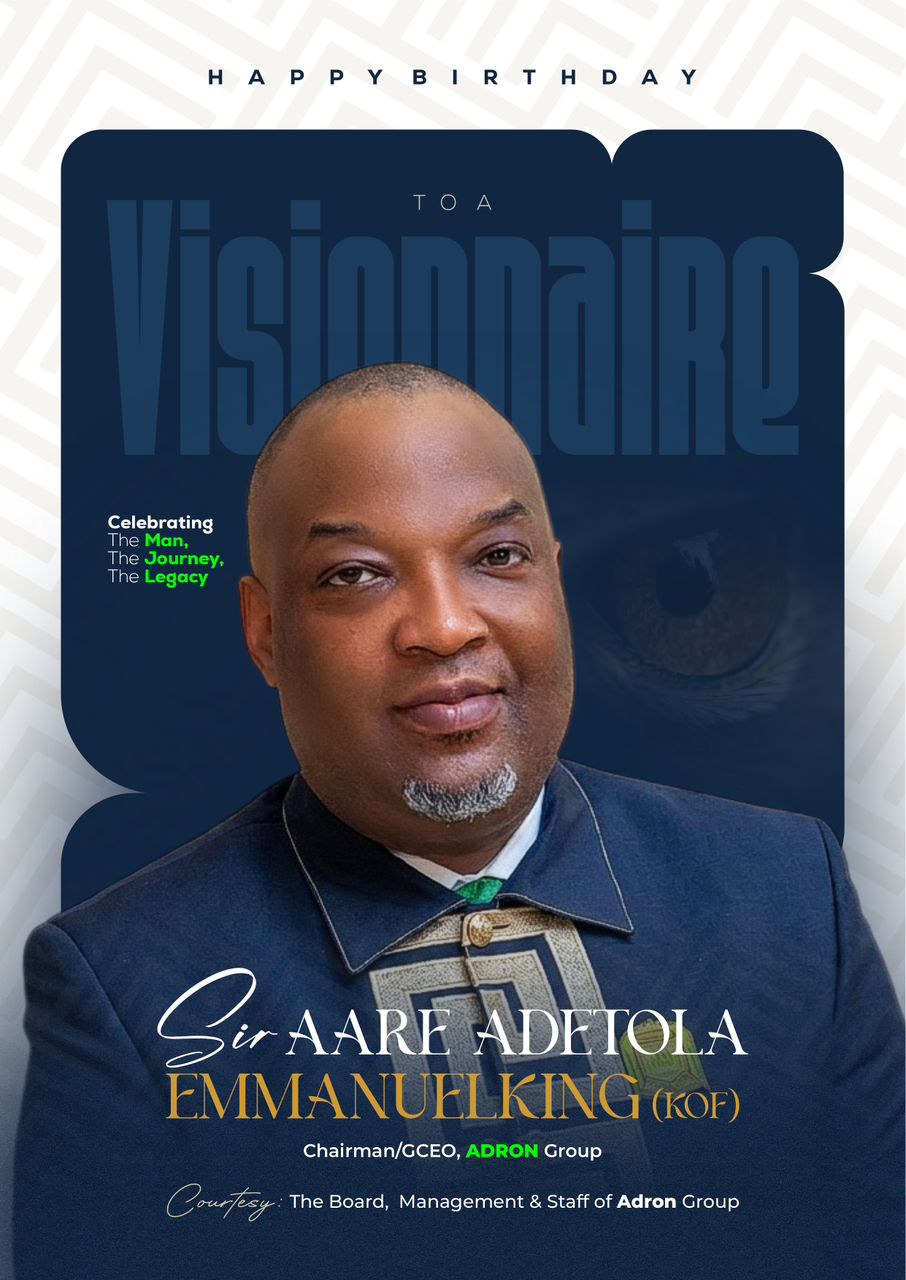
Adron Homes Celebrates Visionary Chairman, Aare Adetola Emmanuel King, at 51
The management and staff of Adron Homes and Properties Limited have joined family, friends, associates, and well-wishers across the globe to celebrate their Chairman and Chief Executive Officer, Aare Adetola EmmanuelKing, as he marks his 51st birthday.

In a statement released by the company, the milestone was described as a celebration of an exceptional leader whose vision, resilience, and entrepreneurial brilliance have not only transformed Adron Homes into a household name in Nigeria’s real estate sector but have also redefined affordable housing across the country.
Under his dynamic leadership, Adron Homes has continued to expand its footprint, delivering value-driven residential solutions while empowering thousands of Nigerians with opportunities for home ownership. His commitment to excellence, innovation, and customer satisfaction has remained the driving force behind the company’s sustained growth and industry leadership.
The statement further highlighted Aare EmmanuelKing’s passion for nation-building and community development, noting his significant contributions to job creation, youth empowerment, and the promotion of socio-economic development through real estate investments.
“As a leader, mentor, and visionary, Aare Adetola EmmanuelKing has consistently inspired a culture of excellence, integrity, and dedication within the organization. His ability to turn bold ideas into reality continues to position Adron Homes as a trailblazer in the industry,” the statement read.
The company expressed profound gratitude for his steadfast leadership and prayed for continued wisdom, strength, and sound health as he embarks on another year of impactful achievements.
As he celebrates his 51st birthday, the entire Adron Homes family proudly honours a man whose legacy continues to shape the future of real estate in Nigeria.
Happy 51st Birthday, Aare Adetola EmmanuelKing!

Oba Ara Releases Emotional Tribute to Late Taiwo Adegbodu
Taofik Afolabi
The gospel music community continues to grieve the painful loss of Taiwo Adegbodu, a beloved figure whose sudden departure left a deep void among fans, colleagues, and loved ones. In response to this loss, renowned gospel minister Rotimi Onimole, popularly known as Oba Ara, has released a moving tribute song that captures both the sorrow of the moment and the enduring legacy of the late singer.
Oba Ara, a proud son of Isale Eko, channels raw emotion throughout the song, using heartfelt lyrics and soul-stirring melodies to reflect on his personal connection with Taiwo Adegbodu. In the tribute, he openly expresses how deeply the news of Adegbodu’s passing shook him, describing it as a painful and unexpected loss that is difficult to come to terms with.
The song goes beyond mourning, it celebrates the life, ministry, and impact of Taiwo Adegbodu. Oba Ara highlights the late artist’s dedication to spreading the gospel through music, his inspiring voice, and the spiritual influence he had on many within and beyond Nigeria. Through powerful verses, he paints a picture of a man who lived for God and touched countless lives through his ministry.
Listeners have described the tribute as both comforting and deeply emotional, as it resonates with the collective grief of the gospel music community. It serves as a reminder that although Taiwo Adegbodu is no longer physically present, his music, message, and legacy will continue to live on.
In honoring his late colleague, Oba Ara not only pays his respects but also offers a source of healing for fans and fellow ministers, using music as a tool to process grief and celebrate a life well lived.
celebrity radar - gossips
Buratai, Fagbemi , Shagaya, Olofa, Others Eulogise Olowu Kuta’s Olori On 60th Birthday, Foundation Launch

Buratai, Fagbemi , Shagaya, Olofa, Others Eulogise Olowu Kuta’s Olori On 60th Birthday, Foundation Launch
Eminent personalities across the Nigeria stormed the TFK Event Centre, Bala Mohammed Way, Guzape, Abuja, to celebrate the 60th birthday of Olowu Kuta’s Olori, Queen Jumai Amoke and her Foundation Launch on Saturday 28, March 2026.

From former Chief of Army Staff, Lt Gen TY Buratai rtd, to the Minister of Justice and Attorney-General of the Federation, Prince Lateef Fagbemi; Olofa of Offa, HRM Oba Mufutau Gbadamosi. Even top businesswoman and socialite, Chief (Mrs) Bola Shagaya, was in attendance.


Other dignitaries were newly promoted Deputy Inspector-General of Police and former AIG Zone 2 , Lagos , Adegoke Fayoade, Major General Abdumalik, Major General Samuel Adebayo rtd (Fmr CDI);
Major General Anthony Omozoje rtd (Fmr Copp);
Alhaji Tajudeen Owoyemi (Asiwaju of Offa and CEO Radisson Hotel Nigeria;
Dr Waheed Olagunju, former managing director of Bank of Industry, Oniba of Iba, Lagos State, HRM Oba Dr Suleiman Raji ;
Justice Falola, Olu of Ile-Ogbo , Oba Adetoyese amongst many traditional rulers and captains of industry too numerous to mention.
Speaking at the occasion, the Chief Host, Olowu of Kuta, HRM Oba Dr Adekunle Oyelude Makama, CON , Tegbosun iii, who is also the husband of the celebrant commended Queen Jumai for ‘ her slender arms full of kindness’ to establish such humanitarian Foundation, ‘Amoke Children and mother in Need Foundation’ at a time Nigerians are going through economic crisis occassioned by the global meltdown.
Olowu also commended her steadfastness and love for the less privileged and downtrodden.
The monarch refrenced the task before his wife’s humanitarian gesture said her best is yet to come.
” Olori Amoke Jumai, I celebrate you. You will celebrate 70, 80, 90 and continue to shine as you continue to put a smile on people’s faces. I love you, “Olowu Kuta added.
To Lt Gen Buratai, a former army chief and former Nigerian Ambassador to Benin Republic, the reward of hard work is more work.
Buratai, who also doubles as Balogun Agba of Owu Kuta, a chieftaincy title reserved for a generalismo congratulated Queen Jumai for attaining the age of 60 in good health.
The retired army General said he’s not surprised by the turn out of eminent personalities across the country to celebrate the Olowu Kuta’s Olori because she merited it through her hospitality to all, adding that Allah the most merciful, most beneficial would accept all her act of ibadah.
The minister of Justice, Prince Fagbemi, was full of praises for Queen Jumai for deeming it fit to have a place in her heart to accommodate the needy and less privileged in ‘our society.’
Prince Fagbemi urged the guests to contribute generously to support the Foundation in order to continue to alleviate poverty and put a smile on the faces of the people.
” I congratulate you on your 60th birthday and Foundation Launch. I wish you many happy returns of the day and many more fruitful services to the country and motherland”, Prince Fagbemi added.
The celebrant, Queen Jumai who was grining from ear to ear thankfully said she was excited by the turn out and the response of the people to her foundation.
Queen Jumai, however, promised to continue to use her resources and donations received for the good of the needy and less privileged in the society.
” I want to appreciate my own Kabiesi Olofa of Offa , for his presence and im I’m using him as a point of contact to all other Kabiesis present here, the minister of justice and Attorney-General, you’re welcome, sir; Mrs Bola Shagaya, I salute your enterprise, Lt Gen Buratai, I’m grateful, sir; DIG Fayoade, Justice Falola and other dignitaries too numerous to mention, I thank you, all. To my darling husband, Kabiesi Olowu , I thank you immensely for your support. And to my family and friends, I thank you , all. E se pupo!”, she said.


-

 society7 months ago
Religion: Africa’s Oldest Weapon of Enslavement and the Forgotten Truth
-

 news4 months ago
WHO REALLY OWNS MONIEPOINT? The $290 Million Deal That Sold Nigeria’s Top Fintech to Foreign Interests
-

 society6 months ago
“You Are Never Without Help” – Pastor Gebhardt Berndt Inspires Hope Through Empower Church (Video)
-

 celebrity radar - gossips2 months ago
Dr. Chris Okafor Returns with Power and Fire of the Spirit -Mounts Grace Nation Altar with Fresh Anointing and Restoration Grace on February 1, 2026