
society
How Primate Ayodele Foretold France Crisis In Newly Launched ‘’Warnings To The Nations’

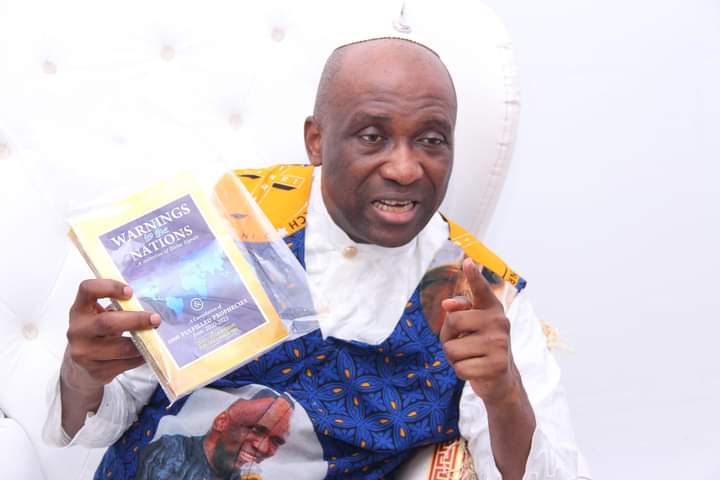
How Primate Ayodele Foretold France Crisis In Newly Launched ‘’Warnings To The Nations’’
Barely two days after the official unveiling of his annual prophecy book ‘Warnings To The Nations’, Primate Ayodele is in the news again for the fulfillment of one of the major prophecies contained in the book.

The prophecy fulfillment is about the current crisis happening in France which has led to serious unrest and protests in the country. France has been rocked by a wave of protests following the death of Nahel, a 17-year-old of Algerian descent who was shot by a police officer in Nanterre earlier in the week and whose funeral took place on Saturday at a mosque in the Paris suburb amid a heavy security presence.
The youth’s death has reignited a debate on policing in France’s marginalized communities and raised questions over whether race was a factor in his death.
While the French government has deployed security forces and riot police across the country, the unrest continued with another night of protests on Saturday.
More than 700 people were detained across France overnight, according to a provisional tally from the Interior Ministry.
The statement added 45 police officers and gendarmes had been injured overnight, while 74 buildings including 26 police and gendarmes stations were damaged and 577 vehicles set on fire.
‘Warnings To The Nations’ which according to Primate Ayodele was compiled In March 2023 accurately foretold the current happening in France on two different pages. On page 301, it was written that the police will shoot a youngster and the action will lead to the breakdown of law and order.
‘’ FRANCE: I foresee there will be police shooting that will kill young stars and this will bring France into crisis. I foresee a total breakdown of laws and order in France.’’
On Page 80 of the book, Primate Ayodele wrote that he foresees protests in France while warning the country to be careful of terrorist attacks and crises in the country. He emphasized that the country will face so many challenges.
‘’ FRANCE: There are going to be a lot of new bills that people will go against. I foresee major protests even as rail workers will embark on strike. The country must be careful of terrorist attacks and attacks on trains. They must rebuke attacks on the president and must be tactical in the next election. I foresee there will be lots of critics that the country will experience. Let us rebuke cases of collapsed buildings. The country will face so many challenges. I foresee women will go to the protest because of so many things. Paris France should pray against unexpected shooting.’’
With the obvious fulfillment of this prophecy, it is pertinent to assert that Primate Ayodele’s ‘Warnings To The Nations’ is indeed not a result of intellectual ability or analyzing skills but the gift of prophecy.
WTN 2023/2024 edition is a 308-page prophecy book that was compiled through the inspiration of the Holy Spirit. As its title implies, it contains prophetic warnings to presidents, governors, prime ministers, monarchs, states, local governments, celebrities, footballers, and several others.





CAC Palace of Light & Salvation Marks 8th Anniversary with Four-Day Spiritual Programme
LAGOS — The Christ Apostolic Church (CAC), Palace of Light & Salvation, Vineyard of Mercy District Coordinating Council (DCC), is set to celebrate its 8th anniversary with a four-day programme of revival, prayer, and thanksgiving.
The anniversary, themed “And It Came to Pass,” is drawn from the biblical text in Habakkuk 2:3, which church leaders describe as a guiding scripture received at the inception of the ministry nearly eight years ago.
Journey of Faith and Growth
According to the leadership, the church’s journey to its eighth year has been marked by challenges and perseverance. They noted that despite periods described as “bumpy and clouded,” the ministry has continued to grow, attributing its progress to divine grace and sustained faith.
Programme Schedule
The anniversary celebration will feature a series of spiritual activities scheduled as follows:
April 8–9: Revival Services (6:00 pm – 8:00 pm)
April 10: Prayer Vigil (11:00 pm)
April 12: Grand Anniversary Thanksgiving Service (10:00 am)
Guest Ministers
The event will host several ministers, including Prophet Timothy Olatunbosun Igbalajobi (Host Minister), Prophet Akinola Fasawe (Guest Minister), and Pastor Gideon Adeyemi Ajayi (Assembly Pastor).
Venue and Invitation
Activities will hold at the church auditorium located at 2, Delana Ojo Street, Silva Estate, by Church Bus Stop, near Chrisland College, Idimu, in Alimosho area of Lagos.
The church has extended an open invitation to members of the public and residents of the Idimu community to participate in the anniversary events.
For enquiries, interested participants can contact the organisers via +234 803 489 2275 or +234 803 833 6935.
Nigerians Are Being Asked to Accept Dysfunction as Normal-Banwo
Lawyer and public affairs commentator, Dr. Ope Banwo, has delivered a scathing assessment of Nigeria’s governance landscape, warning that citizens are gradually being conditioned to accept systemic failures as a normal way of life.
In a strongly worded critique, Banwo painted a picture of a country where basic services remain inconsistent despite years of policy promises and public spending, raising concerns about accountability and leadership priorities.
He pointed to the continued instability in electricity supply, describing it as a long-standing issue that continues to burden households and businesses alike. According to him, the reliance on alternative power sources has become an economic strain that reflects deeper structural inefficiencies.
Banwo also highlighted persistent challenges in the education sector, where disruptions and extended academic timelines have become familiar patterns. He argued that such conditions place young Nigerians at a disadvantage in an increasingly competitive global environment.
On healthcare, he noted that limited public confidence in local systems continues to drive medical travel abroad among those who can afford it, a trend he said raises questions about the effectiveness of domestic investment in the sector.
Beyond service delivery, Banwo expressed concern over what he described as a visible disconnect between public officials and the realities faced by citizens. He referenced widespread perceptions of inequality and questioned whether governance structures are sufficiently aligned with public needs.
“What is worrying is not just the existence of these problems,” he said, “but the growing acceptance of them as inevitable.”
Banwo argued that when dysfunction becomes normalized, the urgency for reform diminishes, allowing systemic issues to persist unchecked.
He called for stronger institutional accountability, emphasizing the need for transparency in public spending and decision-making. While refraining from naming individuals, he stressed that sustainable development requires leadership that is both responsive and responsible
*Primate Ayodele’s Prophecies On Former President’s Death, Deputy Gov, Others Fulfilled
The Leader of INRI Evangelical Spiritual Church, Primate Elijah Ayodele is in the news again for the fulfilment of his prophecies as usual.
As we know, the only time Primate Ayodele gets in the news is when he makes prophecies and when they come to pass. No extra, no unnecessary attention, no lifestyle showcasing, just doing what God has sent him to do.
Just as it had been established earlier, Primate Ayodele has nothing less than 20,000 prophecies that have been fulfilled to his credit and as the day goes by, they continue to increase.
Recent additions to his fulfilled prophecies include:
1 Death of Former Algeria President: Former Algerian President Liamine Zeroual has died at the age of 85, the Algerian presidency said Sunday.
A statement said Zeroual had been battling illness for some time and was receiving treatment at the Mohamed Seghir Nekkache Military Hospital.
He died at the hospital.
Primate Ayodele had in a prophetic session warned nations to be pray against the death of a former president.
2 Resignation of Kano Deputy governor: The Deputy Governor of Kano State, Aminu Gwarzo, has resigned from the position, citing the need to ensure stability in governance and allow the office to function effectively.
In a press statement issued by the Kwankwasiyya Movement on Friday, the decision was described as “difficult” but necessary in the overall interest of the people of Kano State.
“The Deputy Governor of Kano State has tendered his resignation from office… This decision, though difficult, has been taken in the overall interest of the people and the stability of governance in Kano State.”
Primate Ayodele in a prophetic moment had revealed that it is not every deputy governor that will finish their tenure, indicating that some may die or resign. The prophecy was first fulfilled with the deputy governor of Bayelsa state and now Kano, with resignation.
3 Plateau attacks: The Plateau State Government has imposed a 48-hour curfew on Jos North Local Government Area following a deadly attack in the Angwan Rukuba community.
In a statement on Sunday, the state Commissioner for Information and Communication, Joyce Ramnap, said the curfew would take effect from midnight of March 29 to April 1, 2026.
The government said the decision followed a “tragic security incident” in the area, which resulted in loss of lives and left several others injured.
The statement read, “Following the tragic security incident that occurred at Gari Ya Waye community, Angwan Rukuba, today, Sunday, 29th March 2026, resulting in the loss of lives, while several others sustained varying degrees of injuries.
Primate Ayodele had in several prophecies mentioned that Plateau state would be attacked by gunmen. He called on security operatives to watch out and prepare ahead for the attacks.
These were his words:
“Terrorist attacks will be extended to Nasarawa, Gombe, Plateau, Kaduna, Bauchi, Benue, Abuja and Kogi. Let the CDS and COAS brainstorm and strategise, it’s time to eliminate terrorists in the country.
“They are both capable hands, they should not allow these terrorists to destroy their legacies and credibility.
”The ESN is also planning an attack in the South-East, it is a red alert because they want to abort a lot of people including an emir,”
https://tribuneonlineng.com/primate-ayodele-names-states-to-be-attacked-by-terrorists/


-

 society6 months ago
Religion: Africa’s Oldest Weapon of Enslavement and the Forgotten Truth
-

 news4 months ago
WHO REALLY OWNS MONIEPOINT? The $290 Million Deal That Sold Nigeria’s Top Fintech to Foreign Interests
-

 society6 months ago
“You Are Never Without Help” – Pastor Gebhardt Berndt Inspires Hope Through Empower Church (Video)
-

 celebrity radar - gossips2 months ago
Dr. Chris Okafor Returns with Power and Fire of the Spirit -Mounts Grace Nation Altar with Fresh Anointing and Restoration Grace on February 1, 2026