
news
How ‘real estate firm’ duped 4,000 investors in fresh Ponzi scheme using Moniepoint, Others


Six months after the collapse of the N1.3tn CBEX Ponzi scheme that ensnared hundreds of thousands of Nigerians, another wave of desperate investors has fallen victim to a fresh scam masked as a real estate venture, which used fintech accounts. In this special report, IMOLEAYO OYEDEYI uncovers how a shadowy online platform, EMAAR, lured over 4,000 people into yet another digital trap—leaving families across the country counting painful losses and searching for answers
Months after over 600,000 Nigerians invested in the fraudulent Ponzi scheme, Crypto Bridge Exchange aka CBEX, and lost N1.3tn, thousands more have poured money into another digital platform, EMAAR, getting nothing in return.
Many of the victims, scattered across the country, who spoke to Saturday PUNCH, echoed various accounts of pains, sorrow and regrets.
They said unlike CBEX, managers of the fresh Ponzi scheme operated under the pretext of a real estate firm that existed mainly virtually, as there were no physical locations or offices where they could be traced.
According to them, the platform was introduced between July and September 2025 as a trading portal where they could invest certain amounts of money that would supposedly yield returns and interest within 10 days, after which they could make withdrawals.
But the platform crashed on October 27, when many had yet to make any withdrawals from their accounts.
Faceless group, illegal activities
Findings by our correspondent showed that promoters of the scheme operated different Telegram accounts.
While the official group had over 4,000 active investors, who participated in investment discussions and contributed funds, another group sighted by Saturday PUNCH had 1,468 participants.
However, all the Telegram groups have since been locked following the collapse of the platform.
Checks by Saturday PUNCH suggest that the company might have been operating without registration, as its name wasn’t found on the Corporate Affairs Commission database.
Though several companies bearing the name EMAAR appear on the CAC website, none has ‘real estate investments’ indicated in their names.
Further checks on the name the group used for their Moniepoint Bank account, CreditB-24H, showed only a similarly named ‘Credit24h’ online, a Romanian property developer with no confirmed link to the group.
It was also observed that the logo used by the alleged EMAAR Real Estate Investment outfit matches that of EMAAR Properties, a legitimate real estate development company based in India, although there is no evidence of any affiliation between the two.
Victims count losses
A computer engineer based in Ibadan, Oyo State, who asked not to be named due to shame, was among those who invested in the EMAAR Ponzi scheme.
He lost nearly N2m.
A trusted friend introduced him to the platform, claiming it was legitimate and trustworthy.
“I don’t usually get involved in things like that,” he said.
“But my friend told me he had met the company representatives in person and knew their office. He is someone who has always been very loyal to me and whom I trust deeply. That was why I decided to give it a try.”
The company was said to have presented itself as a real estate investment firm.
“They said they had a yearly plan and other options where people could invest for a few months. Later on, they introduced a weekly package. They told us that those who invested for a year could not withdraw shortly after putting in their money, but that once you invested for a month or two, you would be able to cash out quickly,” the engineer explained.
“But I was not able to do that because the very week I planned to withdraw was when they suddenly disappeared,” he lamented.
The man said what pained him most was the abruptness of the collapse.
“There was no sign that they were about to fold up. It happened suddenly, and thousands of people were affected. They created a Telegram platform for us, where we met with them online every day,” he said.
“We were over 4000 in that group apart from the managers. We held nightly meetings on the Telegram platform where they communicated with us and shared tips on the investment and other information. We were always excited during those meetings until everything collapsed.”
He revealed that he lost a total of N1,828,000 to the scheme.
“I first transferred N790,000 to their Kuda Microfinance Bank account and later sent N1,038,000 to their Moniepoint account. I learnt that some people who had prior experience with such schemes quickly cashed out before the crash. I could not because it was my first time,” he said.
The victim said he had been forced to mourn his loss in silence due to the thought of being mocked by his relatives and close allies, whom he had advised against investing in Ponzi schemes.
“It is very painful that someone like me, who always advised people not to invest in such schemes, could end up falling victim to the same thing,” he said with tones of regret.
When asked if the Telegram channel was still active, he said, “Not at all. They are gone. It is just a pity.”
Kaduna family loses N500,000
The family of an artisan in Gidan Waya, a town in Jema’a Local Government Area of Kaduna State, also fell victim to the EMAAR Ponzi scheme.
Mr Dennis Iliya, his wife, Emmanuela, and their relatives reportedly lost about N500,000 to the platform.
Recounting how a neighbour first introduced him to the scheme, Iliya said he was told the platform offered various investment products, each with its maturity period.
“They said the minimum withdrawal after investing was N20,000, and once you accumulated that amount in interest, you could request payment, and the money would be sent to your bank account,” he explained.
However, things quickly went awry.
Just a week after he made his second payment, expecting withdrawals in a few days, “the managers shut down the platform. People began to complain immediately.”
Iliya, who was on the official Telegram group, said the closure sparked outrage among investors.
He noted that instead of reopening the platform, the managers sent messages demanding an additional N10,000 from each member to recover their invested money, saying it was at that point that he realised they had all been defrauded.
“I refused to pay N10,000, but many did. None of them received anything. Two days later, the managers deleted their Telegram accounts. Since then, there has been no way to contact them. That is how it happened. I lost about N230,000 to the scam,” he said.
His wife, Emmanuela, a corps member serving in Kaduna State, also lost money.
Speaking with our correspondent, the ABU Zaria graduate of Guidance and Counselling said a family friend introduced her to the platform.
“Two of my sisters were also affected, aside from my husband. Blessing lost N70,000, while Faith lost N40,000. My mother also lost N35,000,” she said.
She explained that the platform had been presented to them as an investment arrangement, similar to a cash-flow scheme.
“We were instructed to buy shares and allow our funds to appreciate over a set period. We were told we could later withdraw our capital and earnings. In the end, we did not get back our money or the interest. Nothing at all,” the corps member lamented.
Victims across Nigeria
Across different parts of the country, several other Nigerians also poured hundreds of thousands of naira into the Ponzi scheme, only to end up with losses and frustration.
In Jos North, Plateau State, 30-year-old Johnson Jonathan recounted how he lost N212,000.
He said, “I sent the money around October. I made the payment to their Moniepoint account, which is the account they use to receive deposits from people. I heard about the platform through my cousin.”
In Rivers State, Precious Promise shared a similar experience. She said everything happened in October after a friend referred her to the scheme.
“I invested N128,000 but never received anything in return. They presented it to us like a trading system. You put in some money, it yields returns for 10 days and then you withdraw,” she explained.
But according to her, things took a different turn once participants’ payments hit the platform.
She said, “After we all made payments, they started giving excuses and told us to pay another N10,000 in order to access our money. After some people paid the additional amount, all we saw was that they shut down the trading platform and deleted their Telegram accounts. Many people were affected. Some even invested millions.”
In Kaduna, Bernard Sylvester also found himself trapped in the scheme.
He lost about N120,000 after making payments in September.
“Someone in my neighbourhood introduced me to the platform. I was supposed to withdraw after two weeks, which I did, but I reinvested the money to earn more profit,” he narrated.
His hopes were short-lived.
“Shortly after that, everything collapsed around October 27 and we could no longer reach them. When I contacted my referrer, he said he had also been affected. Since then, we have been trying to find ways to trace them, but nothing has worked,” he said.
While several victims confirmed losing amounts ranging from tens of thousands to hundreds of thousands of naira, the overall financial loss still remains unclear as of press time.
EFCC demands petition
However, the Economic and Financial Crimes Commission advised victims of the EMAAR scheme to submit a formal petition to enable the anti-graft agency to open an investigation into the alleged scam.
Speaking with Saturday PUNCH, the EFCC’s Head of Media and Publicity, Dele Oyewale, noted that the agency had earlier this year alerted Nigerians to the illegal activities of about 58 Ponzi scheme operators.
Oyewale expressed disappointment that, despite the warnings, Nigerians still fell into Ponzi traps.
“We are closely monitoring the activities of such companies to protect the financial space of our nation and the investing public, so that opportunistic and predatory operators will not have any hold on our economy.
“But for the particular one you are talking about, let the affected people submit a petition to us, and we will act accordingly,” he said.
The EFCC spokesperson also attributed the persistence of such scams to poor vigilance on the part of investors.
“People are not adhering to our advisories and warnings. And they are also not doing due diligence on these companies before putting their money in. Many people are drawn into such schemes because of greed,” he added.
Moniepoint advises victims, Kuda cites privacy
When contacted, the Moniepoint Microfinance Bank explained formal steps victims of fraudulent transactions should take when defrauded.
The bank’s Public and Media Relations Manager, Bemigho Awala, said victims were required to notify their banks and the police.
According to him, once a formal letter to the bank is filed, the complaint triggers an internal investigation between the originating bank and the receiving bank.
This process, he said, might lead to an embargo on the fraudulent account after a court order has been obtained.
•A money changer counts Nigerian currency notes for a customer in Lagos Photo: Al-Jazeera
“Based on the order of the court, the bank will then carry out an in-depth investigation of the transaction inflow into the account and if the allegations are found proven, both banks will then agree on the appropriate remedial actions,” he said.
Awala stressed that every bank, including Moniepoint, maintains online reporting platforms that victims can use to lodge complaints.
“But if the victims haven’t done this, there is no way we can know,” he noted.
He assured that he would review the receipt screenshots sent by Saturday PUNCH, identify the fraudulent account and escalate the matter to the customer service and fraud desks for further action.
However, a bank official confided in our correspondent that the Moniepoint account used by the fraudsters had been deactivated.
“The merchant, CreditB, has been deactivated after being caught for Ponzi facilitation,” the official said.
“Most of the reported cases are being refunded, provided the complaints are backed by a court order.” he added.
The official declined further comment when asked the total sum paid into the account.
When Saturday PUNCH reached out to Kuda Microfinance Bank for clarity on whether it had received complaints linked to the controversial EMAAR investment platform, the bank declined to divulge any customer-specific details, citing regulatory and privacy constraints.
In a formal statement sent to our correspondent, the Head of Fraud at Kuda, Farouk Junaid, explained that the bank was legally prohibited from sharing information about individual accounts or complaints unless compelled by law or expressly authorised by the affected customers.
According to him, the confidentiality rights granted to customers under Nigeria’s banking and data-protection framework prevent them from releasing any such details to the public or the media.
“Under banking and data privacy regulations and the confidentiality rights afforded to our customers, we can’t share any information regarding individual complaints relating to EMAAR or similar platforms, except where we are legally compelled to do so or with our customers’ express consent,” Junaid said.
He noted that the constraint made it impossible for the bank to respond to Saturday PUNCH’s specific request.
He, however, stressed that the bank’s commitment to combating fraud remains unwavering.
Junaid noted that the bank treats all allegations of fraud with “utmost seriousness,” explaining that reports of suspicious or illicit activity trigger thorough internal investigations.
‘CBN must turn heat on fintechs’
Reacting to the matter, a financial analyst, Prof. Sheriffdeen Tella, said it was high time the Central Bank of Nigeria increased vigilance on the operations of fintechs.
Speaking to Saturday PUNCH, Tella said the recurring wave of fraudulent investment platforms was also fuelled by desperation and poor financial discernment among citizens.
He said, “The CBN seems to be trying in its efforts. It’s just that Nigerians are also gullible. Everyone wants to make money without much effort. That could be the reason behind the recurrence of Ponzi scam.”
He recalled that the apex bank had previously listed financial institutions under its approval and flagged those operating illegally, but insisted that these measures, though helpful, were not enough.
For him, there must be much more vigilance and surveillance from the apex bank in order to sanitise the system.
Tella urged the CBN to probe microfinance banks indicted in such incidents.
He added that the CBN often reported erring institutions to the EFCC, but emphasised that beyond regulatory action, “there is a need for continuous vigilance and Nigerians also must be cautious of where they put their money.”
The Centre for Anti-Corruption and Open Leadership said the fresh Ponzi scandal exposes deep cracks in the country’s financial ecosystem, highlighting the urgent need for stronger consumer protection mechanisms.
The CACOL Director, Debo Adeniran, noted that every major scam further erodes public confidence in online investment platforms, creating an atmosphere of fear.
Adeniran said while regulators continue to issue warnings, the absence of swift enforcement allows fraudulent operators to flourish and exploit vulnerable citizens.
He added that repeated Ponzi collapses signal a growing sophistication among fraud syndicates, who now leverage digital channels to mask their identities and move funds quickly.
“If unchecked, these schemes could cripple trust in legitimate fintech in
novations and distort economic participation, especially among young and low-income Nigerians,” he warned.


news
“You Only Exposed Yourself” – Nigerians Blast Bayo Adelabu Over Petition Against Primate Ayodele
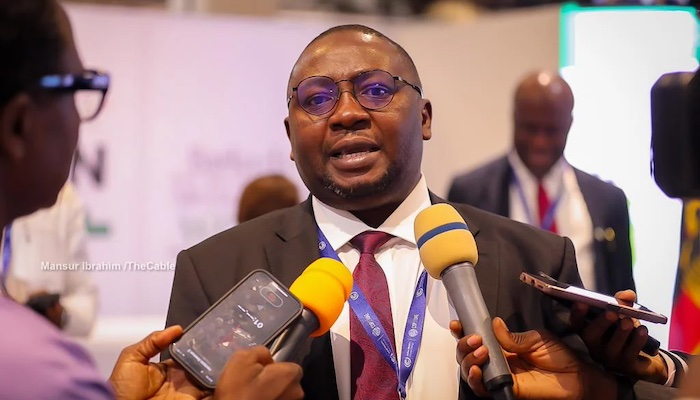
Several Nigerians have taken to the internet and other platforms to blast Nigeria’s Minister of Power, Bayo Adelabu, over his recent petition to the DSS against Primate Elijah Ayodele, whom he accused of trying to extort him of N150 million.
In his petition, which was published on a few news platforms yesterday, Adelabu stated that Primate Ayodele asked him to purchase 1,000 trumpets for prayers after he sought his help for his governorship ambition in Oyo State.
In his reaction, signed by his media aide, Osho Oluwatosin, Primate Ayodele clarified that he never asked the minister to bring money, neither did he say the trumpets would be for his own use, but that it was purely a spiritual direction which required him to purchase the materials himself.
The prophet denied requesting money from the minister, and this was also confirmed in the text messages exchanged between the prophet and the minister. He categorically told Adelabu to buy the items himself, but the minister, in turn, asked the prophet to help him find out the price, which was what brought about the N150 million saga, which the prophet didn’t even ask him to bring to him.
Nigerians reacting to this case have blasted the Minister of Power for showing desperation in becoming the next governor of Oyo State after failing several times because, obviously, the people don’t want him to rule them.
One of the reactions, made by Folashade Adetola, described the minister as a busybody who has abandoned his duty as a minister to fight unnecessary battles that may eventually consume him.
“I think Bayo Adelabu has so much time on his hands despite the epileptic nature of our power supply. He is clearly a busybody who has abandoned his primary duty to involve himself in battles that won’t lead him anywhere other than destruction. He is just too desperate.”
Another person, Johnson Akinawo, commended the prophet for not allowing it to get to a stage where the minister sent money to him, while describing the minister as someone who cannot be trusted with power or anything.
“Adelabu doesn’t know that what he has done simply exposed him even more than Primate Ayodele. He has exposed himself as someone who cannot be trusted with anything, and definitely not power. Thank God he didn’t send money to the prophet, and the prophet didn’t also ask him to send money. I wonder what people like this are doing in power.”
Likewise, Afolabi Nureni described the situation as Adelabu setting himself up and exposing his secret dealings to Nigerians, party leaders, Muslim clerics, and President Tinubu.
“Adelabu was advised wrongly with this thing he did. It will lead him nowhere, and I see this as self-sabotage. It’s a big setup for him if he doesn’t know yet, and he has exposed himself to everyone. They now know the kind of person he is. As a Muslim, you are exposing your dealings with Christian clerics. It simply shows your desperation for power.”
A political analyst, Kareem Ajani, explained that Adelabu is digging his political grave with the petition to the DSS and his further actions exposing the exchange of messages between him and the prophet. He stated that the prophet asking him to get musical instruments is obviously not for his church alone, but instead of quietly ignoring the request if he couldn’t fulfil it, he went through a very bad route.
“I think this is why Adelabu will always lose elections. He isn’t a politician; he is just lucky to be where he is because of Tinubu’s magnanimity. He hasn’t started his career as a politician at all, and what he has done proves to everyone that he may never be a good politician. He has dug his political grave, and everyone will start running from him. The man didn’t even force you; it was a transaction that didn’t go successfully. He should have just moved on, but let’s see where this leads him.”
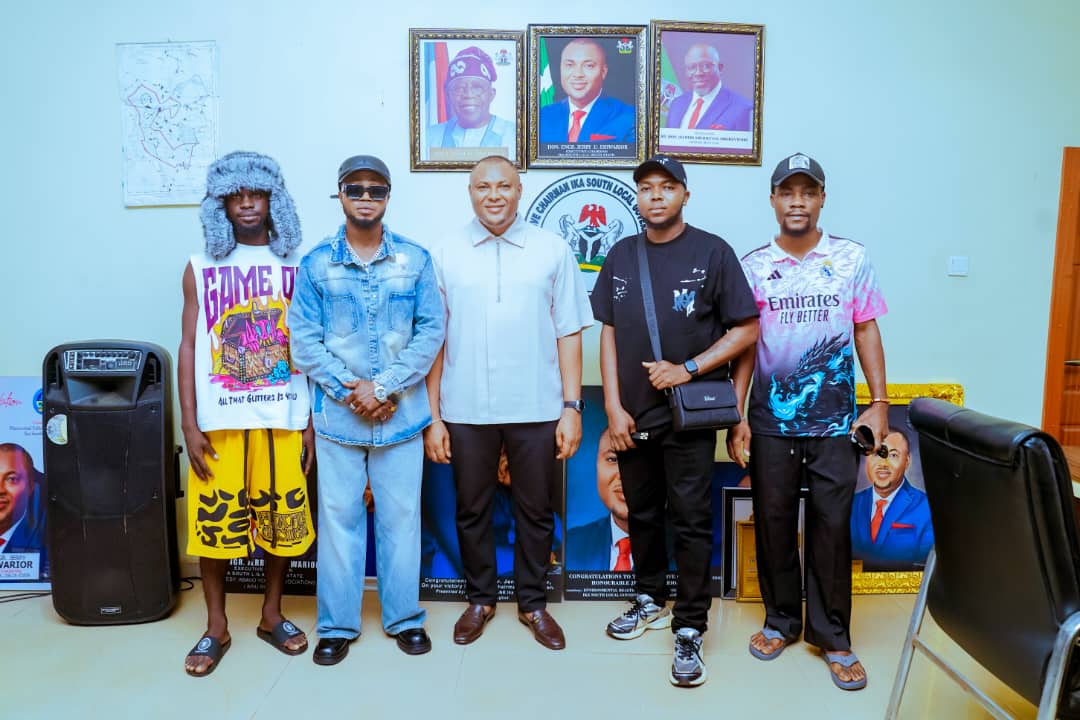
In a major show of support for homegrown talent, the Chairman of Ika South Local Government Area of Delta State, Engr. Jerry Ehiwarior, has officially endorsed Oso Richie’s newest single titled “Kiss.”
The endorsement comes on the heels of a similar public commendation by renowned Nigerian music star, Mr P of Psquare, a move that has further amplified the artist’s fast-rising profile in the entertainment industry.
The backing from Mr P—one of Africa’s celebrated music icons—sparked widespread excitement among fans, music lovers, and online communities, placing Oso Richie firmly in the spotlight. Building on this momentum, Engr. Ehiwarior expressed his admiration for Oso Richie’s creativity and musical growth, describing the rising singer as a promising talent whose consistency is gradually earning him national attention.
According to the Chairman, supporting young creatives in Ika South remains a priority for his administration, as such encouragement not only boosts individual careers but also promotes the cultural and artistic identity of the local government area. He emphasised that Oso Richie’s commitment to his craft reflects the potential embedded in many youths across the region.
Oso Richie’s forthcoming single, “Kiss,” has already generated significant anticipation across social media platforms, with fans eagerly awaiting its official release. Industry watchers believe that the dual endorsements—from both a top-tier Nigerian musician and a prominent political leader—will further elevate the artist’s career trajectory.
As the buzz continues to grow, many within the entertainment community view these endorsements as a strong indication of Oso Richie’s expanding influence and the increasing recognition of emerging talents from Delta State.
By Sammy Godson
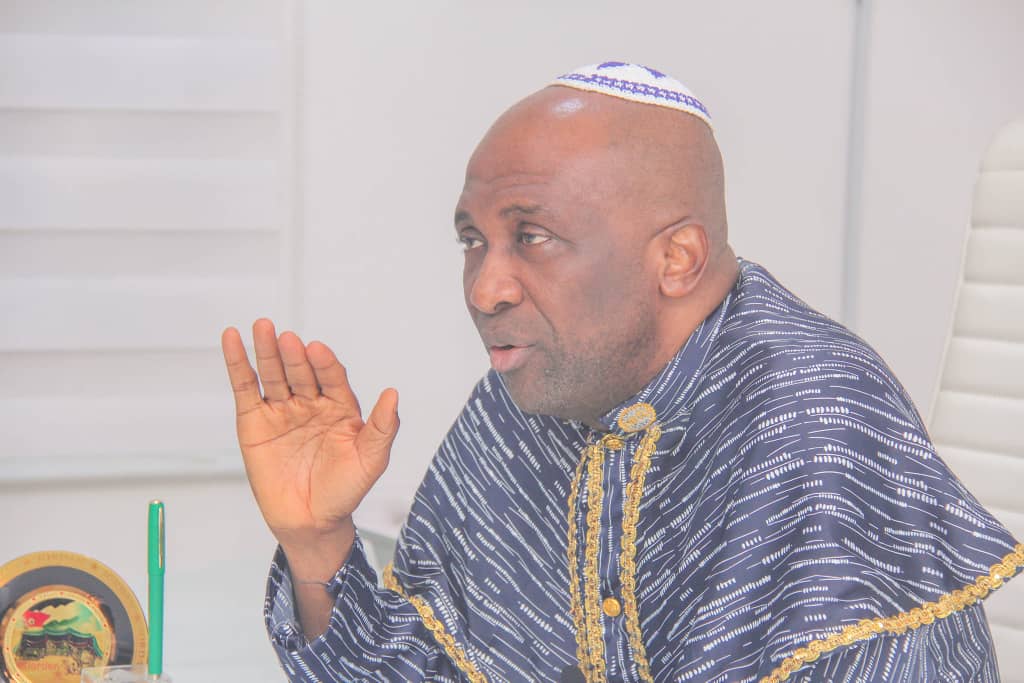
Seeing the title General attached to Elijah Ayodele may surprise many because everyone knows he is not a member of the army, nor has he ever been publicly addressed as such. But permit me to re-christen him, because at this point, his revelations on security matters go far beyond what an army general’s intelligence can cover.
General Elijah Ayodele is a prophet and the leader of the INRI Evangelical Spiritual Church in Lagos, yet one wonders how he has accurately foretold coup-related events across Africa—events that have been happening exactly as he mentioned.
There is a huge difference between vaguely predicting that coups will occur in a continent and specifically naming the exact countries where they will take place—and seeing them happen precisely that way. Even the world’s most powerful army general cannot achieve such accuracy, no matter the intelligence available. It is absolutely impossible.
An army general is limited to the affairs of his own country. A Nigerian general cannot know of a coup being planned in Benin Republic, and vice versa. Yet General Elijah Ayodele will sit in Lagos and speak of dangerous events such as military coups in distant countries, and they happen exactly as though he wrote the script.
This simply shows that General Elijah Ayodele is firmly connected to the throne of heaven, from where all things are revealed. As the Bible says, God does nothing without revealing it to His prophets. His prophets are His generals, and in Nigeria, we can boldly say that General Elijah Ayodele is not just a member of God’s troops but a commander—no one else comes close.
Starting with the latest coup attempt in Africa, which occurred in Benin Republic: on Sunday morning, a group of soldiers seized the national television station to announce that they had taken over the country and removed President Talon from power. They declared the suspension of all political activities and the constitution. It was a tense situation before the soldiers were repelled, resulting in the ultimate failure of the coup.
This did not happen without General Elijah Ayodele mentioning it days earlier. He had spoken about it at least three times, with the last warning given on Friday—just two days before the incident. He said some countries would experience revolutions through coups or elections, and Benin Republic was among them. He warned these nations to prepare, and within two days, it happened.
His exact words were:
“The following nations will face revolution in the coming year, either by coup or any other way. There will be disorderliness in the following countries: Cameroon, Chad, Niger, Mali, Tanzania, Benin Republic, Ethiopia, South Sudan, and Uganda. Let them prepare for the challenges ahead.”
Recently, a coup also occurred in Guinea-Bissau after the presidential election. The army announced that they had taken over the country, suspended all electoral activities, and removed the president from power.
This, too, did not occur without General Elijah Ayodele’s warning earlier in November. He called on the president to be careful during the election and not tamper with the process, warning that a coup could occur if he attempted it. In videos and news publications, he advised the president to step down if he lost, so as not to be removed unconstitutionally.
He said:
“In Guinea-Bissau, there is going to be an election, but if there is a coalition and the president tries to rig the election, the country will turn to fire. There will be anarchy, and the impossible coup can be possible. To the president: if you lose this election, just leave. Don’t force yourself because you will fail.”
Additionally, during a live service on November 11, General Ayodele said that Guinea-Bissau would experience military action. He specifically warned that the president would lose relevance and would need to take urgent steps to stabilize the country.
His words were:
“Guinea-Bissau: The country isn’t yet settled; there is still a crisis. They will be fighting seriously. The president will not be reckoned with, and the military will carry out another action. The president must be ready to do anything to stabilize the country because I see a crisis in Guinea.”
Let us also not forget the reported attempt to unseat President Bola Ahmed Tinubu months ago, which allegedly led to the removal of some service chiefs. Weeks before the incident, General Ayodele specifically mentioned that soldiers were angry with the president and that powerful Nigerians were planning to use the military against him.
He warned:
“There will be an attempt to unseat Tinubu unconstitutionally; the NSA, DSS, and Chief of Army Staff must be careful. There are gangs planning between November and January to unseat him.”
“Even the Navy and Air Force will be part of it, including the Nigerian Army. President Tinubu must be ready for anything and fortify himself. He needs to change his security strategy because these personalities will be unbelievable names.”
In July 2025, he had also said that Tinubu must strengthen his security system because he foresaw an attempt to carry out a coup against his government.
“I see an attempt to take power from him (Tinubu) in an unconstitutional manner. God warns him to take his personal safety seriously. What I saw was coup-like, with tension everywhere.”
Going back further, in 2019—before the 2020 coup in Mali—General Ayodele warned in his prophecy for 2020 (released in December 2019) that there would be a gang-up against the president. Just months into the new year, it came to pass.
He had said:
“There will be a gang-up against the Malian president. The country should pray against protests and disorderliness.”
In Gabon, before Ali Bongo was ousted, General Ayodele stood in his church on October 7, 2022, during a live service and advised Bongo to resign because the military would remove him. This was long before the election that ultimately ended in a coup.
He told Bongo:
“Gabonese president, your time is up. I am seeing a crisis, if not a coup d’état. Because of your health, why not resign? Why do you want to die on this seat? I am telling you what the Lord has said. Your staying on the throne is killing you. You are incapacitated, but no one is telling you the truth. I am advising you to humble yourself, resign, and hand over to someone who can do better so you won’t cause a crisis in your country.”
Other coups—including those in Niger and Burkina Faso—were also foretold by General Ayodele. Even though some governments did nothing until events swept them away, one thing is certain: none of them can ever say the prophet did not warn them.
However, for the sake of the good citizens of the nations concerned, I would like to ask the General:
Where is the next coup taking place?
Thank you.


-
 Politics6 months ago
Nigeria Is Not His Estate: Wike’s 2,000‑Hectare Scandal Must Shake Us Awake
-

 society6 months ago
JUSTICE DENIED: HOW JESAM MICHAEL’S KINDNESS WAS TURNED AGAINST HIM
-
 celebrity radar - gossips4 months ago
Why Babangida’s Hilltop Home Became Nigeria’s Political “Mecca”
-

 society7 months ago
NAFDAC ALLEGED EXTORTION OF ₦3.5 BILLION FROM ONISHA TRADERS — IGBOS HEROES FOUNDATION REACTS By Joseph Monday