
society
Inside Story of How Widow Lured Lagos Businessman Circulating Ex-Lovers Nude Into Police Net

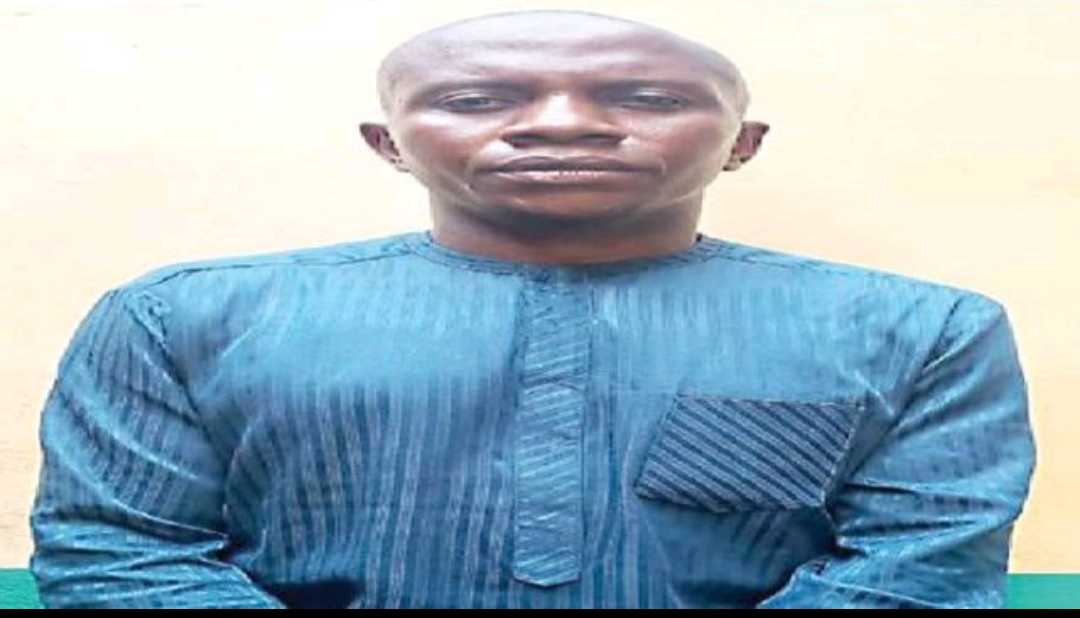
Inside Story of How Widow Lured Lagos Businessman Circulating Ex-Lovers Nude Into Police Net
The controversial Lagos Businessman Circulating his Ex-Lovers nudes on social media has been arrested. Known as Kennedy, he was arrested on Friday in the Oshodi area of the state after one of his victims, Kester, agreed to meet him under the pretext of resolving their disagreement.
Amara Kennedy, a 44-year-old businessman, has been arrested by the Lagos State Police Command for circulating n*de photos of his former lovers.

Kennedy was arrested on Friday in the Oshodi area of the state after one of his victims, Kester, agreed to meet him under the pretext of resolving their disagreement.
The PUNCH correspondent had reported in a special feature on Sunday that two women, Kester and Temi, met Kennedy separately on different WhatsApp and Facebook chat groups for singles.
Kester, who lost her husband about eight years ago in a car crash, said the banker turned businessman, after chatting her up, started showering her with monetary gifts.
However, after a disagreement, he sent her over 50 of her n*de photos which he secretly took after their lovemaking in a hotel.
She said the Umunze, Anambra State indigene, demanded N100,000 from her as a condition to delete the photos.
The mother of two noted that after she sent the money and asked if the photos had been deleted, he demanded an additional N40,000 to delete them permanently, which she sent to him.
Despite the payments, the suspect went ahead to circulate the photos on Facebook.
Kester said she attempted suicide twice but failed, as some of those who saw the images started questioning her.
The second victim, Temi, said the suspect usually had marathon s&x with her in hotels while under the influence of drugs, and afterwards gave her N1,000 as transport fares.
She noted that after she discovered that he was not serious about the relationship and was merely using her, she stopped talking to him.
However, Kennedy sent her several of her n*de photos and demanded all the money he had spent on her in the relationship.
She said she borrowed N15,000, which she sent to him.
However, after she appealed to his sister on Facebook for help to talk to him, he started circulating the n*de photos.
Temi said the businessman regularly called her to demand money.
After the report was published, the suspect on Monday threatened to continue to damage the reputation of the women for “spoiling my image.”
He then started sending the n*de photos to their Facebook friends, family members, co-workers and church members.
Kennedy also sent the n*de photos to Kester’s in-laws, vowing that “by the time I am done, suicide will be her only option.”
After a series of reports on his continued criminal act, the suspect on Thursday accused this reporter of being “a tribal bigot and an idiot”.
He poured expletives on the journalist, querying why he was “bent on destroying” him.
That night, Kester informed The PUNCH reporter of a plan to lure Kennedy out of his hiding, saying she had agreed to resolve issues with him.
The peace meeting was mediated by a rights activist, Arike Adelodun.
On Friday morning, the day of the meeting, Adelodun called this reporter on the phone to say the suspect decried PUNCH’s continuous reports on the matter.
She said he wanted an assurance that the report would stop, as part of the conditions for the meeting, where he would delete all the n*des.
“I will call you back shortly and ask if you’re the one from PUNCH who has been writing the story. I will ask you to stop writing for the sake of Kester’s mental health. I will be very aggressive. Try to explain why you’re doing it, but I will shut you up. Just play along. He (Kennedy) will be added to the conference call. The purpose is for him to show up at the meeting,” she added.
After she called back, The PUNCH reporter agreed to stop reporting on the matter pending when he would get feedback from the women “by the end of today
The PUNCH correspondent was told that Kennedy did not send the meeting location until around 7am on Friday; he fixed the meeting for 9am at an eatery at Oshodi.
Around 12 noon, the suspect was arrested.
Kester, who spoke to Saturday PUNCH on the phone, said she felt like “someone who just won a visa to Canada.”
“I feel excited; this has traumatised me so much. My daughters will see the mummy they have always known,” she added with a laugh.
Recalling the arrest, she said, “My friend who mediated created a group for me and Kennedy. We had a video call yesterday (Thursday) where he said he still had the (n*de) pictures on his phones. He said we should meet somewhere so I could use my own hands to delete them. I agreed. We asked him to choose the location and time.
“However, when he saw your publication that day, he said I should reach an agreement with you to stop reporting. That was when you agreed to stop after everything had been settled.
He gave us the location and address. The police had, however, got there even before we arrived. They were hanging around. They took my pictures and we sent his pictures to them. Kennedy came to the bus stop to pick me and my friend. A policeman was already in the eatery. As we were about to enter the eatery, the police arrested him.
“He then started begging the police officer to shoot him and let him die. The man refused. I then told him that the death he wished me, he would beg for it and would not see it.”
She said she was looking forward to the arraignment of the suspect.
The founder of a rights group, Black Diamonds Support Foundation, Defunke Adewunmi, commended the state Commissioner of Police, Idowu Owohunwa, and the gender unit for providing support for the success of the sting operation.

“While I was talking to the victim and her friend whom we used to bait him, I was also speaking to the commander of the CP’s surveillance team. The suspect changed the venue three times before the surveillance team caught him.
I am glad for the arrest. I hope the victims can eventually get closure and justice would be served as quickly as possible,” she added.
Adewunmi’s organisation provided support for the women while the suspect circulated their n*des.
She had said nine widows and three single mothers claimed the suspect blackmailed them.
Reacting to the arrest, the second victim, Temi, said, “I can say this is the happiest day of my life. I’ll finally have peace of mind. I just feel like going out for fresh air and to enjoy myself. I feel really relieved.
“For over a year now, he has been a threat to my life. Every day, once I see his message, my heart starts pounding. These past few days when he saw that the matter was in the media, he started tormenting me again for having the courage to speak.
“He had told us that nobody can catch him. We have been to different places for help. It’s either they are demanding money from us or giving excuses as if it’s not possible. This guy told us he had an anti-tracker on his phone, and truthfully, they had been tracking him for a long time. But he kept escaping. I believe with his arrest, more women will come out.
She said the suspect’s action had damaged her business.
“I do online business and two of my customers no longer talk to me. I am in a Facebook group where single mothers get help. But he sent the n*des to one of the people there and they said if the group admin sees the n*de, I would be removed,” she added.
The Lagos State Police Public Relations Officer, Benjamin Hundeyin, confirmed the development after tweeting the suspect’s photo.
He noted that investigation was ongoing into the matter.





US-Based Society Lady, Fehintola-Brat Extends Eid-El-Kabir Greetings To Muslims
United States based fahionista of class, Chief (Mrs) Ayoola Fehintola-Brat has extended a warm greetings to Muslim faithful all over the world on the occasion of the 2026 Eid-El-Kabir celebration.
Fehintola-Brat who is the Balogun Egbe Obaneye Obinrin Akile Ijebu, and the Yeye Asofin of Idenaland in her message to Journalists urged Muslim to continually uphold the enduring values of sacrifice, obedience, faith, and compassion, which are central to the significance of Eid-El-Kabir festival.
A quiet philantropist whose humanitarian services has won her several laurels urged Muslims to use the spiritual occasion to pray for the peace co-existence of Nigerians regardless of religious, social and political leanings stressing that the oneness of the country should not be underplay.
In a related development, she expressed her felicitations to all sons and daughters of Ijebuland on the forthcoming Ojude Oba 2026 celebration, tasking age-groups otherwise known as Regbregbe to be more proactive in giving back to their immediate communities.
According to her, the beauty of the age-groups in Ijebuland is the need to contribute immensely to the development of the land in no small means. “This we will continue to achieve with God on our side”, she concluded.
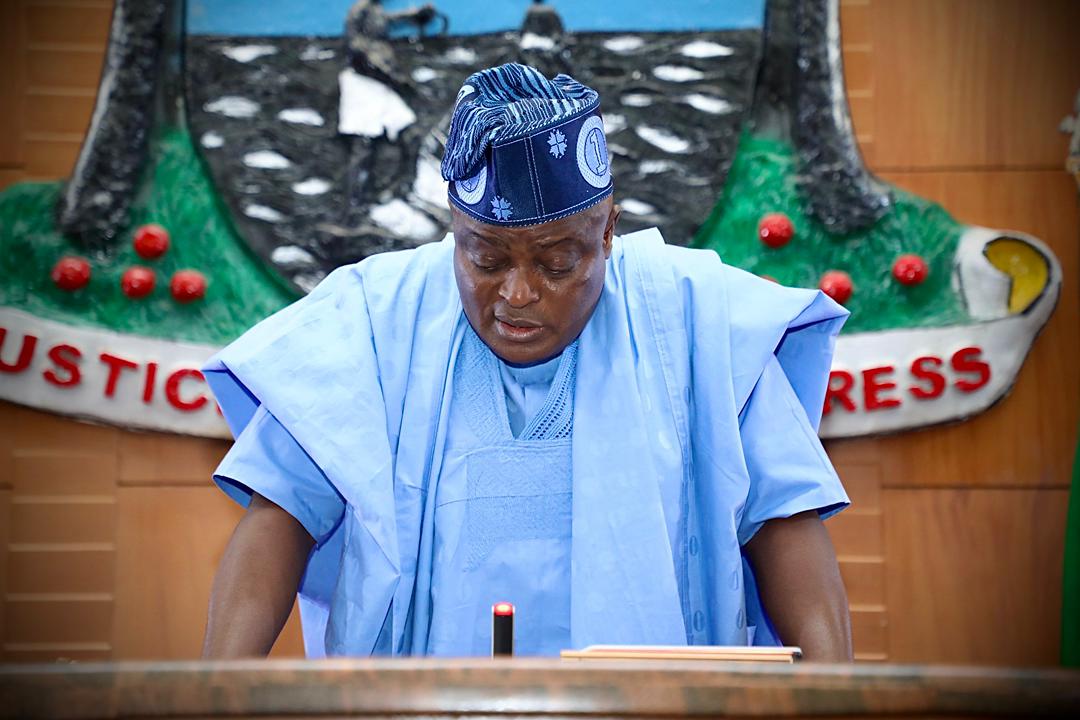
Sallah: Obasa Felicitates Muslim Ummah, Commends Nigerians for APC Primaries Turnout
The Speaker of the Lagos State House of Assembly, Rt. Hon. Mudashiru Obasa has extended warm felicitations to Muslims in Lagos State and across Nigeria on the occasion of Eid al-Adha.
In a statement released by his Chief Press Secretary, Mr. Dave Agboola, Obasa described the festival as a season of sacrifice, reflection, and gratitude, urging the faithful to continue to uphold the values of peace, unity, and love that strengthen the nation.
He noted that the celebration of Eid al-Adha is not only a spiritual milestone but also a reminder of the importance of togetherness and collective responsibility in building a stronger society.
He, likewise, emphasized that the festival provides an opportunity for Nigerians to renew their commitment to national progress and to support leadership that prioritizes development and prosperity.
Obasa, however, commended Nigerians, particularly members of the All Progressives Congress (APC), for their massive turnout during the recently concluded party primaries. He described the participation as a clear demonstration of the people’s confidence in the government of President Bola Ahmed Tinubu and their belief in the administration’s vision for a greater Nigeria.
“The APC primaries have shown the resilience of our democracy and the confidence Nigerians have in the leadership of President Bola Ahmed Tinubu and the Renewed Hope Agenda. This is a strong message that our people are ready to continue supporting policies that will drive growth and prosperity,” Obasa stated.
The Speaker further encouraged Muslims to celebrate responsibly, stressing that the joy of Eid should be accompanied by prayers for the continued peace and progress of Lagos State and Nigeria.
“As you celebrate with family and loved ones, may this season bring joy, peace, and prosperity to your homes. Let us remain united in our resolve to build a stronger nation,” he added.
On behalf of the Lagos State House of Assembly, Obasa wished all Muslims a happy and fulfilling Eid al-Adha celebration.

ABEOKUTA FILM FESTIVAL AT ILEYA
Kayshow Multimedia a filmmaking and Media organization this year 2026 holds its annual Abeokuta film festival at the Ake Palace in Abeokuta.
Alake of Egba land, Ọba Michael Adedotun Arẹmu Gbadebo has graciously endorsed the Free Training of Egba Youths on Film and Arts and the Entertainment of the the People with a FREE FILM SHOW at the AKE PAVILION. as part of the ABEOKUTA FILM FESTIVAL 2.0.
The Convener of the Film Festival Honorable Kehinde Soaga says this year’s event promises to be more exciting as distinguished personalities are sure to attend.
This includes the honorable Minister for Art Culture and Creative Economy in Nigeria, Barr. Hannatu Musa Musawa, Ààrẹ Lai Labode, Sen. Ibikunle Amosun and other special guests.
The event will feature Film, Cultural Dance Cultural foods and Award Ceremony.
The general public is hereby invited to the Free film show at the Abeokuta film festival at the Alake Palace Pavilion on Thursday 28th of May 2026 by 4:00 p.m.
Only well dressed is the Entry. The Abeokuta Film Festival is an annual event taking place in the capital city of Ogun State state.


- Demand for civic space holds strong across Africa as supply of freedoms wanes May 27, 2026
- Zarein Energy Joins African Energy Week (AEW) 2026 as Gold Sponsor Amid Nigeria Gas Hub Expansion May 27, 2026
- Qrent says delaying Information Technology (IT) refresh cycles may be increasing operational risk for businesses in Africa May 27, 2026
- Dentons’ Iyunola Adekanye Appointed to African Mining Week (AMW) Advisory Board May 27, 2026
- United Nations (UN) Women Liberia and Partners Convene for Spotlight Initiative 2.0 Women’s Economic Empowerment Inception Meeting May 27, 2026
- African Mining Week (AMW) to Host Central Bank Governors Roundtable as Monetary Authorities Deepen Role in Mining Sector Growth May 27, 2026
- Eritrea: Diaspora Nationals Celebrate Independence Day Anniversary May 27, 2026
- Africa Unveils Landmark Humanitarian Coordination Platform to Strengthen aligned Response to Humanitarian Crises May 27, 2026
- Seychelles: President Herminie Engages with Police and Fire Services on Praslin May 27, 2026
- Issue 3 of Mining Review Africa now available for free download May 27, 2026
- Demand for civic space holds strong across Africa as supply of freedoms wanes May 27, 2026
- Zarein Energy Joins African Energy Week (AEW) 2026 as Gold Sponsor Amid Nigeria Gas Hub Expansion May 27, 2026
- Qrent says delaying Information Technology (IT) refresh cycles may be increasing operational risk for businesses in Africa May 27, 2026
- Dentons’ Iyunola Adekanye Appointed to African Mining Week (AMW) Advisory Board May 27, 2026
- United Nations (UN) Women Liberia and Partners Convene for Spotlight Initiative 2.0 Women’s Economic Empowerment Inception Meeting May 27, 2026
- African Mining Week (AMW) to Host Central Bank Governors Roundtable as Monetary Authorities Deepen Role in Mining Sector Growth May 27, 2026
- Eritrea: Diaspora Nationals Celebrate Independence Day Anniversary May 27, 2026
-

 news5 months ago
WHO REALLY OWNS MONIEPOINT? The $290 Million Deal That Sold Nigeria’s Top Fintech to Foreign Interests
-

 society3 weeks ago
SOCIAL MEDIA IS NOT A BATTLEFIELD COMMAND – WHY THE NIGERIAN ARMY’S ACTION AGAINST JUSTICE CRACK IS A NATIONAL SECURITY IMPERATIVE
-

 celebrity radar - gossips4 months ago
Dr. Chris Okafor Returns with Power and Fire of the Spirit -Mounts Grace Nation Altar with Fresh Anointing and Restoration Grace on February 1, 2026
-

 celebrity radar - gossips6 months ago
Prophet Kingsley Aitafo Releases 2026 Prophecy: ‘Nigeria Will Rise, but the World Must Prepare for Turbulence’