
society
Loan controversy: Onasanya’s lawyer condemns media trial, demands summons in court as Judge adjourns case to February 13

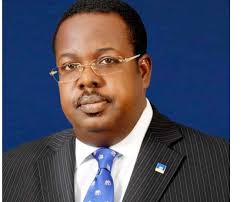
Loan controversy: Onasanya’s lawyer condemns media trial, demands summons in court as Judge adjourns case to February 13
In line with his resolve to defend himself and clear his name, Dr. Bisi Onasanya through his lawyer, Olumide Fusika, SAN, at a session at the Federal High Court Lagos on Monday, January 20, 2025, demanded the service of proof of evidence and summons.

Onasanya, a chartered accountant and a former Group Managing Director of First Bank is defending himself against a controversial loan that allegedly occurred at First Bank 12 years ago. The retired banker is refuting the allegations alongside three others namely former Chairman of the bank, Chief Oba Otudeko, a former board member of Honeywell, Soji Akintayo, and a firm, Anchorage Leisure Ltd.
At a hearing at the Federal High Court in Lagos on Monday, Fusika condemned the media trial his client had been subjected to, saying he was not formally invited by the EFCC or served a notice of the charge.
He expressed surprise at seeing news stories in major newspapers linking Dr Onasanya to a trial on loan controversy during his time as First Bank Group Managing Director without prior notification.
“My Lord, it is concerning that my client has been unduly exposed to media trial without being formally served. This is a procedural anomaly that undermines his right to a fair hearing and personal dignity,” Fusika said.
The prosecuting counsel, Rotimi Oyedepo, denied any involvement by the EFCC in the media coverage of the case.
He stated that the commission had not issued a press statement and suggested that journalists may have obtained information through other means.
“My Lord, we disassociate ourselves from any media reports,” Oyedepo said.
The EFCC also applied for an ex parte motion to issue a bench warrant for the defenders’ arrest and sought permission to serve them through substituted means, alleging they had evaded service.
Fusika opposed the motion, arguing that his client had always been available and had not evaded service. Demonstrating his determination to clear his name, the senior lawyer prayed to the court to have the EFCC serve the charge and the proof of evidence in the open court.
“This application is unwarranted and speculative. My client has neither avoided service nor absented himself from this matter. The claims of the prosecution are baseless. Since I am here and my client is ready to go ahead with this case, I ask to be served the charge and the proof of evidence here in the court,” Fusika argued.
Justice Chukwujekwu Aneke, who presided over the case, dismissed the EFCC’s motion for substituted service on Onasanya since he has accepted to be served in the open court.
The judge consequently ordered that the EFCC serve Fusika the charge and proof of evidence in open court.
The EFCC complied with the directive, and Fusika who confirmed the receipt of the document extracted a confirmation from the prosecution counsel that the proof of evidence submitted is exhaustive and there wouldn’t be an addendum. The defence counsel said EFCC’s confirmation should be on record, insisting that his client was ready to defend himself and clear his name.
Justice Aneke adjourned the case to February 13, 2025.
It will be recalled that Onasanya, through his Communication Advisor, Mr Michael Oshunuyi, had earlier dismissed allegations, describing the claims as baseless and an attempt to tarnish Onasanya’s stellar reputation for professionalism, integrity and humaneness.




FOPCHEN Seeks Wider Engagement As Court Defers Hearing
OTA, OGUN STATE — The High Court of Ogun State, Ota Division, on Thursday resumed hearing in the ongoing matter involving cultural and societal concerns, before adjourning proceedings till Thursday, July 2, 2026, for continuation of hearing.
At the resumed sitting on May 28, 2026, counsel representing the various parties revisited key issues in the case and made further submissions before the court.
The matter, which has continued to generate public interest across different sectors, again drew attention from legal observers and stakeholders who described the case as one with significant implications for societal values, cultural identity and constitutional interpretation.
Speaking after the proceedings, the Foundation for the Protection of Cultural Heritage in Nigeria, popularly known as FOPCHEN, renewed its appeal for dialogue and constructive engagement among Nigerians, stressing that sensitive cultural and moral issues should not be left entirely within the confines of the courtroom.
According to the group, broader conversations involving traditional institutions, civil society organisations, religious leaders and policy stakeholders remain necessary in addressing issues relating to national values and social responsibility.
Legal analysts at the court premises noted that arguments being canvassed by parties in the suit could shape future legal interpretations surrounding cultural and moral questions in the country.
Following submissions by counsel, the presiding judge adjourned the matter till Thursday, July 2, 2026, to enable parties further prepare and respond to issues raised during the hearing.
The development has continued to spark reactions among observers, with many Nigerians closely monitoring the proceedings ahead of the next hearing date.

US-Based Society Lady, Fehintola-Brat Extends Eid-El-Kabir Greetings To Muslims
United States based fahionista of class, Chief (Mrs) Ayoola Fehintola-Brat has extended a warm greetings to Muslim faithful all over the world on the occasion of the 2026 Eid-El-Kabir celebration.
Fehintola-Brat who is the Balogun Egbe Obaneye Obinrin Akile Ijebu, and the Yeye Asofin of Idenaland in her message to Journalists urged Muslim to continually uphold the enduring values of sacrifice, obedience, faith, and compassion, which are central to the significance of Eid-El-Kabir festival.
A quiet philantropist whose humanitarian services has won her several laurels urged Muslims to use the spiritual occasion to pray for the peace co-existence of Nigerians regardless of religious, social and political leanings stressing that the oneness of the country should not be underplay.
In a related development, she expressed her felicitations to all sons and daughters of Ijebuland on the forthcoming Ojude Oba 2026 celebration, tasking age-groups otherwise known as Regbregbe to be more proactive in giving back to their immediate communities.
According to her, the beauty of the age-groups in Ijebuland is the need to contribute immensely to the development of the land in no small means. “This we will continue to achieve with God on our side”, she concluded.
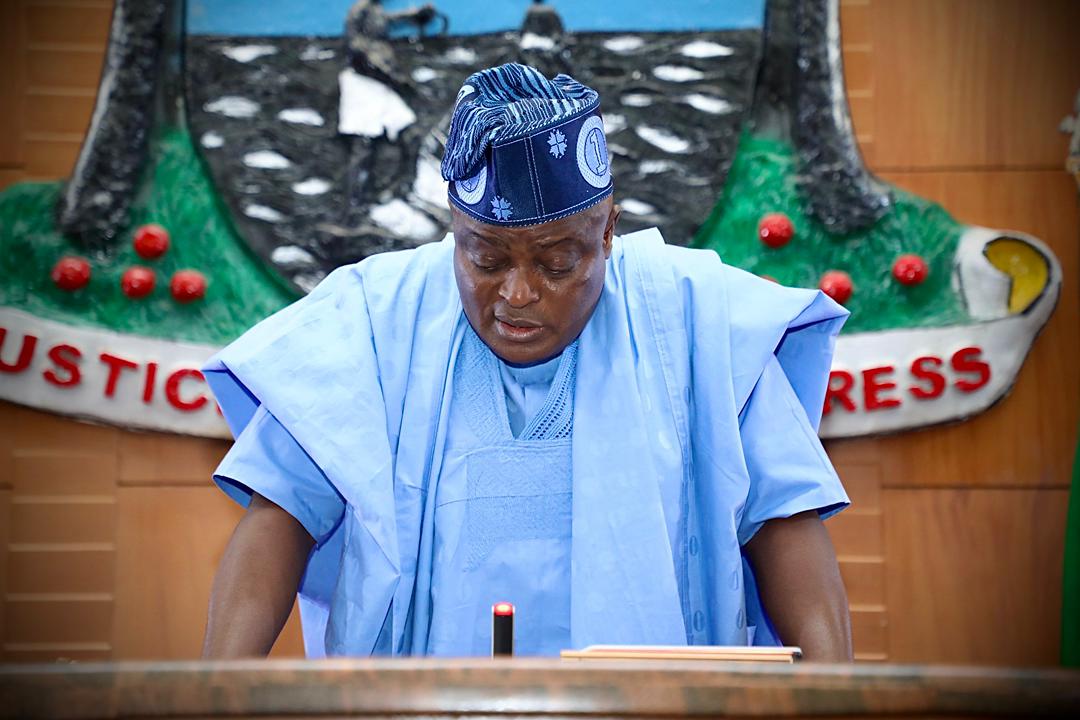
Sallah: Obasa Felicitates Muslim Ummah, Commends Nigerians for APC Primaries Turnout
The Speaker of the Lagos State House of Assembly, Rt. Hon. Mudashiru Obasa has extended warm felicitations to Muslims in Lagos State and across Nigeria on the occasion of Eid al-Adha.
In a statement released by his Chief Press Secretary, Mr. Dave Agboola, Obasa described the festival as a season of sacrifice, reflection, and gratitude, urging the faithful to continue to uphold the values of peace, unity, and love that strengthen the nation.
He noted that the celebration of Eid al-Adha is not only a spiritual milestone but also a reminder of the importance of togetherness and collective responsibility in building a stronger society.
He, likewise, emphasized that the festival provides an opportunity for Nigerians to renew their commitment to national progress and to support leadership that prioritizes development and prosperity.
Obasa, however, commended Nigerians, particularly members of the All Progressives Congress (APC), for their massive turnout during the recently concluded party primaries. He described the participation as a clear demonstration of the people’s confidence in the government of President Bola Ahmed Tinubu and their belief in the administration’s vision for a greater Nigeria.
“The APC primaries have shown the resilience of our democracy and the confidence Nigerians have in the leadership of President Bola Ahmed Tinubu and the Renewed Hope Agenda. This is a strong message that our people are ready to continue supporting policies that will drive growth and prosperity,” Obasa stated.
The Speaker further encouraged Muslims to celebrate responsibly, stressing that the joy of Eid should be accompanied by prayers for the continued peace and progress of Lagos State and Nigeria.
“As you celebrate with family and loved ones, may this season bring joy, peace, and prosperity to your homes. Let us remain united in our resolve to build a stronger nation,” he added.
On behalf of the Lagos State House of Assembly, Obasa wished all Muslims a happy and fulfilling Eid al-Adha celebration.


- Annual Meetings 2026 (AM2026): African Development Bank Group’s 2025 Annual Report Highlights Strong Results and a New Chapter for Africa’s Transformation May 29, 2026
- Eritrea: Progress of National Animal and Plant Health Laboratory May 29, 2026
- Invest Africa, the Mayor of London and FirstBank United Kingdom (UK) to Host Joint Closing Reception as part of The Africa Debate 2026 May 29, 2026
- Merck Foundation Chief Executive Officer (CEO) Dr. Rasha Kelej met Gabon First Lady to discuss the strategy to continue their joint programs to build healthcare capacity and support girl education May 29, 2026
- ‘Crude Oil: Power, Turnaround and Transformation in Angola’ Debuts as Top 3 Amazon New Release May 29, 2026
- Société Nationale des Pétroles du Congo (SNPC) Chief Ominga to Speak at African Energy Week (AEW) 2026 as Congo Accelerates Gas Expansion May 29, 2026
- South Africa: Deputy President Mashatile arrives in India for a Working Visit May 29, 2026
- Seychelles: President Visits Key Development Sites on Coetivy Island May 29, 2026
- Accelerating regional action to advance mental health care in Africa May 29, 2026
- President of the Republic of Seychelles Meets Young La Digue Talent Ahead of London Showcase May 29, 2026
- Annual Meetings 2026 (AM2026): African Development Bank Group’s 2025 Annual Report Highlights Strong Results and a New Chapter for Africa’s Transformation May 29, 2026
- Eritrea: Progress of National Animal and Plant Health Laboratory May 29, 2026
- Invest Africa, the Mayor of London and FirstBank United Kingdom (UK) to Host Joint Closing Reception as part of The Africa Debate 2026 May 29, 2026
- Merck Foundation Chief Executive Officer (CEO) Dr. Rasha Kelej met Gabon First Lady to discuss the strategy to continue their joint programs to build healthcare capacity and support girl education May 29, 2026
- ‘Crude Oil: Power, Turnaround and Transformation in Angola’ Debuts as Top 3 Amazon New Release May 29, 2026
- Société Nationale des Pétroles du Congo (SNPC) Chief Ominga to Speak at African Energy Week (AEW) 2026 as Congo Accelerates Gas Expansion May 29, 2026
- South Africa: Deputy President Mashatile arrives in India for a Working Visit May 29, 2026
-

 news6 months ago
WHO REALLY OWNS MONIEPOINT? The $290 Million Deal That Sold Nigeria’s Top Fintech to Foreign Interests
-

 society4 weeks ago
SOCIAL MEDIA IS NOT A BATTLEFIELD COMMAND – WHY THE NIGERIAN ARMY’S ACTION AGAINST JUSTICE CRACK IS A NATIONAL SECURITY IMPERATIVE
-

 celebrity radar - gossips4 months ago
Dr. Chris Okafor Returns with Power and Fire of the Spirit -Mounts Grace Nation Altar with Fresh Anointing and Restoration Grace on February 1, 2026
-

 celebrity radar - gossips6 months ago
Prophet Kingsley Aitafo Releases 2026 Prophecy: ‘Nigeria Will Rise, but the World Must Prepare for Turbulence’