
Politics
Ministerial List: Real Reasons Tinubu Delayed Kano, Lagos, 9 Other States

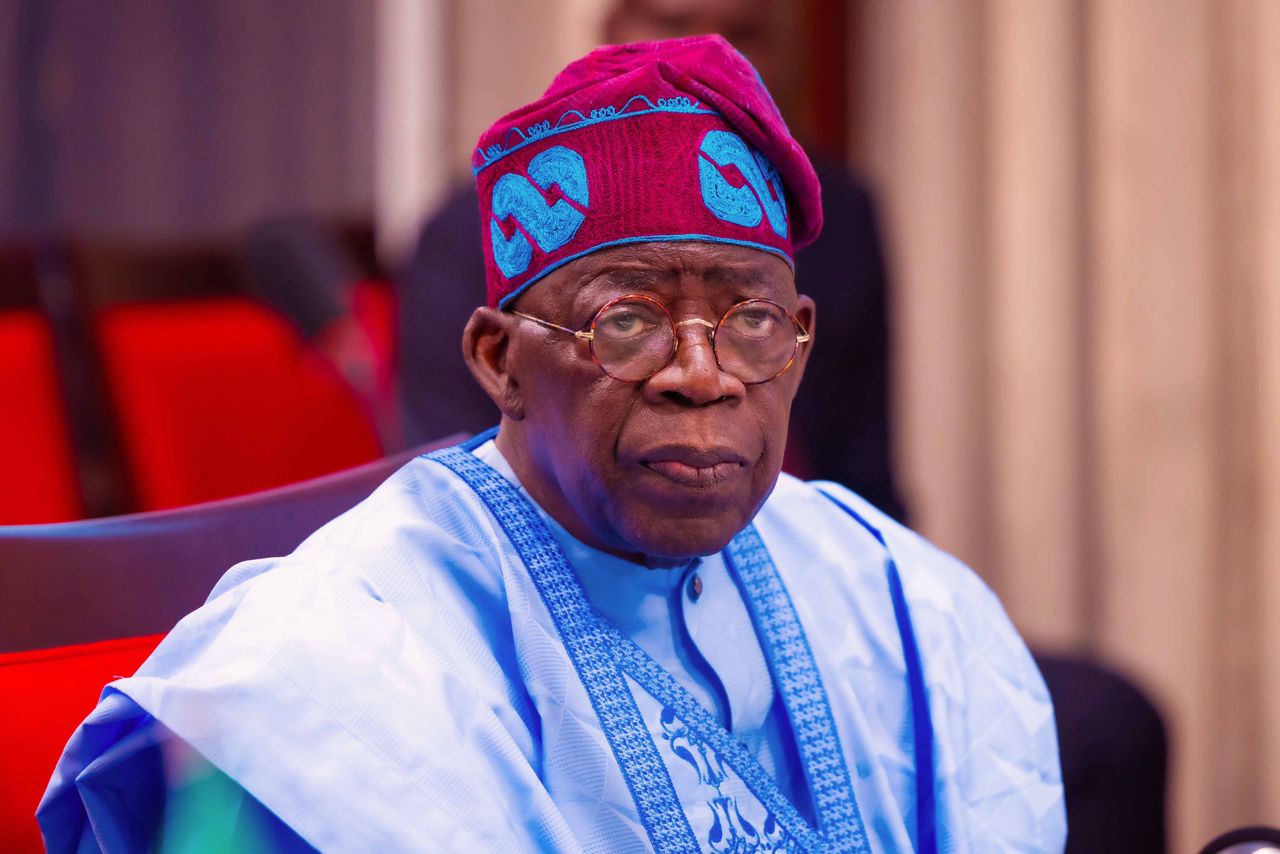
Ministerial List: Real Reasons Tinubu Delayed Kano, Lagos, 9 Other States
The long-awaited ministerial list was on Thursday sent by President Bola Tinubu to the Senate for screening and confirmation.
However, the list, which came barely 24 hours before the constitutionally provided deadline contains nominees from only 25 states, excluding 11 others, among them the president’s home state, Lagos and also Kano. Others excluded from the list are Adamawa, Bayelsa, Gombe, Kebbi, Plateau, Osun, Yobe, and Zamfara.
Those that made the list were major members of the ruling All Progressives Congress (APC), some technocrats like Professor Ali Pate (an academic and health expert); Wale Edun (an economist); and Waheed Adelabu (a banker); as well as Nyesom Wike (leader of the G-5 governors that rebelled against PDP).

Three states – Bauchi, Katsina and Cross River have two nominees. The Chief of Staff to the president, Femi Gbajabiamila told journalists last night that there is the likelihood of creating additional ministries in line with the vision of Tinubu.
Daily Trust reports that Tinubu who was inaugurated on May 29 had till today (Friday, July 28), to submit the list to the Senate in line with section 42(a) of the constitution, which states that “The nomination of any person to the office of a minister for confirmation by the Senate shall be done within sixty days after the date the president has taken the oath of office”.
The delay by the president to unveil his cabinet had heightened expectations from Nigerians, who were keenly waiting for the list of ministers that would assist the president to deliver his Renewed Hope Agenda.
Competent sources informed Daily Trust that high-wire politics, technocracy, party politics and compensation were among the key factors considered by the president in coming up with the list
Those who made it to the released list included four former governors: David Umahi (Ebonyi); Nyesom Wike (Rivers); Mohammed Badaru (Jigawa), and Nasir El-Rufai (Kaduna).
Other nominees are: Abubakar Momoh (Edo State); Yusuf Maitama Tuggar (Bauchi); Ahmad Dangiwa (Katsina); Hannatu Musawa (Katsina); Uche Nnaji (Enugu); Betta Edu (Cross River); Doris Uzoka (Imo); Ekperikpe Ekpo (Akwa Ibom), Nkiru Onyejiocha (Abia), Olubunmi Tunji-Ojo ( Ondo), Stella Okotete (Delta), Uju Ohaneye (Anambra), Bello Mohammed Goronyo (Sokoto), Alake (Ekiti), Lateef Fagbemi (Kwara), Mohammed Idris (Niger), Edun (Ogun), Adebayo Adelabu (Oyo), Imaan Sulaiman-Ibrahim (Nasarawa), Pate (Bauchi), Joseph Utsev (Benue), Abubakar Kyari (Borno), John Enoh (Cross River), and Sani Abubakar Danladi (Taraba).
Why Tinubu omitted Kano, Lagos, others
Daily Trust checks revealed that the omission of Kano State in the 28-man list of ministerial nominees submitted to the National Assembly on Thursday by the president may not be unconnected to the uncertainty surrounding the former governor of the state, Abdullahi Umar Ganduje, who it was gathered is the president’s favourite candidate from the North-West state.
It was also gathered that the post-election romance between the president and presidential candidate of NNPP, Rabiu Musa Kwankwaso, and the resignation of the APC national chairman, Abdullahi Adamu, which now creates a vacuum, are factors believed to be responsible for the non-inclusion of Kano in the released ministerial list.
Days after Adamu resigned, it was gathered that the president was said to have tipped Ganduje to succeed him, which many believe might be the reason for his absence in the ministerial list forwarded to the National Assembly.
A chieftain of the party in Kano had told Daily Trust last week that they had been informed that the former governor did not make the ministerial list.
He said what they were told was that Ganduje would be given the opportunity to fill in the vacant position of the ruling party’s chairmanship.
“For us, this is even better news because as the party chairman, Baba (Ganduje) will be directly involved with not just the party but also maintain his cordial relationship with the president,” he said.
The permutations among party leaders in the state had however been zeroed on the fears that the recent overtures from the president to Kwankwaso, a former governor of the state, whose party now controls the state, might affect the slot(s) to be given to the state, with several of them insisting that this would negatively affect the party and would aggravate the discord in the state with the superiority battle that might follow. A source said beyond the ministerial position, Tinubu was also considering electoral value ahead of 2027.
“There is also the issue of the election petition tribunal. Tinubu wants strong personalities in the states, not just Kano, so that if there would be a rerun, they would deliver votes for him.”
The vice chairman of the APC in the state, Shehu Maigari told Daily Trust that the state has strong personalities that contributed immensely to the emergence of Tinubu as president.
“We have people like Ahmed Tijjani Gwarzo, a former deputy governor of the state who has been with Asiwaju since their days in ACN and who I can boldly say apart from our leader (Ganduje), no one else contributed more to the success than him. We also have Rabiu Suleiman Bichi, a former Secretary to the State Government, and also Abdulrahman Dambazau, former Minister of Interior. These are just a few among qualified persons that should be considered,” he said.
Working to harmonise interests in Lagos
In Lagos, Daily Trust learnt that political struggles and the need to harmonise interests prevented it from being represented in the 28-member ministerial list even though Lagos-based politicians were well-represented.
Both Dele Alake and Wale Edun have their political base in Lagos and are known foot soldiers of Tinubu, who served in his cabinet when he was the governor of the state.
However, there are rumours that Tinubu, who has maintained a stronghold of the state since he became governor in 1999, is considering his former Chief of Staff, Babatunde Fashola; Lagos East Senator, Tokunbo Abiru and former Lagos State governor, Akinwunmi Ambode as potential nominees from the state. The National Youth leader of the party, Dayo Israel is also said to be eyeing a ministerial slot.
Similarly, it was learnt that Tinubu is yet to settle for anybody in Bayelsa, owing to the struggle in the state. Political gladiators in the state are said to be scheming for the exalted position.
Former President Goodluck Jonathan, recently, denied any involvement in nominating a ministerial nominee from the state.
While Cross River had two nominees- APC national woman leader, Dr. Betty Edu, and Senator John Owan-Eno, the omission of the former governor, Ben Ayade is said to be unsettling politicians in the state.
Slot between Lawan, Machina in Yobe
In Yobe, our correspondent gathered the names of former Senate President Ahmad Lawan and Bashir Sheriff Machina are being mentioned.
While Lawan had lost out to Tinubu during the primary election of the APC, he also had a legal battle with Machina over the Yobe North senatorial seat ticket.
We’ll certainly have our preferred choice – Kebbi
Elsewhere, officials in Kebbi State said they were certain the best would be chosen as minister to represent them.
The Special Adviser to Governor Nasiru Idris on Political Affairs, Alhaji Kabiru Sani Giant said Kebbi had contributed immensely to the success of Mr. President in the presidential election.
“He will surely appoint a minister from Kebbi State like he has done in other states but is yet to exhaust his list”, he said.
On whether the face-off between Senator Adamu Aliero and former governor Abubakar Atiku Bagudu might be responsible for why there is no ministerial nominee yet from Kebbi, Alhaji Giant said Aliero has no power to stop or influence the president on the choice of who is to be appointed as minister in Kebbi State. Before now, two former governors of the state, Abubakar Atiku Bagudu and Sa’idu Nasamu Dakingari were being touted for the ministerial position in the state.
It was believed that Bagudu by virtue of his position as former APC Governors Forum and being the chairman of the convention where Tinubu emerged the APC presidential flag bearer has a better chance without prejudice to Dakingari who was the director general for the governorship campaign in the state.
Daily Trust gathered that unresolved permutations resulted in a delay in announcing a ministerial nominee from Gombe State by President Tinubu.
Last minute politics ‘robbed’ Gombe in first list
A chieftain of the APC in the state, who craves anonymity, said President Tinubu had earlier settled for his associate, a Kaduna-based businessman, Alhaji Umar Abdullahi.
According to him, Abdullahi, popularly known as ‘Umaru Dan Adda,’ is a long-time associate of the president and participated in the 2023 presidential campaign that brought Tinubu to power.
He was a one-time staff of the New Nigeria Development Company (NNDC) and served as board member for several parastatals after his retirement.
However, another contender for the ministerial seat, Abubakar Inuwa Kari, the immediate past Chief of Staff to Governor Inuwa Yahaya and ally to President Tinubu, also pushed harder for the seat.
He was one of the returning officers of Tinubu during the APC’s Presidential election. He was not reappointed as chief of staff by Governor Yahaya in anticipation of his likely nomination as a ministerial nominee.
Also, a heavy-weight politician, Jamilu Isyaku Gwamna was contending to get the ministerial slot for Gombe to represent the state at the Federal Executive Council. Gwamna was a gubernatorial aspirant under the PDP, but returned to APC, after he lost the party’s ticket and contributed immensely towards the victory of the party. According to the source, the failure to reconcile and pick one from the three contenders made it impossible for a ministerial nominee from the state to be in the first batch unveiled by Senate President Godswill Akpabio yesterday.
In Plateau, pundits have expressed surprise that immediate past governor, Simon Lalong, was not named among the list. They were equally surprised that Plateau was excluded from the first list even though Lalong served as Tinubu’s Presidential Campaign Director General.
Daily Trust gathered that the state had earlier submitted three names, including Lalong, the current APC chairman in the state, Rufus Bature and Prof. Dakas C. Dakas. But pundits say the non-inclusion of Plateau on the list may not be unconnected with the pending suit instituted by Lalong and the APC.
Senate to commence screening Monday – Spokesperson
The Chairman of the Senate Committee on Media and Public Affairs, Senator Yemi Adaramodu (APC, Ekiti) said the screening of the ministerial nominees will commence on Monday.
Briefing journalists after yesterday’s plenary, Adaramodu assured that the nominees would be thoroughly grilled.
He said, “This time around, the Senate will examine the character, background and achievement of all nominees, and Nigerians will not be disappointed with the 10th Senate.
“It is until they come forward with their resume because it won’t be a shadow screening where you have a good resume and you don’t have a good character. They must have good character,” he said.
New ministries on the way
Gbajabiamila while fielding questions from State House reporters after the ministerial list was submitted to the National Assembly, said “Mr President intends to separate portfolios or restructure the ministries in such a way you might be hearing of new ministries that were not standalone ministries before. So, the process continues.”
He said a second part comprising 13 names would be sent to the Senate, adding that this was part of the process of having a cabinet for the administration.
“As you know, he had 60 days from the time of inauguration, as stipulated in the constitution. He has fulfilled that requirement of the constitution by submitting 28 names today.
“As his letter stated, and was read on the floor of the Senate, the remaining names, not sure how many, probably about 12, maybe 13, will be forwarded to the Senate in the coming days.
“As far as the nominees themselves are concerned, and like I said, Mr President took his time to sift through those names,” he said.
He also said the president decided to toe the line of tradition by not attaching the portfolio of the nominees in the letter to the senate in order to give room for reviews.
“As good as that sounds, it straitjackets the president to pigeonhole one person in an office or the other. What happens then if you change your mind, do you then bring the person back for screening again, because the president is at liberty to change your mind.
“For instance, if I decide I want somebody as minister of labour, and then after sending the name, later on, I decide that this person would actually be better with another portfolio. And meanwhile, the Senate has screened that person for that particular initial portfolio?
“What happens then? Do you now re-screen the person? So, a lot of these things have their merits and demerits,” the Chief of Staff said




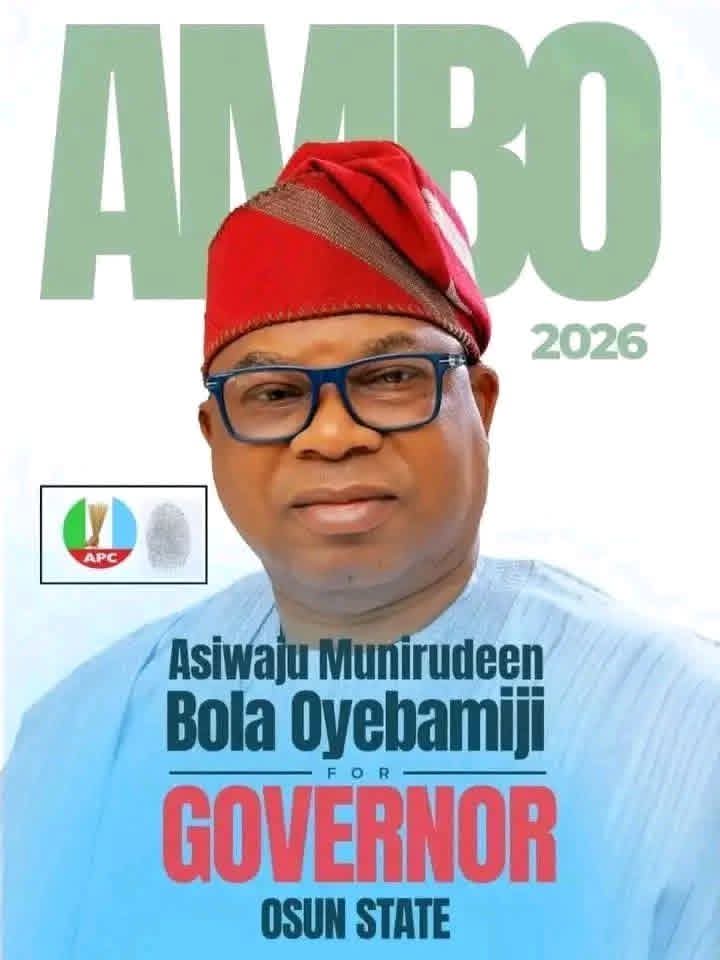
AMBO and the Osun Governorship Race: Assessing the Man, the Politics and the Vision
As political activities gather momentum ahead of the 2026 Osun State governorship election, a public affairs commentator, Oluseyi Olonade, has described the emergence of Asiwaju Munirudeen Bola Oyebamiji, popularly known as AMBO, as a significant development in the state’s political landscape.
In an article titled “Oyebamiji: The Man, The Politics and The Aspiration,” Olonade argued that the All Progressives Congress governorship hopeful possesses the character, experience and vision needed to reposition Osun State for sustainable growth.
According to the writer, Oyebamiji’s appeal stems from his extensive background in the banking sector, where he spent nearly three decades working with institutions including Wema Bank, Trans International Bank, Spring Bank and Enterprise Bank.
A native of Ikire in Irewole Local Government Area, Oyebamiji was described as a technocrat whose experience in corporate governance, finance and risk management has shaped his approach to public administration.
The article noted that his public service journey gained prominence in 2012 when he was appointed to oversee the then Osun State Investment Company Limited. Under his leadership, the organisation was reportedly restructured and transformed into Omoluabi Holdings Limited.
The writer further highlighted Oyebamiji’s tenure as Commissioner for Finance under successive APC administrations, where he was credited with managing the state’s finances during challenging economic periods.
Olonade also referenced Oyebamiji’s appointment as Managing Director of the National Inland Waterways Authority, describing it as further evidence of his administrative and leadership capabilities.
The article contrasted Oyebamiji’s governance philosophy with that of the current administration in Osun State, arguing that the APC aspirant favours institutional reforms, economic diversification and fiscal discipline.

According to the writer, Oyebamiji’s proposed agenda includes strengthening transparency in government spending, expanding internally generated revenue, attracting private-sector investments and promoting industrial and agricultural development.
The article also highlighted youth empowerment, entrepreneurship development and digital skills acquisition as key components of his vision for the state.
Olonade concluded that the forthcoming governorship election would present voters with a choice between different approaches to governance, expressing confidence that Oyebamiji’s experience and developmental agenda make him a strong contender in the race.
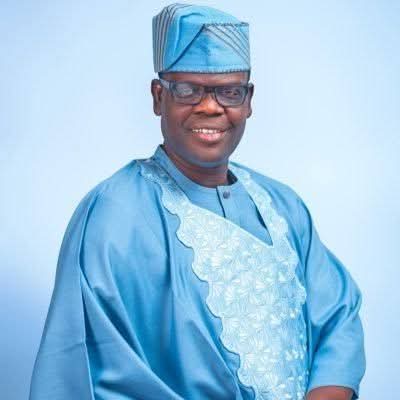
*Oselu Tiwa nTiwa Endorses Oriyomi Hamzat for Oyo Governorship*
A sociopolitical support group in Oyo State, Oselu Tiwa nTiwa, has declared its support for Alhaji Oriyomi Hamzat as the authentic governorship candidate of the Accord Party ahead of the forthcoming governorship election in the state.
The group made its position known in a statement jointly signed by its President, Mr. Adewale Oluwaseyi and Secretary, Alh. Adebayo Oyewole, on Thursday, describing Hamzat as a grassroots figure with strong connection to the people and a track record of humanitarian interventions across Oyo State.

According to the group, the endorsement followed what it described as careful observation of Hamzat’s leadership qualities, compassion and dedication to the welfare of ordinary citizens.
“Oriyomi Hamzat has consistently demonstrated empathy, courage and selfless commitment to humanity. Through his numerous interventions in the lives of ordinary citizens, he has become a symbol of hope to many families and communities,” the statement read.
Oselu Tiwa nTiwa also appealed to the national leadership of the Accord Party to prioritise the long-term future and electoral growth of the party in its decision-making process.
The group noted that Hamzat’s candidacy presents an opportunity for the party to strengthen its grassroots support base and expand its political relevance across Oyo State.
“We respectfully appeal to the National Leadership of the Accord Party to look beyond immediate political calculations and consider the bigger picture, the future growth, stability and electoral success of the party in Oyo State and beyond,” the statement added.
The group further expressed confidence in the leadership of the party, saying it believes the party’s national officers and stakeholders would take decisions that reflect fairness, inclusiveness and the collective interest of members.
While calling on party loyalists to remain calm and united, Oselu Tiwa nTiwa said continued consultations among stakeholders would help strengthen the Accord Party ahead of the election.
Signed:
Alh. Adebayo Oyewole,
Secretary.
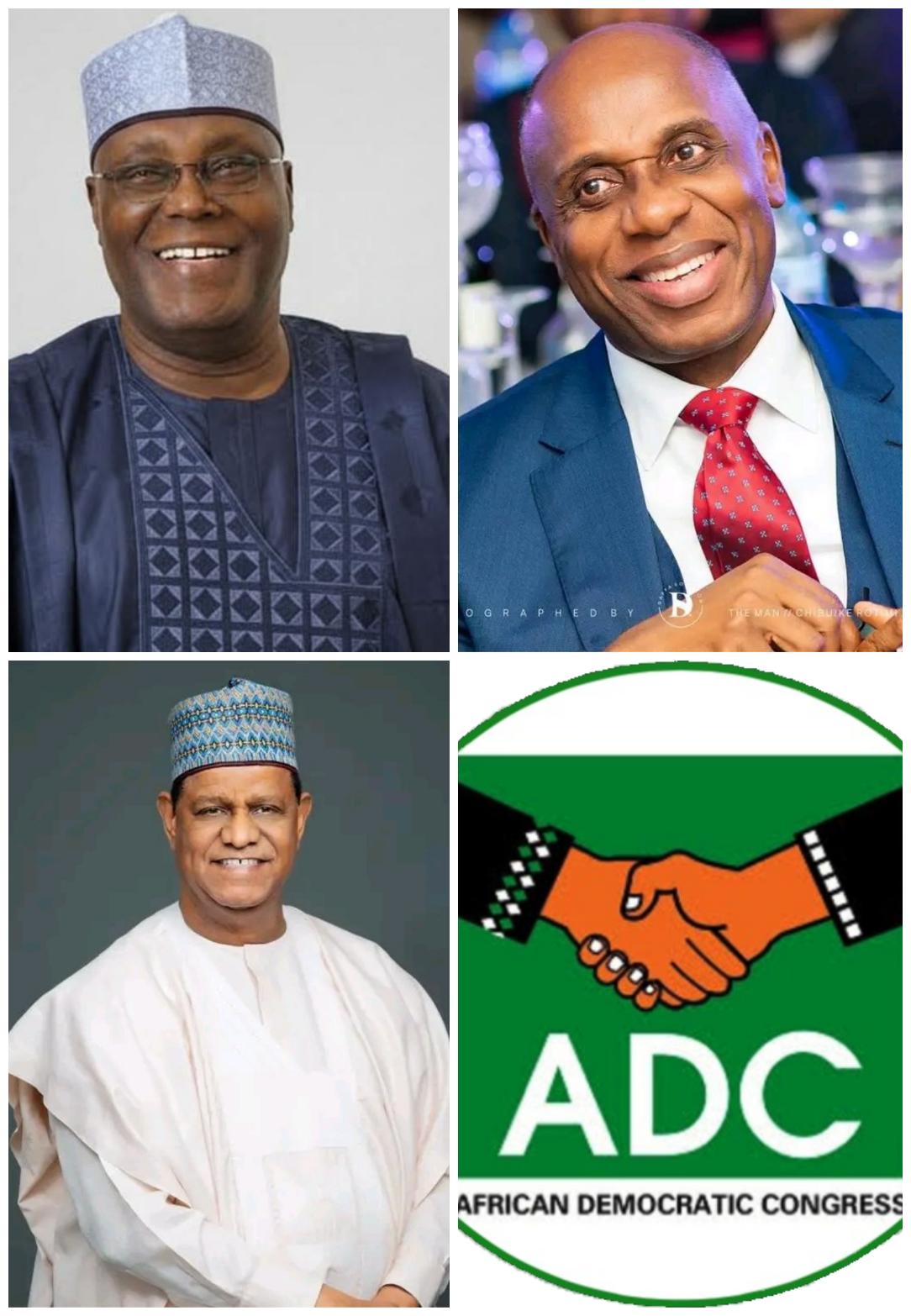
Atiku Set To Clinch ADC Presidential Ticket, Leads Amaechi, Hayatu-Deen In 34 States
Former Vice President of Nigeria and frontline presidential aspirant of the African Democratic Congress (ADC), Atiku Abubakar, is projected to emerge winner of the party’s presidential primaries, according to impeccable sources in Abuja.
The primaries, conducted across over 8,000 wards in the 36 states of the federation and the Federal Capital Territory, reportedly placed Atiku far ahead of his closest rivals — former Rivers State Governor, Rotimi Amaechi, and former Chairman of the Nigerian Economic Summit Group, Mohammed Hayatu-Deen.

Highly placed party insiders disclosed that Atiku is currently leading in 34 states, including the FCT, after securing dominance across the 19 Northern states, the five South-East states, and the six South-West states, while also maintaining a strong showing in at least three states in the South-South geopolitical zone.
The sources added that the outcome reflects what they described as “an overwhelming nationwide acceptance” of the former vice president within the opposition party ahead of the 2027 general election.
Meanwhile, the ADC leadership has invited members of the press to the official announcement of the final collated results scheduled for 11:00 a.m. on Tuesday, May 26, 2026, in Abuja.
The declaration of results is expected to be broadcast live on ARISE Television and two other major television stations, while also being livestreamed on the party’s official social media platforms on X and Facebook.
Speaking ahead of the announcement, the founding National Chairman of the ADC, Chief Ralph Nwosu, said the decision to televise the exercise live was aimed at promoting transparency and democratic accountability.
“We want millions of Nigerians at home and in the Diaspora to witness democracy in action,” Nwosu said.
He further revealed that the party leadership would encourage all three presidential aspirants to publicly embrace a peace accord and commit themselves to working together in unity for the party’s success.
According to him, the move is necessary to strengthen internal cohesion and position the ADC for victory in the presidential election scheduled for January 16, 2027.
Details later.


- Afreximbank Deepens Commitment to Economic Progress in The Bahamas June 1, 2026
- African Electric Vehicle (EV) platform Spiro raises $215M in equity to scale electric mobility and energy infrastructure across Africa June 1, 2026
- Africa Centres for Disease Control and Prevention (Africa CDC) Statement on Attacks Against Health Facilities During the Bundibugyo Virus Disease Response in the Democratic Republic of the Congo June 1, 2026
- Putting consumers at the centre of Africa’s dairy transformation June 1, 2026
- International Rescue Committee (IRC) warns Democratic Republic of the Congo (DRC) Ebola outbreak likely far larger than official figures suggest June 1, 2026
- South Africa: Portfolio Committee on Health Marks National Cancer Survivor Day and Reaffirms Importance of Early Detection and Public Awareness June 1, 2026
- Rwanda’s RSSB Tigers Crowned 2026 Basketball Africa League Champions June 1, 2026
- Uganda: Appointments Committee Begins Vetting of Ministerial Nominees June 1, 2026
- Sudan braces for worsening child malnutrition as pre-harvest season starts June 1, 2026
- Etu Energias Strengthens Angolan Footprint, Returns to Angola Oil & Gas (AOG) 2026 as Champion Sponsor June 1, 2026
- Afreximbank Deepens Commitment to Economic Progress in The Bahamas June 1, 2026
- African Electric Vehicle (EV) platform Spiro raises $215M in equity to scale electric mobility and energy infrastructure across Africa June 1, 2026
- Africa Centres for Disease Control and Prevention (Africa CDC) Statement on Attacks Against Health Facilities During the Bundibugyo Virus Disease Response in the Democratic Republic of the Congo June 1, 2026
- Putting consumers at the centre of Africa’s dairy transformation June 1, 2026
- International Rescue Committee (IRC) warns Democratic Republic of the Congo (DRC) Ebola outbreak likely far larger than official figures suggest June 1, 2026
- South Africa: Portfolio Committee on Health Marks National Cancer Survivor Day and Reaffirms Importance of Early Detection and Public Awareness June 1, 2026
- Rwanda’s RSSB Tigers Crowned 2026 Basketball Africa League Champions June 1, 2026
-

 news6 months ago
WHO REALLY OWNS MONIEPOINT? The $290 Million Deal That Sold Nigeria’s Top Fintech to Foreign Interests
-

 society4 weeks ago
SOCIAL MEDIA IS NOT A BATTLEFIELD COMMAND – WHY THE NIGERIAN ARMY’S ACTION AGAINST JUSTICE CRACK IS A NATIONAL SECURITY IMPERATIVE
-

 celebrity radar - gossips4 months ago
Dr. Chris Okafor Returns with Power and Fire of the Spirit -Mounts Grace Nation Altar with Fresh Anointing and Restoration Grace on February 1, 2026
-

 celebrity radar - gossips6 months ago
Prophet Kingsley Aitafo Releases 2026 Prophecy: ‘Nigeria Will Rise, but the World Must Prepare for Turbulence’