
society
Multilateralism’s Moment: The Johannesburg Declaration and the Case That Cooperation Can (and Must) Deliver


Multilateralism’s Moment: The Johannesburg Declaration and the Case That Cooperation Can (and Must) Deliver.
By George Omagbemi Sylvester | Published by saharaweeklyng.com
“The adoption of the G20 Leaders Declaration in Johannesburg is more than ceremony; it is a practical rebuke to cynicism; a binding message that well-crafted, inclusive multilateralism remains humanity’s best instrument for solving shared crises.”
When leaders gathered in Johannesburg on 22–23 November 2025 for the first G20 summit ever held on African soil, something very plain and very consequential happened: they adopted a Leaders Declaration that speaks to the core question of our time; can the world still govern itself cooperatively when so many forces push it toward fragmentation? The short answer, emphatically, is YES. The Johannesburg declaration sends a clear signal that multilateralism can and must deliver, and that signal matters because the alternatives (unilateralism, great-power rivalry, and competitive isolation) are already proving ruinous for ordinary people everywhere.
Why does a declaration matter? Because multilateralism is not a SLOGAN; it is a set of instruments (institutions, financial arrangements, commitments and follow-through) that, when working, translate global consensus into local gains. The Johannesburg text does not pretend to solve every problem in a single paragraph. It does, however, marshal consensus on immediate, measurable priorities: accelerating renewable energy and a just energy transition, catalysing finance for developing economies, strengthening disaster resilience and post-disaster reconstruction, and re-energising efforts to tackle inequality and food insecurity. Those are not abstract goals; they are policy blueprints that require joint financing, coordinated regulation and institutional reform; the very machinery that only multilateral cooperation can provide at scale.
The politics around the summit illustrate the stakes. Washington’s absence (a high-profile boycott of the leaders sessions) made headlines and revealed the limits and frictions of global diplomacy. But the fact that a broadly representative group of G20 members nonetheless adopted a joint declaration underscores the resilience of collective action even when one major power steps back. The adoption by consensus; and the willingness of participants to anchor the declaration to concrete financing and reform proposals — demonstrates that multilateral outcomes can be both pragmatic and principled. It is the practical capacity to deliver that gives multilateralism its moral force.
South Africa’s Presidency framed the summit with a theme that was more than rhetorical: “SOLIDARITY, EQUALITY and SUSTAINABILITY.” In his opening address, President Cyril Ramaphosa put it bluntly: “The adoption of the declaration from the summit sends an important signal to the world that multilateralism can and does deliver.” That line matters not as flattery but as a public affirmation; a promise that the commitments on the page will be turned into funding, institutional changes and measurable outcomes for countries that have too often been left on the margins.
Nor is this moment detached from long-standing calls for reform. The United Nations recent “PACT FOR THE FUTURE” and the Summit of the Future discussions have argued for a multilateral system that is “FIT FOR THE PRESENT AND THE FUTURE” more representative, more democratic and more capable of rapid collective action. António Guterres has repeatedly warned that “we are here to bring multilateralism back from the brink,” a refrain echoed across policy platforms and echoed in Johannesburg by leaders and experts who see reform and delivery as two sides of the same coin. If institutions are to be strengthened, they must also show deliverables; climate finance disbursed, debt vulnerabilities addressed, supply chains stabilized, and social protections scaled.
Economic justice is central to credibility. The Johannesburg Declaration does more than nod to inequality; it foregrounds the necessity of mobilising trillions in finance (concessional lending, catalytic private finance and innovative instruments) to help developing countries invest in both DECARBONISATION and INDUSTRIALISATION. The G20’s own advisory workstreams, including an Extraordinary Committee on Global Inequality chaired by Nobel laureate Joseph Stiglitz, have produced evidence that inequality corrodes growth and that coordinated global policy can make redistribution and sustainable growth mutually reinforcing. Multilateralism’s delivery, in practice, will be measured by whether these financial pledges translate into affordable capital for infrastructure, energy access for isolated communities, and fiscal space for social investment.
Sceptics will say declarations are cheap; what matters is implementation. They are right to demand results. That is why the Johannesburg outcome matters: it links declaratory politics to institutional mechanisms and to an agenda for reform of the international financial architecture. The leaders did not simply declare a wish; they pointed toward the Sevilla Commitment and a set of G20 workstreams intended to create pipelines of bankable projects, reform multilateral development bank practices, and coordinate post-disaster reconstruction financing. In short, the declaration is a roadmap (heavy on specifics) for turning CONSENSUS into CAPITAL and CAPITAL into CAPACITY.
Although delivery will require more than good intentions. It will require political will at home and patience abroad. It will require democratic legitimacy for multilateral institutions (which means involving civil society, parliaments and subnational governments in oversight) and it will require INNOVATIVE ACCOUNTABILITY: CLEAR MILESTONES, TRANSPARENT MONITORING and INDEPENDENT EVALUATION. As IMF analysts and leading economists have argued, the multilateral system needs to become “INCENTIVE COMPATIBLE” so that every participant sees visible, near-term benefits alongside longer-term structural gains. That blend of incentives and oversight is how the system will survive the fractures of our multipolar age.
The Johannesburg declaration is also political theatre with policy teeth. It shows that when countries are willing to compromise and to prioritise collective gain over zero-sum signalling, they can put in place a common platform to tackle shared threats: climate shocks, food insecurity, pandemics, technology risks and violent conflict. These are not problems a single state can solve alone. They require interoperable rules, pooled financing, and coordinated action. The Johannesburg leaders’ document is an admission that the old adage remains true: sovereignty is protected, not weakened, when nations cooperate to reduce risks that respect no borders.
So what should we expect next? First, rigorous follow-up: project pipelines must be created, funded and monitored. Second, reform: the G20 and other institutions must accelerate the hard work of reforming governance structures (including representation and voice) so that developing countries have meaningful agency in decisions that affect their futures. Third, accountability: civil society, academia and parliamentary institutions must be empowered to hold leaders to the commitments they signed in Johannesburg. And finally, results: more renewable capacity deployed in Africa, debt relief and restructuring where necessary, and tangible reductions in vulnerability for the poorest communities.
If Johannesburg teaches us anything, it is that multilateralism’s moral claim rests on its practical performance. As Joseph Stiglitz and other leading scholars emphasize, multilateral action is both economically sensible and politically necessary; without it, inequity and instability will deepen. António Guterres’ plea to “bring multilateralism back from the brink” is not a rhetorical flourish; it is an agenda that demands both reform and delivery. The Johannesburg Declaration is a constructive step along that path. Now the real test begins: turning WORDS into WORK, and COMMITMENTS into CHANGE.
History will judge Johannesburg not simply by the eloquence of its statements but by whether the summit’s promises are lived out in schools with power, hospitals with supplies, farms with drought resilience, and economies with inclusive jobs. That is the only defensible yardstick for multilateralism: performance that improves lives. The declaration says it can be done. The world must now prove it — quickly, transparently and with fierce resolve. The future of cooperative global governance depends on nothing less.






US-Based Society Lady, Fehintola-Brat Extends Eid-El-Kabir Greetings To Muslims
United States based fahionista of class, Chief (Mrs) Ayoola Fehintola-Brat has extended a warm greetings to Muslim faithful all over the world on the occasion of the 2026 Eid-El-Kabir celebration.
Fehintola-Brat who is the Balogun Egbe Obaneye Obinrin Akile Ijebu, and the Yeye Asofin of Idenaland in her message to Journalists urged Muslim to continually uphold the enduring values of sacrifice, obedience, faith, and compassion, which are central to the significance of Eid-El-Kabir festival.
A quiet philantropist whose humanitarian services has won her several laurels urged Muslims to use the spiritual occasion to pray for the peace co-existence of Nigerians regardless of religious, social and political leanings stressing that the oneness of the country should not be underplay.
In a related development, she expressed her felicitations to all sons and daughters of Ijebuland on the forthcoming Ojude Oba 2026 celebration, tasking age-groups otherwise known as Regbregbe to be more proactive in giving back to their immediate communities.
According to her, the beauty of the age-groups in Ijebuland is the need to contribute immensely to the development of the land in no small means. “This we will continue to achieve with God on our side”, she concluded.
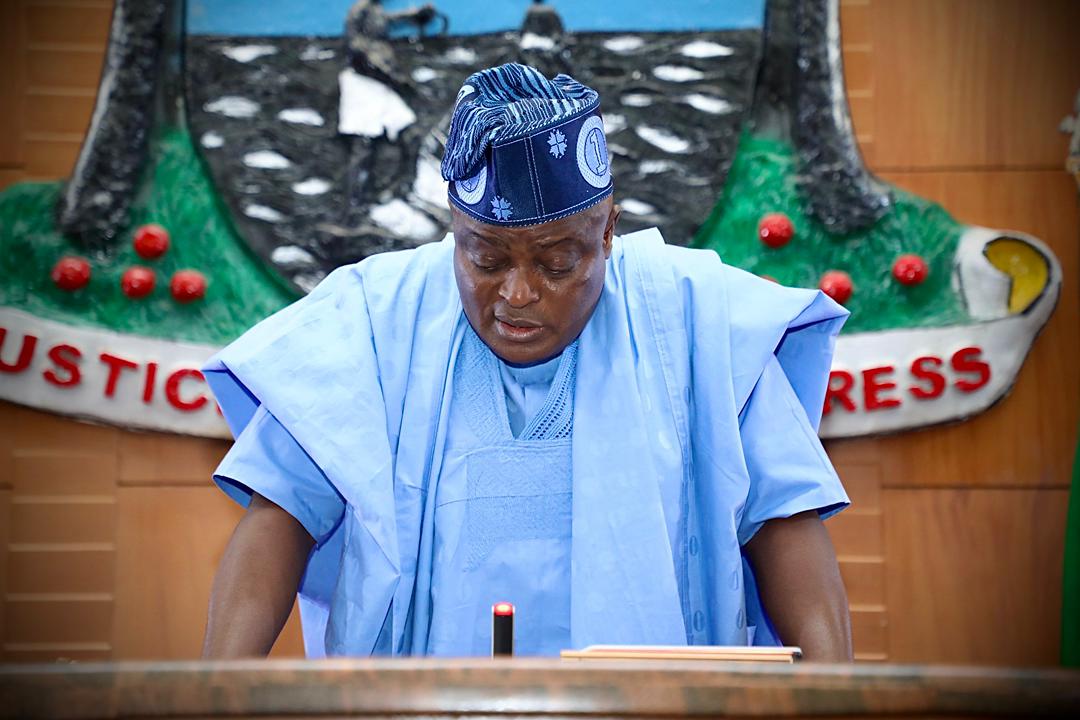
Sallah: Obasa Felicitates Muslim Ummah, Commends Nigerians for APC Primaries Turnout
The Speaker of the Lagos State House of Assembly, Rt. Hon. Mudashiru Obasa has extended warm felicitations to Muslims in Lagos State and across Nigeria on the occasion of Eid al-Adha.
In a statement released by his Chief Press Secretary, Mr. Dave Agboola, Obasa described the festival as a season of sacrifice, reflection, and gratitude, urging the faithful to continue to uphold the values of peace, unity, and love that strengthen the nation.
He noted that the celebration of Eid al-Adha is not only a spiritual milestone but also a reminder of the importance of togetherness and collective responsibility in building a stronger society.
He, likewise, emphasized that the festival provides an opportunity for Nigerians to renew their commitment to national progress and to support leadership that prioritizes development and prosperity.
Obasa, however, commended Nigerians, particularly members of the All Progressives Congress (APC), for their massive turnout during the recently concluded party primaries. He described the participation as a clear demonstration of the people’s confidence in the government of President Bola Ahmed Tinubu and their belief in the administration’s vision for a greater Nigeria.
“The APC primaries have shown the resilience of our democracy and the confidence Nigerians have in the leadership of President Bola Ahmed Tinubu and the Renewed Hope Agenda. This is a strong message that our people are ready to continue supporting policies that will drive growth and prosperity,” Obasa stated.
The Speaker further encouraged Muslims to celebrate responsibly, stressing that the joy of Eid should be accompanied by prayers for the continued peace and progress of Lagos State and Nigeria.
“As you celebrate with family and loved ones, may this season bring joy, peace, and prosperity to your homes. Let us remain united in our resolve to build a stronger nation,” he added.
On behalf of the Lagos State House of Assembly, Obasa wished all Muslims a happy and fulfilling Eid al-Adha celebration.

ABEOKUTA FILM FESTIVAL AT ILEYA
Kayshow Multimedia a filmmaking and Media organization this year 2026 holds its annual Abeokuta film festival at the Ake Palace in Abeokuta.
Alake of Egba land, Ọba Michael Adedotun Arẹmu Gbadebo has graciously endorsed the Free Training of Egba Youths on Film and Arts and the Entertainment of the the People with a FREE FILM SHOW at the AKE PAVILION. as part of the ABEOKUTA FILM FESTIVAL 2.0.
The Convener of the Film Festival Honorable Kehinde Soaga says this year’s event promises to be more exciting as distinguished personalities are sure to attend.
This includes the honorable Minister for Art Culture and Creative Economy in Nigeria, Barr. Hannatu Musa Musawa, Ààrẹ Lai Labode, Sen. Ibikunle Amosun and other special guests.
The event will feature Film, Cultural Dance Cultural foods and Award Ceremony.
The general public is hereby invited to the Free film show at the Abeokuta film festival at the Alake Palace Pavilion on Thursday 28th of May 2026 by 4:00 p.m.
Only well dressed is the Entry. The Abeokuta Film Festival is an annual event taking place in the capital city of Ogun State state.


- Qrent says delaying Information Technology (IT) refresh cycles may be increasing operational risk for businesses in Africa May 27, 2026
- Dentons’ Iyunola Adekanye Appointed to African Mining Week (AMW) Advisory Board May 27, 2026
- United Nations (UN) Women Liberia and Partners Convene for Spotlight Initiative 2.0 Women’s Economic Empowerment Inception Meeting May 27, 2026
- African Mining Week (AMW) to Host Central Bank Governors Roundtable as Monetary Authorities Deepen Role in Mining Sector Growth May 27, 2026
- Eritrea: Diaspora Nationals Celebrate Independence Day Anniversary May 27, 2026
- Africa Unveils Landmark Humanitarian Coordination Platform to Strengthen aligned Response to Humanitarian Crises May 27, 2026
- Seychelles: President Herminie Engages with Police and Fire Services on Praslin May 27, 2026
- Issue 3 of Mining Review Africa now available for free download May 27, 2026
- NOV Joins African Energy Week (AEW) 2026 as Gold Sponsor Amid Africa’s Offshore Expansion Push May 26, 2026
- African Union of Broadcasting (AUB) and United Nations University Institute for Water, Environment and Health (UNU-INWEH) Launch Landmark Webinar Series on Africa’s Water Crisis, Starting June 2, 2026 May 26, 2026
- Qrent says delaying Information Technology (IT) refresh cycles may be increasing operational risk for businesses in Africa May 27, 2026
- Dentons’ Iyunola Adekanye Appointed to African Mining Week (AMW) Advisory Board May 27, 2026
- United Nations (UN) Women Liberia and Partners Convene for Spotlight Initiative 2.0 Women’s Economic Empowerment Inception Meeting May 27, 2026
- African Mining Week (AMW) to Host Central Bank Governors Roundtable as Monetary Authorities Deepen Role in Mining Sector Growth May 27, 2026
- Eritrea: Diaspora Nationals Celebrate Independence Day Anniversary May 27, 2026
- Africa Unveils Landmark Humanitarian Coordination Platform to Strengthen aligned Response to Humanitarian Crises May 27, 2026
- Seychelles: President Herminie Engages with Police and Fire Services on Praslin May 27, 2026
-

 news5 months ago
WHO REALLY OWNS MONIEPOINT? The $290 Million Deal That Sold Nigeria’s Top Fintech to Foreign Interests
-

 society3 weeks ago
SOCIAL MEDIA IS NOT A BATTLEFIELD COMMAND – WHY THE NIGERIAN ARMY’S ACTION AGAINST JUSTICE CRACK IS A NATIONAL SECURITY IMPERATIVE
-

 celebrity radar - gossips4 months ago
Dr. Chris Okafor Returns with Power and Fire of the Spirit -Mounts Grace Nation Altar with Fresh Anointing and Restoration Grace on February 1, 2026
-

 celebrity radar - gossips6 months ago
Prophet Kingsley Aitafo Releases 2026 Prophecy: ‘Nigeria Will Rise, but the World Must Prepare for Turbulence’