
Politics
N2.2bn Fraud: EFCC presents four witnesses against Ex-Ekiti governor, Ayo Fayose

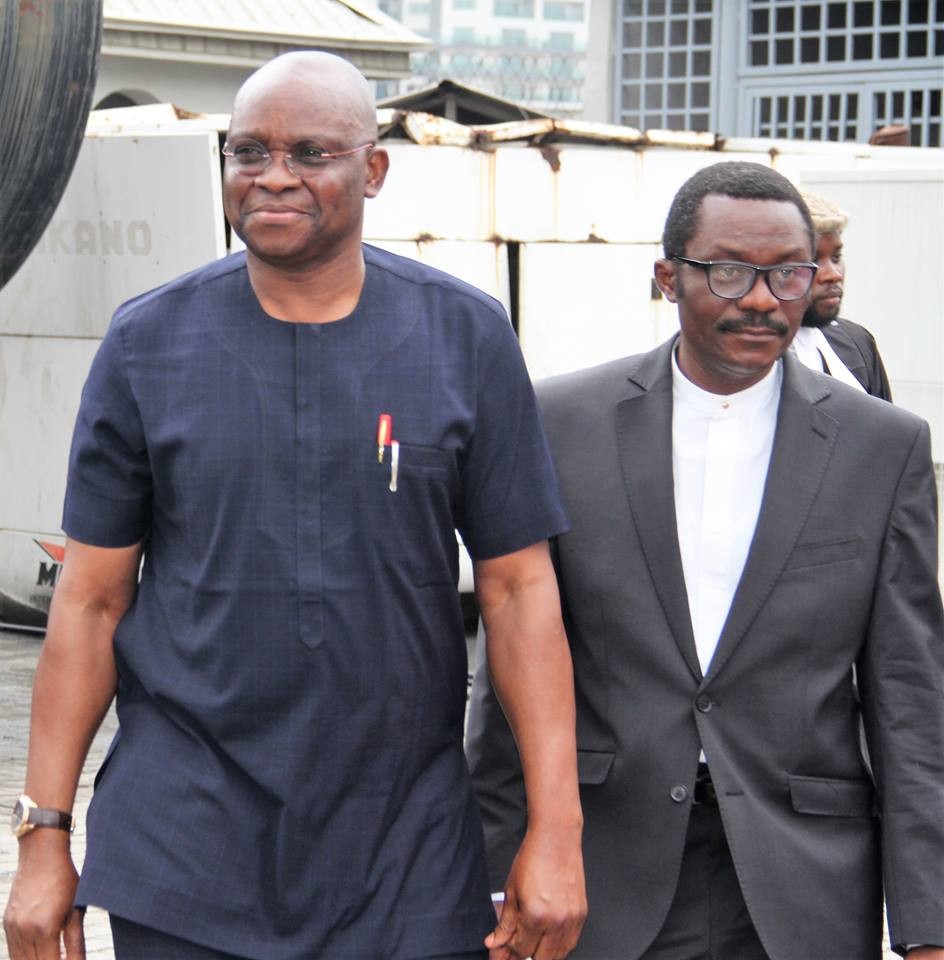

The Economic and Financial Crimes Commission, EFCC, on Monday, November 19th, opened its case against a former governor of Ekiti State, Ayodele Fayose, who is being prosecuted for an alleged N2.2bn fraud before Justice Mojisola Olatoregun of the Federal High Court sitting in Ikoyi, Lagos .
Fayose was arraigned alongside his company, Spotless Investment Limited, on October 22, 2018 on an 11-count charge bordering on fraud and money laundering to the tune of N2.2bn.
The former governor is facing trial in connection with N1.299bn and $5.3m out of the N4.65bn slush funds allegedly shared by the Office of the National Security Adviser, NSA, through a former Minister of State for Defence, Musiliu Obanikoro.
Fayose pleaded not guilty to the charges preferred against him and was granted bail in the sum of N50m with one surety in like sum. The Judge had adjourned to Monday, November 19, 2018 for the commencement of trial.
In the course of the sitting, a prosecution witness, Lawrence Akande, told the court that one Abiodun Agbele informed him sometime in June 2014 that he had about N1.2 billion cash lodgement to make in Akure,Ondo State.
Akande, an employee of Zenith Bank Plc in charge of South West comprising Ogun, Oyo and Osun States, further told the court that he subsequently received a call from the first defendant in respect of the same issue earlier discussed with him by Agbele.
“Since the lodgement was in Akure, I had to call my colleague there to follow up on it. This is all I know about it, ” he added.
When asked if he knew about the company, Spotless Investment Limited, Akande, who was led in evidence by the prosecution counsel, Rotimi Jacobs, SAN, stated that it was one of his bank’s customers at the Dugbe branch.
When he was shown the account opening document of Spotless Nigeria Limited, De Privateer Limited and Still Earth Limited as well as account document of the first defendant, the witness confirmed the documents. They were tendered and admitted in evidence as exhibita A-D by the court.
When asked where the account of the first defendant was domiciled, he said: ” It is not domiciled within my domain. “But from the documents before me here, I can see Apapa”, he said.
Asked to state if the People’s Democratic Party, PDP, maintained an account with his bank, the witness said so many parties, including PDP, had accounts with his bank.
Under cross-examination by counsel to the first defendant, Kanu Agabi, SAN, the witness told the court that he made statements to the EFCC on June 6, 2016. He, however, said that he did not mention the first defendant in his earlier statement. “I only mentioned him in my subsequent statements to the EFCC ,” he added.
When the defence counsel told him that his evidence was based on what he was told by his colleague, whom he said handled the transactions in Akure, he responded that “I was told how the cash was processed.”
He also stated that he had sought patronage by the first defendant for opening of government account with his bank in line with his responsibility of looking for deposits.
During cross-examination by counsel to the second defendant, Olalekan Ojo, SAN, Akande confirmed to the court that a person who is not a signatory to an account cannot make withdrawals from such account.
“There are withdrawal limits in every account and where withdrawals are to be made above the stipulated limits, it is reported to the Nigeria Financial Intelligence Unit (NFIU) to investigate such transaction,” he further stated.
When asked if his bank ever lodged any report of suspicious transactions on the various company accounts, he said: “We had no reason to do so.”
Also, when asked if he told the EFCC that before the account opening of De Privateer, the sum of N200 million was lodged in the account, he answered in the affirmative.
When asked if he was aware that the PDP organised a fund raiser before the election and that political parties do organise fund raising, the witness said, ” It is not impossible. But I don’t know.”
Akande, who confirmed that he had not had any dealing with the account of the second defendant, also told the court that the CCTV installed in the bank usually captures customers making lodgements in the bank, except it is faulty.
A second prosecution witness, Abiodun Oshodi, who is the Zonal Head of the bank covering South West 2 comprising Ondo, Kwara and Ekiti, recalled some developments in 2014 in relation to the case, saying, “I received a call from my colleague (Akande) that Agbele would be coming to make some lodgments and that I should organise a bullion van. I waited for Agbele who arrived with one Sadiku and some escorts. Senator Musiliu Obanikoro, the then Minister of State for Defence, and his aide, also accompanied them. As soon as the aircraft arrived, I moved with the bullion van towards the plane to evacuate the money.
“The total sum amounted to N1.2 billion. They were lodged into accounts supplied by Agbele. Others include Spotless Nigeria Limited, De Privateer Limited as well as personal account of former governor, Fayose. Some cash were taken to Ado-Ekiti.”
When asked to look at the deposits in the account of Spotless Limited from June 17 to Aug 4, 2014, Oshodi, who also supervises all branches in the three localities, told the court that there was a lodgment of N100 million on June 17. On June 23, there was a cash lodgement of N49 milion. On June 24, there was a cash lodgement of N200,000 while on August 4, there was a cash lodgement of N40 million.
“On same August 4, there were also cash lodgements in the sums of N35 million, N35 million, N24 million, N20 million and N14 million respectively,” he added.
The witness told the court that Agbele made the deposit on June 17.
He, however, said that from the statement before him, the depositor’s name on August 4 was given as Ayo.
A third prosecution witness, Olaitan Fajuyitan, a banker in Diamond Bank, told the court about the involvement of the bank in the transaction, saying , “We received payment instructions on June 16, 2014 to pay cash of N1.2bn. We then moved the funds to CITS account. On the same process on June 17, 2014, we paid N200 millon.”
The account details, account statement and instructions were tendered and admitted as exhibit E.
He confirmed to court that the money was legitimate, since it was received from the Office of the National Security Adviser NSA, through the Central Bank of Nigeria, CBN.
PW3 mentioned the beneficiaries of disbursement funds as: Santuraki Bello( N200m); Yusuf Ulama (N120m); Chmenun Injoku( N250m); Josaha Moses( N250m); Abubaka Sodiq Zanna (N200m) and Franklin Tolani (N150m), respectively.
Also, the fourth prosecution witness, PW4, Damola Otuyemo, Head, Cash in Transit in Service, Diamond Bank, said his duties involved evacuating cash from a bank that has surplus and supplying banks that do not have enough.
He said on June 16, 2014, his Director, Premier Oiwoh, informed him that they needed to pay a sum of N1.2bn cash to a customer, and that he should get the cash ready.
He said because the beneficiaries were not available to pay the cash to, he was told by his Director to move the cash to the airport.
He said: “We had to contact a company that operates bullion vans and moved the cash to the Muritala Muhammed Airport, Ikeja, Lagos .
“On getting to the Airport, we could not have access to enter. So, my Director spoke to Gbolahan Obanikoro, who was described as the person that could help us to proccess the pass. He did and we then entered. After, this Musilu Obanikoro was phoned and the cash was handed over to him. Obanikoro told me not to evacute the cash because it had to be loaded in aircraft”, he said
Giving further evidence, he said: ” The whole cash was moved into the aircraft and they left the airport.
“We did not see the six beneficiaries. We released the cash to Mr Musilu Obanikoro, having been identified by my Director. It was Obanikoro who signed for the money. On June 17, 2014, my Director called me and instructed that I pay a sum of N200m to Malik Bauchi. He said we should waive identification.
“But because the amount was too much, we did not waive the identification, and the money was paid to Obanikoro. They used a cash bag called “jumbo bags” to pack N1.2bn and Ghana- must-go bags to pack N200m. The cash was handed over to Musliu Obanikoro”.
Justice Olatoregun adjourned the matter to January 21 and 28, 2019 for continuation of trial.




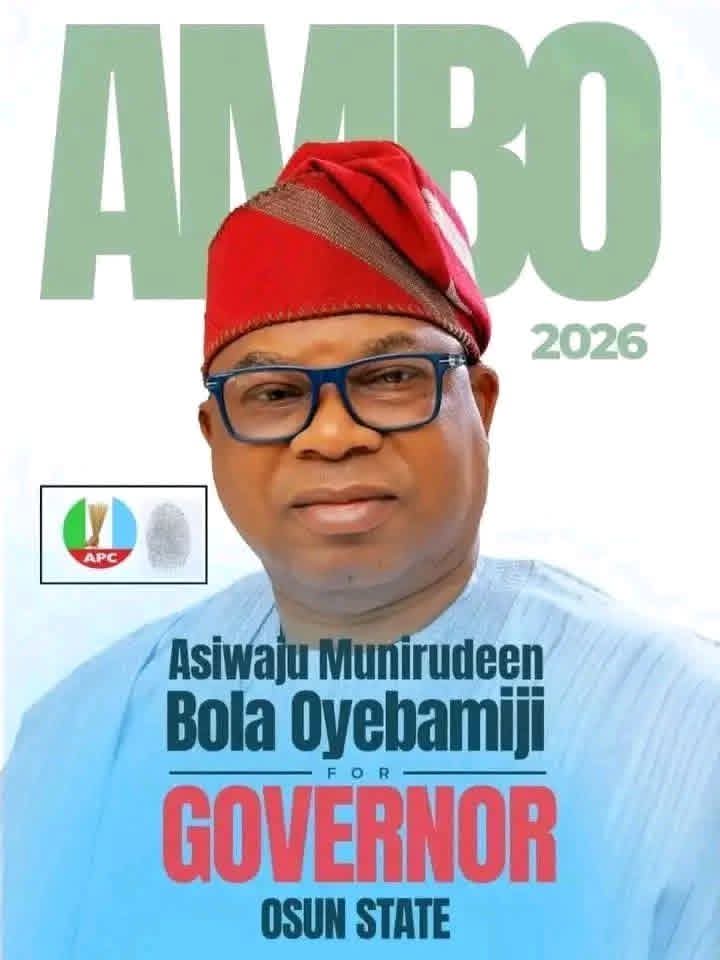
AMBO and the Osun Governorship Race: Assessing the Man, the Politics and the Vision
As political activities gather momentum ahead of the 2026 Osun State governorship election, a public affairs commentator, Oluseyi Olonade, has described the emergence of Asiwaju Munirudeen Bola Oyebamiji, popularly known as AMBO, as a significant development in the state’s political landscape.
In an article titled “Oyebamiji: The Man, The Politics and The Aspiration,” Olonade argued that the All Progressives Congress governorship hopeful possesses the character, experience and vision needed to reposition Osun State for sustainable growth.
According to the writer, Oyebamiji’s appeal stems from his extensive background in the banking sector, where he spent nearly three decades working with institutions including Wema Bank, Trans International Bank, Spring Bank and Enterprise Bank.
A native of Ikire in Irewole Local Government Area, Oyebamiji was described as a technocrat whose experience in corporate governance, finance and risk management has shaped his approach to public administration.
The article noted that his public service journey gained prominence in 2012 when he was appointed to oversee the then Osun State Investment Company Limited. Under his leadership, the organisation was reportedly restructured and transformed into Omoluabi Holdings Limited.
The writer further highlighted Oyebamiji’s tenure as Commissioner for Finance under successive APC administrations, where he was credited with managing the state’s finances during challenging economic periods.
Olonade also referenced Oyebamiji’s appointment as Managing Director of the National Inland Waterways Authority, describing it as further evidence of his administrative and leadership capabilities.
The article contrasted Oyebamiji’s governance philosophy with that of the current administration in Osun State, arguing that the APC aspirant favours institutional reforms, economic diversification and fiscal discipline.

According to the writer, Oyebamiji’s proposed agenda includes strengthening transparency in government spending, expanding internally generated revenue, attracting private-sector investments and promoting industrial and agricultural development.
The article also highlighted youth empowerment, entrepreneurship development and digital skills acquisition as key components of his vision for the state.
Olonade concluded that the forthcoming governorship election would present voters with a choice between different approaches to governance, expressing confidence that Oyebamiji’s experience and developmental agenda make him a strong contender in the race.
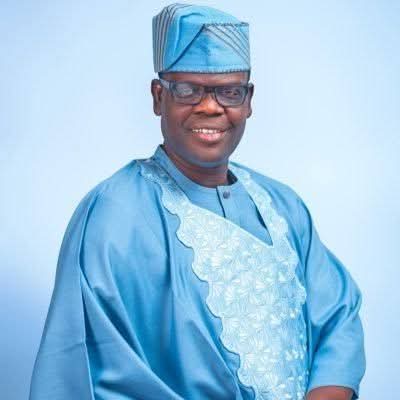
*Oselu Tiwa nTiwa Endorses Oriyomi Hamzat for Oyo Governorship*
A sociopolitical support group in Oyo State, Oselu Tiwa nTiwa, has declared its support for Alhaji Oriyomi Hamzat as the authentic governorship candidate of the Accord Party ahead of the forthcoming governorship election in the state.
The group made its position known in a statement jointly signed by its President, Mr. Adewale Oluwaseyi and Secretary, Alh. Adebayo Oyewole, on Thursday, describing Hamzat as a grassroots figure with strong connection to the people and a track record of humanitarian interventions across Oyo State.

According to the group, the endorsement followed what it described as careful observation of Hamzat’s leadership qualities, compassion and dedication to the welfare of ordinary citizens.
“Oriyomi Hamzat has consistently demonstrated empathy, courage and selfless commitment to humanity. Through his numerous interventions in the lives of ordinary citizens, he has become a symbol of hope to many families and communities,” the statement read.
Oselu Tiwa nTiwa also appealed to the national leadership of the Accord Party to prioritise the long-term future and electoral growth of the party in its decision-making process.
The group noted that Hamzat’s candidacy presents an opportunity for the party to strengthen its grassroots support base and expand its political relevance across Oyo State.
“We respectfully appeal to the National Leadership of the Accord Party to look beyond immediate political calculations and consider the bigger picture, the future growth, stability and electoral success of the party in Oyo State and beyond,” the statement added.
The group further expressed confidence in the leadership of the party, saying it believes the party’s national officers and stakeholders would take decisions that reflect fairness, inclusiveness and the collective interest of members.
While calling on party loyalists to remain calm and united, Oselu Tiwa nTiwa said continued consultations among stakeholders would help strengthen the Accord Party ahead of the election.
Signed:
Alh. Adebayo Oyewole,
Secretary.
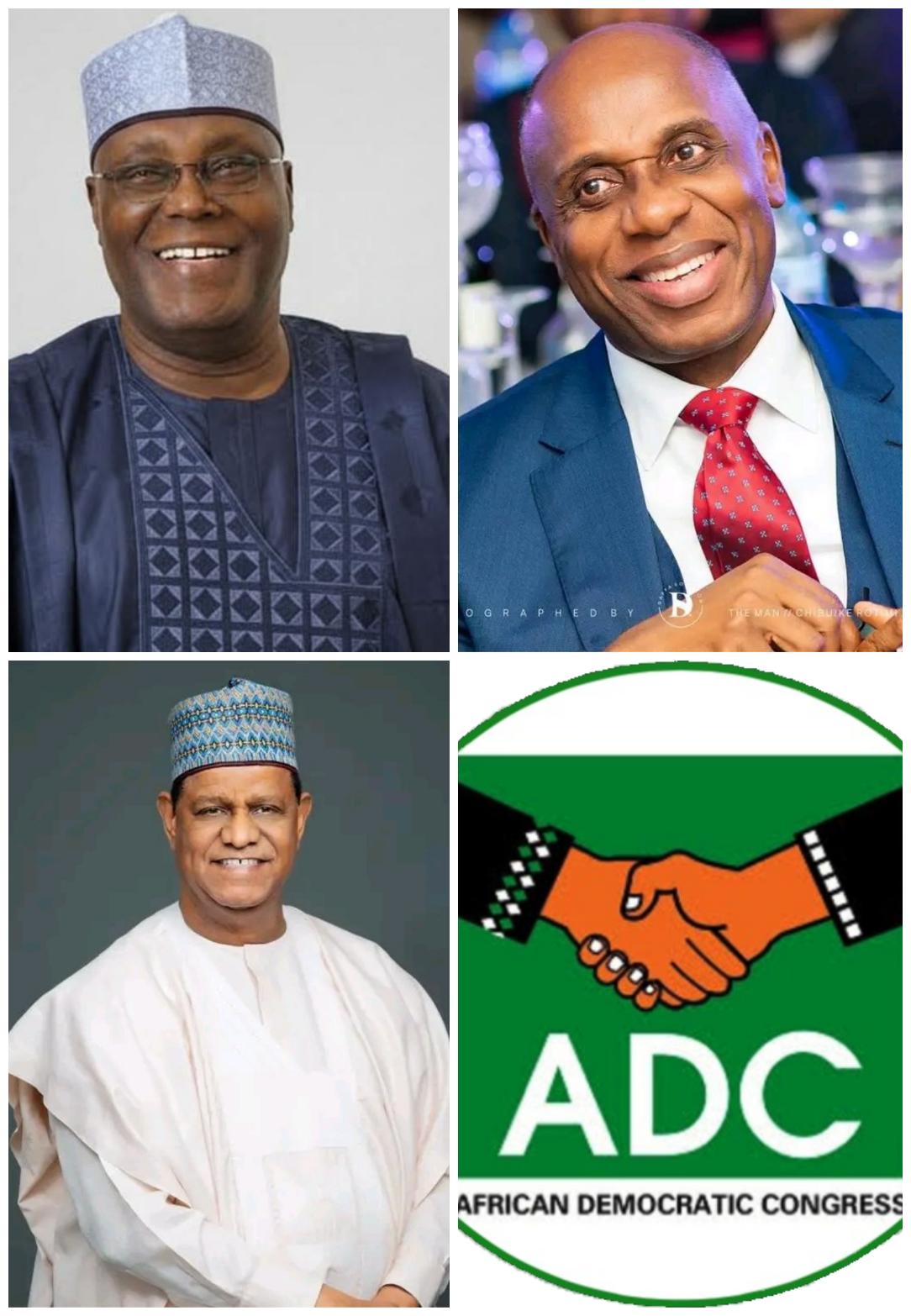
Atiku Set To Clinch ADC Presidential Ticket, Leads Amaechi, Hayatu-Deen In 34 States
Former Vice President of Nigeria and frontline presidential aspirant of the African Democratic Congress (ADC), Atiku Abubakar, is projected to emerge winner of the party’s presidential primaries, according to impeccable sources in Abuja.
The primaries, conducted across over 8,000 wards in the 36 states of the federation and the Federal Capital Territory, reportedly placed Atiku far ahead of his closest rivals — former Rivers State Governor, Rotimi Amaechi, and former Chairman of the Nigerian Economic Summit Group, Mohammed Hayatu-Deen.

Highly placed party insiders disclosed that Atiku is currently leading in 34 states, including the FCT, after securing dominance across the 19 Northern states, the five South-East states, and the six South-West states, while also maintaining a strong showing in at least three states in the South-South geopolitical zone.
The sources added that the outcome reflects what they described as “an overwhelming nationwide acceptance” of the former vice president within the opposition party ahead of the 2027 general election.
Meanwhile, the ADC leadership has invited members of the press to the official announcement of the final collated results scheduled for 11:00 a.m. on Tuesday, May 26, 2026, in Abuja.
The declaration of results is expected to be broadcast live on ARISE Television and two other major television stations, while also being livestreamed on the party’s official social media platforms on X and Facebook.
Speaking ahead of the announcement, the founding National Chairman of the ADC, Chief Ralph Nwosu, said the decision to televise the exercise live was aimed at promoting transparency and democratic accountability.
“We want millions of Nigerians at home and in the Diaspora to witness democracy in action,” Nwosu said.
He further revealed that the party leadership would encourage all three presidential aspirants to publicly embrace a peace accord and commit themselves to working together in unity for the party’s success.
According to him, the move is necessary to strengthen internal cohesion and position the ADC for victory in the presidential election scheduled for January 16, 2027.
Details later.


- Uganda: Parliament concludes vetting of ministers June 2, 2026
- Fund for Export Development in Africa (FEDA) Board Appoints Mr. Emmanuel Assiak as Chief Executive Officer June 2, 2026
- Ecobank Group Launches World First Nature Bond Mobilising Global Capital to Protect Africa’s Natural Ecosystems June 2, 2026
- Merck Foundation Chief Executive Officer (CEO) Dr. Rasha Kelej together with Kenya First Lady support the education of 47 Kenyan Schoolgirls by providing Annual Scholarships till they Graduate June 2, 2026
- Annual Meetings 2026: Governors Back the Bank’s Platform Solutions to Transform Aviation and Health Systems in Africa June 2, 2026
- ThinkMarkets launches ChelseaAI, bringing live CFD trading into Artificial Intelligence (AI) assistants June 2, 2026
- Afreximbank Invites Rugby Africa President Herbert Mensah to Address the 33rd Annual Meetings on a Panel Exploring Sport as a Driver of African Industrialisation June 2, 2026
- Afreximbank Deepens Commitment to Economic Progress in The Bahamas June 1, 2026
- African Electric Vehicle (EV) platform Spiro raises $215M in equity to scale electric mobility and energy infrastructure across Africa June 1, 2026
- Africa Centres for Disease Control and Prevention (Africa CDC) Statement on Attacks Against Health Facilities During the Bundibugyo Virus Disease Response in the Democratic Republic of the Congo June 1, 2026
- Uganda: Parliament concludes vetting of ministers June 2, 2026
- Fund for Export Development in Africa (FEDA) Board Appoints Mr. Emmanuel Assiak as Chief Executive Officer June 2, 2026
- Ecobank Group Launches World First Nature Bond Mobilising Global Capital to Protect Africa’s Natural Ecosystems June 2, 2026
- Merck Foundation Chief Executive Officer (CEO) Dr. Rasha Kelej together with Kenya First Lady support the education of 47 Kenyan Schoolgirls by providing Annual Scholarships till they Graduate June 2, 2026
- Annual Meetings 2026: Governors Back the Bank’s Platform Solutions to Transform Aviation and Health Systems in Africa June 2, 2026
- ThinkMarkets launches ChelseaAI, bringing live CFD trading into Artificial Intelligence (AI) assistants June 2, 2026
- Afreximbank Invites Rugby Africa President Herbert Mensah to Address the 33rd Annual Meetings on a Panel Exploring Sport as a Driver of African Industrialisation June 2, 2026
-

 news6 months ago
WHO REALLY OWNS MONIEPOINT? The $290 Million Deal That Sold Nigeria’s Top Fintech to Foreign Interests
-

 society4 weeks ago
SOCIAL MEDIA IS NOT A BATTLEFIELD COMMAND – WHY THE NIGERIAN ARMY’S ACTION AGAINST JUSTICE CRACK IS A NATIONAL SECURITY IMPERATIVE
-

 celebrity radar - gossips4 months ago
Dr. Chris Okafor Returns with Power and Fire of the Spirit -Mounts Grace Nation Altar with Fresh Anointing and Restoration Grace on February 1, 2026
-

 celebrity radar - gossips6 months ago
Prophet Kingsley Aitafo Releases 2026 Prophecy: ‘Nigeria Will Rise, but the World Must Prepare for Turbulence’
You must be logged in to post a comment Login
You must log in to post a comment.