
society
Nigeria’s Solar Cooking Scam: Empty Promises or Another National Distraction? (10 Million Solar Cookers, 200 Million Nigerians; Who Is Fooling Who?)


Nigeria’s Solar Cooking Scam: Empty Promises or Another National Distraction? (10 Million Solar Cookers, 200 Million Nigerians; Who Is Fooling Who?)
By George Omagbemi Sylvester | Published by SaharaWeeklyNG.com
Nigeria has never lacked promises; what we lack is delivery. Once again, the Federal Government (FG) has announced yet another lofty pledge; this time, a so-called “Free Solar Cooking Program” that allegedly targets 10 million households across the 36 states of the federation. The idea, on the surface, appears noble: providing free solar cookers to households as part of a clean energy initiative. But when examined with the eyes of reason, logic and Nigeria’s history of failed promises, it smells less like a plan and more like a political joke at the expense of a weary population.

The Numbers Don’t Add Up. Nigeria is a country of over 200 million people, with an estimated 45 million households. If the FG is targeting 10 million, that means only 1 in 5 households will benefit; assuming, of course, that the project ever materializes. History has taught us better: government promises in Nigeria are currency without backing, empty IOUs printed for political optics.
Take for example:
The ₦30,000 minimum wage signed into law in 2019. Till today, over 20 out 36 states have failed to implement it.
In June 2024, the FG promised a new ₦70,000 minimum wage. Two months later, more than half the states have refused to comply.

In 2023, Tinubu’s administration promised stable electricity, yet Nigeria has witnessed some of the worst power outages in a decade. Instead, the presidency spent ₦10 billion installing solar panels at Aso Rock, a personal luxury while the nation groans in darkness.
The government promised massive job creation, but youth unemployment remains above 33% (National Bureau of Statistics, 2024).
With this track record, what confidence should Nigerians have in a solar cooker initiative that sounds like a public relations stunt rather than a serious policy?

The Political Gimmickry of “Solar”. Solar cookers in themselves are not bad ideas. In fact, across Africa, many rural communities benefit from low-cost solar stoves to reduce dependence on firewood and charcoal. It’s an environmental win, reducing deforestation and greenhouse emissions. However, in Nigeria, context matters.
How do you roll out 10 million solar cookers in a country where:
The supply chains for such devices are weak?
Rural poverty is endemic?
Corruption ensures that contracts for such projects are inflated beyond recognition?
Previous government initiatives (from “Operation Feed the Nation” to “TraderMoni”) ended in waste, theft and unaccountability?
The danger is clear: this initiative risks becoming another avenue for looting, where billions are budgeted, a fraction is spent and the rest disappears into the pockets of cronies. Nigerians may never see these “solar cookers,” except during political campaign photo-ops.
Promises Without Performance. The Nigerian political class has mastered the art of governing by press release. Every administration comes armed with SLOGANS, CATCHY HEADLINES and COLORFUL PROMISES, only to abandon them halfway.
As Chinua Achebe once warned: “The trouble with Nigeria is simply and squarely a failure of leadership.” Leadership that prioritizes PROPAGANDA over POLICY, PROJECTS over PEOPLE and ANNOUNCEMENTS over ACCOUNTABILITY.
From Jonathan’s Subsidy Reinvestment Programme (SURE-P) to Buhari’s Next Level Agenda and now Tinubu’s “Renewed Hope,” Nigerians have seen hope renewed only in the bellies of politicians, never in their own kitchens. What is a solar cooker to a mother who cannot afford rice? What is renewable energy to a graduate roaming the streets unemployed? What is free cooking equipment to a man who cannot afford garri?
The Economic Burden. Let us be blunt: a solar cooker is not the priority of an average Nigerian household today. Inflation stands at 34% (NBS, July 2025), food inflation at over 40%, fuel prices have tripled since subsidy removal and the naira continues its free fall against the dollar.
Dr. Ayo Teriba, a respected Nigerian economist, recently noted: “The Nigerian economy is bleeding not from lack of projects, but from lack of priorities.” Instead of investing in real economic relief (minimum wage enforcement, agricultural subsidies, job creation) the government is offering solar stoves as consolation prizes.
History of Broken Energy Promises. This solar cooker scheme is also insulting when placed against the backdrop of Nigeria’s energy crisis. For decades, the government has promised stable electricity. Billions of dollars have been poured into power reforms, yet Nigeria generates less than 4,500 MW for over 200 million people, compared to South Africa’s 52,000 MW for 62 million people.
In 2020, Buhari promised 5 million new solar connections for households and businesses under the Solar Naija program. By 2023, less than 10% of that target had been achieved. What became of the billions allocated? Silence. Today, the same script is being replayed, this time with solar cookers. Nigerians have every right to call this what it is: a SCAM in DAYLIGHT.
Expert Opinions and Global Lessons. Globally, successful energy transitions require consistent planning, transparent funding and community buy-in. Ethiopia, for instance, has successfully distributed over 3 million solar lamps through partnerships with NGOs and the private sector. Kenya has become Africa’s leading hub for off-grid solar solutions, powered by strict accountability and international partnerships.
Nigeria, by contrast, treats such projects as political trophies. Professor Pat Utomi once lamented: “In Nigeria, development is not a serious agenda; it is a campaign slogan.” Until that mindset changes, no initiative (whether solar cookers or wind turbines) will bring real change.
What Nigerians Truly Need. Instead of empty promises, Nigerians need basic governance.
Enforce the ₦70,000 minimum wage across all states.
Invest in reliable electricity, not gimmicks.
Create jobs for the 13 million unemployed youths.
Tackle food insecurity, as millions face hunger daily.
Stop corruption that siphons funds from every program.
The IRONY is BITTER: a government that cannot provide fuel for cooking gas, stable electricity for electric stoves or affordable kerosene, now wants Nigerians to believe in a mass solar cooker miracle.
Closing Thought: A Call for Accountability. The solar cooker initiative may sound attractive to foreign donors and environmental lobbyists, to Nigerians, it is yet another mirage in the desert of false promises. Unless backed with transparency, proper funding and measurable outcomes, it will join the long list of Nigeria’s abandoned projects.
As the late Obafemi Awolowo wisely said: “The Nigerian problem is not money, it is how to spend it.” If the FG truly wants to solve the energy crisis, let it start with electricity reform, wage justice and food security not toys disguised as policy.
Until then, Nigerians must keep asking: Who benefits from these promises; the people or the politicians?





US-Based Society Lady, Fehintola-Brat Extends Eid-El-Kabir Greetings To Muslims
United States based fahionista of class, Chief (Mrs) Ayoola Fehintola-Brat has extended a warm greetings to Muslim faithful all over the world on the occasion of the 2026 Eid-El-Kabir celebration.
Fehintola-Brat who is the Balogun Egbe Obaneye Obinrin Akile Ijebu, and the Yeye Asofin of Idenaland in her message to Journalists urged Muslim to continually uphold the enduring values of sacrifice, obedience, faith, and compassion, which are central to the significance of Eid-El-Kabir festival.
A quiet philantropist whose humanitarian services has won her several laurels urged Muslims to use the spiritual occasion to pray for the peace co-existence of Nigerians regardless of religious, social and political leanings stressing that the oneness of the country should not be underplay.
In a related development, she expressed her felicitations to all sons and daughters of Ijebuland on the forthcoming Ojude Oba 2026 celebration, tasking age-groups otherwise known as Regbregbe to be more proactive in giving back to their immediate communities.
According to her, the beauty of the age-groups in Ijebuland is the need to contribute immensely to the development of the land in no small means. “This we will continue to achieve with God on our side”, she concluded.
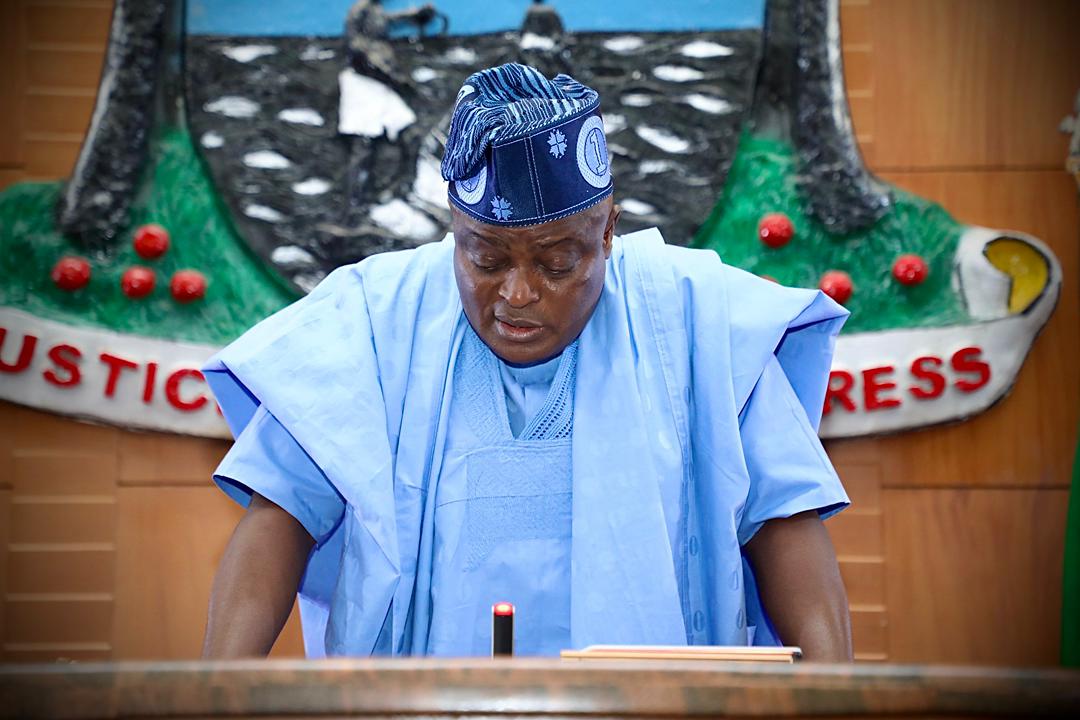
Sallah: Obasa Felicitates Muslim Ummah, Commends Nigerians for APC Primaries Turnout
The Speaker of the Lagos State House of Assembly, Rt. Hon. Mudashiru Obasa has extended warm felicitations to Muslims in Lagos State and across Nigeria on the occasion of Eid al-Adha.
In a statement released by his Chief Press Secretary, Mr. Dave Agboola, Obasa described the festival as a season of sacrifice, reflection, and gratitude, urging the faithful to continue to uphold the values of peace, unity, and love that strengthen the nation.
He noted that the celebration of Eid al-Adha is not only a spiritual milestone but also a reminder of the importance of togetherness and collective responsibility in building a stronger society.
He, likewise, emphasized that the festival provides an opportunity for Nigerians to renew their commitment to national progress and to support leadership that prioritizes development and prosperity.
Obasa, however, commended Nigerians, particularly members of the All Progressives Congress (APC), for their massive turnout during the recently concluded party primaries. He described the participation as a clear demonstration of the people’s confidence in the government of President Bola Ahmed Tinubu and their belief in the administration’s vision for a greater Nigeria.
“The APC primaries have shown the resilience of our democracy and the confidence Nigerians have in the leadership of President Bola Ahmed Tinubu and the Renewed Hope Agenda. This is a strong message that our people are ready to continue supporting policies that will drive growth and prosperity,” Obasa stated.
The Speaker further encouraged Muslims to celebrate responsibly, stressing that the joy of Eid should be accompanied by prayers for the continued peace and progress of Lagos State and Nigeria.
“As you celebrate with family and loved ones, may this season bring joy, peace, and prosperity to your homes. Let us remain united in our resolve to build a stronger nation,” he added.
On behalf of the Lagos State House of Assembly, Obasa wished all Muslims a happy and fulfilling Eid al-Adha celebration.

ABEOKUTA FILM FESTIVAL AT ILEYA
Kayshow Multimedia a filmmaking and Media organization this year 2026 holds its annual Abeokuta film festival at the Ake Palace in Abeokuta.
Alake of Egba land, Ọba Michael Adedotun Arẹmu Gbadebo has graciously endorsed the Free Training of Egba Youths on Film and Arts and the Entertainment of the the People with a FREE FILM SHOW at the AKE PAVILION. as part of the ABEOKUTA FILM FESTIVAL 2.0.
The Convener of the Film Festival Honorable Kehinde Soaga says this year’s event promises to be more exciting as distinguished personalities are sure to attend.
This includes the honorable Minister for Art Culture and Creative Economy in Nigeria, Barr. Hannatu Musa Musawa, Ààrẹ Lai Labode, Sen. Ibikunle Amosun and other special guests.
The event will feature Film, Cultural Dance Cultural foods and Award Ceremony.
The general public is hereby invited to the Free film show at the Abeokuta film festival at the Alake Palace Pavilion on Thursday 28th of May 2026 by 4:00 p.m.
Only well dressed is the Entry. The Abeokuta Film Festival is an annual event taking place in the capital city of Ogun State state.


- Qrent says delaying Information Technology (IT) refresh cycles may be increasing operational risk for businesses in Africa May 27, 2026
- Dentons’ Iyunola Adekanye Appointed to African Mining Week (AMW) Advisory Board May 27, 2026
- United Nations (UN) Women Liberia and Partners Convene for Spotlight Initiative 2.0 Women’s Economic Empowerment Inception Meeting May 27, 2026
- African Mining Week (AMW) to Host Central Bank Governors Roundtable as Monetary Authorities Deepen Role in Mining Sector Growth May 27, 2026
- Eritrea: Diaspora Nationals Celebrate Independence Day Anniversary May 27, 2026
- Africa Unveils Landmark Humanitarian Coordination Platform to Strengthen aligned Response to Humanitarian Crises May 27, 2026
- Seychelles: President Herminie Engages with Police and Fire Services on Praslin May 27, 2026
- Issue 3 of Mining Review Africa now available for free download May 27, 2026
- NOV Joins African Energy Week (AEW) 2026 as Gold Sponsor Amid Africa’s Offshore Expansion Push May 26, 2026
- African Union of Broadcasting (AUB) and United Nations University Institute for Water, Environment and Health (UNU-INWEH) Launch Landmark Webinar Series on Africa’s Water Crisis, Starting June 2, 2026 May 26, 2026
- Qrent says delaying Information Technology (IT) refresh cycles may be increasing operational risk for businesses in Africa May 27, 2026
- Dentons’ Iyunola Adekanye Appointed to African Mining Week (AMW) Advisory Board May 27, 2026
- United Nations (UN) Women Liberia and Partners Convene for Spotlight Initiative 2.0 Women’s Economic Empowerment Inception Meeting May 27, 2026
- African Mining Week (AMW) to Host Central Bank Governors Roundtable as Monetary Authorities Deepen Role in Mining Sector Growth May 27, 2026
- Eritrea: Diaspora Nationals Celebrate Independence Day Anniversary May 27, 2026
- Africa Unveils Landmark Humanitarian Coordination Platform to Strengthen aligned Response to Humanitarian Crises May 27, 2026
- Seychelles: President Herminie Engages with Police and Fire Services on Praslin May 27, 2026
-

 news5 months ago
WHO REALLY OWNS MONIEPOINT? The $290 Million Deal That Sold Nigeria’s Top Fintech to Foreign Interests
-

 society3 weeks ago
SOCIAL MEDIA IS NOT A BATTLEFIELD COMMAND – WHY THE NIGERIAN ARMY’S ACTION AGAINST JUSTICE CRACK IS A NATIONAL SECURITY IMPERATIVE
-

 celebrity radar - gossips4 months ago
Dr. Chris Okafor Returns with Power and Fire of the Spirit -Mounts Grace Nation Altar with Fresh Anointing and Restoration Grace on February 1, 2026
-

 celebrity radar - gossips6 months ago
Prophet Kingsley Aitafo Releases 2026 Prophecy: ‘Nigeria Will Rise, but the World Must Prepare for Turbulence’