
society
Nigeria’s $9 Million Image-Laundering Debacle: Misplaced Priorities, Diplomatic Failure and the Cost of Reputation Over Security

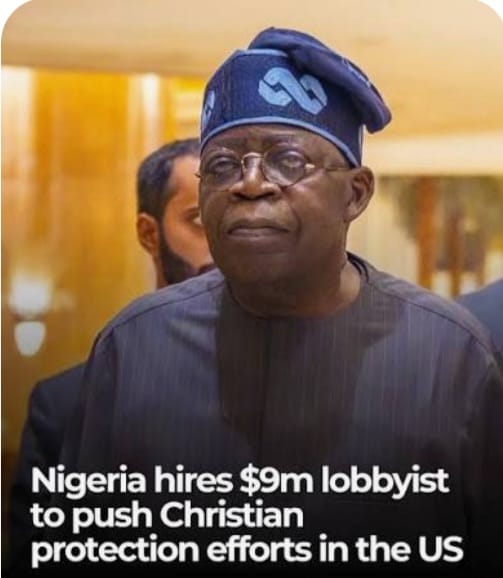
Nigeria’s $9 Million Image-Laundering Debacle: Misplaced Priorities, Diplomatic Failure and the Cost of Reputation Over Security.
By George Omagbemi Sylvester
“Why Abuja’s Decision to Spend Millions on U.S. Lobbying Amid Deepening Insecurity and Economic Hardship Is a National Embarrassment.”
In a decision that has sparked domestic outrage and intensified global scrutiny, the Federal Government of Nigeria has entered into a $9 million (about ₦13.5 billion) lobbying contract with a Washington-based public affairs firm in a bid to shape the narrative over alleged “GENOCIDE” claims against Christians in the country. The contract, which was executed on December 17, 2025, was signed on behalf of the Nigerian government by Aster Legal, a Kaduna-based law firm and DCI Group, an American lobbying and public affairs company. The agreement mandates that DCI Group help communicate Nigeria’s actions to protect Christian communities and sustain U.S. support for counter-terrorism efforts.

Yet, this costly engagement abroad has provoked resounding condemnation from political parties, civil society organizations and policy analysts who argue that such an expenditure (at a time of worsening insecurity and economic hardship) reflects a distorted sense of national priority and diplomatic failure.
A $9 Million Contract Amid Crises at Home. Under the terms of the contract, Nigeria paid an upfront $4.5 million on December 12, 2025, covering the first six months of the lobbying engagement. The remaining amount is structured as a monthly retainer of $750,000, bringing the total value to $9 million over one year, with the initial period running until June 30, 2026, and subject to automatic renewal unless terminated by either party with a 60-day notice.
The ostensible objective, officials say, is to “assist the Nigerian government in communicating its actions to protect Nigerian Christian communities and maintaining U.S. support in countering West African jihadist groups and other destabilizing elements.”
On its face, this may seem like a legitimate diplomatic engagement. However, critics argue it is reductive, counterproductive and a glaring misallocation of public funds at a time when Nigerians are confronted with everyday threats and from rampant banditry and terrorism to crippling inflation and infrastructure decay.

Misplaced Priorities, According to Critics. Commentators and civil society leaders have condemned the contract as scandalous, indefensible and morally blind. The African Democratic Congress (ADC), for instance, described the expenditure as “OBSCENE,” saying no amount of paid lobbying would hide the government’s failure to protect lives and property at home. The party’s National Publicity Secretary said: “While the ADC recognizes the importance of representing Nigeria’s interests internationally, spending $9 million on image management at a time when millions of Nigerians cannot afford food, fuel, or basic healthcare is a clear case of misplaced priorities and moral blindness.”
Similarly, the Peoples Democratic Party (PDP) labeled the public relations contract “DEFECTIVE and DECEPTIVE,” questioning why a government with vacant ambassadorial positions would outsource core diplomatic functions to a private law firm and yet fail to articulate its record effectively through its own diplomatic corps.
Human Rights Writers Association of Nigeria (HURIWA) also weighed in, calling the move a “senseless waste of public funds” when those resources could have been deployed to address security gaps that have cost thousands of lives and displaced millions.
Diplomacy by Proxy: A Sign of Institutional Weakness?

The Nigerian government’s turn to paid lobbying in Washington exposes a deeper institutional weakness in Nigeria’s diplomatic architecture. Diplomats and foreign service professionals are meant to champion Nigeria’s interests abroad. Yet, the reliance on external firms suggests that the government views international image management as a technical exercise to be contracted rather than a fundamental part of statecraft to be pursued through capable, accountable institutions.
An experienced former foreign service officer, speaking anonymously, noted: “A government that has left key ambassadorial positions vacant now seeks to outsource diplomacy to lobbyists, further weakening Nigeria’s institutional credibility and reducing foreign policy to transactional propaganda.” This view echoes widespread concern that international perception cannot be effectively rebranded without genuine improvement in security and governance on the ground.
The Genocide Narrative and Its Complexity. The backdrop to this lobbying contract is a contentious narrative surrounding alleged violence against Christian communities in Nigeria. In 2025, influential U.S. political figures, including former President Donald Trump, characterized the violence as “GENOCIDE,” a designation the Nigerian government has firmly rejected. Nigerian authorities insist that insecurity affects all communities irrespective of religion, attributing violence to terrorism, banditry and criminality rather than systematic religious persecution.
Yet the issue has gained traction among foreign policymakers, think tanks and diaspora advocates who argue that ethno-religious violence in Nigeria is intensifying and requires urgent international attention. This has created a competitive narrative environment in Washington, with various lobbyists, including groups linked to pro-Biafra activism, vying to influence U.S. policy and perceptions. According to recent reporting, Nigeria may well be outspending these lobbyists in an effort to shape the narrative in its favour.
While the debate is complex and multifaceted, the government’s heavy investment in narrative management abroad raises a fundamental question: Why spend millions on perception management when realities on the ground cry out for sound governance and security solutions?
A Government Under Pressure. Nigeria’s diplomatic outreach comes at a time when its international standing is under pressure. Aside from allegations of targeted violence, the country grapples with allegations of human rights violations in various regions and concern over the effectiveness of its counter-terrorism strategies. Meanwhile, within Nigeria, citizens face deteriorating economic conditions, skyrocketing inflation and daily insecurity.
A respected international relations scholar, Professor Amina Yusuf, summed up the dilemma: “Reputation is a by-product of reality, not a substitute for it. A government cannot buy legitimacy abroad while legitimacy at home collapses.”
This insight is particularly poignant in a nation where tertiary education experts and economists have repeatedly argued that security and economic stability are prerequisites for a positive global image and not the other way around. Investing in robust public institutions and ensuring citizens’ safety should logically precede investment in public relations abroad.
Toward an Authentic National Narrative. If Nigeria is to defend its global image effectively, the starting point must be substantive improvements at home. International audiences (policymakers, investors and civil society) look beyond glossy talking points to concrete developments: declining rates of violence, improved access to justice, respect for human rights and economic progress.
A veteran diplomatic analyst, Ambassador (ret.) Chukwuemeka Okafor, stresses this point: “Diplomacy without results is propaganda, and propaganda without results is hypocrisy. Our ambassadors must be empowered to tell our story, grounded in progress, not spin.”
The current approach (outsourcing narrative management while core domestic issues fester) runs the risk of projecting desperation rather than confidence. It is akin to repainting a crumbling wall instead of repairing the foundation.
Summative Perspective: Rebuilding Trust Through Action. Nigeria’s $9 million image management deal with a U.S. lobbying firm lays bare a deeper crisis of governance. It exemplifies a decisions-over-delivery mindset, prioritizing perception over performance. At a time when millions of Nigerians face insecurity, economic hardship and eroding trust in state institutions, this contract underscores a leadership disconnected from the immediate needs of its people.
A government that truly cares about its global reputation must first ensure security, accountability and prosperity at home. Only then can international narratives shift, but not through paid lobbyists but through undeniable progress. As Professor Yusuf aptly concludes: “A nation’s reputation is earned in the field, not bought in the boardroom.”
This report was compiled with reference to multiple sources including Nigeria’s recent $9 million lobbying engagement to counter alleged genocide claims and critical analyses of the broader political responses.






ABEOKUTA FILM FESTIVAL AT ILEYA
Kayshow Multimedia a filmmaking and Media organization this year 2026 holds its annual Abeokuta film festival at the Ake Palace in Abeokuta.
Alake of Egba land, Ọba Michael Adedotun Arẹmu Gbadebo has graciously endorsed the Free Training of Egba Youths on Film and Arts and the Entertainment of the the People with a FREE FILM SHOW at the AKE PAVILION. as part of the ABEOKUTA FILM FESTIVAL 2.0.
The Convener of the Film Festival Honorable Kehinde Soaga says this year’s event promises to be more exciting as distinguished personalities are sure to attend.
This includes the honorable Minister for Art Culture and Creative Economy in Nigeria, Barr. Hannatu Musa Musawa, Ààrẹ Lai Labode, Sen. Ibikunle Amosun and other special guests.
The event will feature Film, Cultural Dance Cultural foods and Award Ceremony.
The general public is hereby invited to the Free film show at the Abeokuta film festival at the Alake Palace Pavilion on Thursday 28th of May 2026 by 4:00 p.m.
Only well dressed is the Entry. The Abeokuta Film Festival is an annual event taking place in the capital city of Ogun State state.
society
Still Earth Holdings Strengthens Governance Structure Through EFCC–SCUML Compliance Training
Still Earth Holdings Strengthens Governance Structure Through EFCC–SCUML Compliance Training
Lagos, Nigeria – The Economic and Financial Crimes Commission (EFCC), through its Special Control Unit against Money Laundering (SCUML), has conducted an intensive Anti-Money Laundering and Counter-Financing of Terrorism (AML/CFT) compliance training for the board and senior management of Still Earth Holdings.
The programme, held over the weekend, was designed to reinforce corporate governance, regulatory compliance, and risk management across the group and its subsidiaries.
Delivering the keynote, Ibinabo Mary Amachree, Head of SCUML Lagos, underscored the importance of board-level responsibility in compliance. She emphasised that under the Money Laundering (Prevention and Prohibition) Act 2022 and the Terrorism Financing Prevention and Prohibition Act 2022, directors now face both personal and corporate liability for systemic failures.
Reinforcing this regulatory warning with a strategic vision, Mr. Mutiu Sunmonu, Chairman of Still Earth Holdings, framed governance as both a moral compass and a competitive differentiator for the group.
“Our responsibility as leaders is not only to deliver profits but to safeguard the reputation and resilience of the institutions we steward,” Sunmonu noted. He asserted that the board’s role is to ensure that every subsidiary—whether in construction, energy, or finance—operates under the same uncompromising ethical framework. “Governance is not a department; it is the DNA of Still Earth,” he added, highlighting that the company’s legacy depends on its ability to harmonize compliance with innovation.
The training session covered critical areas including board responsibilities in AML/CFT oversight, fundamentals of money laundering, terrorism financing risks, legal frameworks, preventive measures, and governance duties. Participants were trained on Know Your Customer (KYC) procedures, customer due diligence, suspicious transaction reporting, targeted financial sanctions screening, and record keeping.
Interactive case studies exposed sector-specific risks across subsidiaries such as Tirex Petroleum & Energy, Still Earth Construction, and Still Earth Capital Finance. Discussions highlighted issues including over-invoicing, shell companies, offshore payments, contract splitting, and the identification of politically exposed persons (PEPs).
Commenting on the operational impact of this vision, Kingsley Inyama, Head of Credit Risk, described the programme as both timely and essential.
He noted: “The essence of the training is to understand when anti-money laundering violations or terrorism financing may be taking place. In business, especially in the international sector, it is important to know the source of funds.” Inyama stressed the importance of identifying beneficial owners in transactions, noting that “the penalties for failing to do so can include fines, sanctions, and even imprisonment.”
The training concluded with a commitment to several high-level board resolutions aimed at cultivating a brand synonymous with probity and excellence:
• Adoption of a zero-tolerance policy on money laundering and terrorism financing.
• Establishment of compliance committees to ensure constant oversight.
• Mandating annual training programmes for staff and management.
• Approval for independent audits to validate internal compliance claims.
The annual compliance programme was attended by staff and management of Still Earth Holdings and its subsidiaries, reinforcing the group’s commitment to embedding integrity at the heart of its operations and building a corporate legacy that transcends financial earnings.
society
King Saheed Osupa Releases New 2-in-1 Album, Acapella & Metamorphosis By Alhaji Arems (Baba Fuji)
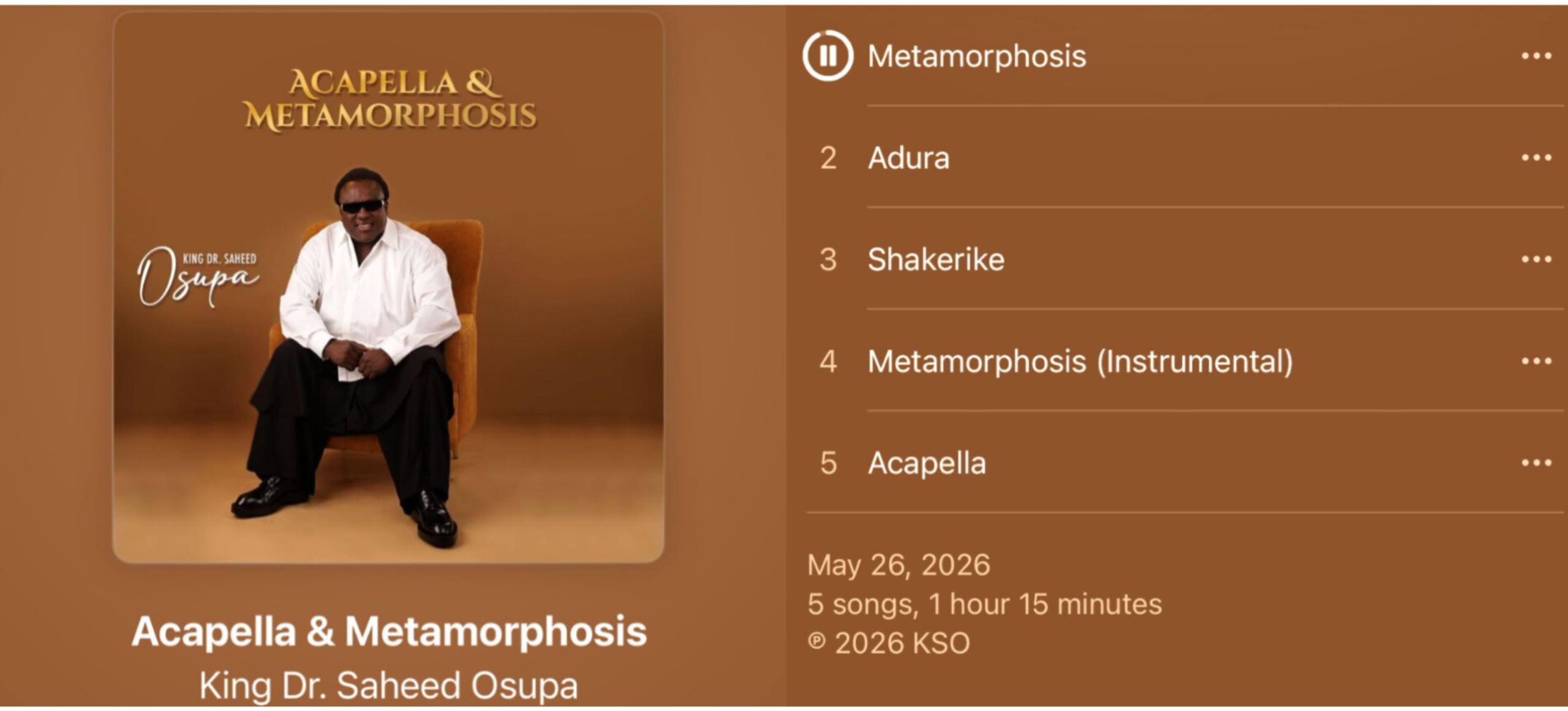
King Saheed Osupa Releases New 2-in-1 Album, Acapella & Metamorphosis
By Alhaji Arems (Baba Fuji)
Veteran Fuji music icon King Dr. Saheed Osupa has officially released his new 2-in-1 album, Acapella & Metamorphosis, now live on Apple Music and being promoted across other digital platforms. Apple Music lists the project as a 2026 Fuji release containing five songs with a total runtime of 1 hour and 15 minutes.
The release arrives after a buildup of promotional activity across social media, where posts describing the project as available on major streaming platforms helped fuel anticipation ahead of the drop. Public-facing materials tied to the rollout also framed the album as a significant new entry in Osupa’s catalog.
With Acapella & Metamorphosis, Osupa extends a career that has long positioned him among the most respected voices in Fuji music. His work has consistently carried the weight of Yoruba cultural storytelling, strong lyrical identity, and a sound that continues to resonate with longtime Fuji listeners as well as newer audiences drawn to traditional rhythms. Apple Music’s artist page also places the album at the top of his latest releases, underscoring the project’s arrival as his newest major body of work.
The album’s title gives the project an immediate conceptual edge. Acapella suggests a stripped-down, voice-led expression, while Metamorphosis points toward growth, reinvention, and artistic transition. Together, the two titles create the sense of a project that may balance classic Fuji sensibilities with a refreshed presentation, a combination that fits Osupa’s reputation for preserving the foundation of the genre while remaining visibly active in the present era. That reading is an editorial inference based on the album title and release framing, not an official statement from the artist.
The release also reflects a wider pattern among legacy acts who continue to treat full-length projects as statements of intent. In an era where many artists rely heavily on singles and shorter drops, a five-track, hour-long album signals patience, range, and confidence in the listening experience. For Osupa, it is also another reminder that Fuji still has room to breathe, evolve, and command attention in a fast-moving streaming landscape.
Fans following the rollout have continued to react positively online, with messages of support and anticipation circulating ahead of the release. With the album now available, attention will turn to how listeners receive the project and whether Acapella & Metamorphosis becomes another defining entry in the singer’s long-running catalogue.
Acapella & Metamorphosis is available now for streaming.


- African Leaders Mobilise Funding and Regional Response as Ebola Outbreak Escalates May 26, 2026
- Seychelles: Appointment of the Chief Executive Officer of the Careers and Further Education Agency May 26, 2026
- African Leadership Magazine Announces Winners of the 16th African Business Leadership Awards (ABLA) 2026 May 26, 2026
- President receives credentials of Ambassador of the Kingdom of Sweden to the Republic of Seychelles May 26, 2026
- Seychelles: President Herminie Presented with Future Development Vision for New Baie St Anne Jetty May 26, 2026
- Ammat Global Resources Redefines Local Content Through Congolese-Led Operations May 26, 2026
- Republic of Congo’s Newly-Appointed Hydrocarbons Minister Stev Simplice Onanga to Speak at African Energy Week (AEW) 2026 Amid Major Gas Expansion Push May 26, 2026
- Merck Foundation in partnership with Ghana First Lady and Lordina Foundation launch their “Educating Linda” Program to support Girl Education May 26, 2026
- Transforming Healthcare and Empowering Women: Dr. Rasha Kelej Recognized Among Africa’s 100 Most Influential Women May 25, 2026
- 2026 BASKETBALL AFRICA LEAGUE SEASON: BY THE NUMBERS May 25, 2026
- African Leaders Mobilise Funding and Regional Response as Ebola Outbreak Escalates May 26, 2026
- Seychelles: Appointment of the Chief Executive Officer of the Careers and Further Education Agency May 26, 2026
- African Leadership Magazine Announces Winners of the 16th African Business Leadership Awards (ABLA) 2026 May 26, 2026
- President receives credentials of Ambassador of the Kingdom of Sweden to the Republic of Seychelles May 26, 2026
- Seychelles: President Herminie Presented with Future Development Vision for New Baie St Anne Jetty May 26, 2026
- Ammat Global Resources Redefines Local Content Through Congolese-Led Operations May 26, 2026
- Republic of Congo’s Newly-Appointed Hydrocarbons Minister Stev Simplice Onanga to Speak at African Energy Week (AEW) 2026 Amid Major Gas Expansion Push May 26, 2026
-

 news5 months ago
WHO REALLY OWNS MONIEPOINT? The $290 Million Deal That Sold Nigeria’s Top Fintech to Foreign Interests
-

 society3 weeks ago
SOCIAL MEDIA IS NOT A BATTLEFIELD COMMAND – WHY THE NIGERIAN ARMY’S ACTION AGAINST JUSTICE CRACK IS A NATIONAL SECURITY IMPERATIVE
-

 celebrity radar - gossips4 months ago
Dr. Chris Okafor Returns with Power and Fire of the Spirit -Mounts Grace Nation Altar with Fresh Anointing and Restoration Grace on February 1, 2026
-

 celebrity radar - gossips6 months ago
Prophet Kingsley Aitafo Releases 2026 Prophecy: ‘Nigeria Will Rise, but the World Must Prepare for Turbulence’