
society
Obi’s Civility Mandate: Reclaiming Opposition Politics from the Politics of Toxicity


Obi’s Civility Mandate: Reclaiming Opposition Politics from the Politics of Toxicity
By George Omagbemi Sylvester | SaharaWeeklyNG.com
“Why condemning insults against coalition partners is not just strategy, but a moral imperative for Nigeria’s democratic renewal.”
In an era when political discourse increasingly resembles a battlefield littered with verbal grenades, Peter Obi’s unmistakable declaration that “anyone insulting ADC leaders is a criminal, not an Obidient” marks not merely a rhetorical pivot, but a fundamental moral stance in Nigeria’s fractious political landscape.
Obi, the former Labour Party presidential candidate and one of the most consequential voices in Nigerian politics today, delivered the statement at an engagement of his Obidient Movement. In unmistakable terms he dissociated himself and his movement from the tidal wave of infighting poisoning the opposition coalition, insisting that resorting to name-calling, mudslinging and personal attacks does not belong in the politics he envisions for the nation.
This stance is not a trivial reprimand. It is a clarion call for a higher standard of political engagement at a time when Nigeria grapples with deepening insecurity, unemployment, institutional dysfunction and widening distrust between leaders and citizens. The significance of Obi’s statement is profound and its implications extend well beyond intra-party disagreements.
A Foundational Rejection of Toxic Politics.
Mr. Obi’s emphasis that verbal attacks against coalition partners or whether within the African Democratic Congress (ADC) coalition or among the broader opposition (are signs of criminal behavior, not genuine political advocacy) reframes how political movements should conduct themselves.
He refused to allow political identity to be weaponized against personal dignity. In his own words, those hurling insults are not authentic Obidients but “criminals that are not Obidient people.”
This matters for two reasons:
It anchors political contestation back to ideas and governance priorities rather than personality attacks.
It preserves the moral credibility of a movement that has attracted millions of Nigerians tired of corrosive politics.
In saying so, Obi effectively rejects a politics of vitriol that has, for decades, stood as an impediment to democratic deepening in Nigeria. Where political debate once focused on issues and policy, it all too often collapses into ad hominem attacks, death of ideas by drowning in anger.
Context: Opposition Realignment and Internal Strain.
Nigeria’s opposition has been in flux since the 2023 general elections. Parties and movements coalesced into what became the ADC coalition, seeking to offer a viable alternative to the ruling All Progressives Congress (APC). Embedded within that coalition are figures such as former Vice President Atiku Abubakar, Rotimi Amaechi, Nasir el-Rufai and other veterans of Nigeria’s political field.
As Obi engaged with the coalition, tensions emerged. Supporters of different aspirants, driven by fervent hope for leadership change, began to clash (sometimes online, sometimes in street protests) over ideas of zoning, prioritization and political leadership direction. Some of these disputes degraded into personal attacks.
In response, Obi’s emphatic repudiation of those attacks was not mere politeness. It was a strategic and ethical refusal to allow the opposition’s project to be undermined by the very habits of contempt that Nigerians have grown weary of under years of governance failures.
Why Civility Is Strategic Politics.
At first glance, insisting on respectful dialogue might appear soft politics in a hard political world. Yet respected political theorists have long argued that healthy democracies require norms of mutual respect, even amidst passionate disagreement.
The late political scientist Robert Dahl observed that “democracy is not merely a system of institutions; it is a culture of respect, dialogue and mutual tolerance.” When that culture is abandoned for polarization, democratic systems weaken and may eventually collapse into extremism or authoritarian habits.
By repudiating insults (even from within his own rank and file) Obi demonstrates an adherence to democratic norms that scholars say are essential for political legitimacy. Political psychologist Dr. Jonathan Haidt echoes this in his work on social cohesion, arguing that political movements that police toxic language are better positioned to build inclusive coalitions and durable governance frameworks. Such restraint signals maturity and a long-term view of national interest over short-term factional advantage.
A Principle-First Approach, Not Personality Politics.
Obi’s rebuke of abusive rhetoric is not a call for blind loyalty or silence in disagreement. Rather, it is a principled commitment that disagreements within democratic politics should advance through debate, persuasion and principle, never through degrading those with whom one disagrees.
This distinction is crucial. Civility is not the absence of dissent; it is dissent conducted with dignity.
This stance distinguishes Obi’s Obidient Movement from other movements in Nigerian politics. It counters narratives that portray his supporters as reactive or hostile and positions them instead as advocates of disciplined political engagement focused on solving Nigeria’s systemic problems.
Reframing Political Discourse: Issues Over Insults.
In his statement, Obi urged supporters to concentrate on the pressing challenges Nigeria faces: out-of-school children, hunger, unemployment, insecurity and widespread kidnappings.
This grounding in substantive issues reflects a broader philosophy in policy-oriented politics: discourse should elevate concerns that affect citizens’ lives rather than consume itself with internal squabbles.
Former U.S. President Abraham Lincoln captured the essence of political purpose when he said, “A house divided against itself cannot stand.” In a Nigerian context, if opposition politics devotes itself to name-calling, it betrays the very voters demanding accountability, competence and sustainable governance.
The Political Risks of Toxicity.
Why does this matter now, because toxicity in political movements is not just unprofessional, it is harmful.
Political science research shows that:
Electoral alliances built on bitter internal conflict rarely endure. Sections of coalition partners may defect, voter confidence may erode and narratives of incompetence can gain traction.
Toxic discourse can amplify divisions along ethnic, regional and religious lines, which Nigeria, with its historical regional and identity sensitivities, cannot afford ahead of national elections.
When insults become normalized, adversaries of democratic reform benefit. They use chaos to justify centralization, suppression or rule by decree. What starts as internal bickering can metastasize into a crisis of legitimacy and national instability.
Obi’s Leadership Test.
By disowning verbal attacks, Obi invites his supporters (and Nigerian politics) to a far higher standard of engagement. He calls for restraint without surrendering ambition; for firmness without bitterness; for advocacy without abuse.
In doing so, Obi’s message resonates with scholars like Norman Ornstein, who asserts that “democracy dies in darkness and thrives in the light of thoughtful, civil, informed dialogue.” This is not a call for passivity. It is a call to elevate the discourse while staying laser-focused on outcomes that impact Nigeria’s future.
Parting Thought: A Turn Toward Democratic Maturity.
Peter Obi’s statement is not a garden-variety political rebuke. It is a critical inflection point in Nigerian politics that emphasizes:
The importance of respect in political coalitions
The necessity of focusing on policy and governance not personalities
The moral foundation for opposition unity built on discourse not division
As Nigeria prepares for future elections and the challenges of nation-building ahead, Obi’s stance reminds us that leadership begins with how we speak to and about one another. Civility in politics is not weakness, it is strength, courage and a profound demonstration of a movement that seeks to govern with integrity, not insult.
In a country yearning for change, repositioning political language toward respect and substance may be the most transformative act of leadership of all.






Dr. Bernard Shiaunda Eete Mobilizes Loyalists Ahead of Kenya’s General Election
Ahead of Kenya’s 2027 general election, Nyanza ODM aspirant Dr. Bernard Shiaunda Eete, popularly known as Dumex3, has intensified grassroots mobilization by holding a strategic meeting with his loyalists across the region. The gathering was aimed at aligning his team, refining campaign strategies, and positioning the movement for a decisive outcome at the polls.
The meeting provided an important platform for open consultation, idea exchange, and consensus building. Dr. Eete emphasized the need for unity, discipline, and clear communication as the campaign enters a critical phase. According to attendees, the discussions focused on strengthening the political structure on the ground, addressing community concerns, and ensuring that the movement remains responsive to the aspirations of the people.
A key focus was Dr. Eete’s developmental agenda for Nyanza. He outlined his commitments to education, youth empowerment, healthcare access, and infrastructure development, noting that these areas remain central to transforming lives in the region. He urged his loyalists to carry the message to the grassroots, explaining both what has been achieved so far and what the region stands to gain if they rally behind his candidacy.
“This is not just about winning an election. It’s about building a stronger, united political movement that delivers real change for our people,” Dr. Eete told the gathering. He called on his supporters to remain focused, avoid divisive rhetoric, and engage voters with facts about his track record and plans.
The meeting ended with a renewed commitment from the loyalists to expand outreach, coordinate ward-level activities, and mobilize voters ahead of party primaries and the general election. Organizers described the session as productive, noting that it sharpened the team’s resolve and clarified immediate next steps.
As political activity heats up in Nyanza, Dr. Eete’s camp says the strategy is clear: consolidate support, communicate consistently, and deliver a campaign anchored on service and results.


Live update from Kenya by Hon. Babatunde Seidu, Youths Ambassador._
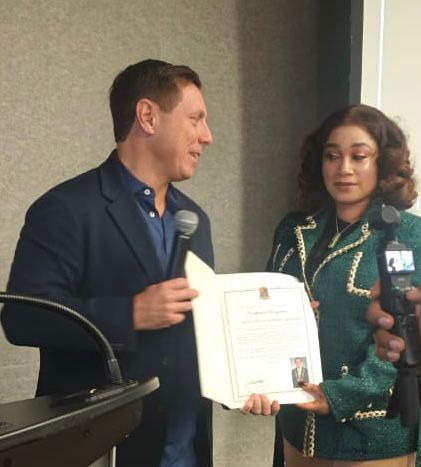
Mayor of Brampton Honours Olajumoke Abegunde For Charitable Works
…Foundation Touches Over 8,000 Women, Widows, and Youth in Ondo State…..
…Collaborates with International Partners for Free Skill Acquisition in Canada…
For Chief Mrs. Olajumoke Abegunde, the act of touching lives positively and contributing meaningfully to societal development is not merely a pastime but a deeply ingrained existential mandate. With unwavering gusto, she has remained faithful to this noble vision, championing the esoteric principle that cheerful giving and advocacy for the downtrodden are responsibilities too sacred to be left exclusively in the hands of the government.
This resolute philosophy has not only engendered transformative impact within her immediate locality but has also catapulted her onto the global stage. Recently, her passionate charitable exertions—executed both within and outside the shores of Nigeria—earned her prestigious international recognition.
A Legacy of Grassroots Transformation
As the visionary founder of the Jummy I Care Foundation, Chief Mrs. Abegunde has systematically dismantled barriers of vulnerability across Ondo State. Through sustained philanthropic gestures, she has disbursed extensive humanitarian relief and social assistance to over 3,000 indigent widows and elderly persons. In parallel, her foundation has galvanized robust support for orphaned and vulnerable children while orchestrating an ambitious women’s empowerment programme. To date, over 5,000 women have benefited from skills acquisition and income-generating activities designed to cultivate self-reliance and entrepreneurial audacity. Many of these beneficiaries have also received start-up seed capital to establish their own enterprises.
A proud alumna of Criminology and Security Studies from the National Open University of Nigeria, Chief Mrs. Abegunde has also distinguished herself as a patron of youth development. She has sponsored numerous essay writing and entrepreneurship competitions across Ondo State, in addition to funding medical outreaches, orphanage interventions, Iftar and Easter entrepreneurship programmes, and sustained feeding initiatives for the less privileged.
Her core philosophy remains immutable: when those who are well-to-do invest strategically in their immediate society, the collective becomes safer, more stable, and poised for greater heights.
International Collaboration and Brampton Honour
In a decisive move to intensify her developmental footprint, the Jummy I Care Foundation recently entered into a strategic tripartite collaboration with the Habeeb Okunola Foundation and the MakeMee Elegant Foundation. Together, they delivered a gratuitous, high-impact skill acquisition training programme to residents of Brampton, Canada.
Participants were immersed in an array of artisan crafts, including the production of resin bags, photo books, picture otters, resin key holders and frame holders, ornamental flower vases, rhinestone embellishment, and the advanced technique of printing images on fabrics.
In a ceremonial recognition of her sustained benevolence, the Mayor of Brampton formally hosted Chief Mrs. Abegunde and her delegation at the mayor’s office. The mayor personally expressed profound gratitude for her unwavering support of community development and entrepreneurship. As a tangible emblem of this appreciation, she was presented with a personally signed certificate of appreciation and commendation.
Unwavering Commitment to the Future
While accepting the honour, Chief Mrs. Olajumoke Abegunde reaffirmed her immutable resolve. She declared that her commitment to touching lives remains absolute and non-negotiable. According to her, she will not relent in ensuring that more lives are touched, more support is channeled to the people, and greater stability is secured for communities. She further emphasized her dedication to cultivating the spirit of entrepreneurship among women and youths as a cornerstone for sustainable development.
With over 8,000 direct beneficiaries in Nigeria alone and an expanding international footprint, Chief Mrs. Abegunde stands as a formidable testament to the profound change one determined philanthropist can effectuate when passion meets purpose.



APM Senatorial Candidate Ajadi Distributes Over 500 Bags of Rice
The Senatorial candidate of Oyo Central Senatorial District under the Allied Peoples Movement (APM), Ambassador Olufemi Ajadi Oguntoyinbo, has distributed over 500 bags of rice to residents, party members, state executives, and key stakeholders across Oyo State ahead of the forthcoming Eid al-Adha celebration.
The gesture, which forms part of his annual humanitarian outreach, was aimed at easing economic hardship and strengthening unity among party executives, party members, and residents within the senatorial district during the festive period.
Ajadi said the distribution was a continuation of his commitment to supporting vulnerable households and fostering community solidarity, especially at a time when many families are facing rising food prices and economic pressure.
He explained that Eid al-Adha is rooted in sacrifice, sharing, and compassion, adding that political leadership must consistently reflect empathy for the people, regardless of political affiliation or election cycles.
According to him, the intervention was extended to party executives, grassroots mobilizers, youth groups, and key stakeholders across the senatorial district to ensure equitable distribution across different segments of the political structure in Oyo State.
Ajadi further noted that the initiative was designed to complement household food needs during the festive season, stressing that small acts of support can significantly ease the burden on families affected by economic challenges.
He urged political leaders at all levels to prioritize welfare-driven initiatives that have direct impact on citizens, emphasizing that leadership should go beyond campaigns to sustained service delivery and humanitarian engagement.
Beneficiaries of the rice distribution expressed appreciation for the gesture, describing it as timely and thoughtful amid rising food costs across the country.
They commended Ajadi for maintaining close contact with grassroots members and consistently demonstrating what they described as people-oriented leadership.
The distribution exercise was carried out across selected locations within Oyo Central Senatorial District and coordinated through local party structures to ensure fairness and orderly sharing.
Political observers in the state noted that such interventions have become a key feature of political engagement in Nigeria, particularly during festive seasons, as politicians seek to connect with constituents beyond electoral promises.
As the Eid al-Adha celebration approaches, Ajadi reaffirmed his commitment to continuing similar initiatives aimed at supporting families and promoting unity among residents of Oyo State.


- Venezuela Under Rodriguez: Turning Back Toward Stability and Opportunity (By NJ Ayuk) May 25, 2026
- Dubai Chamber of Commerce concludes trade mission in Addis Ababa with series of bilateral business meetings between companies from Dubai and Ethiopia May 25, 2026
- How Congo’s Offshore Legacy Fields Are Powering a New Production Upswing May 25, 2026
- Rugby Africa Appoints Former National Basketball Association (NBA) Africa Executive Aïcha Diop as Chief of Staff to the President May 25, 2026
- Global Africa Business Initiative shifts Digital and Health Action Pathways into higher gear to accelerate continent’s economic transformation May 25, 2026
- The Board of Trustees of the Al-Sumait Prize for African Development announces the award winner for the year 2025; It has been awarded to an African institution and researcher in the field of food security May 25, 2026
- Statement of the International Contact Group for the Great Lakes (ICG) on the situation in the eastern Democratic Republic of the Congo (DRC) May 24, 2026
- Eritrea: Messages of Congratulations May 24, 2026
- African Development Bank (AfDB) – 2026 Annual Meeting: Full live coverage on Africa 24 May 24, 2026
- Countries in the Horn of Africa and Yemen recommit to ending variant poliovirus May 23, 2026
- Venezuela Under Rodriguez: Turning Back Toward Stability and Opportunity (By NJ Ayuk) May 25, 2026
- Dubai Chamber of Commerce concludes trade mission in Addis Ababa with series of bilateral business meetings between companies from Dubai and Ethiopia May 25, 2026
- How Congo’s Offshore Legacy Fields Are Powering a New Production Upswing May 25, 2026
- Rugby Africa Appoints Former National Basketball Association (NBA) Africa Executive Aïcha Diop as Chief of Staff to the President May 25, 2026
- Global Africa Business Initiative shifts Digital and Health Action Pathways into higher gear to accelerate continent’s economic transformation May 25, 2026
- The Board of Trustees of the Al-Sumait Prize for African Development announces the award winner for the year 2025; It has been awarded to an African institution and researcher in the field of food security May 25, 2026
- Statement of the International Contact Group for the Great Lakes (ICG) on the situation in the eastern Democratic Republic of the Congo (DRC) May 24, 2026
-

 news5 months ago
WHO REALLY OWNS MONIEPOINT? The $290 Million Deal That Sold Nigeria’s Top Fintech to Foreign Interests
-

 society3 weeks ago
SOCIAL MEDIA IS NOT A BATTLEFIELD COMMAND – WHY THE NIGERIAN ARMY’S ACTION AGAINST JUSTICE CRACK IS A NATIONAL SECURITY IMPERATIVE
-

 celebrity radar - gossips4 months ago
Dr. Chris Okafor Returns with Power and Fire of the Spirit -Mounts Grace Nation Altar with Fresh Anointing and Restoration Grace on February 1, 2026
-

 celebrity radar - gossips5 months ago
Prophet Kingsley Aitafo Releases 2026 Prophecy: ‘Nigeria Will Rise, but the World Must Prepare for Turbulence’