
Business
OLUMIDE AKINDIYA WINS AN AWARD


Recently, an Award was organised by an entertainment company, NaijaGal Entertainment on the 16th of August, 2015 to celebrate 37 personalities. Few of the Awardees are Malvin Records, AY, Koffi, Godwin Enakhena, Toyin lbitoye, Mfon Udoh, Bar. Olumide Akindiya, Zinnox Technologies, Omo Baba, Yemi Alade, Mr. Femi Aderibigbe aka Kwame and other top personalities/celebrities. This Award named: MyMicMySwag Season 2 has its host to be Koffi ldowu Nuel, Empress Njamah and Omo Baba (Masters of Ceremonies). DJ Switch played at the event apart from receiving Award with other artists: BXY, etc. Our guest being one of the Awardees for Barrister was celebrated for his amazing inspiration to African Youths through legal education and tenacity. His name is Barrister Olumide Akindiya.
Olumide Akindiya is the Principal Partner of Olumide Akindiya & Co., Legal Practitioners, Corporate & Real Estate Consultants with corporate office at No. 47, Apapa-Oshodi Expressway, Charity Bus Stop, Orile-Oshodi in Lagos State. His law firm came into existence in March 27, 2012 with lone vision of his. With his members of staff, they have offered Client satisfaction through several litigation matters and Solicitorship and also free legal services to helpless and poorer people. His firm offers general legal services including entertainment. Just like other professionals, he has celebrities as friends, clients and prospective clients. He is also a Poet with his type of poem called legal poem. He is one of the youngest law columnists in Nigeria with his weekly column called “Ask the Lawyer” in Hallmark Newspaper every Tuesday for more than a year educating the public on law and raising potentials of youth through seminars. He has published up to 39 legal topics and legal issues. He was one of the recipients of an Award of Service from Oshodi Community Development Association in Oshodi Local Government on 24th of July, 2015 for his selfless community services and contributions to the development of Oshodi in general. ln maximizing his potential apart from law practice, he will soon publish his first law book comprising about 330 pages and 480 cases cited to correct public perception and legally educate the public on “Suspect & Accused Person in Nigeria” as crime is increasing in Nigeria. Lastly, he has enjoyed several interviews both locally & internationally on state of the nation, entertainment and so on. He is expecting more Awards soon and he is happy that the Awards are coming in before launching of his law book. To him, the Awards are testimony of his legal hustle and positive impacts in the societies through law practice, his law column, adding value to people including clients and legal orientation in media, programme about law and motivational talks.
On his journey to become a Lawyer, he said, it started from childhood when his flair for mental argument, writing, drawing and love for Chief Gani Fawehinmi (SAN)’s efforts during military era. So he reposted from science class to art class in Secondary School by his parents who have discovered his potential that their son cannot be in science class. That his father died before his admission to Lagos State University (LASU) to study Law. Thus, it was a rough journey as there was no financial back up than his little father’s estate and great efforts of his old mother. He started his internship in law firm and attending Court earlier and he started his law firm earlier too. ln all, he thanked God that he did not only achieve his dream of being a Lawyer, but added more to it to enhance its law practice, management of his law firm and preaching about law through through his legal orientation.
On how he felt about the Awards, he said he was excited that it came through recommendation. That the Award from Oshodi community blew his mind more since Apapa-Oshodi Expressway is within Oshodi Local Government and that is where his law office was situated and his little contribution was appreciated. He said he has contributed to entertainment industry too going through his profile. He ended it by saying thank to the organisers of both awards; those in advance too as it motivated him to work harder and preach about law more.
On his piece of advice to others, he advised that there was need to discover ones potentials, exploit it with ones chosen profession, have strong passion, make sacrifice, be rugged, set priority, have principle, be humble and knowing what you want in life. The focus should not be on money but meeting needs and adding values. The more problems are solved; the more money and benefits will come at the right time. It takes extra- ordinary efforts to bring extra-ordinary rewards and benefits. Thank you!




Business
TRADEMARK INFRINGEMENT—Federal High Court Abuja Stops Mamuda Beverages from Further Producing its Pop Power Energy Drink in Its Present Bottle Design
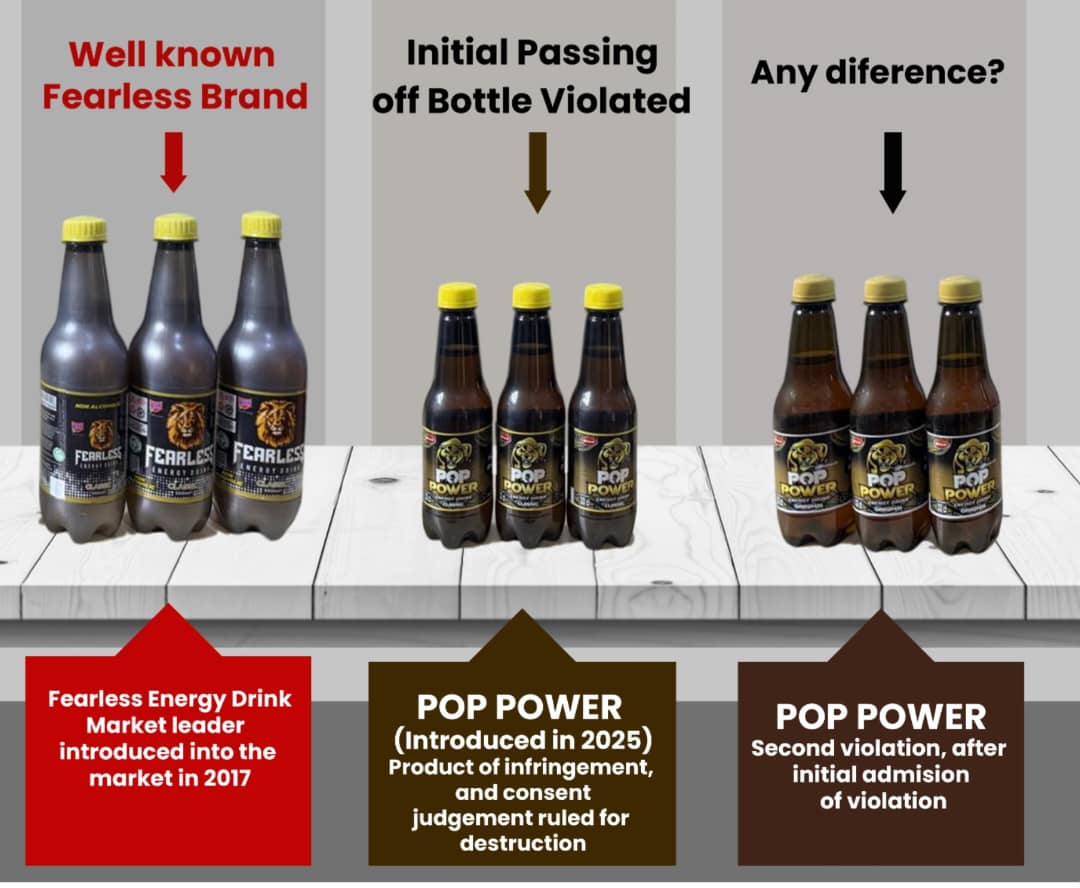
TRADEMARK INFRINGEMENT—Federal High Court Abuja Stops Mamuda Beverages from Further Producing its Pop Power Energy Drink in Its Present Bottle Design
In keeping with a clear understanding of conducting business within the confines of the rules, the Federal High Court in Abuja has again ordered Mamuda Beverages Nigeria Limited (“Mamuda”) to stop producing its Pop Power Energy Drink, which infringes on the trademark of the popular Fearless Energy Drink brand of Rite Foods Limited.
This rulings on Mamuda’s Notice of Preliminary Objection and Rite Foods’ Motion for interlocutory injunction were delivered by Hon. Justice B.F.M. Nyako, on Friday, 22nd May 2026, in the Suit No. FHC/ABJ/CS/705/2025. At the proceeding of the day, Mamuda’s Notice of Preliminary Objection was refused and dismissed, while Rite Foods’ application for injunctive reliefs prohibiting Mamuda from further trademark infringement was granted.
In the court’s ruling, Hon. Justice Nyako refused Mamuda’s Notice of Preliminary Objection which had challenged the suit on the basis of abuse of court process and held that Rite Foods’ present complaint of infringement of its intellectual property is distinct from an earlier suit between the parties, wherein Rite Foods had complained about a different act of infringement.
The court further held that it appears on its face that Mamuda’s newly introduced bottle design, manufactured, still bears a striking resemblance to Rite Foods’ established Fearless Energy Drink product. Therefore, the court granted an order restraining Mamuda from further production of its Pop Power Energy Drink product, pending the final determination of the suit.
Accordingly, the court ordered Mamuda to cease production of the product forthwith, destroy all existing products, and directed the court Bailiff, in conjunction with the parties, to undertake an inventory of the products slated for destruction and file the same.
The court further ordered that the injunction shall remain in force until the end of the year or pending the determination of the substantive suit.
Consequently, the court adjourned the suit to Wednesday, 23rd September 2026, for the hearing of the substantive suit.
This order follows an earlier suit against Mamuda in January 2025, where Rite Foods sued the company for infringing on the trademark and design of its iconic Fearless Energy Drink through the launch of a lookalike product, Pop Power Energy Drink.
However, Mamuda, in an apparent admittance of guilt, sought a settlement, and terms of settlement were agreed and filed, and the court entered same as its consent judgment. Some of the terms of settlement included that Mamuda would desist from further violation of Fearless Energy Drink trademark and identity pass-off. It also agreed to destroy all infringing products and pledged to change its design and avoid any form of identity imitation.
In an unexpected turn, Mamuda subsequently reintroduced Pop Power into the market, with only cosmetic adjustments to its appearance. Rite Foods maintains that these changes are minor and do little to address the original issues of consumer confusion. Reports from the market indicate that the new Pop Power continues to be informally referred to as “small Fearless,” reinforcing concerns that the revised product may not only breach the spirit of the earlier agreement but could also undermine consumer clarity and brand differentiation.
While reaffirming its position, Rite Foods stressed its continued commitment to protecting its brand and the principles of innovation and fair competition in Nigeria’s marketplace.
The company emphasized that genuine business growth must be anchored on originality and respect for intellectual property, rather than imitation and fraudulent business practices.
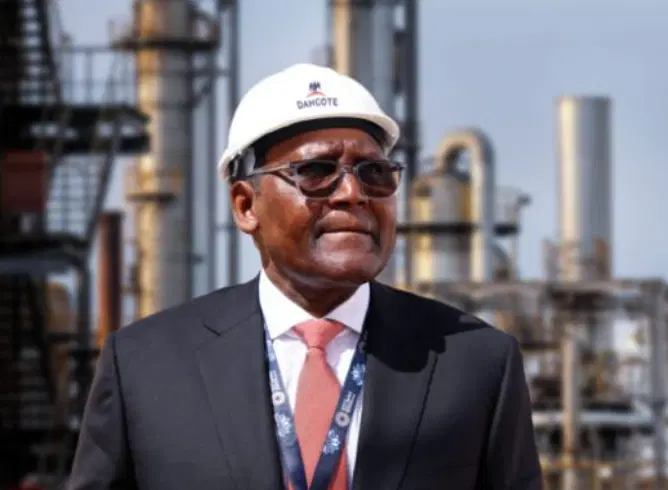
S&P: Dangote Refinery Driving Nigeria’s Economic Resurgence
The Dangote Petroleum Refinery & Petrochemicals is emerging as a major driver of Nigeria’s improving economic outlook, following the country’s sovereign credit rating upgrade by S&P Global Ratings.
In its latest assessment, S&P upgraded Nigeria’s long term foreign and local currency sovereign credit ratings to “B” from “B-”, citing stronger economic growth, improved external balances, rising oil production, and expanded domestic refining capacity as key factors supporting the country’s recovery.
The global ratings agency specifically identified the operational ramp up of the 650,000 barrels per day Dangote Petroleum Refinery & Petrochemicals as a major contributor to Nigeria’s improving balance of payments position and broader economic resilience.
According to S&P, the refinery’s full capacity operations are helping to strengthen Nigeria’s current account surplus, reduce dependence on imported refined petroleum products, and improve foreign exchange liquidity.
“Significant refining capacity is now also online; Dangote Industries Ltd.’s large scale refinery and petrochemical complex has ramped up to near its maximum capacity of 650,000 barrels per day,” the report stated.
S&P projected that Nigeria’s current account surplus would improve to 5.8 per cent of GDP in 2026 from 4.8 per cent in 2025, supported partly by increased domestic refining and hydrocarbon exports.
The report noted that the refinery is helping to ensure the availability of refined fuel, gas, and fertiliser for the domestic market, while also providing a buffer against global supply disruptions triggered by ongoing geopolitical tensions in the Middle East.
The agency further stated that Nigeria’s improving external position has been supported by reduced fuel import dependence, the removal of fuel subsidies, exchange rate liberalisation, and higher oil production.
Foreign exchange reserves, according to S&P, have risen significantly from about $33 billion in 2023 to nearly $50 billion by early 2026, aided partly by lower import demand for refined petroleum products following the commencement of operations at the Dangote Refinery.
The report also highlighted the refinery’s broader role in supporting Africa’s industrialisation ambitions, noting that Nigeria is transitioning from being primarily a crude oil exporter to an emerging producer and exporter of refined petroleum products.
S&P disclosed that Dangote Industries has already unveiled plans to undertake feasibility studies aimed at expanding refining capacity to about 1.4 million barrels per day from the current 650,000 barrels per day.
The agency said the planned expansion, alongside the rehabilitation of other local refineries, could further strengthen Nigeria’s economy and deliver additional gains to the country’s balance of payments position over the next few years.
While acknowledging that global crude oil prices and market driven pricing continue to influence domestic fuel costs, S&P maintained that the increased local refining capacity provides Nigeria with greater energy security and reduced exposure to external supply shocks.
The report also linked Nigeria’s improving macroeconomic outlook to reforms undertaken since 2023, including exchange rate liberalisation, fiscal reforms, higher petroleum revenue remittances, and efforts to improve oil production through enhanced security in the Niger Delta.
S&P said Nigeria’s economic growth is expected to remain firm despite inflationary pressures, with reforms continuing to support investor confidence and non-oil sector expansion.
The stable outlook, according to the agency, reflects a balance between Nigeria’s improving external position and continuing structural challenges such as a narrow tax base, high inflation, and low formal employment levels.
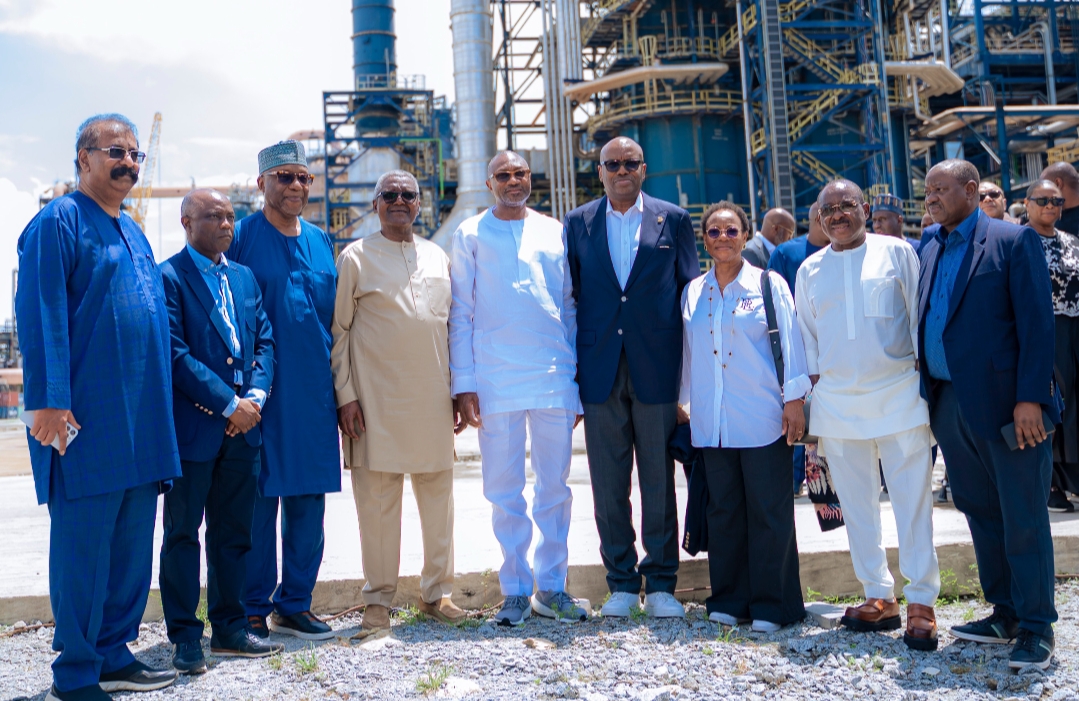
First HoldCo Group Companies’ Boards and Management teams visit Dangote Refinery
…All Nigerians will have access to the Refinery’s IPO and be part-owners-Dangote
Chairman of FirstHoldCo, Femi Otedola, has appealed to the President of Dangote Group, Aliko Dangote, to allocate $100 million worth of shares to him in the proposed listing of Dangote Petroleum Refinery & Petrochemicals. He disclosed that he divested his stake in Geregu Power Plc specifically to position himself for investment in the refinery’s initial public offering (IPO), which he described as a transformative industrial platform helping to free Africa from decades of reliance on imported petroleum products.
Otedola made these remarks during a visit by the FirstHoldCo leadership team to the 650,000 barrels-per-day refinery and Dangote Fertiliser Limited in Ibeju Lekki, Lagos, where he commended Dangote for building the world’s largest single-train refinery and accelerating Africa’s industrial transformation.
“He is a genius and one of the greatest men to emerge from Africa. What he has achieved is helping to liberate the continent from economic dependency and import reliance,” Otedola said. “I have visited this refinery more than 25 times, and I have consistently appealed for $100 million worth of shares during the private placement. That informed my decision to sell my stake in Geregu so I can reinvest in the Dangote Petroleum Refinery.”
Otedola also expressed strong confidence in the Group’s planned expansion of refining capacity to 1.4 million barrels per day, noting that Africa’s growing demand for refined petroleum products clearly supports further investment in domestic refining infrastructure.


In his remarks, President of Dangote Group, Aliko Dangote, assured that the refinery’s IPO would be broadly inclusive, enabling ordinary Nigerians to become part-owners and benefit from its value creation. He emphasised that the Group is committed to democratising access to investment opportunities by opening participation to retail investors across Nigeria and the African continent.
“We want ordinary Africans to participate in the value being created,” Dangote said. “What companies like Amazon and Apple achieved globally in terms of wealth creation is what we seek to replicate in Africa. We want people to invest, grow with us, and share in the prosperity.”
Dangote further disclosed plans for a proposed East Africa refinery with a projected capacity of 700,000 barrels per day, alongside polypropylene and base oil production facilities. According to him, the project could commence within the next three to four years once construction begins. He noted that the initiative was not originally captured in the Group’s Vision 2030 strategy, underscoring the company’s trajectory toward exceeding its long-term growth targets.
Chief Executive Officer of FirstBank Group, Olusegun Alebiosu, described the refinery as a symbol of vision, courage, and industrial ambition capable of inspiring similar investments across Africa.
“If you see this refinery and realise that an individual conceived and delivered a project of this magnitude, already helping to stabilise energy supply across Africa, you cannot help but be inspired,” Alebiosu said. “We have delegates here from the United Kingdom and several African countries who will return home with renewed commitment to building industries that can transform their economies. It is about building Africa together.”
Dangote also highlighted the Group’s sustained leadership across its core businesses over the past five years, including cement operations in 11 African countries, alongside significant investments in refining, petrochemicals, and fertiliser production. He noted that cement capacity has expanded to 55 million tonnes per annum, supported by the development of clinker export terminals to strengthen regional trade.
“We have built businesses that address Africa’s critical needs and create long-term value for the continent,” Dangote said. “Africa must stop exporting raw materials and importing finished goods. That amounts to exporting jobs and importing poverty.”
He added that investor appetite for the refinery’s listing on the Nigerian Exchange has remained exceptionally strong, with demand for the private placement already exceeding $2 billion.
“There is significant interest in both the IPO and the private placement,” he said. “While we are not able to meet all requests, the strong demand reflects investors’ confidence in the refinery and in Africa’s industrial future.”


- Statement of the International Contact Group for the Great Lakes (ICG) on the situation in the eastern Democratic Republic of the Congo (DRC) May 24, 2026
- Eritrea: Messages of Congratulations May 24, 2026
- African Development Bank (AfDB) – 2026 Annual Meeting: Full live coverage on Africa 24 May 24, 2026
- Countries in the Horn of Africa and Yemen recommit to ending variant poliovirus May 23, 2026
- Seychelles: President Visits Police and Fire Services in Final Stop on La Digue Tour May 23, 2026
- United Nations World Food Programme (WFP) scales up emergency Ebola response in eastern Democratic Republic of the Congo (DRC) to contain risk of regional crisis May 23, 2026
- Economic Community of West African States (ECOWAS) Inspection Team Visits ECOWAS Stabilisation Support Mission in Guinea Bissau May 23, 2026
- Member States advance regional coordination on Bundibugyo Ebola response May 23, 2026
- World Health Organization (WHO) Supports Zambia to Strengthen Access to Mental Health Medicines and Services May 23, 2026
- Brazzaville 2026 African Development Bank Group (AfDB) Annual Meetings to focus on mobilising Africa’s development financing at scale May 22, 2026
- Statement of the International Contact Group for the Great Lakes (ICG) on the situation in the eastern Democratic Republic of the Congo (DRC) May 24, 2026
- Eritrea: Messages of Congratulations May 24, 2026
- African Development Bank (AfDB) – 2026 Annual Meeting: Full live coverage on Africa 24 May 24, 2026
- Countries in the Horn of Africa and Yemen recommit to ending variant poliovirus May 23, 2026
- Seychelles: President Visits Police and Fire Services in Final Stop on La Digue Tour May 23, 2026
- United Nations World Food Programme (WFP) scales up emergency Ebola response in eastern Democratic Republic of the Congo (DRC) to contain risk of regional crisis May 23, 2026
- Economic Community of West African States (ECOWAS) Inspection Team Visits ECOWAS Stabilisation Support Mission in Guinea Bissau May 23, 2026
-

 news5 months ago
WHO REALLY OWNS MONIEPOINT? The $290 Million Deal That Sold Nigeria’s Top Fintech to Foreign Interests
-

 society3 weeks ago
SOCIAL MEDIA IS NOT A BATTLEFIELD COMMAND – WHY THE NIGERIAN ARMY’S ACTION AGAINST JUSTICE CRACK IS A NATIONAL SECURITY IMPERATIVE
-

 celebrity radar - gossips4 months ago
Dr. Chris Okafor Returns with Power and Fire of the Spirit -Mounts Grace Nation Altar with Fresh Anointing and Restoration Grace on February 1, 2026
-

 celebrity radar - gossips5 months ago
Prophet Kingsley Aitafo Releases 2026 Prophecy: ‘Nigeria Will Rise, but the World Must Prepare for Turbulence’
You must be logged in to post a comment Login
You must log in to post a comment.