
Business
“Our government has been helping states to realise their developmental plans irrespective of political parties’ – President Buhari

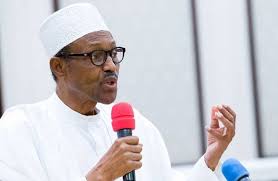

President Muhammadu Buhari has declared that change can not be attained on a bed of roses and demanded understanding of Nigerians while he deals with the ailing economy.
He also described the newly completed Osogbo Government High school built by the Governor of Osun state, Mr Rauf Aregbesola as an educational legacy that must be emulated by other states of the federation.
Speaking while commissioning the state-of-the-art school to commemorate the 25th creation anniversary of the state in Osogbo yesterday, President Buhari stated that his government has been doing all it could to assist state governments to realise their developmental plans irrespective of their political parties.
His words: “Our government has been helping states to realise their developmental plans irrespective of political parties. We are here to commission Osogbo Government High School, one of the legacy projects of Rauf Aregbesola.
“The facility here is worthy of emulation by other states. What we are witnessing here is a fulfilment of our government policy on education.
“The economy of scales in this edifice is unquantifiable and so we must seize the opportunities the school has in stock.
“During our campaigns, we promised our people positive and progressive change. But history has taught us that change does not come as easy as that. Change will come after much hard work, patience and perseverance. We promise that we shall do everything for our country and our people and this won’t be long in coming,”.
“As you are aware, the purpose of state creation is to bring leaders of government closer to the people, accelerate development, promote patriotic spirit and engender self-sufficiency”.
“I am glad to note that efforts are in place for Osun to achieve these desire goals”.
“With our progressive governance system in place, I believe it will only be a matter of time before more will be done that will quicken the pace of development all over the country”.
“In a federal system, states and local governments are the centres of development, our administration has been helping the states, not just to survive the harsh economic and financial weathers, but to realise their developmental objectives as well, irrespective of the political party in place. We will continue to do this”.
“In our party’s manifesto, we promised to provide free and qualitative basic education by implementing the Basic Education Act. We also promised to make education more cost-effective, even as we devote not less than 10 percent of the budget on education”.
“There should be a substantial commitment of energy and resources to education by all the levels of government. This is how we can renew our society and shape the future of our children”.
“We promised the Nigerian people positive and progressive change during our campaign. We are not and shall not be deterred from that noble undertaking”.
“But as we have learnt from history, change has never been attained by nation states on a bed of roses, but rather, through patience, perseverance and steadfastness”.
“We are quite aware of the pains and incoveniences that have been the lot of the citizenry in the past one year as we strive to faithfully implement our programmes in fulfilment of our change agenda”.
“We are however comforted by the real change and progress we have made in fighting corruption and restoring integrity to government; providing security for lives and property; and positioning the government for effectiveness and especially deregulating the oil sector”.
“We must also not forget the fiscal discipline that has nor characterised government business at all levels. This indeed is how it should be and we are determined to introduce and implement actions and measures that will entrench the change mantra in our individual lives just as we are doing in curtailing excessive waste and rent seeking in governance”.
“We are determined to remain on track as we strive to deliver to rescue the country from past mistakes in fulfilment of our promise of improving the conditions of our people and makinf Nigeria a prosperous country”.
Speaking earlier, the Governor of Osun, Ogbeni Rauf Aregbesola commended President Buhari for his leadership qualities, saying that Buhari since his assumption of office has not disappointed the many patriots.
He also lauded the President for facing his job with uncommon courage despite the obvious grim challenges, one of which is declining revenue.
Aregbesola attributed the challenge being faced by the President to the progressive decline in oil receipts to less than 20 per cent of what it was shortly before he came to office.
He noted that the shortfall in oil has affected the Federal Government and put not less than 28 states under severe financial strain, adding that if not for the courage of the President and his team, the country could have gone totally bankrupt.
Governor Aregbesola noted that the commissioning of the school is the manifestation of both governments’ commitment to educational development, which is also derived from APC’s ideology and manifesto of providing mass education to the people.
“We are producing the new man. The overall aim is to develop the new man intellectually, socially and morally. This new man is placed in the centre of society who views his own development as part of and for the development of society.
Dignitaries at the event were: the Governor’s of Borno, Oyo and Lagos States Kazeem Shettima, Isiaka Ajimobi and Akinwunmi Ambode respectively; former Governor of the state, Prince Olagunsoye Oyinlola, Minister of Communications, Adebayo Shittu, and former Deputy Governor of Ogun, Segun Adesegun.
Wife of the Osun Governor, Alhaja Sherifat Aregbesola, Deputy Governor of Osun, Mrs Grace Titi Laoye-Tomori were also present at the ceremony.
Others included former Chief of Army Staff, General Alani Akinrinade (rtd) and Air Vice Marshal Oluseyi Petirin (rtd); Speaker of Lagos State, Rt. Hon Mudasir Obasa; Senator Babajide Omoworare (Osun West); Senator Prof. Sola Adeyeye (Osun Central).
Royal fathers at the occasion were Alaafin of Oyo, Oba Lamidi Adeyemi; Ooni of Ife, Oba Adeyeye Ogunwusi; Ataoja of Osogbo, Jimoh Olanipekun; Akinrun of Ikirun, Oba Abdurauf Adedeji; Oluwo of Iwo, Oba AbdulRasheed Adewale Akanbi among others.




Business
Alpha Morgan Bank Reinforces Commitment to Education at Redeemer’s University Business School Commissioning
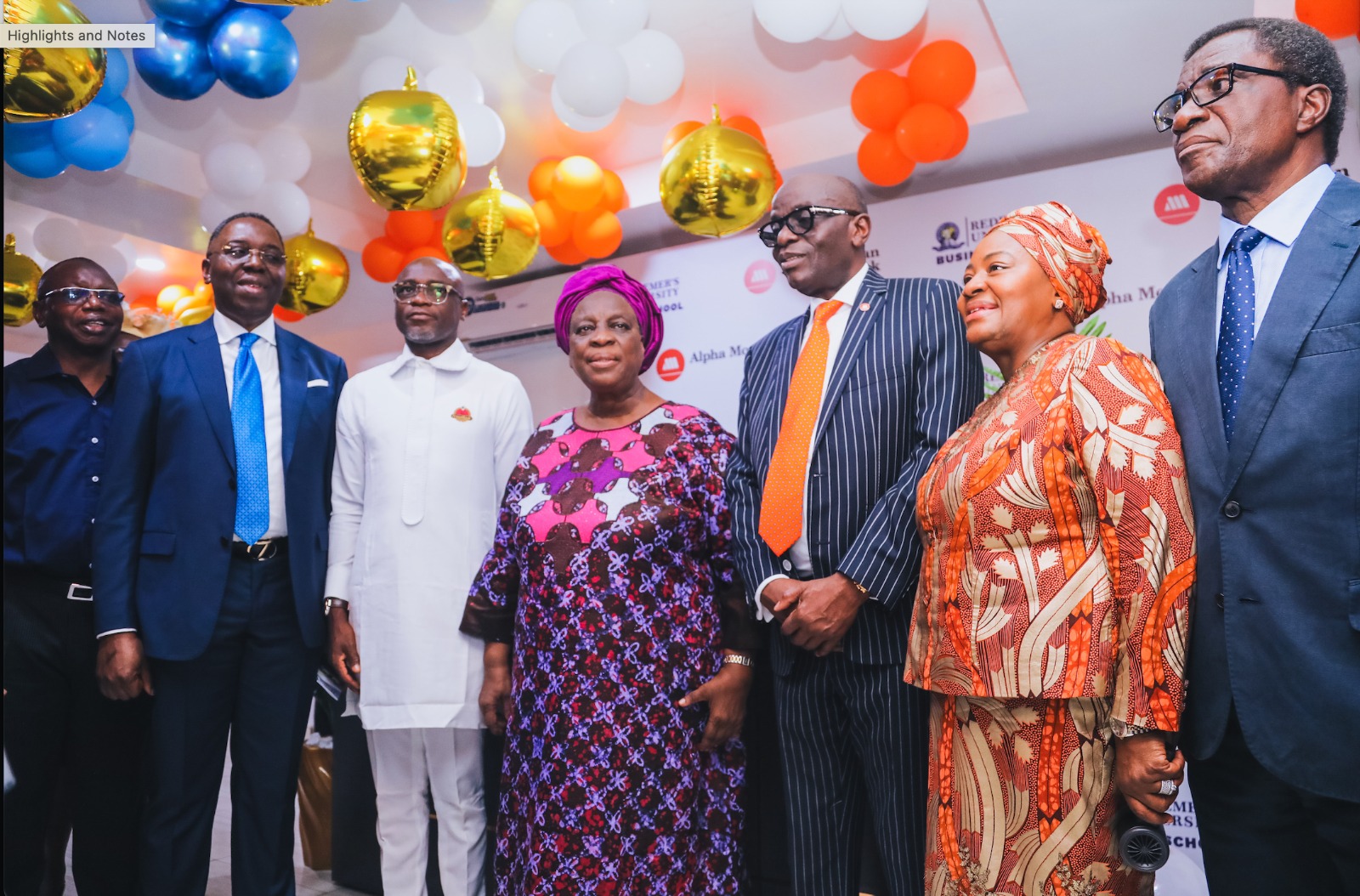
Alpha Morgan Bank Reinforces Commitment to Education at Redeemer’s University Business School Commissioning
Alpha Morgan Bank has reaffirmed its commitment to education and institutional development through its support for the commissioning of the Redeemer’s University Business School.
The Business School was officially inaugurated by Pastor (Mrs.) Folu Adeboye, at the commissioning ceremony attended by distinguished guests including Her Excellency, Mrs. Bola Obasanjo; the Pro-Chancellor and Chairman, Governing Council of Redeemers University, Professor Oluwatoyin Ogundipe; the Vice Chancellor, Professor Shadrach Olufemi Akindele; and other notable dignitaries.
Speaking at the event, the Managing Director of Alpha Morgan Bank reiterated the Bank’s commitment to supporting institutions that drive intellectual growth and national development.
As part of its broader focus on knowledge sharing and thought leadership, Alpha Morgan Bank will host its Economic Review Webinar in May 2026, bringing together experts to share insights on key economic trends and opportunities.
The Bank’s involvement reflects its continued dedication to empowering institutions and shaping the future of business and leadership in Nigeria.
Read more about Alpha Morgan Bank on www.alphamorganbank.com
PHOTO
L-R: Prof. Shadrach Olufemi Akindele, Vice Chancellor, Redeemers University, Engr. Eloka Eje, Dr Perez Araka, Pastor (Mrs) Folu Adeboye, Mother-In-Israel, The Redeemed Christian Church of God, Mr Ade Buraimo, MD/CEO Alpha Morgan Bank, Dr (Mrs) Oluwatomi Somefun, Dr. Simeon Ifere, at the inauguration of the Redeemer’s University Business School, Redemption City, Ogun State on Thursday 2nd April, 2026
Tinubu Aide Rebuts Rufai Oseni Over ₦3.3tn Power Debt Deal
Business
Aare Adetola Emmanuelking Welcomes President Tinubu to Gateway International Airport Commissioning in Iperu-Remo

Aare Adetola Emmanuelking Welcomes President Tinubu to Gateway International Airport Commissioning in Iperu-Remo
In a momentous occasion that underscores the rapid infrastructural advancement of Ogun State, renowned real estate mogul and philanthropist, Aare Adetola Emmanuelking, warmly received the President of the Federal Republic of Nigeria, Bola Ahmed Tinubu, at the official commissioning of the Gateway International Airport, located in Iperu-Remo.
The landmark event, held under the visionary leadership of the Ogun State Governor, Dapo Abiodun, marks a significant stride in the state’s economic transformation agenda, positioning Ogun as a key hub for aviation, commerce, and investment in Nigeria.
Aare Emmanuelking, who is also the Chairman/CEO of Adron Homes and Properties, commended the Ogun State Government for its foresight and commitment to infrastructural excellence. He described the airport project as a “game-changer” that will not only boost connectivity but also stimulate real estate growth, tourism, and industrial expansion across the region.
Speaking during the commissioning, President Tinubu lauded Governor Abiodun’s administration for delivering a world-class facility that aligns with the Federal Government’s Renewed Hope Agenda, emphasizing the importance of strategic infrastructure in driving national development.
The Gateway International Airport is expected to serve as a critical gateway for investors and travelers, further enhancing Ogun State’s reputation as one of Nigeria’s most business-friendly environments.
The presence of top dignitaries, industry leaders, and stakeholders at the event underscores the project’s significance and its anticipated impact on the state’s socio-economic landscape and beyond.


- Afreximbank supports Dangote Group as it targets US$100 billion annual revenue by 2030 April 8, 2026
- Africa's top-ranked Global Reporting Initiative (GRI) Training Partner launches 15th cohort of globally recognized sustainability reporting certification April 8, 2026
- African Energy Chamber (AEC) Intervenes in Landmark Climate Case to Defend Africa’s Energy Future April 8, 2026
- Eswatini opens to investors for first-of-its-kind roadshow April 8, 2026
- Egypt: President El-Sisi Meets Ministers of Electricity, Petroleum April 8, 2026
- Seychelles and Japan explore expanded cooperation and future partnerships April 8, 2026
- President Mahama to headline The Africa Debate 2026 as Ghana-United Kingdom (UK) investment ties deepen April 8, 2026
- Angolan Production Gets New Uplift as Eni’s Guido Brusco Joins Angola Oil & Gas (AOG) 2026 April 8, 2026
- Liquid C2 launches Africa’s first Google Cloud-powered Experience Centre to accelerate Artificial Intelligence (AI) adoption April 8, 2026
- Uganda: Opposition calls for reforms amid rising debt burden April 8, 2026
- Afreximbank supports Dangote Group as it targets US$100 billion annual revenue by 2030 April 8, 2026
- Africa's top-ranked Global Reporting Initiative (GRI) Training Partner launches 15th cohort of globally recognized sustainability reporting certification April 8, 2026
- African Energy Chamber (AEC) Intervenes in Landmark Climate Case to Defend Africa’s Energy Future April 8, 2026
- Eswatini opens to investors for first-of-its-kind roadshow April 8, 2026
- Egypt: President El-Sisi Meets Ministers of Electricity, Petroleum April 8, 2026
- Seychelles and Japan explore expanded cooperation and future partnerships April 8, 2026
- President Mahama to headline The Africa Debate 2026 as Ghana-United Kingdom (UK) investment ties deepen April 8, 2026
-

 news4 months ago
WHO REALLY OWNS MONIEPOINT? The $290 Million Deal That Sold Nigeria’s Top Fintech to Foreign Interests
-

 society7 months ago
“You Are Never Without Help” – Pastor Gebhardt Berndt Inspires Hope Through Empower Church (Video)
-

 celebrity radar - gossips2 months ago
Dr. Chris Okafor Returns with Power and Fire of the Spirit -Mounts Grace Nation Altar with Fresh Anointing and Restoration Grace on February 1, 2026
-

 celebrity radar - gossips4 months ago
Prophet Kingsley Aitafo Releases 2026 Prophecy: ‘Nigeria Will Rise, but the World Must Prepare for Turbulence’
You must be logged in to post a comment Login
You must log in to post a comment.