
society
Pondering the Remarkable Policies of Utsev as Water Resources Minister

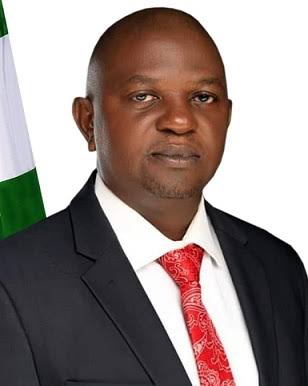
Pondering the Remarkable Policies of Utsev as Water Resources Minister
By John Peters
Sahara Weekly Reports That The affirmative impacts of the water value chain on the entire universe and global communities cannot be overstressed. Many logicians support the aphorism “water is life” because human existence in every ramification relies on the availability of the water value chain. The entire universe cannot function for a second without H2O; thus, water is the air we breathe. It shelters us, and machines cannot be made without water. Every living and non-living thing begins and ends with water. Subsequently, “water is indeed life.” Life without water is meaningless.

Thanks to the late Afro-beat artist Fela Anikulapo Kuti, who praised the neutrality of water in one of his albums. Though many may interpret Fela’s song on water as having no time to keep enmity, if he were alive today, I would have given him accolades for praising water’s neutral stance. Fela anchored that water has no enemy, as even adversaries cannot do without water.
Besides, the Bible describes the world as being without form and void, with the spirit of God moving upon the waters (Genesis 1:2). This means the universe came to meet water on earth. I would have loved to sing more praises of water, but I must switch to the main issue that motivated me to write this piece: the impactful policies of Professor Joseph Utsev, the present Honorable Minister of the Federal Ministry of Water Resources.
No doubt some readers may have different views regarding his policies; however, facts don’t lie, and technology has made every segment of human existence and the global community transparent. So, I may be correct in respect of the facts at my disposal to appraise his remarkable policies on the water value chain in Nigeria.
The positive policies of Professor Utsev, a thoroughbred engineer with a proficient touch, cut across over 80,000 council wards that formed the 777 local government areas in Nigeria. His leadership has positively impacted every segment of Nigeria. To say the Federal Ministry of Water Resources under President Ahmed Bola Tinubu’s administration is renewing Nigerians’ hope in water supply, sanitation, and economic purposes could be an exaggeration. However, Professor Utsev’s visionary leadership style, attested to by experts as the best thing that has happened to the Federal Ministry of Water Resources since its establishment, is beyond imagination. His technocratic display of leadership prowess has placed the water resources ministry on the map of best-performing countries in the water value chain.
To say the Federal Ministry of Water Resources under the administration of His Excellency President Ahmed Bola Tinubu is renewing Nigerians’ hope in the area of water supply, sanitation and using water for economic purposes could be said to be an exaggeration. This is true because the visionary leadership style of Professor Joseph Utsev which many experts in the water value chain attested to as the best thing that has ever happened to the Federal Ministry of Water Resources since her establishment is not just beyond imagination but a wonder and technocratic display of professionalism which in all standard is placing the water resources ministry under the renewed hope mantra of his Excellency President Ahmed Bola Tinubu on the map of best-performing countries in the water value chain.
His technocratic display of unimaginable leadership prowess on assumption in office, having devoted the best of his time as an erudite scholar for the past 17 years with broad knowledge and experience on water sanitation, hit the ground running as Nigeria’s Honorable Minister for Water Resources by instantly putting up suitable modalities to curb the then high rate of flooding in the year 2023 raining season which caused a lot of devastation across the 36 states of Nigeria especially the flood-prone areas in Nigeria.
He also in the year 2023 on assumption in office achieved a lot in the area of erosion control especially in the south-eastern region of Nigeria, which before he was appointed Honorable Minister for Water Resources caused a lot of havoc in most of the communities in the five state in south-east Nigeria. At this moment, due to the visionary leadership styles of Professor Joseph Utsev as Honorable Minister for Water Resources, most of the communities seriously damaged as a result of erosion in Nigeria especially in the southeast geo-political zone in Nigeria can now have a sigh of relief. His combined proficient efforts with the state minister of water resources Barrister Goronyo are also yielding positive results, especially in the area of dry season farming which normally commences after raining season.
To achieve greater output in the area of irrigational farming, he and the minister of state Barrister Muhammed Goronyo initiated an irrigational farming campaign across the six geo-political zones within the federation and the riverine areas in particular. As expected, the nation’s gross domestic product (GDP) as a result of the irrigational farming system is increasing beyond imagination, especially in the area of fruit farming, rice and other cash crops. The 12 River Basin area in Nigeria is also receiving qualitative attention from Professor Joseph Utsev’s fantastic and highly productive leadership style. On his assumption in office, he hit the ground running by holding frequent meetings with the twelve Managing Director of the 12 River Basin Authority in Nigeria.
The aim is to arouse them to come up with workable policies that can be used to cushion or even to alleviate the suffering of Nigerian masses through the use of water to initiate projects that have positive impacts on every Nigerian in the area of rural, urban and economic development. After the meeting with the Managing Director of the Twelve River Basin Development Authority, he embarked on a tour of all the River Basin headquarters for firsthand information about their operation to know the precise challenges they are facing. During most of the tour, he was moreover able to visit the locations of the Earth warn dam established by the federal government but needed the necessary professional touch to keep them functional to boost the economy of the country.
A prominent earth warn dam visited in the course of his national tour was; the Hadeja Dam in Kano, Kano State. Due to space constraints; I may not be able to highlight all his earthshaking achievements over the last year of piloting the affairs of Nigeria’s water resources value chains, which is making his name become a topic of discussion in every nook and cranny of Nigeria. However, let me highlight just a few! Professor Utsev as a technocrat in the water sector clearly defines dreams and visions for Nigeria’s water value chain, on assumption in office, initiated the taken off of the fractional commercialization policies of the 12 River Basin Development Authority across the six geo-political zones in Nigeria. The aim is to boost productivity and to as well fuel effective service delivery.
For instance, during his tour to the Hadeja water Dam in Kano, Kano State, he commissioned some projects that have good positive impacts on people, especially in the area of job creation which of course will boost the economy of Nigeria especially the indigenes of Kano State. Before I forget, his impacts on the staff welfare in the Ministry and all the agencies, parastatal and commissions domiciled under the Federal Ministry of Water Resources is second to none. A mere look at the staff working at the Federal Ministry of Water Resources will convince an individual that they are doing very well all thanks to the good leadership prowess of Professor Utsev who is doing his best that their emolument is constantly paid to boost their working spirit.
The infrastructure of the ministry is also receiving good attention above all in the area of renovations and provisions of working tools. It is also on record that the 777 LGA in Nigeria including the six area councils in Abuja is receiving serious attention in the area of providing constant pipe-borne water as well as rehabilitating some of the water plants that for so many years have been in comatose. It is given this few out of his tremendous mindboggling encouraging performance across the board both at the rural and urban areas that experts in the water sector and community development commentators are daily singing his praises by saying that if at all there is any minister that deserves excellent award or reward for keeping to the renewed hope agenda of His Excellency President Ahmed Bola Tinubu, such person should be Honorable Minister for water resources Professor Joseph Utsev.
Peters writes from Lagos


society
Liberian Leaders, Citizens Bear Witness as Apostle Suleman Hosts Two-Day Power-Packed Crusade
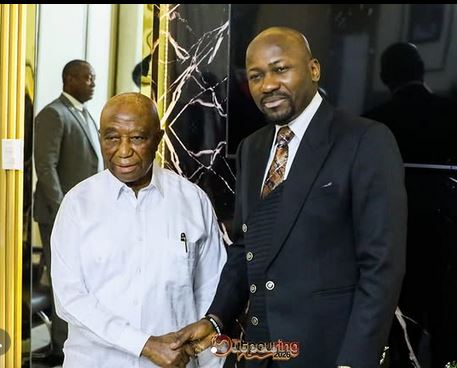
Liberian Leaders, Citizens Bear Witness as Apostle Suleman Hosts Two-Day Power-Packed Crusade
It was testimonies galore on Tuesday, March 31, the first day of the famous servant of God and founder of the Omega Fire Ministries (OFM) worldwide, Apostle Johnson Suleman’s power-packed two-day crusade. The event documented impactful moments with the Gospel and miracles, emphasizing the power of faith and the tangible confirmation of God’s Word through signs and wonders. It was equally an atmosphere of miraculous healing, restoration of lives, and the strengthening of faith.
At the crusade, which was held at the SKD Sports Stadium in Paynesville City, and themed, “Liberia Outpouring Crusade” witnessed testimonies of impact and miracles with participants experiencing instant healing of various kinds of challenges.
Apostle Suleman’s first port of call was Paynesville, the office of Liberian government’s president, Mr. Joseph Nyuma Boakai, who received him in an audience with his junior ministers. Apostle Suleman, who also met with the vice-president, Mr. Jeremiah Kpan Koung, was welcomed by the Liberian leader’s office as part of the president’s ongoing engagements with religious leaders aimed at fostering spiritual support for national development.
The president expressed profound appreciation to Apostle Suleman for the visit and continued prayers and intercessions by men and women of God on behalf of Liberia, emphasizing his firm belief that sustained spiritual guidance and prayer remain vital to the transformation and progress of the nation.
During the visit, Apostle Suleman offered prayers for President Boakai, his cabinet and the Liberian nation, invoking divine alignment, wisdom, and insight in Liberia’s path toward growth and stability. He prayed that the Almighty God would position Liberia for relevance and fulfillment of its national destiny.
Apostle Johnson Suleman, an evangelist who knows no bounds of where preaching the gospel comes to a stop, visited Liberia prepared with the message, compelling power of the Gospel and the work of the Holy Spirit, and bringing people to a point of decision where they surrendered their lives to Christ.
Aside from being prophetic and timely, OFM sources disclosed that the servant of God’s visit underscores the importance of faith-based partnerships in supporting governance and national renewal efforts.
society
Middle Belt Forum Hails Tinubu’s Jos Visit, Calls for United Civil-Military Effort to Restore Lasting Peace
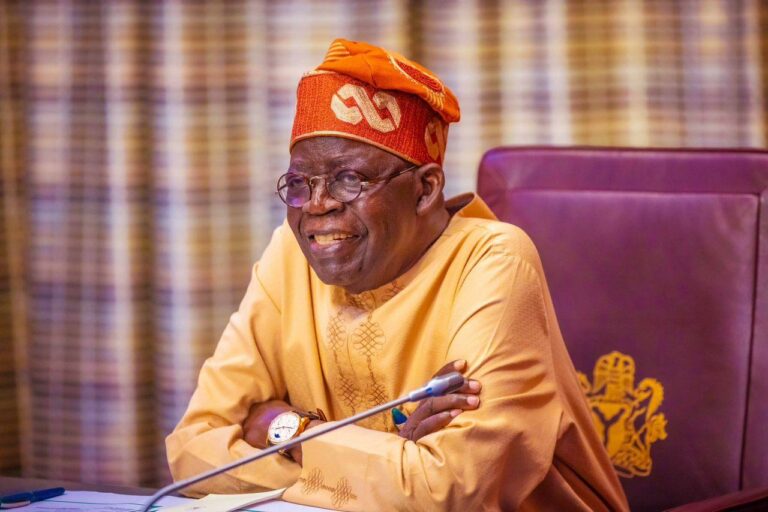
*Middle Belt Forum Hails Tinubu’s Jos Visit, Calls for United Civil-Military Effort to Restore Lasting Peace
The Middle Belt Peace Forum (MBPF) has commended President Bola Ahmed Tinubu for his profound demonstration of empathy and responsive leadership following his decision to postpone an official engagement in Iperu in order to visit victims of the recent attacks in Jos.
In a statement signed by its National Coordinator, Pastor Bulus Garba, in Jos on Friday, the Forum said the President’s decision to personally identify with grieving communities sends a powerful message of solidarity and reinforces public confidence in the commitment of the Federal Government to the protection of lives and property.
“The Middle Belt Peace Forum warmly commends President Bola Ahmed Tinubu for prioritising compassion over ceremony. At a time of deep sorrow for the people of Plateau State, his decision to visit Jos stands as a mark of true leadership—one that listens, responds, and stands with the people in their moment of pain,” the statement read.
The Forum described the perpetrators of the recent attacks as “cowards who prey on innocent and defenceless citizens,” stressing that such acts of violence are not only inhumane but also a direct assault on the unity and peace of the nation.
“We condemn in the strongest terms the actions of these cowardly attackers whose only aim is to instil fear and destabilise peaceful communities. Their actions must be met with firm and decisive resistance from all arms of the state,” Pastor Garba said.
The MBPF further used the opportunity to salute the courage, gallantry, and sacrifices of the Armed Forces of Nigeria under the leadership of the Chief of Defence Staff, General Olufemi Oluyede, noting that their continued efforts remain central to restoring stability across troubled parts of the country.
According to the Forum, the Armed Forces have demonstrated resilience and professionalism in the face of complex security challenges, often operating under difficult conditions to safeguard communities and defend Nigeria’s territorial integrity.
“We salute the Armed Forces of Nigeria for their unwavering commitment and sacrifices. Their gallantry in confronting criminal elements and reclaiming territories is a testament to their dedication to national service. We recognise that the path to peace is demanding, and we honour those who stand daily in defence of our nation,” the statement added.
The Forum pledged its full support to ongoing military operations and called for strengthened collaboration between security agencies and local communities as a critical factor in achieving lasting peace.
It also urged citizens across the Middle Belt to cooperate with security forces by providing timely information and fostering unity within their communities.
The MBPF, however, expressed concern over the need for greater synergy among security agencies, particularly the role of the Nigeria Police in consolidating gains made by the military.
“We call on the Nigeria Police Force to rise fully to its constitutional responsibility by effectively supporting the Armed Forces in stabilising and securing areas that have been cleared of criminal elements. Holding and policing such territories is essential to preventing a resurgence of violence,” Pastor Garba stated.
The Forum emphasised that sustainable peace requires a coordinated approach in which the military clears and secures areas, while the police maintain law and order to enable displaced communities to return and rebuild their lives.
The MBPF concluded by reiterating its commitment to peacebuilding efforts across the Middle Belt and expressed optimism that with sustained leadership, coordinated security efforts, and active citizen participation, lasting peace can be achieved.
“Together, through unity, vigilance, and collective resolve, we can overcome these challenges and build a safer and more peaceful Middle Belt,” the statement added.
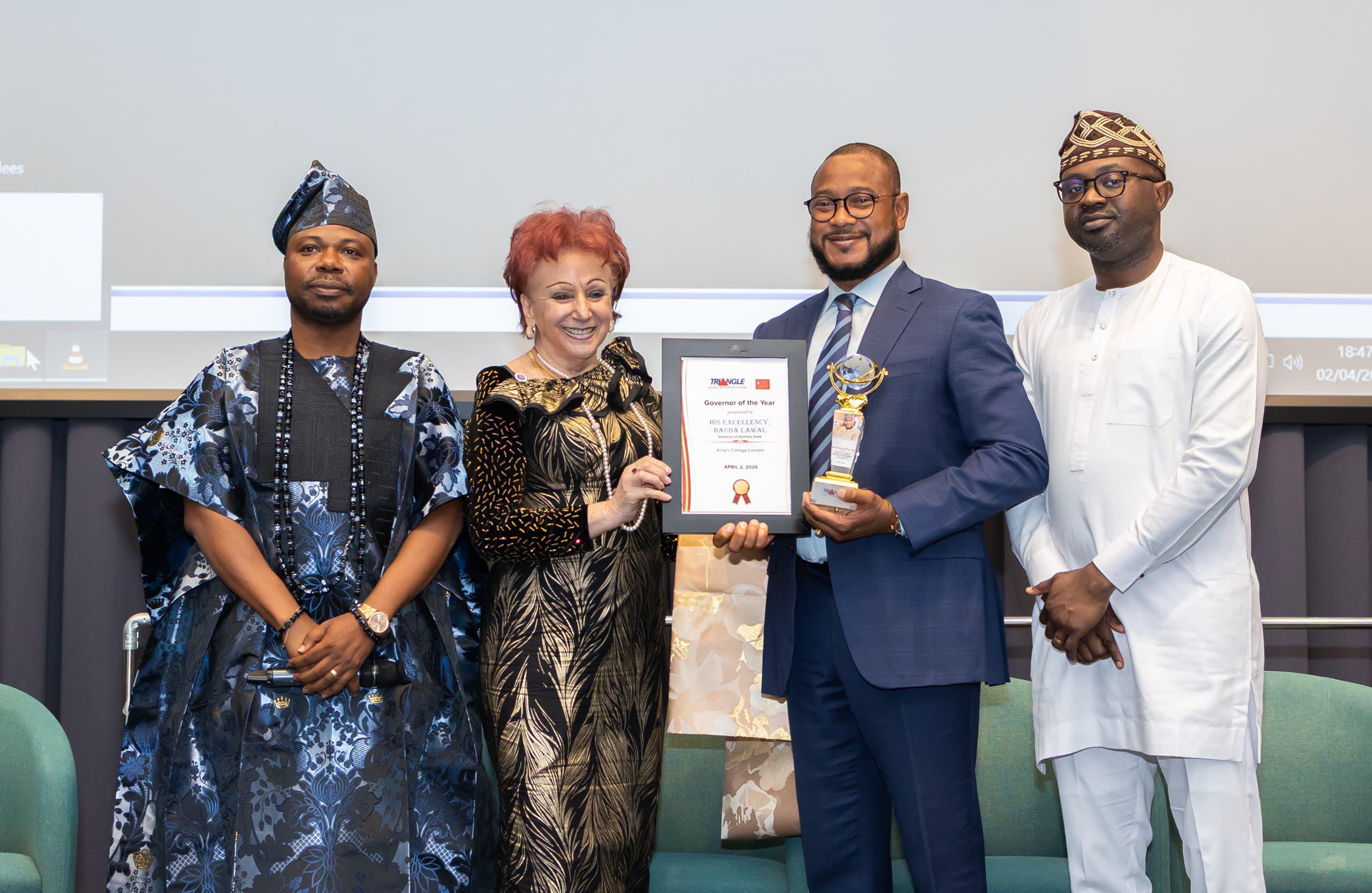
Governor Dauda Lawal Wins Face of Africa Governor of the Year Award in London
Governor Dauda Lawal has been honored with the Outstanding Governor of the Year award by Triangle Media International Magazine.
The award was presented during the magazine’s 10th annual lecture and award ceremony, held on Thursday at the Grand Hall of King’s College, London, United Kingdom.
According to a statement by the governor’s spokesperson, Sulaiman Bala Idris, the awards recognize public and private sector leaders whose leadership positively impacts governance and service delivery.
He added that the lecture, themed “Harnessing the Roles of Nigerians in Diaspora for National Development,” brought together stakeholders from both the public and private sectors.
The statement read in part: “Yesterday, in London, Governor Dauda Lawal received the 2026 Face of Africa Leadership Award for Outstanding Governor of the Year.
“The 2026 edition coincides with the 10th anniversary of Triangle International Magazine, which has over the years celebrated notable Africans across diverse fields.
“The award recognizes the Zamfara State Government under Governor Lawal’s leadership for achieving remarkable milestones in service delivery since his inauguration on 29 May 2023.
“The board of Triangle International noted that, despite inheriting an empty treasury, Governor Dauda Lawal has remained true to the Rescue Agenda’s campaign promise: to rescue and rebuild Zamfara.
“The award also reflects the state government’s innovative approach to indirectly curbing insecurity through educational advancement, demonstrated by the declaration of a state of emergency in the education sector.
“This includes the state government’s swift payment of the outstanding N3.4 billion for WAEC and NECO examinations, as well as the reconstruction and rehabilitation of schools across all 14 Local Government Areas of Zamfara State.
“The international magazine finds these initiatives to be strategic interventions toward long-term efforts to make Zamfara State better.”
The colourful event was attended by the Minister of Interior, Olubunmi Tunji-Ojo, and Sahara Group’s Group Managing Director, Kola Adesina, among others.


-

 society7 months ago
Religion: Africa’s Oldest Weapon of Enslavement and the Forgotten Truth
-

 news4 months ago
WHO REALLY OWNS MONIEPOINT? The $290 Million Deal That Sold Nigeria’s Top Fintech to Foreign Interests
-

 society6 months ago
“You Are Never Without Help” – Pastor Gebhardt Berndt Inspires Hope Through Empower Church (Video)
-

 celebrity radar - gossips2 months ago
Dr. Chris Okafor Returns with Power and Fire of the Spirit -Mounts Grace Nation Altar with Fresh Anointing and Restoration Grace on February 1, 2026