
society
Rains Expose Lagos’ Crumbling Roads, Bridges as Sanwo Olu’s Covid Focus Neglects Infrastructure

It is no longer news that Nigeria is still trying to grapple with the effects of COVID 19 which hit the world early on in January and took a hefty toll sometime in February.
A good number of countries like Germany, New Zealand, South Africa have put plans in motion to overcome recession with stimulus packages ranging from Germany’s 160 billion euros to South Africa’s R500 billion and have also accelerated spending’s on infrastructure and the economy as a whole.
Nigeria on its part seems to be focused more on fighting COVID 19 while Infrastructure and Security have been relegated to the background by almost all state governments leaving the economy in dire straits.
Lagos, Nigeria’s commercial capital for example has recorded impressive results in the fight against COVID-19.
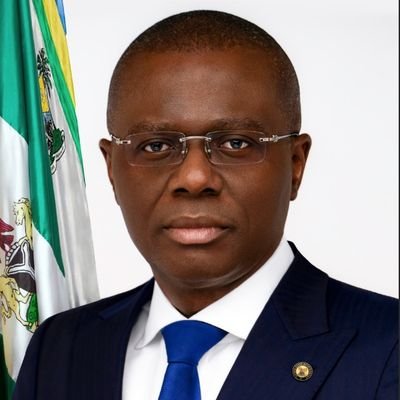
Its Governor Babajide Sanwo Olu of Lagos has however persistently ignored calls to fix dilapidated roads which have now become death traps as the rains fall in full force or likewise check the growing spate of insecurity across the state.
The port city of Apapa continues to experience crushing gridlock with billions of revenue lost monthly by importers and exporters using the port facilities at Apapa and Tin Can ports.
In the case of the roads which are fast becoming death traps to Lagosians with gullies and craters littered around Lagos, former Governor Akinwunmi Ambode, stated in the past that the state recorded a whooping loss of N250 billion to traffic annually.
This is besides the pains businesses and families who often spend four or more hours for a 30 minutes’ journey are exposed to daily due to the excruciating traffic jam.
Despite this revelation by the former governor, he did little or nothing to salvage the challenge.
A resident of Lagos, Segun Akanbi, lamented, “the current Governor came in with a lot of promise, performed fairly but has now diverted focus to the fight against COVID 19 to the detriment of other aspects especially roads.”
There is almost no area in the state that is spared of bad roads, but the worst-hit places are: Mile 2, Abule Ado, Alakija, Lagos-Abeokuta Expressway up to Ikeja Along, Lagos-Ibadan Expressway, Oworosoki- Oshodi Expressway, Oshodi-Apapa Expressway, Ikorodu Road, Lagos-Badagry Expressway, Funsho-Wiliams Avenue, by Costain area, which has been closed to traffic for construction work on the Costain bridge.
Others are: Kirikiri Road, Apapa, which has worsened traffic gridlock caused by truck operators who have taken over the road leaving little or no space for other road users. Satellite Town Road, Oriade LCDA, Otto-Wharf Bandary Road, Ajegunle, In Ajeromi- Ifekodun LGA. Chivita-Canoe Road, Oshodi-Isolo LGA, Isheri-Osun, LCDA, Ishawo, Road, Idimu Pipeline, Ikorodu, among others.
These days, it is a dreadful experience for commuters and motorists to navigate through Lagos-Badagry Expressway. Plying the international road has been hectic due to several failed portions on both sides of the highway, worsened by persistent rainfall which has forced motorists to spend valuable hours maneuvering the road.
In the case of the Ports, stakeholders and residents also continue to appeal to both state and the Federal Govt that a lasting solution be found to solve the gridlock and the infrastructure decay on the Apapa port and Tin Can Island access road to no avail.
President, Muhammadu’s Buhari, gave an ultimatum that made no impact as it is still business as usual with a lot of loss to Nigeria, stakeholders and residents.
Even the visit of Vice President, Professor Yemi Osinbajo brought no respite.
A recent study indicates that at least three of every ten years spent in Lagos is lost to traffic. It means Lagosians spend an average of seven hours 20 minutes in traffic every day.
An economic analyst, Kolapo Oluwo averred that the long hours spent daily in traffic with its attendant economic as well as health, emotional and relational costs is colossal.
“For a potential megacity and the economic hub of the country it shows the incapacity and lack of visionary leadership, despite media campaigns and allusions to the contrary.”
He noted that: “Lagos is the commercial, economic, as well as financial capital of Nigeria accounting for over 50 percent of the industrial and commercial establishments, as well as 70 percent of manufacturing activities. In addition, it has the most active stock exchange in West Africa; its four ports collectively handle about 75 and 90 percent of the country’s imports and non-oil exports by weight respectively. Even more, its international airport handles about 80 percent of airborne exports and imports and 80 percent of passenger movements in and out of the country.”
Oluwo Further said, “the state’s population has continued to grow rapidly – put at between six to eight percent per annum – and is a dragnet for school leavers and other economic migrants from other parts of the country. It is projected that the population of the city will grow to 36 million by 2050.”
A public Analyst, Emeka Ohanyere buttressed this saying despite its huge population and importance, road is the city’s most common and available means of transport. Rail and water transportation are meanwhile relatively under-developed in Lagos.
“Years of military rule, underinvestment and poor maintenance of existing transport infrastructure has seen Lagos lag behind other major global cities in the utilisation of efficient public transportation system such as urban rail system and modern high capacity buses.”
As at 2006, it was estimated that the city’s transport infrastructure and services were at levels that supported a population of six million.
In 2006, the government developed a transport master plan to integrate road, water, rail, and cable-car transport to provide one of the most efficient systems of transportation in a megacity.
Shortly after, in 2008, the Bus Rapid Transit (BRT) was launched as a stop-gap measure while seven train lines were planned to link all parts of the states and even Ogun state with light rail.
However, due to paucity of funds, only the contract for the blue line (the 27-kilometre Badagry line running from Okokomaiko to Marina via Iddo) was awarded at the colossal cost of $1.2 billion (compared to similar projects in other parts of Africa awarded for just a fraction of that amount) to be completed in 2011.
It was projected others will be awarded subsequently and the entire master plan will be completed in 2020.
Analysts have however argued that as governments grapple with the health care challenges associated with the Covid-19 pandemic, the economic toll must also be considered.
Economist, Muyiwa Akintemi says this is a central question that should preoccupy the government as rescue packages amounting to trillions of dollars are announced around the world.
“One critical step government can take is to earmark part of the stimulus spending for infrastructure. During a crisis of near unprecedented scale, paying people’s wages, supporting the most vulnerable and keeping businesses afloat are important priorities in the immediate term. But these measures alone will not bring long-lasting results. By contrast, investment in new infrastructure, such as hospitals, schools, renewable energy and digital networks, will create jobs and deliver tangible assets that will fuel long-term economic growth.
“We have seen in the past; infrastructure spending is one of the key levers that government can pull to stimulate the economy. Spending on concrete and steel, when well directed, boosts both short-term demand and long-term productivity, especially in a time of economic crisis. According to a 2014 study by the IMF, an increase in capital spending of 1.0% of GDP leads to a 0.4% uplift in output that same year, and a 1.5% rise four years later.”
He noted that this economic dividend occurs because building new infrastructure lays the groundwork for future economic growth, whether that’s an
improved transport network to move goods, a digital backbone to power a new economy or education facilities to train a skilled workforce for the future.
“Moreover, countries that spend on new capital stock tend to attract more private investment – as we have seen time and again, the availability of reliable underlying infrastructure boosts productive capacity and enables sustained economic activity,” Akintemi concluded.





US-Based Society Lady, Fehintola-Brat Extends Eid-El-Kabir Greetings To Muslims
United States based fahionista of class, Chief (Mrs) Ayoola Fehintola-Brat has extended a warm greetings to Muslim faithful all over the world on the occasion of the 2026 Eid-El-Kabir celebration.
Fehintola-Brat who is the Balogun Egbe Obaneye Obinrin Akile Ijebu, and the Yeye Asofin of Idenaland in her message to Journalists urged Muslim to continually uphold the enduring values of sacrifice, obedience, faith, and compassion, which are central to the significance of Eid-El-Kabir festival.
A quiet philantropist whose humanitarian services has won her several laurels urged Muslims to use the spiritual occasion to pray for the peace co-existence of Nigerians regardless of religious, social and political leanings stressing that the oneness of the country should not be underplay.
In a related development, she expressed her felicitations to all sons and daughters of Ijebuland on the forthcoming Ojude Oba 2026 celebration, tasking age-groups otherwise known as Regbregbe to be more proactive in giving back to their immediate communities.
According to her, the beauty of the age-groups in Ijebuland is the need to contribute immensely to the development of the land in no small means. “This we will continue to achieve with God on our side”, she concluded.
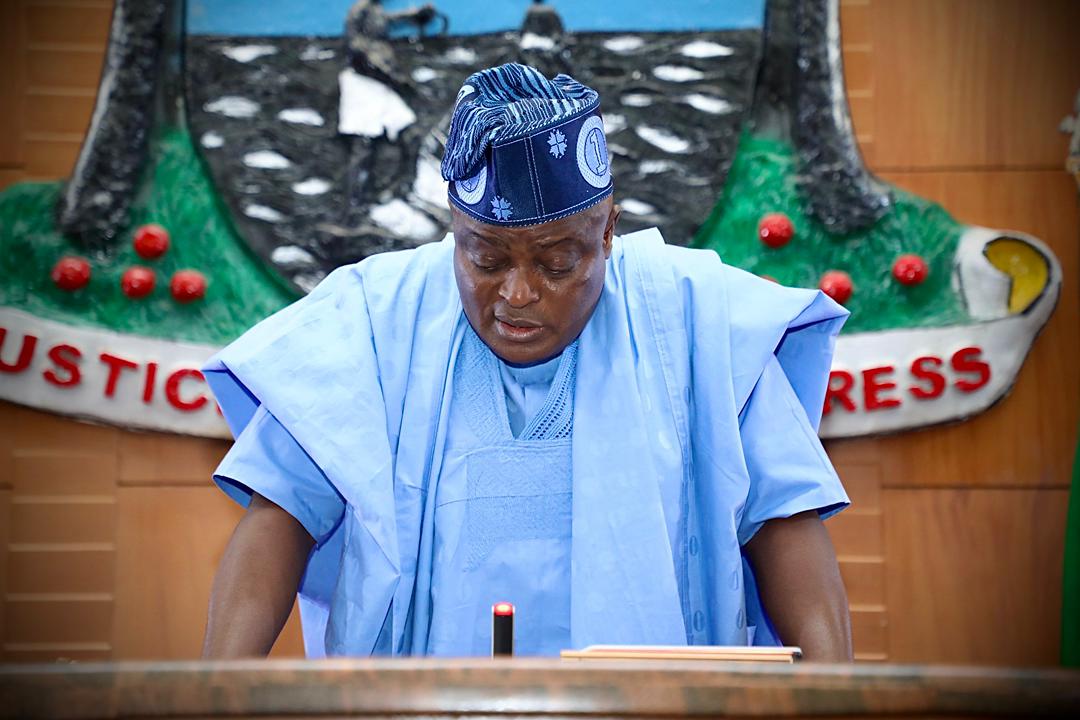
Sallah: Obasa Felicitates Muslim Ummah, Commends Nigerians for APC Primaries Turnout
The Speaker of the Lagos State House of Assembly, Rt. Hon. Mudashiru Obasa has extended warm felicitations to Muslims in Lagos State and across Nigeria on the occasion of Eid al-Adha.
In a statement released by his Chief Press Secretary, Mr. Dave Agboola, Obasa described the festival as a season of sacrifice, reflection, and gratitude, urging the faithful to continue to uphold the values of peace, unity, and love that strengthen the nation.
He noted that the celebration of Eid al-Adha is not only a spiritual milestone but also a reminder of the importance of togetherness and collective responsibility in building a stronger society.
He, likewise, emphasized that the festival provides an opportunity for Nigerians to renew their commitment to national progress and to support leadership that prioritizes development and prosperity.
Obasa, however, commended Nigerians, particularly members of the All Progressives Congress (APC), for their massive turnout during the recently concluded party primaries. He described the participation as a clear demonstration of the people’s confidence in the government of President Bola Ahmed Tinubu and their belief in the administration’s vision for a greater Nigeria.
“The APC primaries have shown the resilience of our democracy and the confidence Nigerians have in the leadership of President Bola Ahmed Tinubu and the Renewed Hope Agenda. This is a strong message that our people are ready to continue supporting policies that will drive growth and prosperity,” Obasa stated.
The Speaker further encouraged Muslims to celebrate responsibly, stressing that the joy of Eid should be accompanied by prayers for the continued peace and progress of Lagos State and Nigeria.
“As you celebrate with family and loved ones, may this season bring joy, peace, and prosperity to your homes. Let us remain united in our resolve to build a stronger nation,” he added.
On behalf of the Lagos State House of Assembly, Obasa wished all Muslims a happy and fulfilling Eid al-Adha celebration.
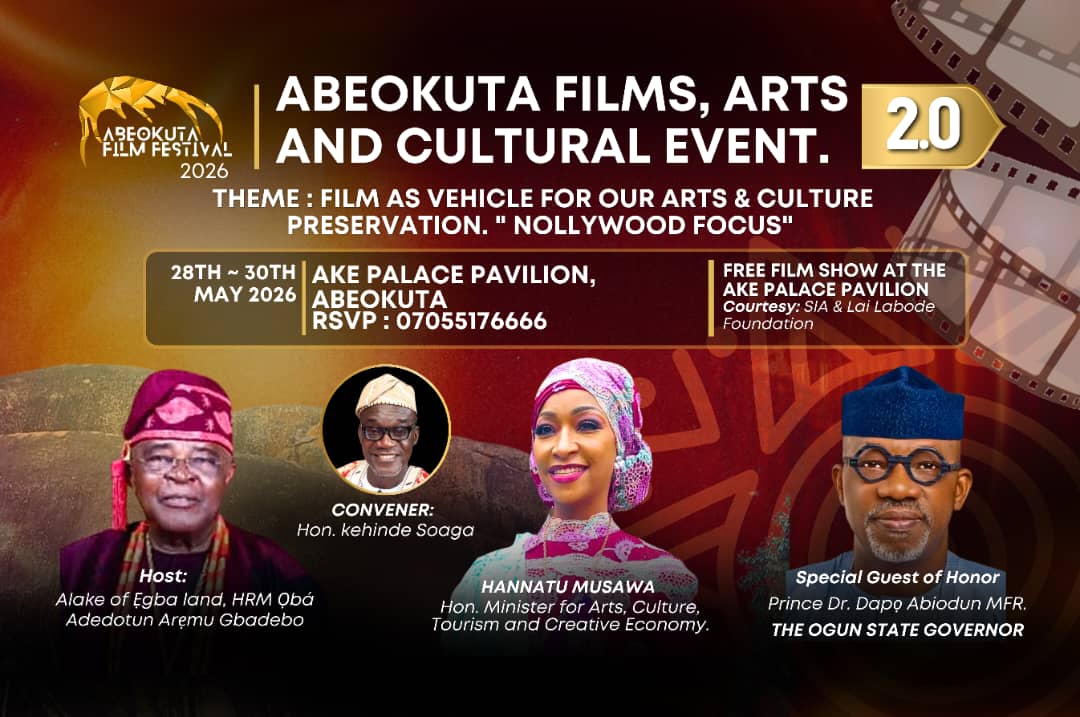
ABEOKUTA FILM FESTIVAL AT ILEYA
Kayshow Multimedia a filmmaking and Media organization this year 2026 holds its annual Abeokuta film festival at the Ake Palace in Abeokuta.
Alake of Egba land, Ọba Michael Adedotun Arẹmu Gbadebo has graciously endorsed the Free Training of Egba Youths on Film and Arts and the Entertainment of the the People with a FREE FILM SHOW at the AKE PAVILION. as part of the ABEOKUTA FILM FESTIVAL 2.0.
The Convener of the Film Festival Honorable Kehinde Soaga says this year’s event promises to be more exciting as distinguished personalities are sure to attend.
This includes the honorable Minister for Art Culture and Creative Economy in Nigeria, Barr. Hannatu Musa Musawa, Ààrẹ Lai Labode, Sen. Ibikunle Amosun and other special guests.
The event will feature Film, Cultural Dance Cultural foods and Award Ceremony.
The general public is hereby invited to the Free film show at the Abeokuta film festival at the Alake Palace Pavilion on Thursday 28th of May 2026 by 4:00 p.m.
Only well dressed is the Entry. The Abeokuta Film Festival is an annual event taking place in the capital city of Ogun State state.


- Demand for civic space holds strong across Africa as supply of freedoms wanes May 27, 2026
- Zarein Energy Joins African Energy Week (AEW) 2026 as Gold Sponsor Amid Nigeria Gas Hub Expansion May 27, 2026
- Qrent says delaying Information Technology (IT) refresh cycles may be increasing operational risk for businesses in Africa May 27, 2026
- Dentons’ Iyunola Adekanye Appointed to African Mining Week (AMW) Advisory Board May 27, 2026
- United Nations (UN) Women Liberia and Partners Convene for Spotlight Initiative 2.0 Women’s Economic Empowerment Inception Meeting May 27, 2026
- African Mining Week (AMW) to Host Central Bank Governors Roundtable as Monetary Authorities Deepen Role in Mining Sector Growth May 27, 2026
- Eritrea: Diaspora Nationals Celebrate Independence Day Anniversary May 27, 2026
- Africa Unveils Landmark Humanitarian Coordination Platform to Strengthen aligned Response to Humanitarian Crises May 27, 2026
- Seychelles: President Herminie Engages with Police and Fire Services on Praslin May 27, 2026
- Issue 3 of Mining Review Africa now available for free download May 27, 2026
- Demand for civic space holds strong across Africa as supply of freedoms wanes May 27, 2026
- Zarein Energy Joins African Energy Week (AEW) 2026 as Gold Sponsor Amid Nigeria Gas Hub Expansion May 27, 2026
- Qrent says delaying Information Technology (IT) refresh cycles may be increasing operational risk for businesses in Africa May 27, 2026
- Dentons’ Iyunola Adekanye Appointed to African Mining Week (AMW) Advisory Board May 27, 2026
- United Nations (UN) Women Liberia and Partners Convene for Spotlight Initiative 2.0 Women’s Economic Empowerment Inception Meeting May 27, 2026
- African Mining Week (AMW) to Host Central Bank Governors Roundtable as Monetary Authorities Deepen Role in Mining Sector Growth May 27, 2026
- Eritrea: Diaspora Nationals Celebrate Independence Day Anniversary May 27, 2026
-

 news5 months ago
WHO REALLY OWNS MONIEPOINT? The $290 Million Deal That Sold Nigeria’s Top Fintech to Foreign Interests
-

 society3 weeks ago
SOCIAL MEDIA IS NOT A BATTLEFIELD COMMAND – WHY THE NIGERIAN ARMY’S ACTION AGAINST JUSTICE CRACK IS A NATIONAL SECURITY IMPERATIVE
-

 celebrity radar - gossips4 months ago
Dr. Chris Okafor Returns with Power and Fire of the Spirit -Mounts Grace Nation Altar with Fresh Anointing and Restoration Grace on February 1, 2026
-

 celebrity radar - gossips6 months ago
Prophet Kingsley Aitafo Releases 2026 Prophecy: ‘Nigeria Will Rise, but the World Must Prepare for Turbulence’