
society
Religion: Africa’s Oldest Weapon of Enslavement and the Forgotten Truth

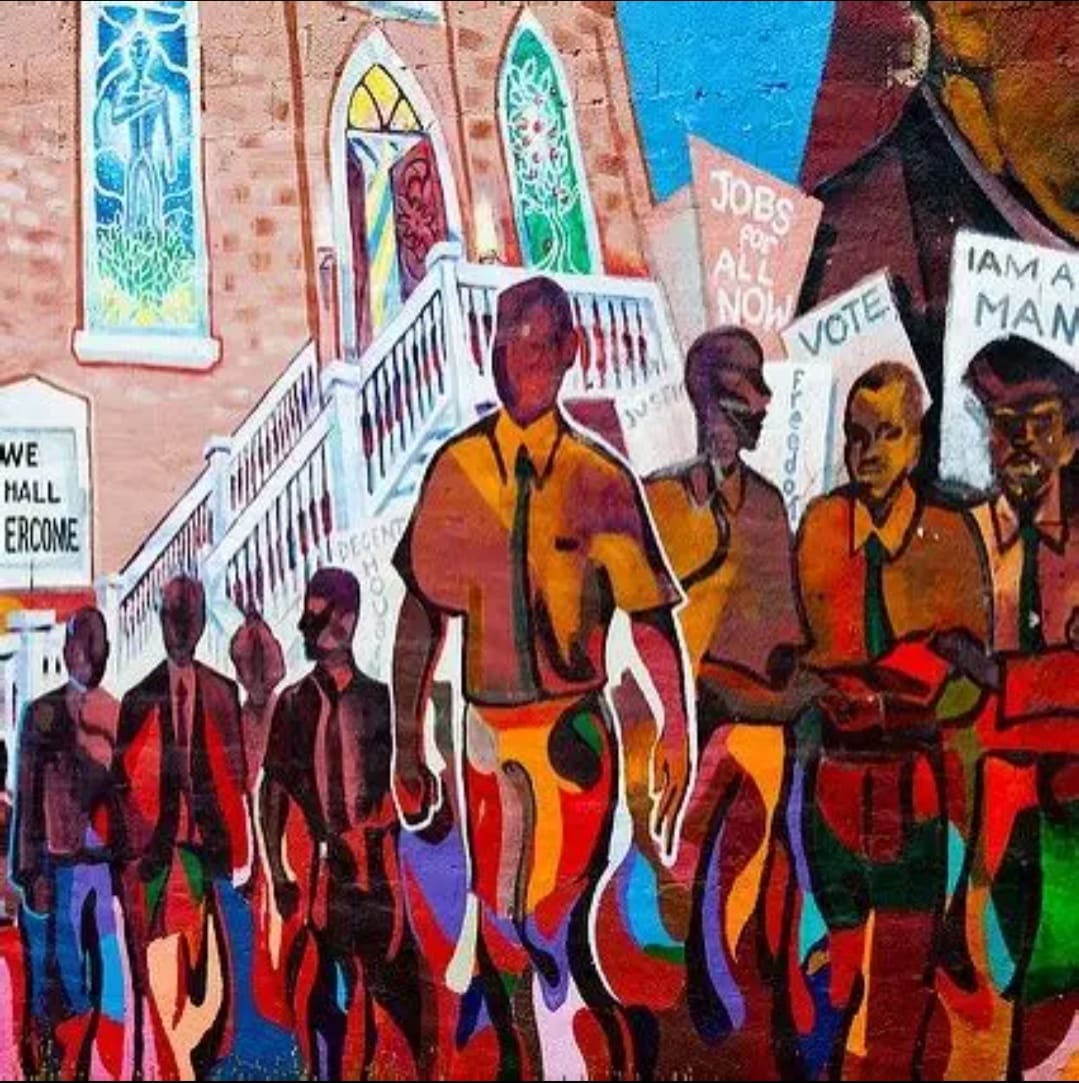
Religion: Africa’s Oldest Weapon of Enslavement and the Forgotten Truth.
By George Omagbemi Sylvester | Published by SaharaWeeklyNG.com
The day Africans stop worshipping their OPPRESSORS’ gods is the day true freedom begins.
Introduction: Chains Broken, But Minds Still Bound.
The history of Africa is incomplete without acknowledging the dual weapons that tore through its body and soul: the physical chains of slavery and the psychological shackles of religion. While the chains of iron rusted and fell off, the chains of the mind (enforced through CHRISTIANITY and ISLAM) remain deeply embedded in the African consciousness. Africans today reject the brutality of slavery, yet cling to the very tools that justified and sustained their oppression.
Religion in Africa, particularly Islam and Christianity, did not arrive as benevolent gifts of spiritual enlightenment. They were imposed, force-fed and institutionalized through violence, coercion and cultural destruction. The Trans-Saharan slave trade spread Islam across North, East and West Africa, while the Transatlantic slave trade embedded Christianity in Central and Southern Africa. Both were instruments of conquest, designed to dismantle African identity, demonize indigenous spirituality and create a submissive, divided people.
The Forgotten Prophets of Africa.
Before the arrival of Arab slave traders and European colonizers, Africa was not without its spiritual compass. The continent was rich with systems of belief rooted in ancestral reverence, herbal medicine, astronomy and moral codes handed down from sages and seers. These men and women were CUSTODIANS of TRUTH; the true prophets and visionaries of Africa.
When the foreign religions came, these prophets were branded as witches, pagans and devil worshippers. They were hunted, imprisoned and executed. Temples of knowledge (the schools of Kemet – ancient Egypt- and Kush) were either destroyed or appropriated. The herbalists who understood the earth’s healing were demonized; the diviners who read the stars were silenced. In their place came the holy books of the slave masters, which demanded blind faith, obedience and loyalty not to the ancestors but to foreign gods.
As the Kenyan scholar John S. Mbiti observed, “Religion was not brought into Africa; it was found in Africa. Africans were religious before the Europeans and Arabs came.” Yet the narrative taught today erases that truth, convincing Africans that their salvation must come from outsiders.
Religion as a Tool of Slavery.
To understand how religion was weaponized, one must confront the history:
Islam and the Trans-Saharan Slave Trade:
From the 7th century onward, Arab traders exported millions of Africans across the Sahara and Indian Ocean. Islam became the cloak under which Africans were told slavery was divinely sanctioned. Quranic justifications were twisted to brand black Africans as “FIT FOR SERVITUDE.” This trade persisted for over 1,000 years; longer than the Atlantic trade.
Christianity and the Transatlantic Slave Trade:
By the 15th century, European powers (Portugal, Spain, Britain, France) embarked on a mass kidnapping campaign that displaced over 12 million Africans. The Bible was the silent whip. Slaveholders cited verses like “Servants, obey your masters” (Ephesians 6:5) to sanctify brutality. Churches were not just silent bystanders; they owned plantations, profited from slavery and baptized captives before shipping them to death across the ocean.
Professor Chinweizu, the Nigerian critic of neo-colonialism, warned: “The white man’s God was never your God. He was invented to enslave you.”
King James and the Bible of Chains.
The King James Bible, often treated as holy scripture in African churches, has its own dark origins. King James I of England was a monarch deeply enmeshed in the politics of empire and colonization. His version of the Bible (1611) was commissioned not as a neutral spiritual text but as a political instrument to unify his kingdom and justify authority.
King James granted the Royal African Company its charter, enabling English merchants to dominate the Atlantic slave trade. This made him not only a ruler but a slave trader. As historian Edward Rugemer notes, the Bible under King James was deployed to discipline slaves, teaching them that obedience was a Christian duty. Africans who glorify this text without scrutiny fail to see the blood-soaked ink in its pages.
Jesus: The White Man’s Idol or the Black Messiah?
Perhaps the deepest deception lies in the image of Jesus. The “white boy with blue eyes” worshipped in Africa today was the creation of European Renaissance art, modeled on Cesare Borgia, the son of Pope Alexander VI. This image became propaganda, replacing the historical Jesus; a dark-skinned, woolly-haired man from the line of David.
The Book of Revelation 1:14-15 describes him plainly: “His head and his hairs were white like wool, as white as snow; and his feet like unto fine brass, as if they burned in a furnace.” This is not the image of a pale European, but of a Black man.
As Marcus Garvey thundered: “We Negroes believe in the God of Ethiopia, the everlasting God. God the Son, God the Holy Ghost, the one God of all ages. That is the God in whom we believe, but we shall worship Him through the spectacles of Ethiopia.”
The Book Jesus Spoke About.
When Jesus asked his disciples, “Have you not read? Is it not written?” he was referring not to the King James Bible, which did not exist, but to the ANCIENT SCROLLS of the TORAH, the PSALMS, and PROPHETIC WRITINGS. Africans must ask themselves: why are we handed a colonial compilation of texts while our own sacred writings (the PAPYRUS SCROLLS of KEMET, the ORAL TRADITIONS of IFA, the HIEROGLYPHIC WISDOM of NUBIA) are discarded as “pagan”?
Dr. Yosef Ben-Jochannan, the eminent Egyptologist, said: “The Bible is a rewritten book of African spiritual writings. What was stolen in Kemet became holy in Europe.”
The Psychological War: Why Africans Still Cling to Religion.
If religion was a weapon, why then do Africans still cling to it? The answer lies in psychology. After centuries of enslavement, colonial education and missionary indoctrination, religion became synonymous with morality, civilization and hope. To reject it feels like rejecting identity itself.
This is the illusion. As Ngũgĩ wa Thiong’o warns in Decolonising the Mind: “The most important area of domination is the mental universe of the colonized.” The colonizers may have left physically, but they left behind a spiritual operating system designed to keep Africa submissive.
The Call for African Awakening.
True liberation for Africa begins not in politics or economics, but in spirituality. Until Africans restore respect for their ancestral wisdom, the continent will remain trapped in foreign systems of thought. The task is not to erase faith but to redefine it, to honor the AFRICAN PROPHETS, HERBALISTS and SAGES who were silenced and to reclaim the spiritual traditions demonized by slave masters.
As Cheikh Anta Diop, the Senegalese historian, put it: “The African who loses his culture loses himself.”
Africa’s Last Awakening: Breaking the Final Chain.
The chains of slavery were visible; the chains of religion are invisible; but both are real. Africa cannot rise while bowing to the idols of its oppressors. To pray to the image of a white Christ while rejecting the wisdom of our ancestors is to spit on their struggle.
The day Africans wake up and realize that their dignity lies not in imported religions but in the reclamation of their own divine heritage, that day the continent will stand tall again.
The final battle is not fought with guns or protests, but with the awakening of the African mind.





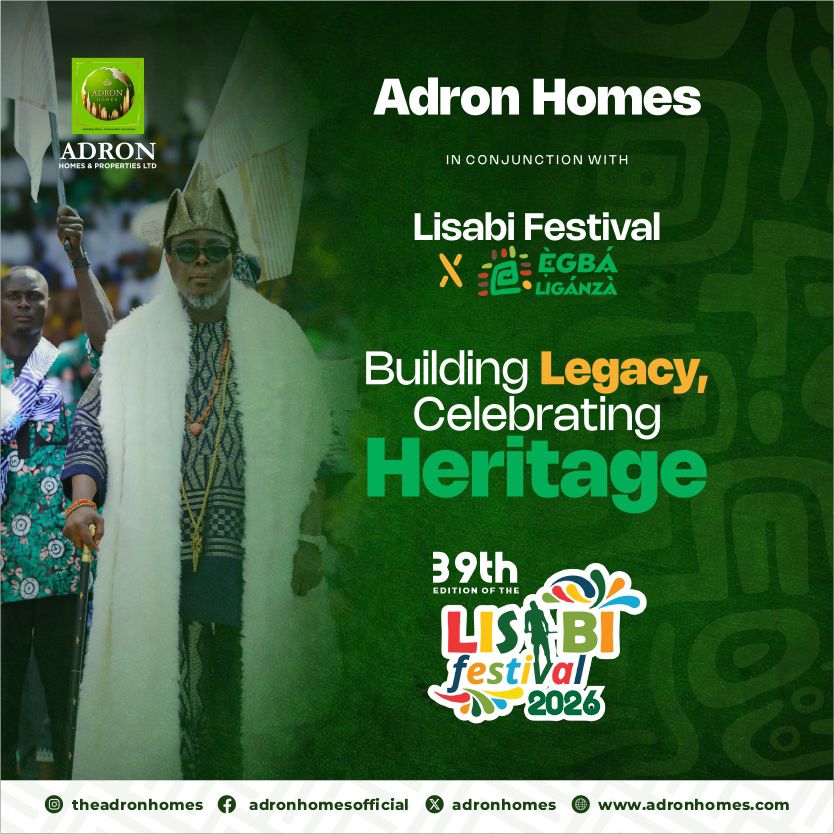
Adron Homes Deepens Commitment to Cultural Heritage, Sponsors 39th Lisabi Festival
Adron Homes and Properties Limited has reaffirmed its commitment to preserving Nigeria’s rich cultural heritage and fostering community development through its sponsorship of the 39th edition of the Lisabi Festival, one of the most revered cultural celebrations of the Egba people.
Held under the distinguished leadership of Oba Adedotun Aremu Gbadebo, the festival remains a symbolic institution that celebrates the unity, resilience, and historical legacy of Egbaland. It pays tribute to the legendary warrior Lisabi Agbongbo Akala, whose courage and leadership united the Egba people and secured their freedom.
Through this strategic sponsorship, Adron Homes and Properties Limited continues to position itself not only as a leading real estate developer but also as a custodian of culture and a partner in sustaining the traditions that shape communities across Nigeria.
Speaking on the importance of the festival, Oba Gbadebo emphasized that Lisabi serves as a vital platform for preserving the Egba people’s values, traditions, and identity, while inspiring younger generations to remain connected to their cultural roots.
For Adron Homes, the partnership reflects a deliberate alignment with the socio-cultural aspirations of Egbaland. By supporting the festival, the company is contributing meaningfully to the preservation of indigenous heritage, the promotion of unity, and the celebration of a people whose influence continues to shape the cultural landscape of Abeokuta and beyond.
Notably, Abeokuta, the capital of Ogun State is also home to key Adron Homes developments, including the prestigious Adron Homes Sunrise Park and Gardens located in Alabata, and Southgate Park and Gardens Estate in Alamala. These flagship estates further reinforce the company’s deep-rooted presence and long-term investment in the socio-economic growth of the region.
The 2026 edition of the Lisabi Festival, themed “Integrating Apprenticeship Training into Education: Opportunities and Challenges,” highlights the intersection between tradition and modern development, an area where Adron Homes continues to make an impact through its community-driven initiatives.
The festival will feature a vibrant lineup of cultural and social activities, including the iconic Woro procession, traditional rites, arts and crafts exhibitions, educational programmes, and community engagements, all reflecting the richness of Egba heritage.
society
Apostle Edith Grace Announces the “National Prayer Conference – April Edition” with Theme “Power of Resurrection Move in Nigeria
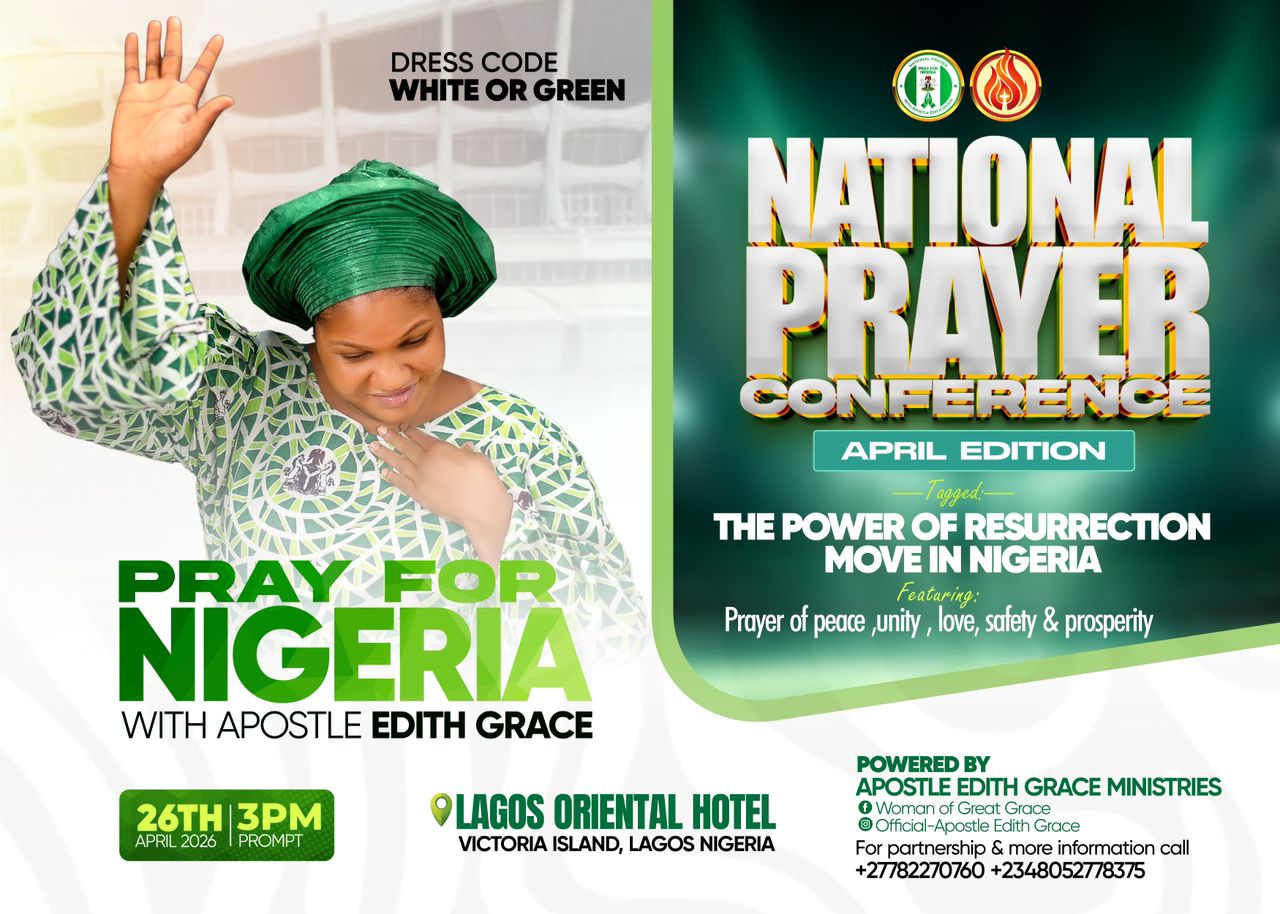
Apostle Edith Grace Announces the “National Prayer Conference – April Edition” with Theme “Power of Resurrection Move in Nigeria
The upcoming *National Prayer Conference*, organized by Apostle Edith Grace Ministries, is set to take place on *26th April 2026* at *3:00 PM* at the Lagos Oriental Hotel. The event, themed _“Power of Resurrection Move in Nigeria,”_ will unite believers in a nationwide spiritual gathering focused on prayer, revival, and divine empowerment.
The conference will run for several hours, featuring multiple sessions of intercessory prayer and inspirational messages.
– *Venue:* Lagos Oriental Hotel, a premier location offering spacious facilities conducive to large spiritual gatherings and comfortable accommodations for attendees.
– *Dress Code:* Attendees are requested to wear *white or green* attire, symbolizing purity and spiritual renewal, aligning with the event’s visual identity.
The host Apostle Edith Grace, popularly known as Woman of Great Grace acclaimed spiritual leader will lead the prayer sessions and deliver powerful messages on national revival and spiritual awakening.
– *Prayer Focus:* The conference will emphasize praying for Nigeria’s spiritual and societal transformation, invoking the “Power of Resurrection” to inspire positive change and divine intervention.
– *Spiritual Atmosphere:* The program includes intense intercessory prayers, worship sessions, and prophetic declarations aimed at igniting a nationwide spiritual movement.
– *Partnership Opportunities:* Organizations and individuals can partner with Apostle Edith Grace Ministries for sponsorship, media coverage, or collaborative ministry initiatives.
Apostle Edith Grace Ministries is a faith-based organization dedicated to spiritual empowerment, prayer-driven revival, and community transformation. Under the leadership of Apostle Edith Grace, the ministry conducts nationwide crusades, conferences, and outreach programs focused on uplifting believers and fostering national spiritual renewal.
Believers, clergy, and spiritual leaders are encouraged to attend the *National Prayer Conference* to experience a transformative spiritual encounter and join the nationwide prayer movement for Nigeria’s revival. Registration and early arrival are advised due to expected attendance.
Woman of Great Grace and other anointed great ministers of God will lead prayer sessions and deliver powerful messages on national revival and spiritual awakening. There will prayers for various sectors in Nigeria, focusing on the nation’s vision, peace, unity, and prosperity. Apostle Grace Edith will lead prayers for the government and leaders, seeking divine guidance and intervention.
Apostle Edith Grace, the convener of Apostle Edith Grace Ministries and Pray For Peace Foundation. A woman of Great Grace who deemed it fit to always pray for the peace of Nigeria.
The program includes intense intercessory prayers, worship sessions, prophetic declarations, and inspirational speeches aimed at igniting a nationwide spiritual movement. And the conference will feature prominent men and women of God, alongside invitations to influential figures in power, making it a unique gathering of faith and leadership.


### Contact Information for Partnership & Inquiries
For more information, partnership opportunities, or registration details, please contact:
– *Phone:* +27782270760 | +2348052778375

Obasa Leads Special Prayer Session to Commemorate President Tinubu’s 74th Birthday
The vast Police College ground in Ikeja heaved, creaked, and pulsated with prayers and plaudits on Saturday, March 21, as Speaker of the Lagos State House of Assembly, Rt. Hon. Mudashiru Ajayi Obasa, led an interfaith prayer session to commemorate President Bola Ahmed Tinubu’s 74th birthday.
Although the president’s birthday falls on Sunday, March 29, Speaker Obasa and The Mandate Movement (TMM) group of Nigeria deemed it auspicious to hold the prayer session earlier. The event drew political leaders, stakeholders, party faithful, community leaders, Islamic and Christian clerics, and All Progressives Congress (APC) supporters from across Lagos State and beyond.
Speaker Obasa explained that the prayer session was significant not only for President Tinubu’s continued good health, long life, wisdom, and success in steering the nation’s affairs beyond 2027, but also for Nigeria’s enduring peace, unity, stability, security, and overall progress.
“This special occasion is not just a celebration of a leader, but a moment of collective reflection and supplication for Nigeria’s progress. Let us come together in faith and patriotism to seek divine guidance and blessings for Nigeria,” Obasa said.
He described the President as a pragmatic and visionary leader whose transformative contributions have rewritten Nigeria’s socio-economic narrative. Obasa urged Nigerians at home and abroad to remain steadfast in supporting the Renewed Hope agenda for a greater Nigeria. He commended initiatives such as subsidy removal, which has boosted state revenues, and the Nigeria Education Loan Fund (NELFund), which he called a “game-changer” for youth seeking higher education.
Among other achievements, Obasa highlighted the Lagos-Calabar Coastal Highway as Nigeria’s most ambitious infrastructural project, poised to strengthen the economy and tourism potential. He also praised the First Lady, Senator Oluremi Tinubu, for her Renewed Hope Initiatives, which he said are positively impacting lives through food outreach, agricultural support for women, economic empowerment, and digital learning centres.
The mammoth attendance, Speaker Obasa noted, was a testament to the love and loyalty President Tinubu commands among the people of Lagos and Nigeria at large. He called on Nigerians to re-elect the president and all APC candidates in the 2027 general election, stressing that continuity is key to consolidating the gains of the Renewed Hope agenda.
Adding his voice, former Governor Akinwunmi Ambode extolled President Tinubu’s enduring legacy and leadership:
“President Tinubu’s commitment to Nigeria’s progress is commendable, and it is our collective duty to support him so that the nation can fully reap the benefits of his reforms,” Ambode said.
The prayer session featured fervent supplications from both Christian and Islamic clerics, who prayed for divine wisdom, protection, and guidance for President Tinubu and Nigeria.


-

 news3 months ago
WHO REALLY OWNS MONIEPOINT? The $290 Million Deal That Sold Nigeria’s Top Fintech to Foreign Interests
-

 society6 months ago
“You Are Never Without Help” – Pastor Gebhardt Berndt Inspires Hope Through Empower Church (Video)
-

 society7 months ago
Who is Chief Kestin Pondi? Niger Delta’s “People’s Chief” Winning Hearts With Hundreds of Millions in Generosity
-

 celebrity radar - gossips2 months ago
Dr. Chris Okafor Returns with Power and Fire of the Spirit -Mounts Grace Nation Altar with Fresh Anointing and Restoration Grace on February 1, 2026