
celebrity radar - gossips
Saraki Continued To Earn Salary As Governor 4 Years After Leaving Office – Witness


Senate President Bukola Saraki continued to earn salary monthly as governor of Kwara state for four years after he left office, a witness of the Economic and Financial Crimes Commission (EFCC), Michael Wetkas, told the Code of Conduct Tribunal (CCT) on Wednesday.
In a continuation of the Senate President’s trial at the CCT, Wetkas said in the course of the EFCC investigation, “we wrote to Access Bank for them to give us details of the salary account of the defendant. The salary that was coming into the account was N254, 212 as of 1 August 2007.
“As of June 3, 2011, the salary was N291, 124. On July 4, there was another payment with the narration Kwara State Government (KSG) June 2011 salary. The amount was N572, 286. On August 29, 2011, there was another payment in the sum of N744, 002 from the Kwara state government.
“On September 29, 2011 there was another payment of N743, 942 with the narration salary payment from KSG. On October 27, 2011, there was another payment of N1, 165, 468 for salary.
“In November 2011, there was payment of the same amount. The narration was December pension. On February 1, 2012, there was payment of the same amount with the narration for pension.
“The salary payments stopped in this account on August 31, 2015. The defendant left office on May 29, 2011, he became senator in the same.”.The witness also alleged that Saraki made cash deposits of $10,000 18 times in one day.
“On March 23, 2005, there was a cash deposit of N8.2 million into the defendant account at the GRA Ilorin branch. On March 29, 2005, there was a N200 million bank draft made in favour of an implementation committee on sale of government property.
“On October 16, 2006, the defendant obtained a loan of N380 million from GTB. On that same day, there was a bank draft in favour of the same implementation committee.
“The draft was N286.3 million. On the same day, there was another draft of N12.8 million in favour of the committee on the landed properties. The loans were meant for purchase of properties by the defendant.
“On that same day there was a loan disbursement of N380 million. On February 7, 2007, there was a transfer of N3 million by Abdul Adama (Saraki’s personal assistant). On April 3, 2007, there was an electronic transfer of N130. 6 million on the instruction of Saraki from the implementation committee to his account. On that same day, there were cash lodgments five times a day.
“The sums were N11m, N20m, N20 million, N20 million, and N6 million. The total amount on that day was N77 million. Before these lodgments, there was a debit balance of N81, 960, 289. On November 22, 2007, there were cash lodgments into the account (Saraki’s naira account) by Abdul Adama, in 50 different transactions.
“Before those lodgments, the account was in a debit balance of N80, 210, 976. On November 29, there were cash lodgments by Ubi. Over 20 transactions in bits of N20 million.
“On March 20, 2008, there were more cash lodgments. Before then the account had a debit balance of N96m. On September 23, 2008, there were different cash lodgments by different individuals.
“On April 30, 2009, there was a bank draft of in favour of PGL Asset Management Limited in the sum of N400m. On October 26, 2009, cash lodgments were made by different individuals to Zenith bank account of the defendant 87 times in a single day.
“On May 19, 2009, he made a cash lodgment of $10, 000 18 times in one day in his dollar account. On 23 August, 2009, $99, 975 was transferred into his account.”
Kwara Denies Paying Saraki After Leaving Office
However, the Kwara State government has denied paying former governor of the state, Dr Abubakar Bukola Saraki, salary after he left office in May 2011.
Saraki was governor in the state between 2003 and 2011.
Secretary to the State Government (SSG), Alhaji Isiaka Gold, in a reaction to claims that the former governor was drawing salary from the State after he left office, explained that Saraki’s last salary was N291,474.00 for the month of May 2011.
The SSG explained that from June 2011, Saraki started receiving his pension which was N578,188.00 as other past governors in the country.
He explained further in his statement that after the review of pensions of former political office holders by the State Pension Board, the former governor’s pension increased to N1,239,493.94 monthly from October 2014 to date.
“Kwara State Government, therefore, dismissed as false and misleading the allegation that former Governor Saraki was receiving salaries after the expiration of his two-term tenure as governor of the state.”
Alhaji Gold advised interested stakeholders to seek clarification from appropriate authority to avoid misleading the public.
Saraki Spent Pension On Charity, Says Aide
As the Code of Conduct Tribunal (CCT) on Wednesday heard of how Senate President Bukola Saraki earned salary monthly even four years after he left office as Governor of Kwara State, his Director General for the Abubakar Bukola Saraki Constituency Office, Mr Abdulwahab Isa, late Wednesday explained that Saraki spent his pension since 2011 on humanitarian activities.
He also said the special account into which the money was paid was not managed by Saraki but by a group of trustees and used for education endowment for students across the state.
According to Isa, Saraki does not have access to the account, adding that the group of trustees which he (Isa) leads, was mandated to use the money in paying scholarship grants and funds for Joint Admission and Matriculation Board ((JAMB) forms for indigent students across the state.
He said: “We have also used the money to pay for coaching of students who were preparing for JAMB examinations.
“For example, the most recent beneficiaries from the funds were two University of Ilorin Faculty of Law students who were the best in their set and needed money for their enrolment into the Nigerian Law School.”
Saraki’s Transferred transfer of $3.4 million to his USA bank account.
Michael Wetkas, an Economic and Financial Crimes commission (EFCC) witness continued with startling revelations of how Senate President Bukola Saraki engaged in financial infractions as governor of Kwara state on Wednesday.
Wetkas told the Code of Conduct Tribunal (CCT) that Bukola Saraki, arraigned on a 13-count charge of under-declaration of assets, authorised the transfer of $3.4 million to his USA bank account.
Led in evidence by EFCC counsel, Rotimi Jacobs (SAN), Wetkas said Saraki authorised the GTBank to transfer the funds to America Express Services, Europe Limited.
This done, Saraki ensured that the money was forwarded to his bank account 730580 at America Express Bank in New York on August 25, 2008 adding that on November 5, 2005, $20,000 was lodged into Saraki’s GTB account at GRA Ilorin Branch by one Bayo Dare and Abdul Adama.
Paul Usoro (SAN), who is standing as Saraki’s counsel said he would reserve his arguments till later date as he was not ready to object to the admissibility of the evidence.




celebrity radar - gossips
Accolades to Empress Genevieve Wining as she Celebrate birthday in Grand style

Accolades to Empress Genevieve Wining as she Celebrate birthday in Grand style
Emmanuel Clement
Vilnius, Lithuania – The Grand Hotel Vilnius will host a grand birthday celebration in honor of Her Majesty The Empress Genevieve Wining of the United Kingdom of Atlantis (UKA) on April 4th, 2026.
The four-day event promises to be an extravagant affair, marking the special birthday of Empress Genevieve Wining. The celebration will take place at the prestigious Grand Hotel Vilnius, Lithuania, renowned for its luxurious ambiance and exceptional service.

According to the event flyer, the birthday celebration will be a spectacular occasion, fitting for an empress. Guests can expect an elegant setting adorned with golden accents, sparkling champagne, and festive decorations, creating a regal atmosphere befitting the occasion.
The Empress Genevieve Wining of UKA is expected to grace the event, which will include various festivities and celebrations in her honor. The occasion aims to bring together dignitaries, followers, and guests to commemorate the empress’s birthday with grandeur and joy.
For media inquiries, accreditation, or further information about the birthday celebration of The Empress Genevieve Wining of UKA, please contact the event organizers.
Courtesy of His Excellency Emperor Prof. Solomon Wining. UKA

Today, Dr. Chris Okafor turns a year older
~By Sunday Adeyemi
It is widely acknowledged that the exceptional Dr. Chris Okafor, a man of great character, always celebrates his birthday on April 4th, and in recognition of this occasion, I am inspired to write this special tribute to honor him.
Today marks a momentous occasion as we commemorate the birthday anniversary of Dr. Chris Okafor, a rare gem, a perfect gentleman, and the revered founder of Grace Nation Church, aka Liberation City.
Without reservation, this versatile and dependable Oracle foundry has consistently proven itself worthy of the accolades bestowed upon it on this notable anniversary.
Let it be reiterated that Dr. Chris Okafor is a leader known for his generosity and commitment to humanity’s welfare and advancement. The special gifts donated recently to widows and widowers within and outside the church are a testament to his exceptional leadership.
Your reputation as an outstanding and authentic man of God is evident in your exceptional goodwill and philanthropic endeavors.
Your dedication and perseverance have yielded impressive results, and numerous people, including myself, are justifiably proud of the remarkable work you are doing.
You have consistently exemplified outstanding leadership in the Christian community, demonstrating the profound impact of your role as a gift from God to humanity. I firmly believe this to be true.
Here’s to a year of productivity, success, and happiness. Congratulations and warm wishes on your birthday, sir.
Sunday Adeyemi
Your Son
celebrity radar - gossips
Adron Homes Celebrates Visionary Chairman, Aare Adetola Emmanuel King, at 51
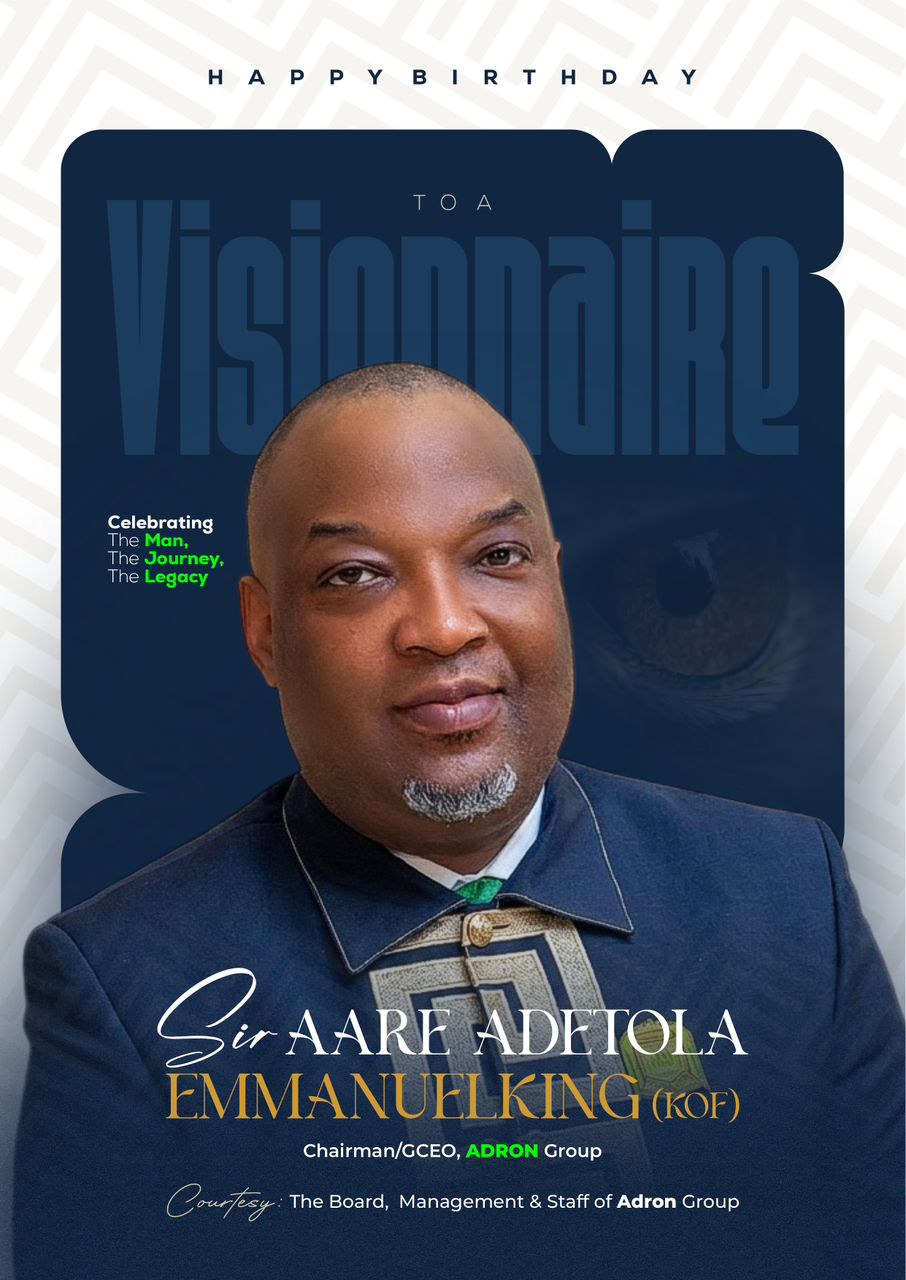
Adron Homes Celebrates Visionary Chairman, Aare Adetola Emmanuel King, at 51
The management and staff of Adron Homes and Properties Limited have joined family, friends, associates, and well-wishers across the globe to celebrate their Chairman and Chief Executive Officer, Aare Adetola EmmanuelKing, as he marks his 51st birthday.

In a statement released by the company, the milestone was described as a celebration of an exceptional leader whose vision, resilience, and entrepreneurial brilliance have not only transformed Adron Homes into a household name in Nigeria’s real estate sector but have also redefined affordable housing across the country.
Under his dynamic leadership, Adron Homes has continued to expand its footprint, delivering value-driven residential solutions while empowering thousands of Nigerians with opportunities for home ownership. His commitment to excellence, innovation, and customer satisfaction has remained the driving force behind the company’s sustained growth and industry leadership.
The statement further highlighted Aare EmmanuelKing’s passion for nation-building and community development, noting his significant contributions to job creation, youth empowerment, and the promotion of socio-economic development through real estate investments.
“As a leader, mentor, and visionary, Aare Adetola EmmanuelKing has consistently inspired a culture of excellence, integrity, and dedication within the organization. His ability to turn bold ideas into reality continues to position Adron Homes as a trailblazer in the industry,” the statement read.
The company expressed profound gratitude for his steadfast leadership and prayed for continued wisdom, strength, and sound health as he embarks on another year of impactful achievements.
As he celebrates his 51st birthday, the entire Adron Homes family proudly honours a man whose legacy continues to shape the future of real estate in Nigeria.
Happy 51st Birthday, Aare Adetola EmmanuelKing!


-

 society7 months ago
Religion: Africa’s Oldest Weapon of Enslavement and the Forgotten Truth
-

 news4 months ago
WHO REALLY OWNS MONIEPOINT? The $290 Million Deal That Sold Nigeria’s Top Fintech to Foreign Interests
-

 society6 months ago
“You Are Never Without Help” – Pastor Gebhardt Berndt Inspires Hope Through Empower Church (Video)
-

 celebrity radar - gossips2 months ago
Dr. Chris Okafor Returns with Power and Fire of the Spirit -Mounts Grace Nation Altar with Fresh Anointing and Restoration Grace on February 1, 2026
You must be logged in to post a comment Login
You must log in to post a comment.