
Business
‘SARS are only meant to hit armed robbers, not investigation’ – Chairman, Police Service commission, Mike Okiro



Former Inspector-General of Police, Mr. Mike Mbama Okiro, is currently Chairman, Police Service Commission.
In the following interview, he spoke about the controversies swirling round the Special Anti-Robbery Squad (SARS) of the Nigeria Police, the state of security in the nation, and more.
Excerpts:-
There is controversy over the activities of the Special Anti-Robbery Squad of the Nigeria Police (SARS), mostly on the conduct of operatives. Some people have even called for its scrap. How do you think the matter should be handled?
Mike Okiro: This issue of SARS is dogged by what I call ‘policy somersault’. A government official, or a government makes a policy and another government comes and changes the policy or abandons it. This is what is causing it.
SARS started with me as the Deputy Commissioner of Police Operations in Ikeja, Lagos, when the infamous armed robber called Shina Rambo was having a field day in 1991. His modus operandi was to snatch cars and begin a shooting spree in a convoy of gunmen. He was so brazen that he even shot at policemen at checkpoints. There was no way to stop him. So, I and the then commissioner, Ademola, came up with the Special Anti-Robbery Squad.
The idea was that they would be in mufti, and armed, simply for the very important element of surprise.
They would take cover, and communicating with walkie-talkies, hit the armed robbers. They did that two or three times, and the robbery attacks went down, drastically, and at a point stopped altogether. Soon SARS started spreading, from Lagos to other states. And I began to notice that at every roadblock, you will see armed policemen, but in mufti.
Now, how do you differentiate between a policeman and an armed robber?
The initial idea of the operatives wearing mufti, like I said, is for the element of surprise. So I’d say the original idea of SARS has been bastardised. The squad was feared before, and I mean by criminals. When there was a robbery in a bank, SARS would move there because they were trained. They also knew themselves because there was nothing like cross-firing. Every command had SARS standing by.
But by the time it spread to other states, it seemed like anyone would be carrying arms, dressed in mufti, with a T-shirt with SARS emblazoned on it. Anybody can wear such an outfit. They even go into cases of bounced cheques and shady business transactions. SARS business is not to investigate, but to hit. It’s a Special Anti-Robbery Squad, not an investigative one.
DT: There’s a call that started from social media, and spilled over to actual protests to scrap SARS. What is your take?
Okiro: We cannot throw away the bathwater with the baby. It cannot be scrapped, rather there is the need to get back to its original concept, to hit robbers and come back. Sometimes robbers take position, waiting for police patrol vehicles to come, not knowing that SARS are passing in a private vehicle.
SARS needs to be restructured and not scrapped completely. The police is meant to fight crime, they should be allowed to do their jobs in the most effective way. If they are deviating from the concept, they should be called back on the right track. Ending SARS is like the police stopping their fight against robbers.
DT: Another issue that seems to have refused to go away is that of kidnapping, especially on the Abuja-Kaduna highway. Do you think, with an effective SARS, kidnappings can be curbed?
Okiro: Yes, I believe it can. This takes me back to when I was Commissioner of Police in Lagos, when robberies were carried out in road traffic, and robbers with guns or knives went car-to-car. I couldn’t cover the whole length and breadth of Lagos roads, it wasn’t possible. We went back to the drawing board and got some vehicles with policemen dressed in veils, but armed. After we countered the robberies several times, they stopped. Like I said, earlier, the efficiency of SARS relies on the element of surprise. However, I repeat: It should not be involved in investigations.
DT: How do you feel about the non-passage of the Nigeria Police Force Reform Trust Fund Bill?
Okiro: I feel sad, as the passage of the bill is supposed to prepare the police more and then create an avenue for its funding. The federal government is not capable of funding the police completely, because if the revenue is lean, ou have to cut your coat according to your cloth. The federal government cannot give all it has to the police, as there are other areas that need attention.
But right now the police is not properly funded. Initially, that bill was supposed to create an avenue through which there would be direct funding. If the police force cannot even take care of itself, how can it take care of other people? So, there’s a need for funding, and that can be addressed and solved by the Police Force Reform Trust Fund Bill.




Bank
Wema Bank Plc Sets the Record Straight on False and Misleading Publication by NDIC on Legacy Transactions Involving Defunct Gulf Bank Plc
Wema Bank Plc Sets the Record Straight on False and Misleading Publication by NDIC on Legacy Transactions Involving Defunct Gulf Bank Plc
General Comments
Wema Bank Plc has noted with concern recent media publications containing false, misleading, and wholly unsubstantiated allegations regarding the sale of certain Banana Island properties purportedly linked to the defunct Gulf Bank Plc. We unequivocally reject these claims, which are inaccurate, malicious, and clearly intended to distort the true position. For the benefit of our stakeholders—shareholders, customers, regulators, and the general public—we set out below the factual background to the transaction.
The Original Exposure and Default
In 2002, Wema Bank Plc (the Bank) made an inter-bank placement with Gulf Bank Plc in the sum of ₦4.6 billion. By August 2004, that exposure had been reduced to approximately ₦1.2 billion, after which the outstanding obligation became delinquent. In seeking to recover depositors’ and shareholders’ funds, Wema Bank pursued lawful recovery steps, which ultimately dovetailed into a criminal investigation of the then Managing Director of Gulf Bank Plc.
Based on the investigation of the Economic and Financial Crimes Commission (EFCC), the funds were found to have been diverted and used to acquire properties in Banana Island, Lagos, through two separate companies Bacad Finance & Investment Company Ltd (now known as Supra Commercial Trust Limited) and Euston Wenberg Eng Ltd. It is important to note that neither Bacad Finance & Investment Company Ltd (nor its successor, Supra Commercial Trust Limited) nor Euston Wenberg Eng Ltd is one and the same as Gulf Bank Plc. They are separate and distinct entities with no identity or equivalence to Gulf Bank. And the two companies are not subject to NDIC supervision.
In the course of its investigation, the EFCC conducted asset-tracing exercises that uncovered significant underlying fraud on a substantial scale. Following the EFCC’s findings, Bacad Finance & Investment Company Ltd and Euston Wenberg Eng Ltd voluntarily relinquished their proprietary interests in the Banana Island properties towards the satisfaction of Gulf Bank Indebtedness to Wema Bank. That process formed part of Wema Bank’s lawful recovery efforts and underscores the legitimacy of its actions against Gulf Bank.
NDIC’s Acknowledgment, Admission of Indebtedness, and Payment of Shortfall.
Critically, following the liquidation of Gulf Bank, Nigeria Deposit Insurance Corporation (NDIC) admitted Gulf Bank’s indebtedness to Wema Bank in two separate letters:
A letter dated September 26, 2007, addressed to the Federal Land Registry; and
A letter dated June 10, 2009, addressed directly to Wema Bank Plc.
These letters constitute clear and formal recognition by the NDIC of the validity of Wema Bank’s claim against the defunct Gulf Bank and its interest over the property in question. Fortunately, both letters form part of the documents frontloaded by NDIC lawyer Dr. Dada Awosika SAN in court in the ongoing proceedings before Justice Allagoa of the Federal High Court Lagos.
Furthermore, after the sale of the properties, the NDIC in fact paid to Wema Bank, the shortfall of what was due to the Bank. These facts demonstrate that the NDIC was not only aware of the transaction but actively participated in settling the outstanding balance following the sale.
In light of the foregoing:
the voluntary relinquishment by Bacad (now Supra Commercial Trust Limited) and Euston Wenberg (distinct entities not constituting Gulf Bank), of the properties in Banana Island for the settlement of the indebtedness of the defunct Gulf Bank
the NDIC’s formal admission of Gulf Bank’s indebtedness to Wema Bank via its letters of September 26, 2007 (to the Federal Land Registry) and June 10, 2009 (to Wema Bank), both of which have been frontloaded in court by NDIC itself, and the acknowledgement of the relinquishment of the Banana Island properties, and
the NDIC’s own payment of the shortfall to Wema Bank,
NDIC is precluded from and cannot in good faith contest the relinquishment of those interests or the appropriateness of Wema Bank’s recovery efforts.
While we acknowledge that the NDIC has recently commenced two separate actions against Wema Bank at the Federal High Court, Lagos, purportedly in its capacity as liquidator of Gulf Bank Plc pursuant to a winding-up order, those proceedings do not alter the material facts stated above. As these matters are currently before the court and therefore sub judice, Wema Bank will refrain from commenting further on issues that fall for judicial determination. The Bank is taking all necessary steps to contest the suits filed in court and will explore all legal and legitimate means to protect its rights and interests.
Conclusion
Wema Bank Plc remains steadfast in its commitment to the highest standards of corporate governance, regulatory compliance, and transparency. We reaffirm our dedication to ethical and prudent banking practices and assure our shareholders, customers, regulators, and all relevant stakeholders that the Bank will continue to act responsibly, lawfully, and in the best interests of all parties it serves. The Bank will continue to exert its rights and will not succumb to the shenanigans of unscrupulous individuals who want to reap where they did not sow.
FOR FURTHER INFORMATION:
For further information, please contact:
Johnson Lebile
General Counsel/Legal Adviser
About WEMA Bank Plc
Wema Bank Plc (NGX: WEMABANK) is the pioneer of Africa’s first fully digital bank, ALAT, and one of Nigeria’s most resilient banks. With decades of experience in the business of banking, the Bank has remained innovative in delivering value to its stakeholders. Wema Bank operates a network of over 150 branches and service stations backed by a robust ICT platform. The publicly quoted Nigerian company has successfully built a legacy of trust and resilience that has won it the loyalty of its customers. The Bank is constantly introducing products and services tailored to the needs of its customers at every stage of their lives. It is a proud partner to more than one million individuals, families and businesses across Nigeria, helping them achieve their personal and financial goals.
More information can be found at https://www.wemabank.com/about-us/
Business
Group Signs Investment Promotion Agreement in Ivory Coast as UNIPGC Deploys Funding for Capital Projects
Group Signs Investment Promotion Agreement in Ivory Coast as UNIPGC Deploys Funding for Capital Projects
– Ivorycoast, Cot’devouir
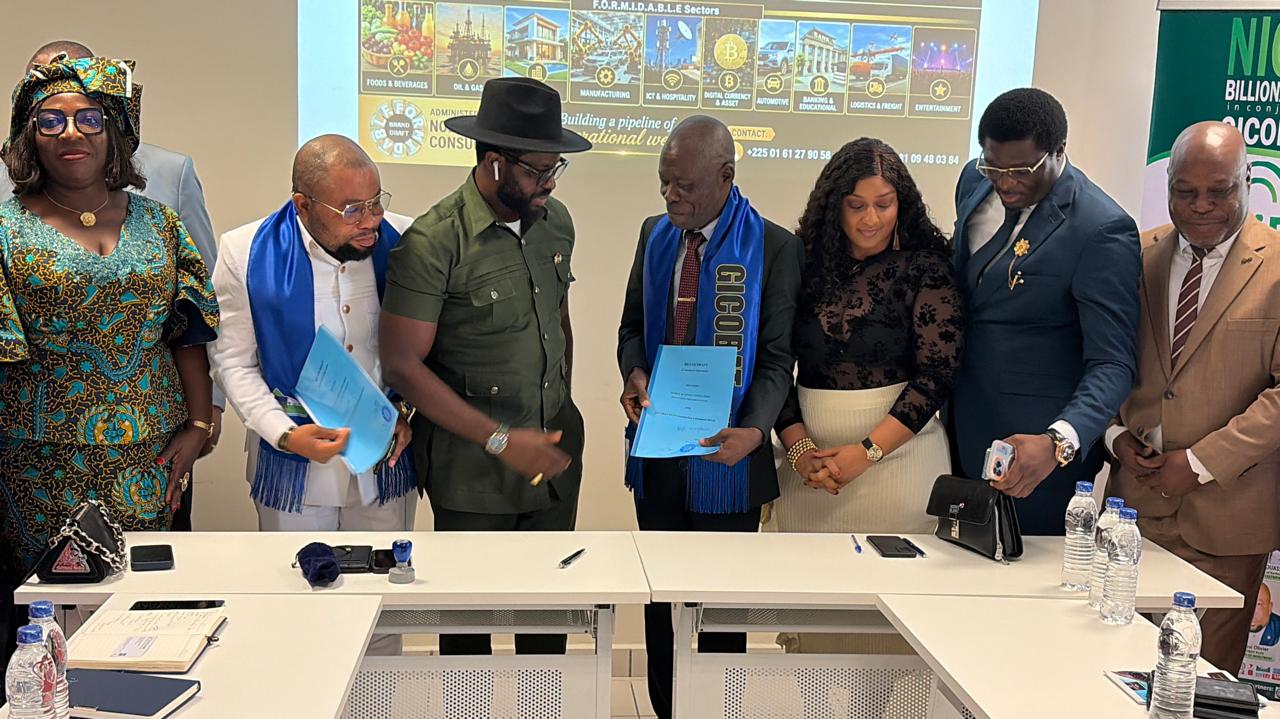
Noble & Gold Consulting Ltd has officially signed a partnership agreement with Gicobat Group of Company to facilitate funding for capital projects in Abidjan, Côte d’Ivoire, through the UNIPGC–Global Economic Development Council (GEDC), during a high-level Business and Investment Roundtable held in the country.
The meeting, which took place on May 12, 2026, at the World Trade Centre in Abidjan, brought together senior executives and stakeholders from both organizations, including His Excellency, Amb. Jonathan Ojadah GCOP, Global President of UNIPGC; Mr. Noble Eze, CEO of Noble & Gold Consulting Ltd; and the Chairman of Gicobat Group of Company, Côte d’Ivoire.
The roundtable focused on opportunities for capital project financing, investment promotion, and business development across strategic sectors of the economy. Following extensive deliberations, the parties finalized terms and signed an agreement aimed at advancing the projects discussed during the engagement.
Speaking at the event, the Chairman of the UNIPGC-GEDC, His Excellency Amb. Jonathan Ojadah, delivered a presentation titled *“How Reputable Brands Can Secure Funding for Capital Projects.”* He stated that the agreement represents a major milestone in supporting high-profile business initiatives that require structured financing and professional project management.
According to him, the partnership aligns with UNIPGC-GEDC’s mandate as a leading investment promotion, advisory, and business development institution operating across Africa and internationally.
> “Today, I am delighted to address this important topic on how leaders of established and reputable brands can secure the capital required for major expansion, technological advancement, or infrastructure development. The objective is not merely to find funding, but to attract the right funding at the most competitive cost of capital,” he stated.
He emphasized that brand reputation remains a critical asset in attracting investors and financial institutions.
> “In business, reputation is everything. In the world of capital-intensive projects, reputation is more than public perception; it is an asset class. A reputable brand represents stability, proven performance, and trustworthiness,” he added.
Amb. Ojadah further noted that successful funding processes begin long before formal investment pitches are made. According to him, investors seek organizations that demonstrate value stewardship, operational excellence, and financial discipline.
Drawing from his international experience in capital project engagements across Egypt, Kenya, the Democratic Republic of Congo, Zambia, and other countries, he highlighted several categories of major funding institutions involved in large-scale development financing. These include multilateral development banks, government agencies, private foundations, and impact investors focused on infrastructure, healthcare, real estate, energy, oil and gas, and sustainable development.
Among the institutions he referenced were the International Finance Corporation (IFC), the European Union (EU), the United Nations Capital Development Fund (UNCDF), the OPEC Fund for International Development, the Bill & Melinda Gates Foundation, the Mastercard Foundation, the Ford Foundation, the Rockefeller Foundation, and the UNIPGC Foundation.
He explained that through the UNIPGC Global Economic Development Council (GEDC), the organization facilitates funding opportunities for startups, private sector operators, and government projects through public-private partnerships (PPP), leveraging its network of international funding partners and financial institutions.
Amb. Ojadah identified three critical indicators commonly assessed by investors and lenders before financing projects:
1. **Transparency and Financial Performance** – Organizations must maintain audited financial records, quality assets, and sustainable growth patterns.
2. **Operational Excellence** – Investors prefer businesses with proven operational systems and stable cash flow generation, which reduce investment risks.
3. **A Strong Project Narrative** – Businesses must clearly demonstrate how proposed projects align with long-term strategic goals such as digital transformation, automation, infrastructure expansion, or increased market competitiveness.
He also outlined key strategies reputable brands can adopt in securing project financing, including bank financing, strategic partnerships, vendor financing arrangements, private equity investments, and asset-based lending structures.
> “Securing capital for projects as a reputable brand is ultimately about combining trust with strategic planning. Reputation is your strongest asset, and when paired with sound financial planning and a compelling vision, it becomes a powerful tool for building the future,” he concluded.
For Gicobat Group of Company, the partnership is expected to accelerate the execution of ongoing and proposed projects by leveraging UNIPGC-GEDC’s network of investors and financial partners. Officials of the company expressed confidence that the collaboration would significantly improve project implementation timelines and financing accessibility.
Organizers noted that the choice of the World Trade Centre, Abidjan, as the venue reflected the international scope and significance of the engagement, particularly for negotiations involving capital-intensive projects in infrastructure, trade, and industrial development.
UNIPGC-GEDC describes itself as a leading global investment promotion, advisory, and business development consultancy, working with governments, private enterprises, and institutional investors to structure, finance, and manage large-scale projects from inception to completion.
According to the organization, the Abidjan agreement adds to its expanding portfolio of strategic partnerships aimed at unlocking capital for projects with significant economic and social impact. It also confirmed that due diligence and project structuring processes had been completed prior to the signing to ensure project bankability and investor confidence.
Officials from both organizations further disclosed that implementation teams would be constituted immediately to oversee the next phase of the agreement. Although specific project details were not disclosed, both parties assured stakeholders that updates would be communicated as implementation milestones are achieved.
UNIPGC-GEDC also encouraged businesses, institutions, and investors with high-impact projects requiring financing or management support to engage with its team for collaboration opportunities. Further information on its services is available via UNIPGC-GEDC Official Website www.unipgc.org/gedc
Business
Dennis Ekamah Isn’t Building Houses—He’s Redefining What Home Means for Africans Through PropTech

Dennis Ekamah Isn’t Building Houses—He’s Redefining What Home Means for Africans Through PropTech.
The founder of coHouse.ng is reimagining how millions of Africans access, experience, and share housing through technology.
In Africa’s rapidly evolving innovation landscape, the most transformative companies are no longer defined by the industries they enter, but by the systems they redesign.
For Dennis Ekamah, the opportunity was never about constructing buildings, it was about confronting a deeper question.
why is access to housing still so structurally difficult for millions of Africans in a digital age?
Rather than stepping into real estate as a developer. Dennis chose a different path, positioning coHouse.ng as a PropTech platform rethinking how housing is accessed, experienced, and shared. At the heart of this vision which is connecting potential home owners together via resource pooling for the purpose of either Living or Growth. Simply, *Connect. Live. Grow.*
*A Platform Not a Property Company*
coHouse.ng is not a real estate company. It is a technology-driven ecosystem connecting like-minded individuals into structured communities where they can live intentionally, invest collectively, and grow within a shared system.
From Insight to Recognition
In 2025, coHouse.ng was recognised among the Top 50 Tech Startups in Africa. Even ahead of its official launch, the platform attracted over 1,000 early waitlist users, individuals eager to be part of a new way of living and investing.
Solving for Access, Alignment, and Trust
Dennis Ekamah’s diagnosis goes deeper than supply shortfalls. The real barriers he argues are access, coordination, and trust. coHouse.ng tackles all three through identity verification powered by a third party verification system api. coHouse is not flying solo without the help and collaboration with government bodies across Nigeria and other African countries.
In his words;
“Imagine what you would achieve as an individual or group if you’re living with the right people or like-minded individuals around you.”
I’m not a developer, I’m not a professional realtor, I’m just someone who sees the need for this solution based on the problem we face as youth/young entrepreneurs in today’s housing deficiency across Africa.
— Dennis Ekamah
Join our waitlist by visiting www.cohouse.ng


- Mali: Group for the Support of Islam and Muslims (GSIM) must observe international humanitarian law and ensure safety of civilians as Bamako is under siege May 16, 2026
- Merck Foundation advances Healthcare Capacity through 2600+ Medical Scholarships across 52 Countries with African and Asian First Ladies May 16, 2026
- West African Development Bank (BOAD) and International Finance Corporation (IFC) Announce Landmark Reciprocal Euro and West African CFA franc (EUR-XOF) Facilities to Boost Local Currency Financing in West Africa May 15, 2026
- Eritrea: Seminar for female members of the Defense Forces May 15, 2026
- Guinea-Bissau takes another step toward a polio-free future May 15, 2026
- International Monetary Fund (IMF) Staff Completes the 2026 Article IV Consultation and Reaches Staff-Level Agreement with Ghana on the Sixth Review under the Extended Credit Facility Arrangement and on a 36-month Policy Coordination Instrument Request May 15, 2026
- Call for Urgent Regional Coordination Meeting Following Ebola Virus Disease Outbreak in Ituri Province, Democratic Republic of the Congo (DRC) May 15, 2026
- Seychelles and Maldives reaffirm bilateral ties as Foreign Ministers meet in Malé May 15, 2026
- Cross Switch Strengthens Senior Leadership Across the Board as Pan-African Expansion Accelerates May 15, 2026
- A Economic Community of West African States (ECOWAS) youth forum on artificial intelligence to build digital skills and foster innovation May 15, 2026
- Mali: Group for the Support of Islam and Muslims (GSIM) must observe international humanitarian law and ensure safety of civilians as Bamako is under siege May 16, 2026
- Merck Foundation advances Healthcare Capacity through 2600+ Medical Scholarships across 52 Countries with African and Asian First Ladies May 16, 2026
- West African Development Bank (BOAD) and International Finance Corporation (IFC) Announce Landmark Reciprocal Euro and West African CFA franc (EUR-XOF) Facilities to Boost Local Currency Financing in West Africa May 15, 2026
- Eritrea: Seminar for female members of the Defense Forces May 15, 2026
- Guinea-Bissau takes another step toward a polio-free future May 15, 2026
- International Monetary Fund (IMF) Staff Completes the 2026 Article IV Consultation and Reaches Staff-Level Agreement with Ghana on the Sixth Review under the Extended Credit Facility Arrangement and on a 36-month Policy Coordination Instrument Request May 15, 2026
- Call for Urgent Regional Coordination Meeting Following Ebola Virus Disease Outbreak in Ituri Province, Democratic Republic of the Congo (DRC) May 15, 2026
-

 news5 months ago
WHO REALLY OWNS MONIEPOINT? The $290 Million Deal That Sold Nigeria’s Top Fintech to Foreign Interests
-

 society2 weeks ago
SOCIAL MEDIA IS NOT A BATTLEFIELD COMMAND – WHY THE NIGERIAN ARMY’S ACTION AGAINST JUSTICE CRACK IS A NATIONAL SECURITY IMPERATIVE
-

 celebrity radar - gossips4 months ago
Dr. Chris Okafor Returns with Power and Fire of the Spirit -Mounts Grace Nation Altar with Fresh Anointing and Restoration Grace on February 1, 2026
-

 celebrity radar - gossips5 months ago
Prophet Kingsley Aitafo Releases 2026 Prophecy: ‘Nigeria Will Rise, but the World Must Prepare for Turbulence’
You must be logged in to post a comment Login
You must log in to post a comment.