
society
STOP EXPLAINING THE LAW. START EXPOSING THE ROT


STOP EXPLAINING THE LAW. START EXPOSING THE ROT.
By George Omagbemi Sylvester | Published by SaharaWeeklyNG.com
We have spent years preaching COMPLIANCE like a broken record; quoting statutes, reciting sections, promising “zero tolerance.” Meanwhile, the rot has been growing in the walls: procurement cartels, illicit financial flows, bribery-for-basic-services and impunity for the well-connected. The evidence is overwhelming and it is recent. Nigeria’s 2024 Corruption Perceptions Index score is 26/100, ranking 140th of 180 countries. That’s not an abstract number; it is a REAL-TIME diagnosis of how the public sector is perceived to work and why ordinary people brace for a bribe request before they brace for service.
This is not just a Nigerian problem; it is an AFRICAN TRAUMA. The United Nations Conference on Trade and Development (UNCTAD) estimates $88.6 billion leaves Africa annually as illicit financial flows 3.7% of the continent’s GDP. Those are stolen classrooms, stolen hospital beds, stolen futures.

The human cost is brutal. The World Health Organization estimates corruption drains about 7.3% of global health spending (roughly $500 billion) every year. In plain language: avoidable deaths. Empty clinics. Broken trust.
If you want to understand why citizens are cynical, read the most recent fieldwork. Afrobarometer reports that only one in ten Nigerians (10%) believe they can report corruption without fear of retaliation. Majorities who sought public services say they had to pay bribes: 67% for police assistance, 56% for a government document, 26% at public medical facilities. WHEN FEAR SILENCES WITNESSES, CORRUPTION FLOURISHES.


There is, however, a flicker of resistance in daily life. A 2024 UNODC/NBS survey found over 70% of Nigerians who were asked to pay a bribe in 2023 refused at least once. That’s courage at the counter-top; citizens pushing back even when institutions hesitate.
The rot behind the rhetoric.
For decades, political speeches have chased the “AWARENESS” rabbit while grand theft ran the marathon. We know where the blood-loss happens: public procurement. Globally, governments spend about $9.5 trillion a year buying goods and services. In that torrent of money, “COMMISSIONS,” bid rigging, change orders and phantom deliveries hide in plain sight. Serious studies and international guidance consistently warn that 10–30% of the value of publicly funded construction can vanish to mismanagement and corruption. Even cautious reviewers concede the losses are large and chronic.
The financial-crime gatekeepers are waking up slowly. South Africa’s grey-listing in 2023 forced sweeping upgrades to ANTI–MONEY LAUNDERING and TERROR-FINANCE ENFORCEMENT. In June 2025, the FATF acknowledged that South Africa had substantially completed its action plan and merits an ON-SITE assessment toward REMOVAL—PROOF that pressure works when it is real, measured and externally verified.

The moral case is settled
International voices have said the quiet part out loud. UN Secretary-General António Guterres: “Corruption is criminal, immoral and the ultimate betrayal of public trust.” Jim Yong Kim, former World Bank President: “In the developing world, corruption is public enemy number one.” These are not slogans; they are conclusions drawn from lost lives, stunted growth and broken institutions.
From law lectures to enforcement shock therapy.
Enough awareness. Here is what exposing the rot looks like; PRACTICAL, MEASURABLE and HARD to GAME: Publish every contract, line by line, in MACHINE-READABLE FORMATS. Not press releases; data: tender notices, bidder lists, evaluation reports, award values, change orders, delivery milestones, payments and beneficial owners. E-procurement plus open contracting standards have a track record of exposing bid-rigging and price padding. In a market worth ~15% of GDP globally, opacity is the oxygen of cartels.
Name the people behind the companies. Beneficial-ownership registers must be public, searchable and verified. When shell companies can’t hide their human owners, conflicts of interest surface and prosecutors have a map.
Trace the money across borders then bring it home. Use the AML/CFT toolset that FATF expects: customer due diligence, suspicious transaction reports, asset freezing, non-conviction–based forfeiture where appropriate and international cooperation. South Africa’s sprint to satisfy FATF shows compliance rises when delisting has economic consequences, higher borrowing costs, investor hesitation and disrupted correspondent banking force action.

Fix the frontline: health, police, licensing. Health corruption kills. Plug procurement leakages (drug tenders, equipment purchases), audit payrolls and protect whistleblowers. In policing and licensing, slash face-to-face discretion with digital workflows and verifiable queues. The empirical target is simple: reduce the bribery incidence that Nigerians now report in police and documentation services.
Protect whistleblowers and witnesses for real. Afrobarometer’s 10% statistic is a siren: people won’t report if retaliation is likely. Independent reporting channels, legal shields, and time-bound follow-ups must be non-negotiable.
Turn “recoveries” into public goods; visibly. Nigeria’s EFCC reports nearly $500 million recovered in a single year, along with thousands of convictions. Ring-fence those funds to visible, high-impact projects (clinics, classrooms, court upgrades) and publish project-level dashboards so citizens can see where seized assets are building something honest.
Audit construction like a forensic accountant. The sector bleeds money. Independent quantity surveyors, open bills of quantities, satellite verification of progress and delivery-linked payments can reduce the well-documented 10–30% “DISAPPEARANCE” rate. If that figure shocks you, good, because it should.
Measure fear, not only fraud. Add a retaliation risk index to every anti-corruption scorecard. If citizens are too afraid to file a complaint, any “CLEAN” metric is noise. Afrobarometer has already shown how to ask the question; governments should report (and reduce) that fear annually.
The economics are irrefutable.
Consider the counterfactuals. UNCTAD’s $88.6 billion in African illicit outflows could finance clinics, classrooms and court reforms many times over. In health alone, shrinking corruption by even a fraction of the $500 billion annual leak would save more lives than many new policies combined. Add procurement leakages of 10–30% in big-ticket construction and you have a fiscal space story ~without raising taxes.
What “EXPOSING the ROT” means for leaders
It means naming names, not just “STRENGTHENING SYSTEMS.” It means publishing the last 10 years of contracts, mapping politically exposed persons to award histories and explaining every change order over 15%. It means PROSECUTING PROCUREMENT FRAUD as the economic sabotage it is. It means inviting independent observers (civil society, media, academia) into the tender room and the data room.
And it means telling the truth when the numbers improve and when they do not. If bribery incidence at the police desk falls from 67% to 40% in two years, trumpet it and show how you did it. If it rises, admit it and fix the choke points. Sunlight is only disinfectant when it’s direct.
What it means for citizens.
First, know your power. The UNODC/NBS finding that most Nigerians asked for bribes refused at least once shows that small acts compound. Second, use the data when it’s published: follow the money, flag the red flags and demand remedies in writing. Third, demand protection: no anti-corruption drive is credible if whistleblowers are hung out to dry.
A final word.
This is not a sermon about ethics; it is a plan to stop hemorrhaging public value. Guterres called corruption the “ULTIMATE BETRAYAL of PUBLIC TRUST.” Jim Yong Kim called it “PUBLIC ENEMY NUMBER ONE.” They were right and the latest data confirms it. If we keep explaining the law while thieves expertly exploit it, we will lose another decade. The pivot is overdue: from AWARENESS to EXPOSURE, from OPACITY to DATA, from PLATITUDES to PROSECUTIONS. The tools exist. The FACTS are FRESH. The ROT is VISIBLE.
Now, turn on the lights.
~ George Omagbemi Sylvester




FOPCHEN Seeks Wider Engagement As Court Defers Hearing
OTA, OGUN STATE — The High Court of Ogun State, Ota Division, on Thursday resumed hearing in the ongoing matter involving cultural and societal concerns, before adjourning proceedings till Thursday, July 2, 2026, for continuation of hearing.
At the resumed sitting on May 28, 2026, counsel representing the various parties revisited key issues in the case and made further submissions before the court.
The matter, which has continued to generate public interest across different sectors, again drew attention from legal observers and stakeholders who described the case as one with significant implications for societal values, cultural identity and constitutional interpretation.
Speaking after the proceedings, the Foundation for the Protection of Cultural Heritage in Nigeria, popularly known as FOPCHEN, renewed its appeal for dialogue and constructive engagement among Nigerians, stressing that sensitive cultural and moral issues should not be left entirely within the confines of the courtroom.
According to the group, broader conversations involving traditional institutions, civil society organisations, religious leaders and policy stakeholders remain necessary in addressing issues relating to national values and social responsibility.
Legal analysts at the court premises noted that arguments being canvassed by parties in the suit could shape future legal interpretations surrounding cultural and moral questions in the country.
Following submissions by counsel, the presiding judge adjourned the matter till Thursday, July 2, 2026, to enable parties further prepare and respond to issues raised during the hearing.
The development has continued to spark reactions among observers, with many Nigerians closely monitoring the proceedings ahead of the next hearing date.

US-Based Society Lady, Fehintola-Brat Extends Eid-El-Kabir Greetings To Muslims
United States based fahionista of class, Chief (Mrs) Ayoola Fehintola-Brat has extended a warm greetings to Muslim faithful all over the world on the occasion of the 2026 Eid-El-Kabir celebration.
Fehintola-Brat who is the Balogun Egbe Obaneye Obinrin Akile Ijebu, and the Yeye Asofin of Idenaland in her message to Journalists urged Muslim to continually uphold the enduring values of sacrifice, obedience, faith, and compassion, which are central to the significance of Eid-El-Kabir festival.
A quiet philantropist whose humanitarian services has won her several laurels urged Muslims to use the spiritual occasion to pray for the peace co-existence of Nigerians regardless of religious, social and political leanings stressing that the oneness of the country should not be underplay.
In a related development, she expressed her felicitations to all sons and daughters of Ijebuland on the forthcoming Ojude Oba 2026 celebration, tasking age-groups otherwise known as Regbregbe to be more proactive in giving back to their immediate communities.
According to her, the beauty of the age-groups in Ijebuland is the need to contribute immensely to the development of the land in no small means. “This we will continue to achieve with God on our side”, she concluded.
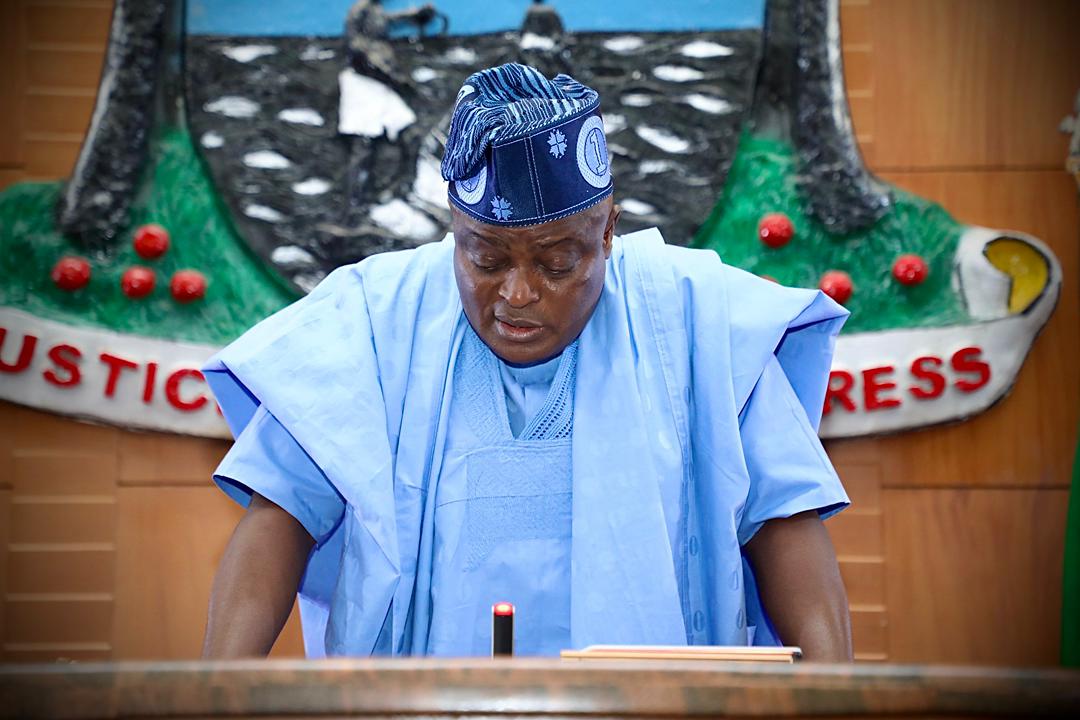
Sallah: Obasa Felicitates Muslim Ummah, Commends Nigerians for APC Primaries Turnout
The Speaker of the Lagos State House of Assembly, Rt. Hon. Mudashiru Obasa has extended warm felicitations to Muslims in Lagos State and across Nigeria on the occasion of Eid al-Adha.
In a statement released by his Chief Press Secretary, Mr. Dave Agboola, Obasa described the festival as a season of sacrifice, reflection, and gratitude, urging the faithful to continue to uphold the values of peace, unity, and love that strengthen the nation.
He noted that the celebration of Eid al-Adha is not only a spiritual milestone but also a reminder of the importance of togetherness and collective responsibility in building a stronger society.
He, likewise, emphasized that the festival provides an opportunity for Nigerians to renew their commitment to national progress and to support leadership that prioritizes development and prosperity.
Obasa, however, commended Nigerians, particularly members of the All Progressives Congress (APC), for their massive turnout during the recently concluded party primaries. He described the participation as a clear demonstration of the people’s confidence in the government of President Bola Ahmed Tinubu and their belief in the administration’s vision for a greater Nigeria.
“The APC primaries have shown the resilience of our democracy and the confidence Nigerians have in the leadership of President Bola Ahmed Tinubu and the Renewed Hope Agenda. This is a strong message that our people are ready to continue supporting policies that will drive growth and prosperity,” Obasa stated.
The Speaker further encouraged Muslims to celebrate responsibly, stressing that the joy of Eid should be accompanied by prayers for the continued peace and progress of Lagos State and Nigeria.
“As you celebrate with family and loved ones, may this season bring joy, peace, and prosperity to your homes. Let us remain united in our resolve to build a stronger nation,” he added.
On behalf of the Lagos State House of Assembly, Obasa wished all Muslims a happy and fulfilling Eid al-Adha celebration.


- Société Nationale des Pétroles du Congo (SNPC) Chief Ominga to Speak at African Energy Week (AEW) 2026 as Congo Accelerates Gas Expansion May 29, 2026
- South Africa: Deputy President Mashatile arrives in India for a Working Visit May 29, 2026
- Seychelles: President Visits Key Development Sites on Coetivy Island May 29, 2026
- Accelerating regional action to advance mental health care in Africa May 29, 2026
- President of the Republic of Seychelles Meets Young La Digue Talent Ahead of London Showcase May 29, 2026
- United Nations Economic Commission for Africa (ECA) launches regional initiative to accelerate women’s digital entrepreneurship across four African countries May 29, 2026
- Ethiopia: International community must act to safeguard press freedom ahead of national election May 29, 2026
- CORRECTION: Annual Meetings 2026 (AM2026): African Development Bank (AfDB) 2025 Trade Finance Report Highlights Resilience of African Financial Institutions After Covid-19 May 29, 2026
- Why Big Tech Could Become Nigeria’s New Gas Partner May 29, 2026
- African Energy Chamber (AEC)-Venezuela Alliance Accelerates Pathways into South-South Energy Expansion May 29, 2026
- Société Nationale des Pétroles du Congo (SNPC) Chief Ominga to Speak at African Energy Week (AEW) 2026 as Congo Accelerates Gas Expansion May 29, 2026
- South Africa: Deputy President Mashatile arrives in India for a Working Visit May 29, 2026
- Seychelles: President Visits Key Development Sites on Coetivy Island May 29, 2026
- Accelerating regional action to advance mental health care in Africa May 29, 2026
- President of the Republic of Seychelles Meets Young La Digue Talent Ahead of London Showcase May 29, 2026
- United Nations Economic Commission for Africa (ECA) launches regional initiative to accelerate women’s digital entrepreneurship across four African countries May 29, 2026
- Ethiopia: International community must act to safeguard press freedom ahead of national election May 29, 2026
-

 news6 months ago
WHO REALLY OWNS MONIEPOINT? The $290 Million Deal That Sold Nigeria’s Top Fintech to Foreign Interests
-

 society4 weeks ago
SOCIAL MEDIA IS NOT A BATTLEFIELD COMMAND – WHY THE NIGERIAN ARMY’S ACTION AGAINST JUSTICE CRACK IS A NATIONAL SECURITY IMPERATIVE
-

 celebrity radar - gossips4 months ago
Dr. Chris Okafor Returns with Power and Fire of the Spirit -Mounts Grace Nation Altar with Fresh Anointing and Restoration Grace on February 1, 2026
-

 celebrity radar - gossips6 months ago
Prophet Kingsley Aitafo Releases 2026 Prophecy: ‘Nigeria Will Rise, but the World Must Prepare for Turbulence’